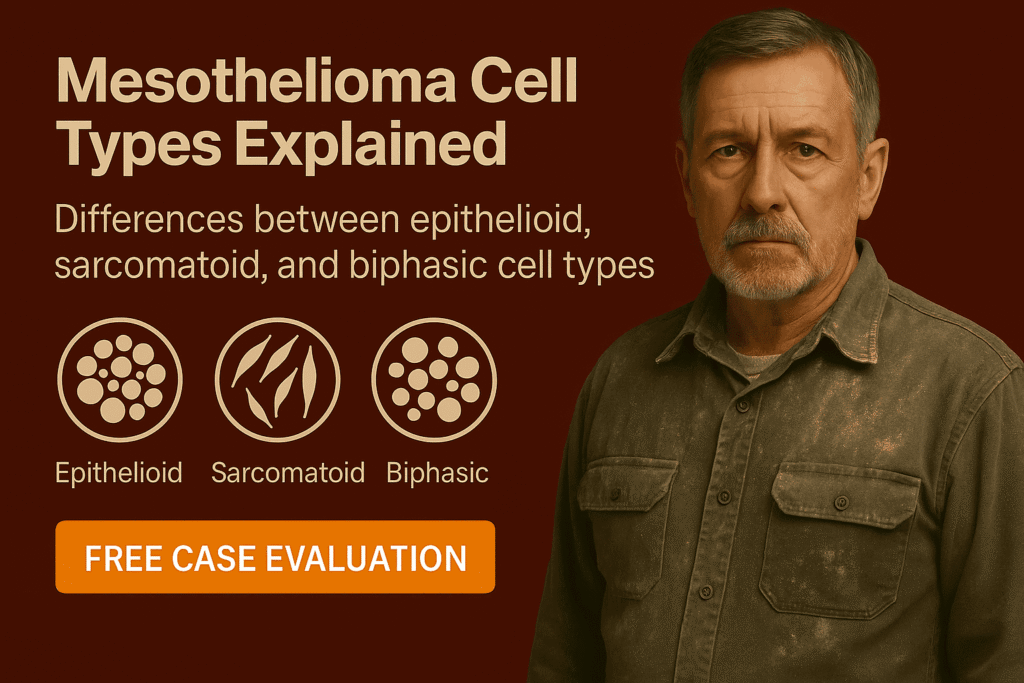
🧫 Mesothelioma Cell Types Explained
Mesothelioma isn’t one single disease—it’s made up of several cell types, each with its own behavior and treatment response.
Understanding your cell type helps your doctors choose the best plan and gives you a clearer picture of what to expect.
📞 Need help understanding your pathology report? Call 800.291.0963 for free answers today.
🔬 Step 1: The Three Main Cell Types
Each mesothelioma case is classified into one of three categories:
| Cell Type | Description | Treatment Response |
|---|---|---|
| Epithelioid | The most common (≈70–80%). Cells form uniform shapes and clump together, allowing surgery and chemo to work better. | Best prognosis; responds well to multimodal therapy. |
| Sarcomatoid | Spindle-shaped cells that spread quickly and resist treatment. | More aggressive; often managed with systemic or targeted therapy. |
| Biphasic (Mixed) | A combination of epithelioid and sarcomatoid cells. Prognosis depends on which type dominates. | Moderate prognosis; treatment tailored to the ratio of cells. |
🧠 Your pathologist identifies cell type by examining tumor tissue under a microscope and testing for specific markers.
🧬 Step 2: Why Cell Type Matters
The cell pattern determines:
-
🩺 Treatment strategy – Some respond better to surgery; others require chemo or immunotherapy first.
-
📈 Prognosis – Epithelioid tends to progress slower, while sarcomatoid spreads faster.
-
🔍 Clinical trial eligibility – Certain new therapies target specific cell behaviors.
Knowing your exact type gives your oncologist the roadmap for treatment.
🧪 Step 3: How Pathologists Identify Your Cell Type
-
🔬 Biopsy review: The sample is stained with special dyes and markers.
-
🧫 Immunohistochemistry (IHC): Tests for proteins like calretinin, CK5/6, and WT-1 confirm mesothelioma.
-
🧍 Tumor pattern:
-
Epithelioid → flat, sheet-like growth
-
Sarcomatoid → spindle or fibrous growth
-
Biphasic → mix of both structures
-
Your pathology report will specify the dominant pattern and include percentage breakdowns.
⚕️ Step 4: Treatment Planning by Cell Type
| Type | Common Treatments | Notes |
|---|---|---|
| Epithelioid | Surgery + chemo + radiation | Best surgical candidate; most long-term survivors fall in this group. |
| Sarcomatoid | Immunotherapy ± chemo | Surgery rarely used; focus on systemic and palliative options. |
| Biphasic | Combination approach | Plan depends on which cell type is more prominent. |
💊 New immunotherapies—like nivolumab and ipilimumab—are improving results, even for advanced sarcomatoid or biphasic cases.
🧘 Step 5: What It Means for Prognosis
-
Epithelioid: Average survival ≈ 18–24 months; some exceed 3 years.
-
Biphasic: Average ≈ 12–16 months.
-
Sarcomatoid: Average ≈ 6–12 months, though immunotherapy can extend this.
🎯 Remember—these are averages, not predictions. Many factors such as age, stage, and overall health influence individual outcomes.
📅 Step 6: What to Do Next
✅ Review your pathology report with a mesothelioma specialist.
✅ Ask which treatments fit your cell type.
✅ Inquire about clinical trials targeting your cell subtype.
✅ Keep a copy of your pathology slides for second opinions.
✅ Call 800.291.0963 to connect with a specialist who can help interpret your results.
📞 Get Help Understanding Your Diagnosis
If you recently received your pathology report, our advocates can explain what your cell type means and guide you toward specialists and support resources.
👉 Call 800.291.0963 now for one-on-one help.
🧾 Summary
Knowing whether your mesothelioma is epithelioid, sarcomatoid, or biphasic is one of the most important steps in your journey.
It shapes your treatment, helps set expectations, and opens doors to new therapies.
Knowledge brings confidence—start understanding your results today.
📞 800.291.0963