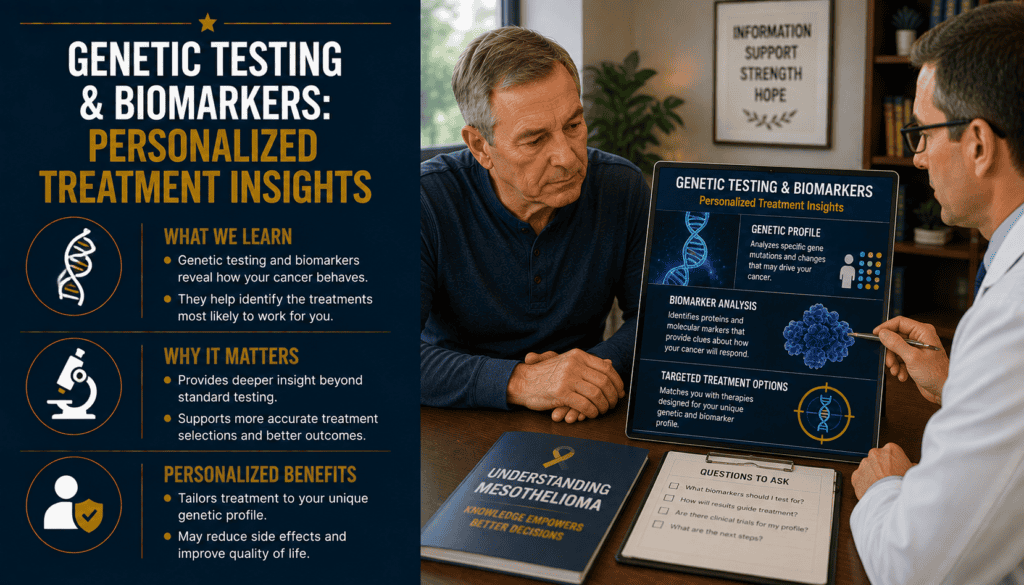
Genetic Testing, Biomarkers and Personalized Treatment for Mesothelioma
Understand tumor profiling, BAP1 hereditary risk, diagnostic markers and how test results may inform care.
Genetic testing and biomarkers can help answer different questions after a mesothelioma diagnosis. Some tests help confirm what a tumor is; others investigate whether a genetic change was inherited or whether a clinical trial might be relevant. This guide explains what each test can and cannot tell you, without promising a personalized drug or predicting an individual outcome.
What Genetic Testing and Biomarkers Can Tell You
Genetic testing is not one single test. For someone diagnosed with mesothelioma, a pathologist may use protein stains and molecular tests to establish the diagnosis, an oncologist may request tumor profiling to explore clinical trials, and a genetics professional may recommend inherited-risk testing for the patient and family. Each answers a different question.
Mesothelioma remains primarily associated with asbestos exposure. A tumor mutation does not, by itself, establish how exposure occurred or prove that a person inherited cancer susceptibility. Ask your team which specific clinical decision a proposed test could change.
| Question | Relevant testing | Important limitation |
|---|---|---|
| Is this malignant mesothelioma? | Biopsy, microscopy and an appropriate immunohistochemistry panel | No single marker establishes every case. |
| Could a tumor alteration inform treatment? | Tumor molecular profiling when clinically appropriate | Many findings have no proven mesothelioma-specific drug. |
| Could susceptibility be inherited? | Germline testing after genetic counseling | Tumor-only testing cannot confirm an inherited variant. |
Tumor Testing Versus Inherited Genetic Testing
Somatic changes arise in tumor cells; germline variants are present from birth and can be detected in non-tumor tissue, usually blood or saliva. The distinction matters for family members. A tumor report that mentions BAP1 does not automatically mean relatives carry a BAP1 variant.
| Feature | Tumor / somatic profiling | Germline testing |
|---|---|---|
| Sample | Tumor biopsy or resection specimen | Blood, saliva or other normal tissue |
| Primary question | What changes are present in the cancer? | Is an inherited predisposition present? |
| Family implications | Not automatically inherited | May prompt counseling and testing for relatives |
| Interpretation | Oncology and molecular pathology team | Genetics professional and treating team |
If a tumor report suggests a potentially inherited alteration, request genetic counseling and confirmatory germline testing rather than interpreting the tumor report alone. The National Cancer Institute explains this distinction in its genetic testing fact sheet.
Biomarkers Used to Support a Mesothelioma Diagnosis
A specialist pathologist interprets the appearance of the tissue together with a panel of immunohistochemical stains. Some markers support mesothelial lineage; others help distinguish mesothelioma from metastatic carcinoma. Loss of BAP1 or MTAP expression and CDKN2A deletion can support malignancy in the correct context, but absence of these findings does not exclude mesothelioma.
| Marker or test | What it may contribute | What it does not prove |
|---|---|---|
| Calretinin, WT1, cytokeratin 5/6 | Help support mesothelial differentiation in a panel | Do not alone establish malignancy |
| BAP1 nuclear loss by IHC | Can support malignant mesothelial proliferation | Does not establish an inherited BAP1 variant |
| MTAP loss by IHC | May support malignancy in appropriate specimens | Not present in every tumor |
| CDKN2A homozygous deletion by FISH | Can support malignant mesothelial proliferation | A negative result does not rule out cancer |
| Carcinoma-exclusion markers | Help assess competing diagnoses | Must be interpreted with morphology and other stains |
The 2023 international pathology consensus describes the roles and limitations of these methods. Read more about the overall diagnosis process and how imaging tests fits before tissue confirmation.
BAP1 and Hereditary Mesothelioma Risk
Certain inherited pathogenic variants in BAP1 are associated with a tumor predisposition syndrome that can include mesothelioma and other cancers. Most mesothelioma diagnoses should not be assumed hereditary. A personal or family pattern of relevant cancers, young age at diagnosis, or a suspicious tumor finding may lead a clinician to recommend genetics evaluation.
| Situation | Useful next discussion |
|---|---|
| BAP1 alteration appears only on a tumor report | Ask whether confirmatory germline testing is appropriate. |
| Known pathogenic germline BAP1 variant | Discuss individualized surveillance and relatives’ counseling. |
| Strong family history of mesothelioma or related cancers | Review the pedigree with a genetics professional. |
| No family history | Ask whether testing is indicated based on personal diagnosis and current specialist guidance. |
ASCO’s updated pleural mesothelioma guideline recommends pretest counseling for patients offered germline testing and counseling for relatives when a pathogenic inherited variant is known. Screening schedules must be individualized by qualified clinicians; this article does not prescribe one.
How Results May Influence Personalized Treatment
Personalized treatment considers tumor location, histologic subtype, stage, prior treatment, overall health, patient preferences and, where relevant, biomarkers. A biomarker report is not a guarantee that a targeted drug will work. In mesothelioma, many genomic findings currently have greater value for trial selection or specialist discussion than for selecting established standard therapy.
| Information | Potential use | Caution |
|---|---|---|
| Histologic subtype | Helps clinicians weigh established options | Requires expert pathology review |
| Tumor molecular findings | May identify a clinical trial or individualized option | No actionable match may be found |
| BAP1 status | May inform hereditary-risk evaluation in context | Tumor BAP1 loss is not a standalone treatment directive |
| General health and disease extent | Affects surgery and systemic-treatment planning | Cannot be replaced by a biomarker score |
The National Cancer Institute outlines established treatment choices on its mesothelioma treatment page. ASCO’s guideline states that evidence is insufficient to support routine somatic testing for choosing current standard-of-care therapies, while recognizing possible trial and individualized-treatment uses. Review the broader treatments discussion with your oncology team.
How Testing Works: Samples, Reports and Costs
Testing usually begins with a discussion of the decision it is intended to inform. A pathology department may be able to use stored biopsy tissue, although limited tissue can restrict the number of assays. Germline testing typically uses a separate normal-tissue sample. Turnaround, laboratory methods and insurance coverage vary.
| Step | What to ask |
|---|---|
| 1. Confirm the purpose | Is this for diagnosis, trial matching, or inherited risk? |
| 2. Check tissue availability | Is the original biopsy sufficient or would repeat sampling be needed? |
| 3. Select the laboratory | Is the test clinically validated and interpreted by specialists? |
| 4. Review consent and coverage | What might insurance pay and could incidental findings arise? |
| 5. Interpret the report | Which findings are established, uncertain or not actionable? |
| 6. Plan follow-up | Who will explain results and coordinate referrals? |
A variant of uncertain significance should not be treated as a proven cancer-causing mutation. A negative result also does not guarantee absence of cancer or inherited risk. If your pathology is complex, consider a second opinion from a center experienced with mesothelioma.
Clinical Trials and Emerging Biomarkers
Clinical trials investigate whether tumor alterations, protein expression or immune features can help identify patients for experimental approaches. Eligibility depends on the specific study and can include diagnosis, disease status, prior treatments, laboratory results and location. A molecular match is not proof of benefit.
| Trial question | What to verify |
|---|---|
| Is the trial recruiting? | Check the current registry record and site contact. |
| Is a biomarker required? | Confirm the assay and accepted test result. |
| Are prior treatments allowed? | Review the exact eligibility criteria. |
| What are the burdens? | Discuss visits, travel, potential side effects and costs. |
Use the NCI mesothelioma clinical trials directory to explore studies and confirm details with the trial team. Do not delay an established treatment while pursuing testing without discussing timing with your oncologist.
Questions to Ask Your Mesothelioma Team
Bring a copy of the pathology report, imaging reports, medication list and family cancer history. Ask the treating team to identify which tests have already been completed and whether further testing would change the plan.
- Was my diagnosis reviewed by a pathologist experienced in mesothelioma?
- Which immunohistochemistry or molecular markers supported the diagnosis?
- Do I need tumor profiling now, or only if the disease progresses?
- Would genetic counseling and inherited-risk testing be appropriate for me?
- If a BAP1 variant is reported, was it found in the tumor or confirmed in normal tissue?
- Are any results actionable through an approved therapy, an individualized option, or a trial?
- Will insurance cover the test and the associated counseling?
- Who will explain uncertain findings and arrange follow-up?
For the overall care pathway, see diagnosis, blood tests and biomarkers, stages and treatments.
Frequently Asked Questions
Can a genetic test diagnose mesothelioma by itself?
No. Diagnosis generally depends on tissue examination and an appropriate pathology workup. Genetic and protein-marker tests may support interpretation but must be assessed with the complete clinical picture.
Is BAP1 always inherited?
No. BAP1 changes may be present only in tumor cells. Confirming inherited BAP1 risk requires appropriate germline testing and clinical interpretation.
Does a negative BAP1 stain rule out mesothelioma?
No. BAP1 loss is not present in every mesothelioma. Pathologists use multiple tests and morphology.
Does everyone with mesothelioma need broad genomic profiling?
Not necessarily. Discuss whether the result would influence diagnosis, treatment, trial eligibility or hereditary-risk evaluation; routine somatic profiling has limitations for current standard treatment selection.
Can tumor testing reveal inherited cancer risk?
Sometimes it raises suspicion, but tumor testing does not replace confirmatory germline testing. Genetic counseling is important before interpreting family implications.
Will a biomarker result guarantee that immunotherapy works?
No. Treatment response cannot be guaranteed by one result; the oncology team considers the complete disease and patient profile.
Should my relatives get tested if I have mesothelioma?
Not automatically. If a pathogenic inherited variant is confirmed, relatives can discuss genetic counseling and possible testing with a qualified professional.
Can I use test results to find clinical trials?
Potentially. Some trials have molecular eligibility requirements, but each trial has specific criteria and recruitment status that must be checked directly.
Medical Sources and Further Reading
- National Cancer Institute: Mesothelioma diagnosis and prognosis
- National Cancer Institute: Biomarker testing for cancer treatment
- National Cancer Institute: Genetic testing fact sheet
- National Cancer Institute: Mesothelioma treatment
- ASCO: Pleural mesothelioma guideline update
- International Mesothelioma Interest Group: Pathology consensus
Get Help After a Mesothelioma Diagnosis
Call 800.291.0963. Live chat is available 24/7, 365 days a year. Submit Your Case.
Every case is different. Eligibility and compensation are not guaranteed; an individualized legal review is necessary.
⚕️ Legal & Medical Information Disclaimer
This page provides general educational information, not medical or legal advice. Discuss testing, treatment and inherited-risk questions with qualified clinicians and genetic counselors; consult a licensed attorney for legal advice.