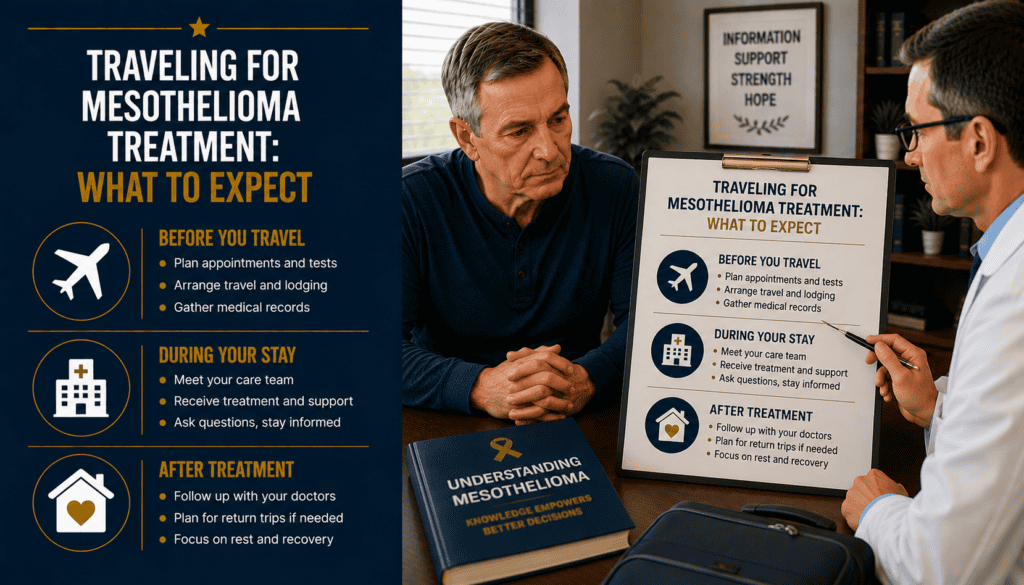
Traveling for Mesothelioma Treatment: Planning, Costs and Patient Support
A practical guide for patients and caregivers arranging specialty cancer care away from home.
Traveling for mesothelioma treatment can mean a one-day consultation, repeated outpatient visits or an extended stay near a cancer center. A carefully coordinated plan can reduce missed appointments, unexpected bills and physical strain. The right plan depends on your diagnosis, symptoms, treatment schedule, insurance and personal preferences.
Start here: Ask the receiving center for a patient navigator or oncology social worker before paying for flights or hotels. Confirm the appointment, medical-record requirements, insurance authorization and whether the treating team considers travel medically appropriate.
Why Mesothelioma Patients May Travel for Treatment
Mesothelioma is uncommon, and a local team may recommend consultation with clinicians experienced in this specific cancer. Patients may travel for a pathology review, surgical assessment, multidisciplinary treatment planning, a second opinion or a clinical-trial evaluation. Traveling does not automatically mean the distant center will recommend a different treatment or that care closer to home is inadequate.
| Reason for travel | What to clarify first |
|---|---|
| Specialist consultation | Will the first visit be in person, or can records be reviewed before travel? |
| Pathology review | Can existing biopsy slides and tissue blocks be shipped directly between pathology departments? |
| Surgery evaluation | Which imaging, lung-function and other tests must be completed beforehand? |
| Clinical-trial screening | Which eligibility tests and visits are required, and what expenses may be reimbursed? |
| Treatment course | How many visits are expected, and which parts can occur locally? |
For background, review mesothelioma diagnosis and mesothelioma treatment options. Ask the distant team to coordinate with your local oncologist so that both offices know who handles prescriptions, complications and follow-up.
How to Choose a Treatment Center and Specialist
Ask about the center’s experience with your particular mesothelioma type, access to relevant specialists and ability to coordinate care with your home team. Pleural and peritoneal mesothelioma can require different expertise. The National Cancer Institute recommends considering a center’s experience, support services, location and insurance-network status when selecting cancer care.
| Question | Why it matters |
|---|---|
| Does the team routinely evaluate my mesothelioma type? | Relevant experience can shape the consultation and treatment discussion. |
| Who will review my biopsy and imaging? | Avoids unnecessary repeat tests and helps identify missing information. |
| Can I see multiple specialists in one trip? | May reduce repeated travel. |
| What care can be shared with my local oncologist? | May reduce travel for infusions, blood tests or surveillance when clinically appropriate. |
| Is the facility and each clinician in my insurance network? | Facility and professional billing may differ. |
Related reading: mesothelioma doctors, second opinions and your care team.
What to Confirm Before Booking a Trip
Do not assume that an appointment confirmation means all scans, pathology material or authorizations have arrived. Request a written itinerary and a direct contact for last-minute changes. Ask whether an initial video consultation is suitable; telehealth rules and insurance coverage vary.
| Item | Action |
|---|---|
| Appointment | Confirm date, check-in time, address, estimated visit length and companion policy. |
| Records | Send pathology report, slides if requested, imaging reports and actual scan images, medication list and prior treatment summary. |
| Insurance | Ask about referral requirements, prior authorization, network status and expected patient responsibility. |
| Travel fitness | Ask your clinician about oxygen, blood-clot risk, mobility, recent surgery and whether flying or long drives are appropriate. |
| Aftercare | Determine whether an overnight stay or a local follow-up is needed after tests, sedation or surgery. |
Bring a written summary of symptoms and questions. See collecting medical records and preparing for appointments together.
Transportation: Driving, Flying and Medical Safety
Choose transportation around the patient’s current condition, not just price. Breathlessness, pain, fatigue, oxygen needs, recent procedures and limited mobility may affect the safest route. Ask the treating clinician for individualized guidance before air travel or a long drive. If oxygen is prescribed, coordinate equipment and carrier requirements in advance; do not assume an airline permits a particular device.
| Travel option | Planning considerations |
|---|---|
| Private car | Plan rest stops, medication access, accessible parking and a backup driver. |
| Commercial flight | Discuss fitness to fly, oxygen arrangements, airport assistance and flexibility if treatment dates change. |
| Train or bus | Consider walking distances, restroom access, transfers and trip duration. |
| Medical transport | Ask the clinical team whether a higher level of support is medically necessary and how it is paid for. |
For local cancer-related appointments, the American Cancer Society’s Road To Recovery program may provide free volunteer rides where available. Call 800-227-2345 well in advance; availability and eligibility vary. It is not a guaranteed long-distance transport service.
Finding Lodging Near a Cancer Center
Ask the hospital social worker about patient housing before reserving a hotel. Options may include hospital-arranged lodging, reduced-rate hotels, nonprofit programs or an extended-stay rental. Confirm distance to the clinic, transportation, accessibility, kitchen access, infection-related precautions and cancellation rules.
| Lodging option | What to verify |
|---|---|
| Hospital-affiliated housing | Eligibility, referral procedure, cost, caregiver policy and availability. |
| American Cancer Society Hope Lodge | Whether the destination has a participating location, outpatient-treatment eligibility, referral requirements and available rooms. |
| Discounted hotel | Patient rate, parking, shuttle, accessibility and refund policy. |
| Extended stay | Kitchen, laundry, stairs/elevator, cleaning arrangements and flexibility if dates change. |
The American Cancer Society Hope Lodge program offers free lodging for eligible cancer patients and caregivers receiving treatment away from home at participating locations; rooms and eligibility are not guaranteed. Contact the treatment facility and ACS at 800-227-2345 before planning around it. ACS also lists other patient lodging resources.
Insurance, Travel Costs and Financial Assistance
Even when treatment is covered, travel can create substantial nonmedical expenses. Ask your insurer and treatment center what is covered before committing to nonrefundable bookings. A travel benefit, if available, may have limits, documentation requirements or designated vendors; do not assume Medicare or private insurance automatically pays for ordinary lodging, airfare or meals.
| Potential expense | Questions to ask |
|---|---|
| Consultations and tests | Are the facility, physician, imaging and pathology services separately billed? |
| Transportation | Are any medically necessary transport services covered? Are ordinary travel costs excluded? |
| Lodging and meals | Does the plan, employer, trial sponsor or hospital offer reimbursement or discounts? |
| Caregiver expenses | Is a companion required, and is any part of their travel supported? |
| Missed work and childcare | Can a social worker identify local assistance or family-leave information? |
| Cancellation and changes | Are fares and hotel reservations refundable if the care plan changes? |
Request a financial-counseling appointment and keep receipts, approval letters and itemized bills. The National Cancer Institute describes assistance resources for transportation, lodging and other costs in its cancer-cost guidance and support services locator. Read mesothelioma treatment costs for additional budgeting considerations.
How Caregivers Can Coordinate Treatment Travel
A companion can help with navigation, questions, medications and changes in plans. The patient should decide what information to share and who may speak with clinicians. Ask the hospital about its consent forms and caregiver participation rules; being a relative does not automatically authorize access to all medical information.
| Before the trip | During the trip | After returning home |
|---|---|---|
| Agree on patient priorities and emergency contacts. | Track symptoms, appointment changes and new instructions. | Send visit summary to local clinicians. |
| Create a shared itinerary and medication list. | Ask which symptoms require urgent attention. | Confirm prescriptions and follow-up tests. |
| Arrange mobility help, lodging and backup transport. | Record whom to call after hours. | Organize receipts and outstanding bills. |
Make room for rest. A trip that includes multiple specialist visits can be tiring, and patients may need additional recovery time after procedures. Related resources include your mesothelioma care team and questions to ask at appointments.
Printable Mesothelioma Treatment Travel Checklist
Use this list as a starting point and tailor it to the treating team’s instructions. Contact the center if an essential item is missing rather than assuming it can be handled on arrival.
| When | Checklist |
|---|---|
| Two to four weeks before, if possible | Confirm appointment; obtain referral/authorization; request records transfer; ask about housing and financial counseling; discuss travel safety. |
| One week before | Reconfirm dates, address and arrival time; check imaging/slides receipt; finalize transportation, accessibility and companion plans. |
| Packing | Identification, insurance cards, medication list, prescribed medicines in original containers, medical contacts, written questions and required equipment. |
| During visits | Ask for a treatment summary, after-hours number, warning signs, medication changes and local-care instructions. |
| Before returning | Confirm fitness to travel, follow-up schedule, pending test results and who will communicate with the home team. |
Questions worth asking before you leave: What is the treatment goal? Which decisions can be made today? Will I need to return, and when? What can my local team do? Who do I call if symptoms worsen between visits?
New or rapidly worsening breathlessness, chest pain, fainting or other severe symptoms require prompt medical evaluation; do not wait for a scheduled out-of-town appointment. For urgent emergencies, use local emergency services.
Frequently Asked Questions About Traveling for Mesothelioma Treatment
Do all mesothelioma patients need to travel for treatment?
No. Travel may be useful for specialist evaluation, a second opinion or a specific procedure, but many elements of care may be delivered locally. Ask whether a remote review or shared-care plan is appropriate.
Can I have a virtual consultation before traveling?
Some centers offer remote consultations or record reviews, but eligibility, state licensing and insurance coverage differ. Ask the center directly.
Will insurance cover flights and hotels?
Do not assume so. Coverage depends on your plan and any special benefits. Ask your insurer and the center’s financial counselor for written details before booking.
Is free lodging available near cancer centers?
Some eligible patients and caregivers can use American Cancer Society Hope Lodge or other programs. Availability, referrals and eligibility vary by location; contact the center and program early.
Can I travel by airplane if I have pleural mesothelioma?
That depends on your health, oxygen needs, recent procedures and other risks. Ask your treating clinician before booking; arrange any required airline-approved oxygen or assistance.
Should a caregiver come with me?
A companion may help with mobility, instructions and recovery, particularly after sedation or surgery. Ask the clinical team whether an escort is required for your planned procedure.
What if my appointment or treatment schedule changes?
Call the treatment center and travel providers promptly. Prefer flexible bookings and ask the center whether its navigator can help reschedule lodging or transportation.
What should I do if symptoms worsen during travel?
Seek prompt medical advice. For severe or rapidly worsening symptoms such as major breathing difficulty, chest pain or fainting, seek emergency care locally rather than continuing the trip.
Sources and Further Reading
- National Cancer Institute: Finding Cancer Care — evaluating facilities and insurance considerations.
- National Cancer Institute: Managing Cancer Costs — travel and lodging assistance guidance.
- American Cancer Society: Hope Lodge — lodging eligibility and locations.
- American Cancer Society: Road To Recovery — volunteer rides and availability.
Program details, availability and coverage can change. Confirm directly with each organization and your treatment team.
Get Help With Mesothelioma Questions and Legal Options
Call 800.291.0963. Live chat is available 24/7, 365 days a year. Submit Your Case.
Discussing potential legal options does not guarantee eligibility, compensation or a particular outcome. Treatment and travel decisions should be made with qualified medical professionals.
⚕️ Legal & Medical Information Disclaimer
This page provides general information, not individualized medical or legal advice. Ask your clinical team about travel safety, treatment and urgent symptoms; consult a qualified attorney about legal deadlines and claims.