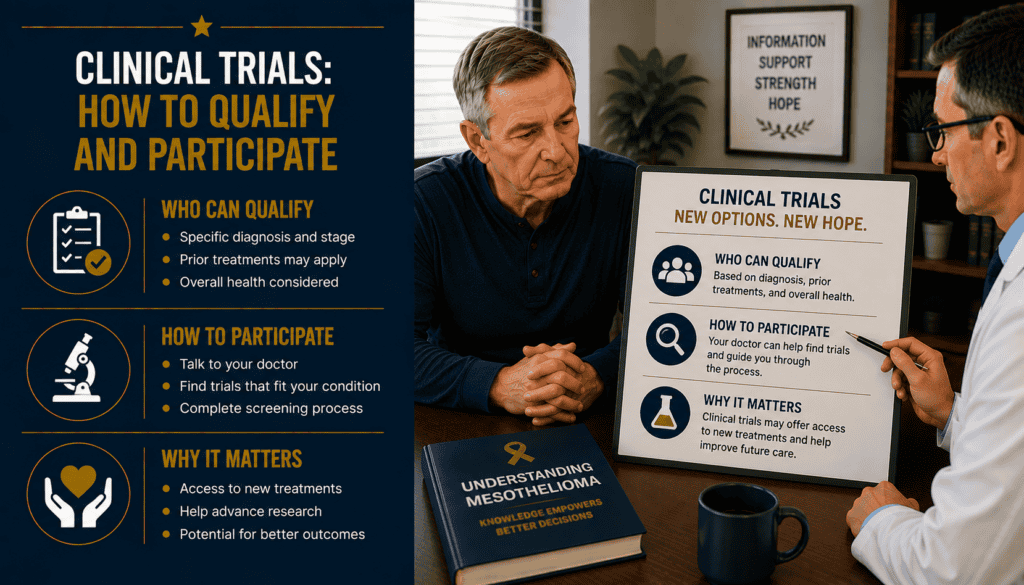
Clinical Trials: How to Qualify and Participate
A practical mesothelioma patient guide to eligibility, enrollment, consent and costs
Clinical trials may offer an opportunity to contribute to mesothelioma research and access an investigational approach, but enrollment is not guaranteed and benefit is uncertain. This guide explains the steps to explore a study with your oncology team and make an informed choice.
🧭 On This Page
Understand Clinical Trials
Clinical trials study whether an intervention is safe and effective, or compare approaches to care. Trials may evaluate medicines, combinations, surgery strategies, radiation, symptom support, or methods of monitoring. A trial is research, not a promise of benefit. Standard treatment, supportive care and a clinical trial can be discussed together with the oncology team.
| Trial type | Main question | What to ask |
|---|---|---|
| Treatment | Does an approach help and what harms occur? | What is the comparison group? |
| Supportive care | Can symptoms or quality of life improve? | Which outcomes are measured? |
| Observational | What can be learned without assigned treatment? | What visits and samples are required? |
Who May Qualify
Every study has its own inclusion and exclusion criteria. Eligibility can depend on mesothelioma location and cell type, pathology confirmation, stage, previous treatment, organ function, performance status, other illnesses and medications. A listing is not an eligibility determination: the research team must review records and perform screening.
| Factor | Why it matters | Preparation |
|---|---|---|
| Confirmed diagnosis | Studies may require a pathology report | Request pathology and imaging reports |
| Prior therapies | Some trials require or exclude specific treatments | List treatments and dates |
| Health and lab results | Safety requirements differ by protocol | Bring recent labs and medication list |
| Travel and timing | Visit frequency may affect participation | Ask about locations and screening windows |
Find Appropriate Studies
Search ClinicalTrials.gov using mesothelioma and relevant terms such as pleural or peritoneal, then check recruitment status and study location. Ask your treating oncologist about studies at their center and whether a mesothelioma specialist can review options. Listings can change, so contact the named study team to confirm whether enrollment is open.
| Search field | How to use it | Caution |
|---|---|---|
| Condition | Enter mesothelioma | Use diagnosis-specific terms when known |
| Recruitment | Filter for recruiting studies | Status may lag behind site updates |
| Location | Review travel requirements | Some visits cannot be remote |
| Contacts | Reach out to the listed team | Do not send sensitive records through unsecured channels |
Referral and Screening
Contact the research coordinator or ask your oncologist to refer you. The team may first review records, then schedule a consent discussion and screening tests. Screening may include examination, imaging, blood tests, review of tumor tissue or other protocol-specific procedures. Screening does not guarantee enrollment.
| Step | Typical activity | Question |
|---|---|---|
| Initial inquiry | Study team checks basic criteria | Is recruitment open at this site? |
| Records review | Diagnosis and treatment history reviewed | Which records should I send? |
| Consent discussion | Procedures and alternatives explained | Can I take the form home? |
| Screening | Protocol-specific tests performed | Who pays if I do not qualify? |
Informed Consent and Patient Rights
Before joining, the team should explain the study purpose, procedures, foreseeable risks, potential benefits, alternatives, privacy, costs and whom to contact. Ask about randomization, placebo use if any, and whether standard treatment is provided. Participation is voluntary: you may decline or withdraw, although the team may recommend follow-up for safety. Never stop prescribed therapy to meet trial criteria without your treating clinician’s guidance.
| Consent topic | What to clarify | Why it matters |
|---|---|---|
| Assignment | Is treatment randomized or blinded? | You may not choose the study arm |
| Risks | What side effects and unknowns exist? | Research involves uncertainty |
| Alternatives | What care is available outside the trial? | Supports an informed choice |
| Withdrawal | What happens if I leave? | Plan ongoing treatment and safety follow-up |
Costs, Insurance and Travel
Separate routine patient-care costs from research-only costs. The sponsor may cover study drugs or protocol-required tests, but coverage varies. Ask the trial’s financial coordinator and your insurer for written explanations of billed services, prior authorization, travel, lodging and caregiver expenses. Do not assume all costs are covered or that participation is free.
| Cost category | Who might pay | Ask before enrollment |
|---|---|---|
| Research-only tests | Often sponsor, protocol dependent | Which items are sponsor-paid? |
| Routine clinical care | May be billed to insurance or patient | What copays and deductibles apply? |
| Travel and lodging | Patient or assistance program, if available | Is reimbursement offered? |
| Unplanned care | Depends on policy and consent terms | What if a study-related injury occurs? |
What Participation Involves
The schedule may include frequent visits, infusions or procedures, symptom questionnaires, scans and long-term follow-up. Keep a calendar, arrange transportation and report new symptoms promptly. Tell the study team about all prescriptions, supplements and other clinicians. Discuss how trial participation may affect work, school, caregiving and travel.
| Planning item | Action | Reason |
|---|---|---|
| Visit calendar | Record appointments and travel time | Reduces missed assessments |
| Medication list | Update at every visit | Helps check interactions |
| Symptom diary | Note onset, severity and changes | Supports prompt safety reporting |
| Care coordination | Share study contacts with regular oncologist | Helps prevent fragmented care |
Questions and Next Steps
Compare the trial’s purpose and demands with your goals, treatment alternatives and support network. Consider a second opinion from a mesothelioma specialist when feasible. If a trial is not appropriate or screening fails, ask about other trials, standard treatments, symptom management and whether re-screening is possible after a change in circumstances.
| Question | Who to ask | Record |
|---|---|---|
| What is the primary goal of this study? | Investigator | Expected outcomes and uncertainties |
| What are my other options? | Treating oncologist | Alternatives and timing |
| How often must I travel? | Coordinator | Visit schedule and costs |
| Who handles problems after hours? | Study team | Emergency contact and instructions |
Frequently Asked Questions
Can I join a trial immediately after diagnosis?
Possibly. Some trials enroll newly diagnosed patients, while others require previous treatment. A study team must review the specific protocol and your records.
Do I need a particular mesothelioma cell type?
Some trials specify epithelioid, sarcomatoid or biphasic disease, while others allow multiple types. Check the protocol and ask the coordinator.
Does a recruiting listing mean I qualify?
No. Recruitment status only indicates that a study may be accepting participants; eligibility is determined through records review and screening.
Will I receive a placebo instead of treatment?
Not necessarily. Study designs vary. Ask whether randomization or a placebo is involved and what standard care each group receives.
Can I leave a clinical trial?
Yes, participation is voluntary. Discuss a safe transition plan and any recommended follow-up with the study team.
Who pays for clinical trial treatment?
Payment varies by study, insurer and service. Ask for a written breakdown of research-only and routine-care costs before enrollment.
Can I enroll if I live far from a trial center?
Possibly, but travel and in-person procedures may be required. Ask about visit frequency, remote visits and available travel assistance.
What if I do not qualify?
Ask why, whether another trial is available, whether re-screening is possible, and which standard or supportive-care options remain appropriate.
Get Help Understanding Your Options
Call 800.291.0963 · Live chat 24/7, 365 days a year · Submit Your Case using the form below. This service is not a clinical trial enrollment office; ask your oncology team or the study coordinator for eligibility decisions.
⚕️ Legal & Medical Information Disclaimer
This information is educational, not medical or legal advice. Only your treating clinicians and the trial research team can assess your care and study eligibility. Do not change treatment without medical guidance.