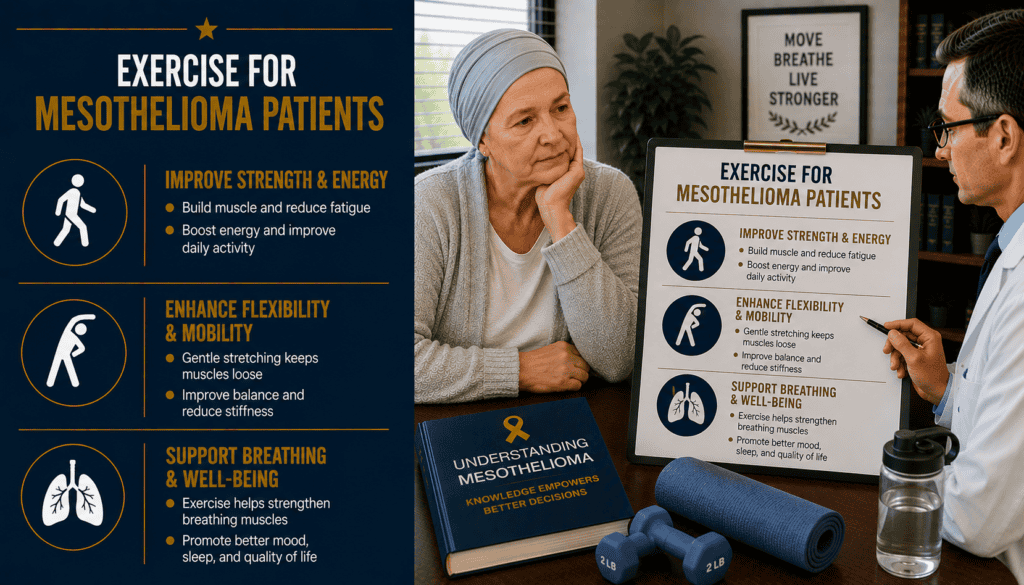
Exercise for Mesothelioma Patients: Safe Movement, Fatigue and Breathing Support
Exercise can look different during mesothelioma care. This guide explains how to discuss gentle movement with your healthcare team, adapt activity to symptoms and recognize when to stop. It is not a one-size-fits-all workout prescription.
How Exercise Can Support Mesothelioma Patients
Movement may help some people with mesothelioma maintain daily function, manage fatigue, preserve strength and support mood. The appropriate activity depends on cancer location, treatment, oxygen needs, symptoms and other health conditions. Exercise is supportive care, not a treatment for the cancer itself. Some people benefit from a short walk; others may begin with seated movement or therapist-guided breathing practice.
Ask your oncology team what is safe before starting or increasing activity, especially after surgery or when you have a pleural effusion, anemia, bone involvement or significant breathlessness. A physical therapist or pulmonary rehabilitation team can help tailor a plan.
| Potential goal | Gentle activity example | Important qualification |
|---|---|---|
| Maintain mobility | Short, comfortable walks | Only if walking is safe and cleared |
| Preserve function | Supervised sit-to-stand practice | Use assistance if unsteady |
| Support well-being | Light stretching or movement | Stop if symptoms worsen |
Get Medical Clearance and a Personal Starting Point
Tell your clinician about your usual activity, recent procedures, oxygen use, dizziness, falls, pain, swelling and whether breathlessness occurs at rest. Ask whether any restrictions apply to lifting, walking, stretching or exertion. After major chest or abdominal surgery, follow the surgeon’s specific instructions rather than a general exercise schedule.
People receiving chemotherapy or other treatments may need to adjust activity when blood counts are low, infection is suspected or side effects are severe. A clinician may recommend physical therapy, occupational therapy or pulmonary rehabilitation. Never change prescribed oxygen flow to exercise without instructions.
| Question for care team | Why ask |
|---|---|
| Do I have activity restrictions? | Accounts for surgery, symptoms and complications |
| Should I use supervised rehabilitation? | Helps adapt exercise to breathing and mobility |
| When should I stop and call? | Establishes individualized warning signs |
Types of Gentle Exercise to Discuss
Walking, seated marching, light range-of-motion movements and carefully selected strengthening exercises are possible options. The best choice is the one that fits current ability and medical advice. Start with a duration you can tolerate and increase only gradually when your care team agrees. Rest breaks are part of a sensible plan.
Resistance bands or light weights may be useful for some people but can be inappropriate immediately after surgery or with particular complications. Stretching should be comfortable, not forceful. If balance is limited, avoid unsupported standing exercises.
| Activity | Possible use | Adaptation |
|---|---|---|
| Walking | Everyday endurance | Short intervals with rests |
| Seated leg movement | Movement with limited standing tolerance | Stable chair, supervision as needed |
| Gentle strengthening | Maintain daily-task ability | Therapist-selected resistance |
| Gentle mobility | Reduce stiffness | Stay within comfortable range |
Breathing Exercises and Pulmonary Rehabilitation
Breathlessness can make activity difficult. A respiratory therapist or rehabilitation clinician may teach breathing control, pacing and positions that make breathing easier. Some patients are referred for pulmonary rehabilitation, a supervised program that can combine exercise, education and symptom-management skills. Whether it is appropriate depends on the individual.
Breathing techniques do not remove a pleural effusion or replace treatment for anemia, infection, blood clots or other causes of breathlessness. Report new or worsening symptoms promptly. Use prescribed oxygen exactly as directed.
| Support | What it may involve | What it cannot replace |
|---|---|---|
| Breathing control | Clinician-taught pacing and breathing | Evaluation of new breathlessness |
| Pulmonary rehabilitation | Supervised individualized training | Cancer-directed treatment |
| Rest positioning | Comfortable posture during recovery | Emergency assessment for severe symptoms |
Exercise During Fatigue and Treatment
Cancer-related fatigue is not simply ordinary tiredness. On difficult days, a brief activity or basic self-care may be enough. Consider doing essential tasks when energy is better and alternating movement with rest. Avoid pushing through exhaustion. Discuss persistent or worsening fatigue because anemia, poor sleep, medication effects, nutrition and other treatable problems may contribute.
During treatment, the plan may change from day to day. Some patients can maintain gentle activity; others need temporary restrictions. Ask about infection precautions and safe exercise when blood counts are low.
| How you feel | Possible approach after clearance | When to seek advice |
|---|---|---|
| Usual energy | Follow individualized plan | If tolerance drops unexpectedly |
| More tired than usual | Reduce activity and rest | Persistent or worsening fatigue |
| Fever or significant illness | Do not exercise; contact care team | Follow urgent instructions promptly |
When to Stop Exercise and Seek Help
Stop activity for chest pain, marked breathlessness, dizziness, faintness, unusual palpitations, new weakness or pain that is new or severe. Seek emergency care for severe chest pain, sudden severe breathing difficulty, fainting or symptoms suggestive of a blood clot. Contact the oncology team for new swelling, fever, worsening cough or a notable decline in exercise tolerance.
Fall prevention matters: wear supportive footwear, clear pathways, use prescribed mobility aids and ask for assistance. Do not exercise alone if you have recently fallen or feel unsteady. A new symptom should not be dismissed as simply being out of shape.
| Sign | Action |
|---|---|
| Sudden severe breathlessness or chest pain | Seek emergency medical care |
| Dizziness or feeling faint | Stop, sit safely and seek medical guidance |
| New fever or worsening symptoms | Contact care team promptly |
| Balance problems | Ask about supervised physical therapy |
Build a Flexible Daily Movement Routine
Choose one manageable goal with your clinician, such as walking to a nearby room, completing a few seated movements or doing a prescribed rehabilitation session. Write down what you did, how you felt and any symptoms. Use that information to discuss adjustments at follow-up visits. There is no universal minutes-per-day target suitable for every mesothelioma patient.
On better days, resist the temptation to make up for missed activity with a large increase. Consistency at an appropriate level is more useful than an exhausting session. A caregiver can help set up a safe space and provide transportation to rehabilitation without pressuring the patient to exceed limits.
| Step | Example | Safety check |
|---|---|---|
| Prepare | Comfortable clothing and clear path | Mobility aid and oxygen as prescribed |
| Move | Clinician-approved short session | Can you talk comfortably and stay steady? |
| Recover | Rest and record symptoms | Report unexpected changes |
Caregiver Help and Related Support
Caregivers can support movement by helping patients follow clinician instructions, arranging rehabilitation appointments, reducing trip hazards and watching for changes in symptoms. Ask the patient what kind of help feels useful; encourage autonomy rather than setting performance targets. If activity becomes stressful, a social worker, rehabilitation professional or palliative-care clinician can help reassess priorities.
Explore mesothelioma support resources, treatment options and hospice care information when relevant to individual goals. Physical activity can be adapted for comfort and function at many stages, but a patient may also choose rest when that best meets their needs.
| Need | Potential resource | Ask about |
|---|---|---|
| Weakness or balance | Physical therapy | Safe mobility plan |
| Breathlessness | Pulmonary rehabilitation | Referral and eligibility |
| Daily tasks | Occupational therapy | Energy-saving adaptations |
| Symptoms and stress | Palliative care or social work | Comfort and practical support |
Frequently Asked Questions
Is exercise safe for everyone with mesothelioma?
No. Safety depends on symptoms, treatment, surgery and other conditions. Ask your oncology team for individualized guidance.
Can exercise cure mesothelioma?
No. Exercise may support function and quality of life but does not treat or cure the cancer.
What if I become short of breath while walking?
Stop and rest safely. Report new or worsening breathlessness to your team; seek emergency care for sudden severe symptoms.
Should I exercise immediately after surgery?
Follow your surgeon’s discharge instructions and ask about physical therapy; restrictions vary by procedure and recovery.
Can I exercise while receiving chemotherapy?
Sometimes, with adjustments and medical guidance. Fever, severe side effects or low blood counts may require changes or temporary restriction.
How long should each session last?
There is no universal duration. Start at a clinician-approved level that is comfortable and adjust based on symptoms.
Is pulmonary rehabilitation the same as cancer treatment?
No. It is supportive rehabilitation that may improve activity tolerance and symptom management for selected patients.
How can a caregiver help?
Assist with safe surroundings, prescribed mobility aids and appointments, while respecting the patient’s choices and reporting concerning symptoms.
Medical References and Further Reading
These public medical resources provide background on exercise during cancer care and rehabilitation. Review individual recommendations with your treating team.
Questions About Mesothelioma Support?
Call 800.291.0963. Live chat is available 24/7, 365 days a year. Submit Your Case using the form below. Contacting us does not guarantee eligibility for compensation.
Legal & Medical Information Disclaimer
This content is general information, not medical diagnosis, individualized exercise advice or legal advice. Consult your oncology team before beginning or changing exercise, and consult a qualified attorney for legal questions.