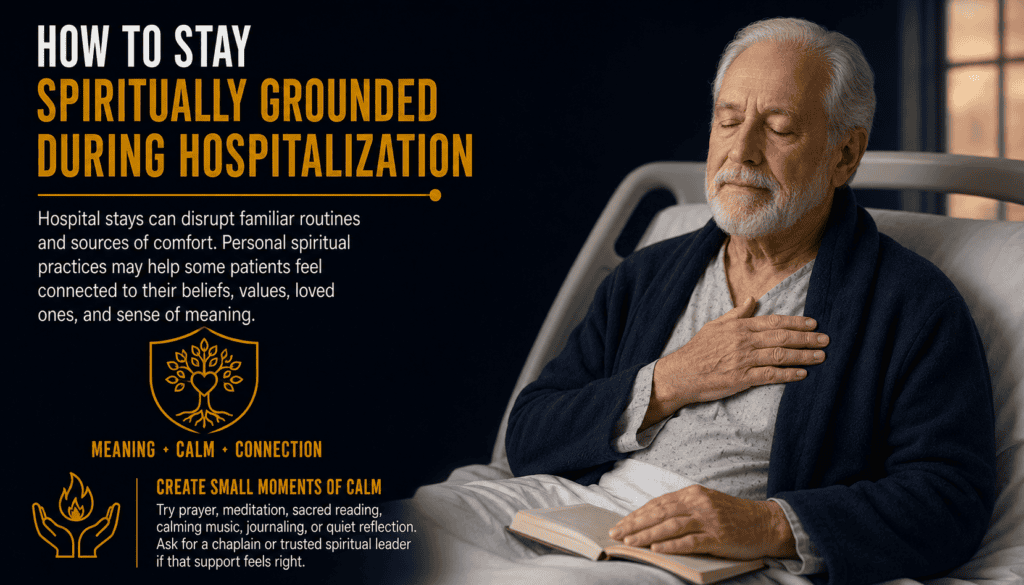
How to Stay Spiritually Grounded During Hospitalization
A gentle, practical guide for people with mesothelioma and their loved ones—whether faith is central, uncertain or not part of their lives.
A hospital stay can interrupt familiar routines, separate you from loved ones and bring difficult questions about illness, uncertainty and what matters most. Spiritual grounding does not require a particular religion or a constantly positive attitude. It can mean reconnecting with faith, personal values, nature, relationships, quiet or meaningful traditions in ways that feel right to you.
Key takeaway: Choose practices that offer comfort and fit your energy. Spiritual care may support emotional well-being; it does not replace mesothelioma treatment, pain relief or professional mental-health support.
What Does It Mean to Feel Spiritually Grounded?
For some patients, grounding means prayer, scripture, a chaplain or connection to a faith community. For others, it means music, gratitude, meaningful conversation, meditation, art or simply remembering the people and values that give life meaning. Both approaches deserve respect.
There is no correct way to respond to a cancer diagnosis. Anger, doubt, sadness and questions about meaning can coexist with hope. You do not have to resolve them to receive spiritual support.
| Grounding may look like | A low-effort hospital example |
|---|---|
| Religious practice | Ask for a short prayer, reading or visit from your chosen faith representative. |
| Connection | Listen to a loved one’s voice message or share a favorite memory. |
| Personal meaning | Keep a photo, letter or meaningful object nearby if hospital rules allow. |
| Quiet attention | Notice the support of the bed, your breathing or sounds in the room for a minute. |
| Nature and creativity | Look at a photo of a favorite place or listen to a familiar song. |
Why Hospitalization Can Disrupt Spiritual Well-Being
Unfamiliar rooms, tests, alarms, sleep interruptions, pain and uncertainty can make it harder to feel connected to yourself. A patient may also worry about family responsibilities or feel isolated from usual spiritual communities. These responses do not signal a failure of faith or resilience.
Tell the care team when symptoms or hospital routines are interfering with rest or meaningful activities. The team may be able to adjust nonurgent visits, arrange communication assistance or connect you with supportive services. See your mesothelioma care team for the different professionals who may help.
| Hospital challenge | Possible response |
|---|---|
| Exhaustion | Choose a one-minute practice rather than a long ritual. |
| Noise or interruptions | Ask whether quiet time can be arranged when clinically safe. |
| Being far from home | Request a phone or video visit with a trusted person. |
| Pain or breathlessness | Ask staff to address symptoms before attempting meditation or prayer. |
| Feeling disconnected | Ask about a chaplain, social worker or patient-support service. |
Small Daily Practices That May Help
Keep practices optional and brief. You might start by naming one thing that matters today, listening to a favorite song, saying a short prayer or noticing five things you can see. If closing your eyes or focusing on breathing increases discomfort, keep your eyes open and focus on a neutral object instead.
Breath-focused exercises are not appropriate for everyone with mesothelioma-related breathlessness. Never force deep breaths or delay medical help for new or worsening breathing symptoms. Ask the care team which relaxation approaches are safe for you.
| Practice | Try this | Adjust if needed |
|---|---|---|
| A familiar phrase | Repeat a comforting phrase, prayer or affirmation once. | Ask someone to read it aloud. |
| Meaningful music | Listen to one song at a comfortable volume. | Use headphones only if staff say they are safe. |
| Grounding through senses | Notice the texture of a blanket or the view outside. | Skip anything that worsens nausea or distress. |
| Gratitude without pressure | Name one kind action or small comfort, if any. | It is fine to say “nothing today.” |
| Connection | Send a brief message to someone you trust. | Ask a caregiver to help or postpone it. |
Sleep is also part of coping. If overnight interruptions or worry are making rest difficult, review managing sleep problems during treatment with your clinicians.
Finding Spiritual and Emotional Support in the Hospital
Many hospitals offer spiritual care or chaplaincy services. Chaplains may support patients of many religions as well as people who do not identify with a faith. Availability and scope vary by hospital; ask what is offered and whether a representative from your own community can visit or call.
Social workers, palliative care clinicians, psychologists and counselors serve different needs. Palliative care can address symptoms and emotional or spiritual concerns alongside cancer-directed treatment; it is not the same as hospice. Ask your nurse or physician for the appropriate referral.
| Who to ask for | How they may help |
|---|---|
| Hospital chaplain or spiritual care | Listening, rituals when available, meaning-related concerns and community contacts. |
| Social worker or patient navigator | Family communication, resources, practical stressors and referrals. |
| Palliative care team | Pain, breathlessness and other symptoms alongside emotional support. |
| Mental-health professional | Persistent anxiety, depression, trauma responses or coping difficulties. |
| Your chosen faith or community leader | Traditions, visits or connection according to your preferences. |
For broader emotional coping ideas, read emotional resilience and faith during treatment.
Need help now? Call 800.291.0963 / Live chat available 24/7, 365 days a year / Submit Your Case.
How Family Members and Caregivers Can Help
Ask, rather than assume, what kind of support the patient wants. “Would you like quiet company, a prayer, music or time alone?” gives the patient control. Bring meaningful items only with permission and within hospital infection-control and safety rules.
Caregivers can also protect their own rest and seek support. You do not have to provide every kind of comfort yourself. If you are traveling to be present, travel planning for mesothelioma treatment may help with logistics.
| Helpful question | Why it helps |
|---|---|
| “What would feel comforting today?” | Lets the patient set the direction. |
| “Would you like me to contact anyone?” | Preserves choice about visitors and beliefs. |
| “Should I stay or give you quiet time?” | Respects fatigue and privacy. |
| “Would you like me to ask the nurse about support?” | Connects needs to the care team. |
Respecting Beliefs, Doubts and Personal Boundaries
A person may welcome prayer one day and decline it the next. They may feel anger toward a religious tradition, want no spiritual discussion or prefer secular support. Do not frame illness as punishment, suggest that faith determines survival or imply that patients must remain hopeful to recover.
Hospital staff can help document visitor preferences and connect patients with appropriate services. Ask about privacy, interpreter services and accommodations for religious practices, food or personal items; availability may depend on clinical safety and hospital policy.
| Avoid saying | Try instead |
|---|---|
| “You have to stay positive.” | “You can tell me how you really feel.” |
| “Everything happens for a reason.” | “I’m here with you, even when this is hard.” |
| “You should pray more.” | “Would any spiritual or nonreligious support help?” |
| “I know exactly how you feel.” | “What has this been like for you?” |
When Fear or Spiritual Distress Becomes Overwhelming
Spiritual questions can become especially intense during painful procedures, bad news or long admissions. Tell a nurse or physician if distress prevents sleep, makes it difficult to participate in care or feels unmanageable. Ask for counseling, social work, chaplaincy or palliative care according to your preferences.
If you develop sudden or severe breathing difficulty, chest pain, confusion or other acute symptoms, alert hospital staff immediately rather than attempting a grounding exercise. If someone is in immediate danger of self-harm, notify hospital staff at once; outside the hospital in the United States, call 911 for immediate danger or call/text 988 for suicide or emotional crisis support.
For anxiety around appointments and scan results, see managing anxiety, fear of recurrence and scanxiety.
| What you notice | Next step |
|---|---|
| Worry that comes and goes | Tell someone you trust; consider a short, optional grounding practice. |
| Persistent distress or panic | Ask your clinical team for a mental-health assessment and support. |
| Pain or breathlessness driving fear | Ask staff to assess and treat symptoms promptly. |
| Thoughts of self-harm or immediate danger | Tell hospital staff immediately; use emergency services if outside hospital. |
A Simple Spiritual Grounding Plan for a Hospital Day
Use this as a menu, not a schedule you must complete. Treatment, rest and symptom care come first. Choose one or two items that feel possible, and change the plan whenever you need to.
| When | Optional action | What to ask for |
|---|---|---|
| Morning | Choose a phrase, song or intention for the day. | A few quiet minutes if clinically possible. |
| Before a procedure | Tell staff what helps you feel safe. | A clear explanation, support person or chaplain if available. |
| Afternoon | Connect briefly with someone meaningful. | Help with a call or video visit. |
| Evening | Reflect, pray, listen to music or rest without ritual. | Help addressing pain, worry or sleep disruption. |
| Any time | Skip the plan when tired or overwhelmed. | Support without pressure. |
Questions to bring to the care team: Can I request a chaplain or counselor? Are virtual visits available? Can my chosen spiritual representative visit? How can pain, breathlessness or sleep problems be addressed? Who can help my family coordinate support?
Related reading: mesothelioma treatment options, understanding the diagnosis and hospice care when comfort-focused care becomes appropriate.
Frequently Asked Questions
Do I need to be religious to receive spiritual care?
No. Spiritual care can address meaning, values, relationships and existential concerns for religious and nonreligious patients. Ask the hospital what services it offers.
Can I ask for a chaplain from my own tradition?
You can ask. A hospital may have chaplains from several traditions or may help contact a community representative, although availability varies.
What if I am too tired to pray or meditate?
Rest is enough. A short phrase, a song or quiet company may feel better, and you can decline every practice.
Can spiritual practices treat mesothelioma?
No. They may offer comfort or help some people cope, but they do not replace evidence-based cancer care or symptom treatment.
What if prayer or meditation makes me more anxious?
Stop that practice and choose something else, such as listening to music or speaking with a trusted person. Tell your team if anxiety persists.
Can my family join a hospital spiritual-care visit?
Often, if you want them there and hospital policies allow it. Tell staff whom you wish to include and whom you do not.
Is palliative care the same as hospice?
No. Palliative care can accompany cancer-directed treatment at any stage. Hospice generally focuses on comfort when the goals of care change.
When should I seek professional help for spiritual distress?
Ask for help when distress is persistent, interferes with sleep or care, or feels overwhelming. Tell hospital staff immediately about any risk of self-harm.
Medical and Support Resources
These authoritative resources offer broader information on cancer-related spiritual concerns and supportive care. Program availability and individual care decisions should be confirmed with your treating team.
Get Help Understanding Your Options
Call 800.291.0963. Live chat is available 24/7, 365 days a year. Submit Your Case.
Every situation is different. Contacting us does not guarantee eligibility, compensation or a particular outcome.
⚕️ Legal & Medical Information Disclaimer
This page provides general information, not medical, psychological, spiritual or legal advice. Consult your oncology team for care decisions and qualified professionals for individualized guidance. Seek immediate help for urgent symptoms or safety concerns.