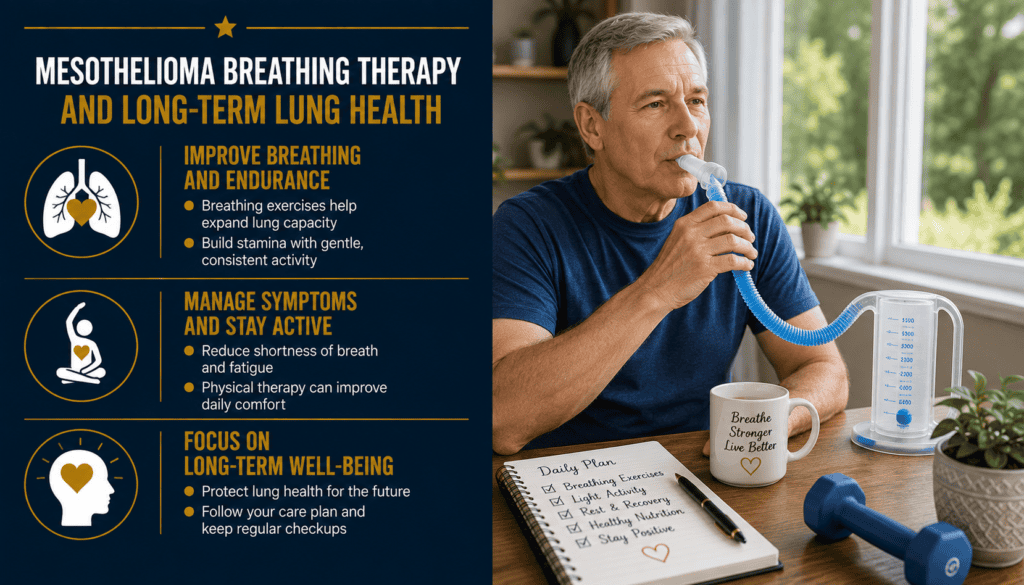
Breathing Therapy and Long-Term Lung Health After Mesothelioma Treatment
A patient and caregiver guide to breathing support, safe activity and follow-up after treatment.
Mesothelioma and its treatment can affect breathing in different ways. Tumor growth, pleural fluid, surgery, anemia, infection and other medical conditions may all contribute to shortness of breath. Breathing therapy can help some people manage symptoms and function, but it cannot remove a tumor, drain a pleural effusion or replace medical treatment. Ask your oncology team to identify the cause of any new or worsening breathing problem before starting exercises.
What breathing therapy can—and cannot—do
Breathing therapy may include coaching in comfortable breathing patterns, airway-clearance strategies when indicated, supervised exercise, energy conservation and education. A pulmonary rehabilitation program combines assessment, individually adapted exercise and self-management support. Your plan should reflect whether you have pleural or peritoneal mesothelioma, recent surgery, low blood oxygen, pain or other health problems.
| Approach | Potential role | Important limit |
|---|---|---|
| Breathing coaching | May ease the sensation of breathlessness and help with pacing | Does not correct low oxygen or a blocked airway |
| Pulmonary rehabilitation | Can support physical function and confidence when appropriate | Requires individualized medical assessment |
| Prescribed oxygen | Treats documented low blood oxygen in selected patients | Not automatically helpful for all breathlessness |
| Pleural fluid management | Can address breathlessness from fluid around a lung | Requires clinician-directed evaluation and procedure |
For a related discussion of causes and fluid treatment, see managing breathing problems and pleural effusion.
Start with a medical breathing assessment
Tell your team when symptoms started, what makes them worse, whether they occur at rest, and whether you have fever, chest pain, cough, swelling or dizziness. Clinicians may review oxygen saturation, examination findings, imaging, blood counts and other tests according to your circumstances. A normal pulse-oximeter reading does not rule out every serious cause of breathlessness.
| What to report | Why it matters |
|---|---|
| New shortness of breath at rest | May require prompt assessment rather than exercises |
| Breathing worse when lying down | Can affect positioning and prompt investigation |
| Recent chest or abdominal procedure | May change activity and breathing precautions |
| New fever or productive cough | Could indicate infection or another complication |
| New leg swelling or sudden chest pain | Could indicate an urgent condition, including a blood clot |
Ask whether a respiratory therapist, pulmonologist, physical therapist or pulmonary rehabilitation program is appropriate. Review any restrictions after surgery before attempting deep breathing, resistance work or strenuous activity.
Breathing techniques to discuss with your care team
Simple techniques can sometimes make everyday tasks more manageable. Have a clinician demonstrate the method and stop if it causes dizziness, pain or worsening breathlessness. These are examples to discuss, not a universal exercise prescription.
| Technique | General approach | Safety note |
|---|---|---|
| Pursed-lip breathing | Breathe in gently through the nose; breathe out slowly through loosely pursed lips | Avoid forceful or prolonged breath-holding |
| Comfortable diaphragmatic breathing | Practice relaxed, unforced breaths in a supported position if your therapist recommends it | May not be comfortable after abdominal or chest surgery |
| Paced breathing during activity | Match exhalation to an effort such as standing or climbing a step | Stop if symptoms escalate |
| Supported positioning | Try an upright seated posture with arms supported | Seek assessment for sudden or severe symptoms |
Do not use incentive spirometers, airway-clearance devices or breathing-resistance trainers without guidance about whether they are indicated and how to use them. For a broader overview, see breathing exercises and pulmonary rehabilitation.
Pulmonary rehabilitation and rebuilding stamina
A supervised program may include an initial functional assessment, walking or other aerobic activity, gentle strengthening, education and strategies to manage breathlessness. The clinician should adjust intensity to your symptoms, oxygen needs, treatment schedule and recovery status. Rehabilitation is not a race: shorter sessions with rest may be more appropriate than trying to meet a fixed step target.
| Program element | What to ask |
|---|---|
| Initial assessment | Which limitations or precautions apply to me? |
| Exercise plan | What intensity and stopping rules are safe? |
| Oxygen monitoring | Do I need assessment during exertion? |
| Strength and mobility | How can I safely rise from a chair and move around? |
| Reassessment | When should the plan change after a scan, treatment or hospitalization? |
Rehabilitation may be especially useful after a period of inactivity, but evidence and eligibility vary by patient. Your team may coordinate it with oxygen therapy and breathing rehabilitation when oxygen is prescribed.
Need help now? Call 800.291.0963 / Live chat available 24/7, 365 days a year / Submit Your Case.
Protecting lung health over time
Long-term care should focus on the actual problems identified by your clinicians rather than assuming that all breathlessness is permanent damage. Keep follow-up appointments, report symptom changes, review medications, and ask about vaccinations and infection prevention appropriate to your treatment and immune status. If you smoke, ask for evidence-based cessation support; avoid secondhand smoke and airborne irritants when possible.
| Long-term priority | Practical action |
|---|---|
| Cancer follow-up | Keep scheduled imaging and oncology visits; report new symptoms between visits |
| Physical function | Maintain a clinician-approved activity plan and reassess after setbacks |
| Medication review | Check inhalers and other medicines are indicated and used correctly |
| Infection prevention | Ask about recommended vaccines and when fever requires a call |
| Air quality | Reduce smoke, dust and other irritating exposures |
| Nutrition and hydration | Discuss weight loss, appetite and fluid limits with your care team |
For a related lifestyle discussion, see nutrition and exercise during mesothelioma treatment. No breathing exercise or supplement has been proven to prevent mesothelioma recurrence.
Recognizing symptoms and urgent warning signs
Call emergency services immediately for sudden or severe difficulty breathing, new severe chest pain, fainting, blue or gray lips, or confusion. Do not try to breathe through these symptoms with exercises. Contact your cancer team promptly for new or worsening breathlessness, fever, a new cough, new leg swelling, unexpected oxygen changes or symptoms that interfere with basic activities.
| Situation | Response |
|---|---|
| Sudden severe breathlessness or chest pain | Emergency evaluation |
| Fainting, confusion or blue/gray lips | Emergency evaluation |
| New fever or increasing cough during treatment | Contact oncology team promptly according to your fever plan |
| Gradually worsening exercise tolerance | Arrange medical review rather than simply increasing exercise |
| Persistent breathlessness despite prescribed oxygen | Seek clinician assessment; do not change oxygen flow without instructions |
Possible causes include fluid recurrence, infection, anemia, pulmonary embolism, treatment-related lung inflammation or cancer progression. Only a clinician can determine the cause and appropriate response.
A practical home and follow-up plan
Build a short plan with your team and caregiver. Record your usual breathing ability, safe activity level, prescribed equipment and the number to call if symptoms change. Do not set an oxygen flow or exercise target based on another patient’s experience.
| When | Suggested check-in |
|---|---|
| Morning | Note breathing at rest, pain and any symptoms your team asked you to monitor |
| Before activity | Check that the task fits your prescribed plan and equipment is ready |
| During activity | Use pacing and planned breaks; stop for concerning symptoms |
| Evening | Record new symptoms and questions; review tomorrow’s appointments |
| After treatment or hospitalization | Ask whether activity, oxygen or rehabilitation instructions need updating |
Keep a current medication list, your team’s contact details, and any oxygen-equipment instructions together. For more on daily pacing, see creating a balanced daily routine during treatment.
Questions to ask your care team
Bring these questions to your next appointment and write down the answers. If you have a caregiver, ask whether they can attend and help record instructions.
| Question | What the answer should clarify |
|---|---|
| What is causing my breathlessness right now? | Whether treatment, fluid drainage, testing or rehabilitation is needed |
| Is pulmonary rehabilitation suitable for me? | Referral, timing and precautions |
| Which breathing technique should I practice? | Demonstration, frequency and stopping rules |
| Should my oxygen level be assessed at rest and with activity? | Whether oxygen testing or a prescription is indicated |
| Which symptoms require an urgent call? | Your personalized escalation plan |
| When should we reassess my plan? | Follow-up after treatment, hospitalization or symptom changes |
If breathing symptoms are affecting sleep, discuss that directly rather than relying on over-the-counter sedatives. See managing sleep problems during treatment.
Frequently asked questions
Can breathing exercises cure mesothelioma?
No. Breathing exercises may help some people manage symptoms and activity, but they do not cure mesothelioma or replace cancer treatment.
Should everyone with mesothelioma use supplemental oxygen?
No. Oxygen is prescribed when an appropriate assessment shows a need; breathlessness alone does not establish that oxygen will help.
Is pulmonary rehabilitation safe after surgery?
It may be appropriate for selected patients, but the surgical and rehabilitation teams must set timing and precautions based on healing and complications.
What if my pleural effusion returns?
Contact your clinical team. Recurrent fluid may need reassessment and treatments such as drainage, pleurodesis or an indwelling pleural catheter depending on your circumstances.
Can I use an incentive spirometer at home?
Use it only if your team recommends it and explains technique and frequency; it is not a substitute for evaluation of worsening breathing.
What if I feel dizzy during a breathing exercise?
Stop, sit safely and tell your care team. Seek urgent help if dizziness accompanies severe breathlessness, chest pain or fainting.
Can rehabilitation prevent mesothelioma from returning?
No. Rehabilitation supports function and symptom management; it has not been established as a way to prevent recurrence.
When should I call for emergency help?
Call emergency services for sudden severe breathlessness, severe chest pain, fainting, confusion or blue or gray lips.
Medical references and further reading
These resources provide general information; recommendations for an individual patient should come from their treating clinicians.
- National Cancer Institute: Cardiopulmonary Syndromes (PDQ)
- National Cancer Institute: Fatigue and Cancer Treatment
- American Thoracic Society: Pulmonary Rehabilitation patient information
Related articles: managing pleural effusion and oxygen therapy and breathing rehabilitation.
Get help with mesothelioma questions
Call 800.291.0963 to discuss possible next steps. Live chat is available 24/7, 365 days a year. Submit Your Case.
Compensation is not guaranteed; eligibility depends on individual circumstances.
⚕️ Legal & Medical Information Disclaimer
This article provides general information, not medical or legal advice. Consult your treating clinicians about symptoms, rehabilitation and treatment, and a qualified attorney about legal questions.