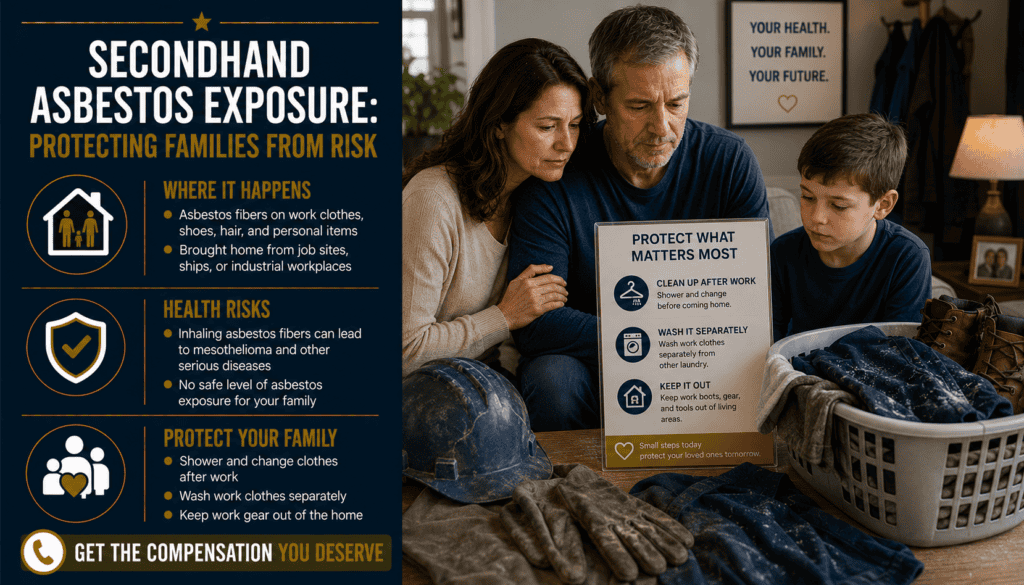
Secondhand Asbestos Exposure: Protecting Families From Risk
Many people assume asbestos exposure only affects workers on job sites — but thousands of families were exposed indirectly when fibers were unknowingly carried home on clothing, boots, skin, and even vehicle interiors. This is known as secondhand asbestos exposure, and it has caused mesothelioma in spouses, children, and loved ones of workers across the U.S.
Understanding how secondhand exposure happens — and how to prevent it — can protect at-risk families and ensure early screening for those who may have been exposed in the past.
If you believe you or a loved one may have been exposed, call 800.291.0963 today for screening guidance and legal support.
🏠 Step 1: What Is Secondhand Asbestos Exposure?
Secondhand asbestos exposure occurs when tiny asbestos fibers are brought home from work sites and inhaled by family members.
This form of exposure was especially common from the 1950s–1990s in industries where asbestos use was widespread.
📌 How Secondhand Exposure Happens
Fibers cling to:
-
Work uniforms
-
Boots and shoes
-
Hair and skin
-
Tool bags
-
Car seats and floor mats
-
Laundry carried home each day
When disturbed, these fibers release into the air, where family members breathe them in — often without ever realizing it.
🧺 Step 2: The Most Common Ways Families Were Exposed
For decades, spouses and children were unknowingly exposed through everyday household routines.
✔ Common Household Exposure Pathways
-
Shaking out dusty work clothes before laundry
-
Doing laundry containing asbestos fibers
-
Hugging a worker immediately after their shift
-
Sweeping floors where dust from work boots accumulated
-
Riding in work vehicles contaminated with asbestos dust
-
Sleeping next to a worker after a shift
-
Handling lunchboxes or equipment covered in job-site dust
Many secondhand exposure cases come from families of shipyard workers, construction workers, firefighters, and mechanics.
👨👩👧 Step 3: Who Is Most at Risk of Secondhand Asbestos Exposure?
Anyone living with an asbestos-exposed worker may be at risk, especially in the years before workplace safety standards were enforced.
📌 Highest-Risk Family Members
-
Spouses who washed or handled work clothes
-
Children who hugged parents after work
-
Infants crawling on floors where dust settled
-
Family members riding in contaminated cars
-
Relatives living in the same home during peak exposure years
Exposure risk was greatest when workers were handling insulation, construction materials, pipe coverings, brake linings, or materials in shipyards and factories.
🩺 Step 4: Health Risks of Secondhand Exposure
Secondhand asbestos exposure can cause the exact same illnesses seen in workers exposed directly.
⚠️ Diseases Linked to Secondhand Exposure
-
Mesothelioma
-
Asbestosis
-
Pleural thickening
-
Lung cancer
-
Ovarian cancer (in some cases)
Mesothelioma is the most serious and can develop 20–50 years after exposure — even in individuals who were exposed only indirectly as children.
🧬 Step 5: Symptoms to Watch For in Exposed Family Members
Symptoms of asbestos-related diseases often appear slowly and may resemble common respiratory conditions.
📋 Early Warning Signs
-
Shortness of breath
-
Chest discomfort
-
Persistent cough
-
Abdominal swelling
-
Unexplained weight loss
-
Rib or shoulder pain
-
Chronic fatigue
-
Frequent respiratory infections
Any person with symptoms and a history of secondhand exposure should request imaging and specialty evaluation.
🩻 Step 6: Screening Recommendations for Secondhand-Exposed Families
Because secondhand exposure often went unnoticed, early screening is essential for prevention and early detection.
🧪 Recommended Screening Tests
-
Chest X-ray to detect plaques or thickening
-
Low-dose CT scan (LDCT) for early tumor detection
-
MRI for soft-tissue evaluation
-
PET-CT if abnormalities appear
-
Biomarker blood tests (mesothelin, fibulin-3, HMGB1)
📅 Screening Schedule
-
Adults with known secondhand exposure: every 1–2 years
-
Anyone with early symptoms: immediate imaging
-
Family members of high-risk occupations: baseline scan at age 30–40
A mesothelioma specialist can determine the ideal screening plan.
🧼 Step 7: How to Prevent Secondhand Exposure Today
Although regulations have improved, some workers may still bring fibers home from older buildings, industrial sites, or demolition projects.
🛡️ Prevention Practices for Workers
-
Change clothes before leaving work
-
Shower on-site if possible
-
Store work boots in sealed containers
-
Wash work clothes separately or use employer-provided laundering
-
Keep tools off household surfaces
-
Avoid bringing equipment into personal vehicles
🏠 Prevention for Families
-
Do not handle contaminated work clothes
-
Keep children away from laundry containing dust
-
Wipe car interiors frequently if used for job travel
-
Use HEPA-filter vacuums for floors and upholstery
-
Maintain good ventilation in mudrooms or entryways
Preventing fiber spread is key to protecting loved ones from long-term harm.
⚠️ Step 8: Why Many Families Never Knew They Were Exposed
Most workers were never warned about asbestos risks — and employers often provided no protective gear until the late 1980s.
📌 Reasons Families Were Unknowingly Exposed
-
Employers failed to provide changing rooms
-
No on-site laundry services
-
Poor enforcement of OSHA rules
-
Asbestos dust was considered “normal”
-
No visible symptoms during exposure
-
Risk information was limited or hidden
Because exposure wasn’t obvious, many patients diagnosed today never realized they were at risk as children.
📘 Step 9: Legal Rights for Victims of Secondhand Exposure
People with mesothelioma caused by secondhand exposure may qualify for compensation, including from asbestos trust funds and legal claims.
📌 You May Be Eligible If:
-
You lived with someone who worked around asbestos
-
You handled their dusty clothing
-
You developed mesothelioma or another asbestos-caused disease
-
Your exposure occurred decades ago
-
You were exposed as a child
Individuals exposed indirectly have the same legal rights as workers exposed on job sites.
✔ Possible Compensation Includes:
-
Medical expenses
-
Lost income
-
Long-term care
-
Pain and suffering
-
Funeral expenses (for families of victims)
-
VA benefits (if exposure involved a veteran family member)
A legal advocate can help trace exposure sources and file claims.
🧑⚕️ Step 10: When to See a Specialist
Not all oncologists understand asbestos diseases.
Specialists trained in mesothelioma offer early detection, improved diagnostic accuracy, and advanced treatment options.
📌 Seek a Specialist If:
-
You were exposed secondhand
-
You have persistent respiratory symptoms
-
Imaging shows pleural plaques
-
There’s a family history of mesothelioma
-
You want screening for peace of mind
Specialists can also interpret pathology, recommend imaging schedules, and provide referrals for screening.
🏥 Where to Get Help
If you believe you or a loved one may have been exposed to asbestos secondhand, we can help you:
-
Understand your exposure history
-
Schedule screening or imaging tests
-
Locate mesothelioma specialists
-
Review CT or MRI results
-
Explore legal compensation options
-
Connect with VA benefits for veteran families
-
Build a long-term prevention and monitoring plan
📞 Call 800.291.0963 today to protect your family and learn your screening options.
📝 Summary
Secondhand asbestos exposure happens when workers unknowingly bring fibers home — putting family members at risk for mesothelioma and other serious diseases.
Key points to remember:
-
Clothing, hair, boots, and vehicles can carry asbestos dust
-
Family members exposed decades ago may still be at risk
-
Early screening is essential
-
Prevention today helps protect loved ones
-
Compensation is available for victims of indirect exposure
Take action today to safeguard your family’s health.
📞 Call 800.291.0963 for screening support and exposure guidance.