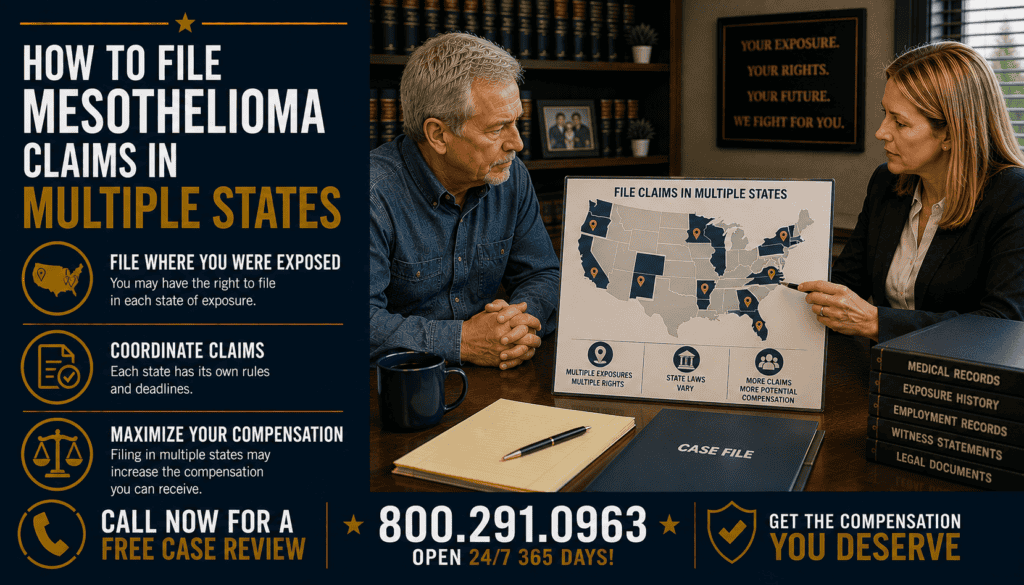
How to File Mesothelioma Claims in Multiple States
People diagnosed with mesothelioma may have worked around asbestos in several states over many years. That does not necessarily mean separate lawsuits should be filed in every state. Multi-state claims require a coordinated review of jurisdiction, venue, choice of law, filing deadlines, defendants, exposure evidence and any existing proceedings.
The objective is to identify legally available forums and organize all exposure into a consistent case strategy. Filing in multiple jurisdictions without that analysis can create procedural conflicts, unnecessary duplication or inconsistent factual positions.
🌎 Why Multi-State Asbestos Claims Require Careful Planning
Construction workers, shipyard workers, industrial trades, military personnel, traveling mechanics and employees transferred between facilities may have asbestos exposure histories crossing state lines. Potential defendants can also be incorporated, headquartered or subject to jurisdiction in states different from the exposure sites.
Federal venue law illustrates the importance of factual connections: 28 U.S.C. § 1391 generally recognizes venue where qualifying defendants reside or where a substantial part of the events or omissions giving rise to a claim occurred. State venue rules have their own requirements.
Start with the Mesothelioma Deadlines & Statute of Limitations hub.
🗺️ Map Every State Connected to the Exposure
Before selecting a court, build a state-by-state exposure map. Each meaningful period should identify the physical work location, employer, dates, job duties, products or equipment, witnesses and potentially responsible companies.
| State connection | Information to document |
|---|---|
| Exposure site | Facility, city, dates, employer, department and tasks. |
| Claimant | Current domicile and residence history. |
| Defendant | Corporate identity, incorporation, principal place of business and relevant contacts. |
| Witnesses | Where coworkers and other witnesses are located. |
| Evidence | Location of employment, facility, union and product records. |
| Prior proceedings | Any lawsuits, trust claims or administrative filings already made. |
⚖️ Determine Which Courts Have Jurisdiction
A court must have authority over the case and the defendants. Personal jurisdiction is evaluated defendant by defendant; a company’s connection to one state should not automatically be treated as authority to sue that company in every state.
The state where the claimant currently lives, where exposure occurred and where a defendant has relevant contacts can all matter, but none should be treated as a universal rule. See How to Identify the Right Jurisdiction for Your Case.
📍 Check Venue Separately
Jurisdiction and venue are related but distinct. Venue identifies the geographic court in which a lawsuit may properly proceed. In federal court, 28 U.S.C. § 1391 generally permits venue in a qualifying district where defendants reside or where a substantial part of the events giving rise to the claim occurred.
A case can therefore have more than one potentially proper venue. Convenience of witnesses, location of records and the connection between the forum and the exposure may become important when a transfer is requested.
📚 Determine Which State’s Law May Apply
Filing in a state does not automatically guarantee that state’s substantive law controls every issue. Courts apply choice-of-law rules to determine which jurisdiction’s law governs particular questions.
Potentially affected issues can include product liability, premises liability, damages, allocation of fault and statutes of limitations. A multi-state strategy should therefore compare not just possible courts, but also the governing-law analysis those courts may perform.
⏳ Compare Filing Deadlines Correctly
States differ in statutes of limitations, accrual rules, discovery rules, wrongful-death periods, tolling doctrines and statutes of repose. Do not select a state simply because an online chart lists a longer filing period.
The forum must first be legally available, and the court’s choice-of-law rules may affect which limitations law applies. Review State-by-State Mesothelioma Filing Deadlines and How Statutes of Limitations Affect Mesothelioma Lawsuits.
🏢 Match Defendants to States and Exposure Sites
A multi-state exposure history should not become one undifferentiated defendant list. For each company, identify the product, premises, equipment or conduct allegedly connecting that defendant to a particular exposure period and location.
| Exposure period | State/site | Potential defendant connection | Supporting evidence |
|---|---|---|---|
| Period 1 | State A / plant | Product or premises | Work records, witness, invoices |
| Period 2 | State B / shipyard | Equipment or replacement component | Ship records, manuals, coworker |
| Period 3 | State C / construction site | Building material or contractor | Specifications, plans, employment records |
Employment at a facility does not by itself establish exposure to every asbestos product used there, and a product invoice does not by itself establish personal contact.
📑 One Lawsuit or More Than One Proceeding?
Multiple exposure states do not automatically require multiple lawsuits. Depending on jurisdiction, parties and claims, one court may be able to adjudicate claims involving several exposure locations. Other circumstances may require separate proceedings or prevent particular defendants from being joined in the same forum.
Federal and state procedural rules govern joinder, jurisdiction and venue. Any strategy involving more than one proceeding should also account for prior judgments, settlements, allocation rules and disclosure obligations.
🏛️ State Court, Federal Court and Removal
Most asbestos tort claims arise under state law, but some cases may qualify for federal jurisdiction. U.S. Courts identifies federal-question and diversity-of-citizenship cases as principal categories of federal jurisdiction. Diversity jurisdiction has statutory citizenship and amount-in-controversy requirements.
A case filed in state court may also be removable when federal statutory requirements are satisfied. Under 28 U.S.C. § 1441, qualifying defendants may remove certain civil actions over which federal district courts have original jurisdiction. Removal should not be confused with filing an independent second lawsuit.
🔄 Transfer and Forum Issues
Even when federal venue is proper, 28 U.S.C. § 1404 allows a district court, for convenience of parties and witnesses and in the interest of justice, to transfer a civil action to another district where it could have been brought or to a district to which all parties consent.
Transfer can have important procedural and choice-of-law consequences. It should therefore be considered when comparing possible forums rather than treated as a minor scheduling issue.
🏦 Coordinate Bankruptcy Trust Claims
Asbestos bankruptcy trusts are separate from civil lawsuits and use their own Trust Distribution Procedures. A person with multi-state exposure may also have evidence supporting claims against more than one trust.
Trust submissions and civil pleadings should use consistent exposure histories. Trust claims may be subject to disclosure, setoff or case-management requirements under applicable state law or court rules. Filing a trust claim should not be assumed to pause a civil statute of limitations.
🚫 Avoid Duplicate Recovery and Inconsistent Positions
Multiple proceedings do not permit recovery of the same compensatory loss more than once. Settlement credits, setoffs, contribution rules and allocation among defendants vary by jurisdiction.
Consistency also matters. Dates, job sites, product identifications and exposure descriptions should be based on the same underlying evidence across civil complaints, discovery responses and trust submissions. Correct new information when appropriate rather than altering a history merely to fit a forum.
📁 Build a State-by-State Evidence File
Organize evidence by exposure period and location. This makes it easier to evaluate jurisdiction and identify which defendants belong to which part of the history.
- Employment and Social Security earnings records
- Union membership and dispatch records
- Military service and assignment records when relevant
- Job-site and facility records
- Product invoices, specifications and manuals
- Coworker and witness information
- Historical photographs
- Corporate and successor-company records
- Medical diagnosis and pathology dates
- Prior complaints, settlements and trust submissions
👨👩👧 Multi-State Wrongful-Death Claims
When the person with mesothelioma has died, additional questions can include who is authorized to bring the claim, estate status, survival claims, the effect of a prior personal-injury action and which state’s wrongful-death law applies.
The place of death is one fact but should not automatically be treated as the controlling jurisdiction. Exposure locations, domicile, defendant contacts and choice-of-law rules can also matter.
✅ Step-by-Step Multi-State Filing Review
- Create a chronological exposure history.
- Separate every significant job site by state.
- Identify defendants connected to each exposure period.
- Map claimant and defendant jurisdictional contacts.
- Identify courts with potential personal and subject-matter jurisdiction.
- Check venue requirements.
- Analyze choice-of-law rules.
- Calculate each potentially applicable limitations period.
- Check discovery rules, tolling and statutes of repose.
- Determine whether one proceeding can include the relevant claims and defendants.
- Evaluate federal jurisdiction, removal and transfer issues where applicable.
- Coordinate bankruptcy trust claims and prior proceedings.
- Preserve a consistent evidence record across all claims.
Also review Time Limits and Statutes of Limitation for Filing Claims and Why Timing Is Critical in Asbestos Claims.
❓ Frequently Asked Questions
Can I file a mesothelioma lawsuit in every state where I was exposed?
Not automatically. Each court must have the required jurisdiction, venue and connection to the claims and defendants, and procedural rules can affect whether separate proceedings are appropriate.
Do I need a separate lawsuit for every exposure state?
No. One court may sometimes adjudicate claims involving exposure in several states, while other circumstances can require or favor separate proceedings.
Can I choose the state with the longest statute of limitations?
Not simply for that reason. The forum must be legally available and its choice-of-law rules may point to another state’s limitations law.
Does my current residence determine where I file?
It can be relevant but is not controlling by itself. Exposure sites, defendant contacts, venue and other jurisdictional facts also matter.
Can a state-court asbestos case be moved to federal court?
Sometimes. Removal requires a statutory basis for federal jurisdiction and compliance with federal removal rules.
What happens if a federal court is inconvenient?
Under 28 U.S.C. § 1404, a federal court may transfer a case to another qualifying district for convenience and in the interest of justice when statutory requirements are met.
Can I recover twice for the same loss by filing in different states?
No. Multiple claims do not create a right to duplicate compensatory recovery. Credits, setoffs and allocation rules depend on applicable law.
Do asbestos trust claims count as another state lawsuit?
No. Bankruptcy trust claims are separate administrative claim processes governed by trust documents, although they can interact with civil litigation.
Should the exposure history be different for each state?
The presentation can focus on the relevant exposure period, but the underlying factual history should remain accurate and consistent across proceedings.
Why is early review important in a multi-state case?
Because jurisdiction, choice of law and limitations analysis can take time, and the shortest potentially applicable deadline may require prompt action while evidence is still being gathered.
📞 Request a Case Evaluation
If you or a family member has been diagnosed with mesothelioma after working in several states, gather a list of employers, job sites, cities, states, approximate dates, coworkers and products or equipment associated with each location. Also preserve any prior lawsuit or asbestos trust documents.
Call 800.291.0963 for a no-obligation case evaluation. Talk to a real person 24/7, 365 days a year. There are no out-of-pocket legal fees for a contingency-fee claim unless compensation is recovered. Submit your case here.
📝 Summary
Multi-state asbestos exposure does not automatically mean filing a separate lawsuit in every state. The correct approach is to map each exposure, connect defendants to particular sites, identify courts with jurisdiction, evaluate venue and choice of law, compare applicable deadlines, and coordinate civil proceedings with trust claims. Federal removal and transfer rules may also affect where a case ultimately proceeds. A consistent state-by-state evidence file helps support this analysis without overstating what any individual record proves.
🔗 Confirmed Sources
- United States Courts — Types of Cases / Federal Jurisdiction
- Cornell LII — 28 U.S.C. § 1391, Venue Generally
- Cornell LII — 28 U.S.C. § 1404, Change of Venue
- Cornell LII — 28 U.S.C. § 1441, Removal of Civil Actions
Disclaimer: General information only—not legal advice. This website is not a law firm. Jurisdiction, venue, choice of law, statutes of limitations, joinder, removal, transfer and trust-claim requirements vary by jurisdiction, parties and facts and can change. Do not rely on this page to select a forum or calculate a filing deadline. No prior result guarantees a future outcome.