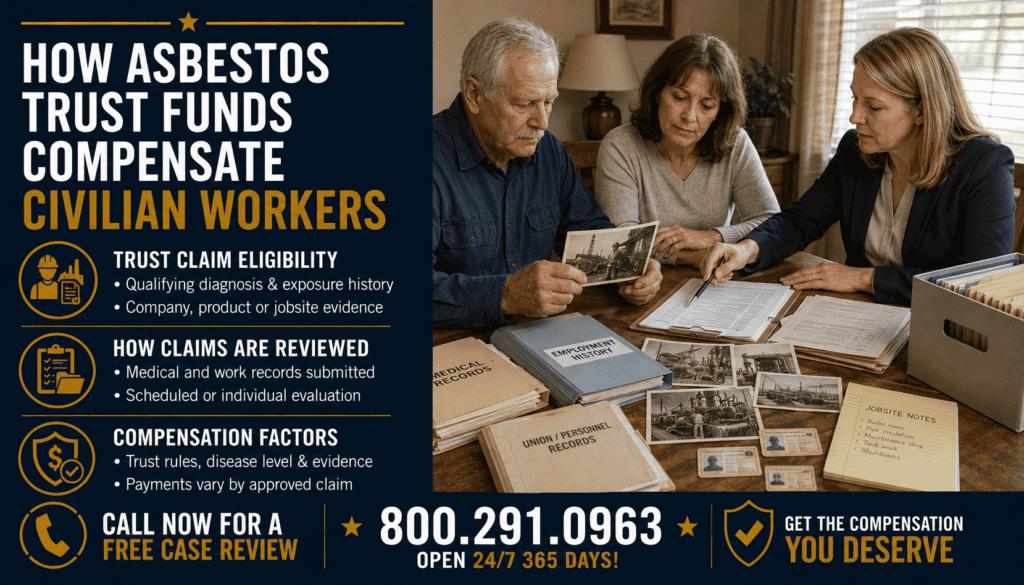
How Asbestos Trust Funds Compensate Civilian Workers
Civilian workers who developed a qualifying asbestos-related disease may be eligible to file claims with asbestos bankruptcy trusts when evidence connects their exposure to a company, product, operation or premises covered by a particular trust. Eligibility does not depend simply on having worked in an industry where asbestos was common. A trust generally requires both medical evidence and credible occupational exposure evidence satisfying its Trust Distribution Procedures (TDP).
How Civilian Worker Asbestos Trust Claims Work
The U.S. Government Accountability Office reports that asbestos litigation grew out of widespread occupational exposure among American workers. Under Chapter 11 and section 524(g), qualifying bankrupt companies can transfer covered asbestos liabilities and assets to asbestos personal-injury trusts responsible for compensating present and future claimants.
For a civilian worker, the claim process generally focuses on two questions: Does the medical evidence satisfy a disease level recognized by the trust, and does the work history establish qualifying exposure for which that trust is responsible?
Each trust answers those questions under its own TDP. There is no universal civilian-worker claim form, exposure standard or payment amount.
Civilian Jobs Linked to Occupational Asbestos Exposure
Asbestos was widely used during the twentieth century for insulation, fire resistance and other industrial and commercial purposes. Occupational exposure occurred in many settings where workers handled asbestos-containing products or worked near trades that disturbed them.
Potentially relevant civilian work histories can include construction, shipyard, industrial plant, refinery, power-generation, manufacturing, maintenance, insulation, boiler, pipe, mechanical and other trades. A job title by itself, however, does not establish eligibility.
The claim must connect the worker’s actual duties, location, dates and asbestos exposure to the debtor, products, operations or premises covered by the particular trust.
Medical Evidence for a Civilian Worker Trust Claim
GAO found that claimants submit medical reports or records sufficient to support the specific disease being claimed and, when applicable, death documentation.
Depending on the TDP and disease, supporting evidence can include pathology or cytology reports, radiology reports, physician reports, pulmonary-function testing and other specified medical records.
Trusts commonly recognize disease categories such as mesothelioma, lung cancer, other cancers, severe asbestosis and nonmalignant asbestos disease, but the medical requirements differ among trusts and disease levels.
Need help now? Call 800.291.0963
Live chat available 24/7, 365 days a year.
Submit Your Case
Employment and Work-History Evidence
For civilian workers, employment documentation can be central to establishing when and where qualifying exposure occurred. GAO identifies work histories, Social Security records, employer records, invoices and claimant or coworker deposition testimony as examples of exposure evidence used in asbestos trust claims.
Useful records may include:
- Social Security earnings histories.
- Employer personnel and payroll records.
- Union membership or dispatch records.
- Jobsite and construction records.
- Invoices and purchase records.
- Work histories and sworn statements when permitted.
- Coworker evidence identifying products or work practices.
Older employment records may be incomplete. GAO notes that the passage of time can make accurate work records unavailable, which can make other credible work-history evidence important.
Product and Jobsite Exposure Evidence
Proving that a worker was employed at an asbestos-containing facility is not always enough. The evidence must satisfy the particular trust’s requirements connecting the claimant to asbestos for which the covered company has responsibility.
Some trusts publish approved-site, product or occupation resources that can help evaluate exposure. These resources should be read together with the TDP because appearing on a site or product list does not necessarily satisfy every disease-specific requirement.
Claimants should document the asbestos-containing materials encountered, the tasks performed, how the materials were disturbed, the frequency and duration of exposure, and the identity of manufacturers or suppliers when known.
For certain disease levels, a TDP may require additional Significant Occupational Exposure beyond basic company-specific exposure.
How Civilian Worker Claims Are Reviewed and Paid
GAO found that trusts typically offer Expedited Review and Individual Review. Under Expedited Review, a claim meeting the preset medical and exposure criteria for a disease level is generally assigned the Scheduled Value specified by that trust.
Individual Review considers claim-specific circumstances and may result in a liquidated value above or below the Scheduled Value, subject to the TDP’s Average Values, Maximum Values and other limitations.
The liquidated value is not necessarily the amount paid. Most trusts use a Payment Percentage to preserve assets for present and future claimants.
Mathematical illustration only — not a guaranteed payment. If a hypothetical trust liquidated a claim at $100,000 and its applicable Payment Percentage were 20%, the arithmetic result would be $20,000 before any other trust-specific rules. This example does not represent any particular trust.
Civilian Workers May Have Claims Involving Multiple Trusts
A worker can encounter asbestos products from several manufacturers during a career. GAO gives an example of an occupationally exposed claimant who worked for construction companies at numerous worksites and shipyards and filed with several trusts whose reorganized companies’ products or operations were identified at those sites.
That does not mean every worker automatically qualifies for multiple trusts. Each claim must independently establish the medical and exposure criteria required by the particular TDP.
Exposure histories should remain accurate and consistent. Trusts use audit and quality-assurance procedures to evaluate medical and work-history documentation.
Trust Claims, Lawsuits and Workers’ Compensation
An asbestos trust claim is an administrative claim against a bankruptcy trust. It is different from a civil lawsuit against a solvent company and different from a state workers’ compensation claim.
GAO notes that asbestos claimants may also seek compensation from potentially liable solvent companies through the tort system. Trust payments and exposure evidence may become relevant in litigation depending on applicable law and discovery rules.
Workers’ compensation rights are governed separately by state or federal law and can depend on employment status, jurisdiction, disease and other circumstances. A trust filing should not be assumed to replace or determine eligibility for those separate remedies.
For general trust qualification criteria, see Asbestos Trust Fund Eligibility Requirements. For claim preparation, see the Asbestos Trust Fund Filing Guides.
Confirmed Primary Sources for Civilian-Worker Facts
No law-firm or lead-generation website was used as factual authority for this page. Government and official trust sources reviewed include:
- U.S. Government Accountability Office report documenting occupational asbestos exposure, TDP requirements, work-history evidence, medical evidence and trust claim processing.
- Official ASARCO Trust resources containing TDP medical and occupational-exposure requirements, claim forms and filing materials.
- Official Kaiser Asbestos Trust resources containing medical, occupational-exposure, site and claim-filing materials.
Related Asbestos Trust Resources for Civilian Workers
Understand Trust Compensation
Prepare a Claim
Employment and Exposure Evidence
Frequently Asked Questions About Civilian Worker Asbestos Trust Claims
Can civilian workers file asbestos trust claims?
Yes, potentially. A civilian worker may qualify when medical evidence and occupational exposure evidence satisfy the requirements of a trust responsible for the relevant asbestos exposure.
Does working in an asbestos industry automatically qualify someone?
No. A job title or industry alone does not establish eligibility. The claimant must satisfy the specific trust’s medical and exposure requirements.
What employment records can support a trust claim?
Social Security records, employer records, union records, jobsite documents, invoices, work histories and permitted claimant or coworker testimony can help establish occupational exposure.
Can construction workers qualify for asbestos trust compensation?
Potentially, when evidence connects their asbestos exposure to products, operations or premises covered by a particular trust and the medical criteria are also satisfied.
Can a civilian worker file with more than one asbestos trust?
Potentially. Workers exposed to products or operations associated with multiple bankrupt companies may have more than one claim, but each trust’s requirements must be independently satisfied.
Is a Scheduled Value the amount a worker receives?
Not necessarily. Many trusts apply a Payment Percentage and other payment provisions to the claim’s liquidated value.
Is an asbestos trust claim the same as workers’ compensation?
No. A bankruptcy trust claim and a workers’ compensation claim are separate legal processes governed by different rules.
Can a civilian worker also have claims against solvent companies?
Potentially. GAO notes that asbestos claimants can seek compensation from potentially liable solvent companies through the tort system as well as qualifying bankruptcy trusts.
Get Help Reviewing a Civilian Worker Asbestos Trust Claim
Call 800.291.0963
Live chat is available 24/7, 365 days a year.
A civilian work history or asbestos-related diagnosis does not automatically establish trust eligibility or compensation. Eligibility depends on qualifying medical evidence, occupational exposure evidence, responsible companies and products, filing requirements, current trust procedures and individual circumstances. Compensation is not guaranteed.
⚕️ Legal & Medical Information Disclaimer
This page provides general educational information and is not medical or legal advice. The information does not establish asbestos exposure, diagnosis, causation, liability, claim eligibility or compensation. Medical concerns should be discussed with a qualified healthcare professional, and legal questions should be reviewed with a qualified attorney.