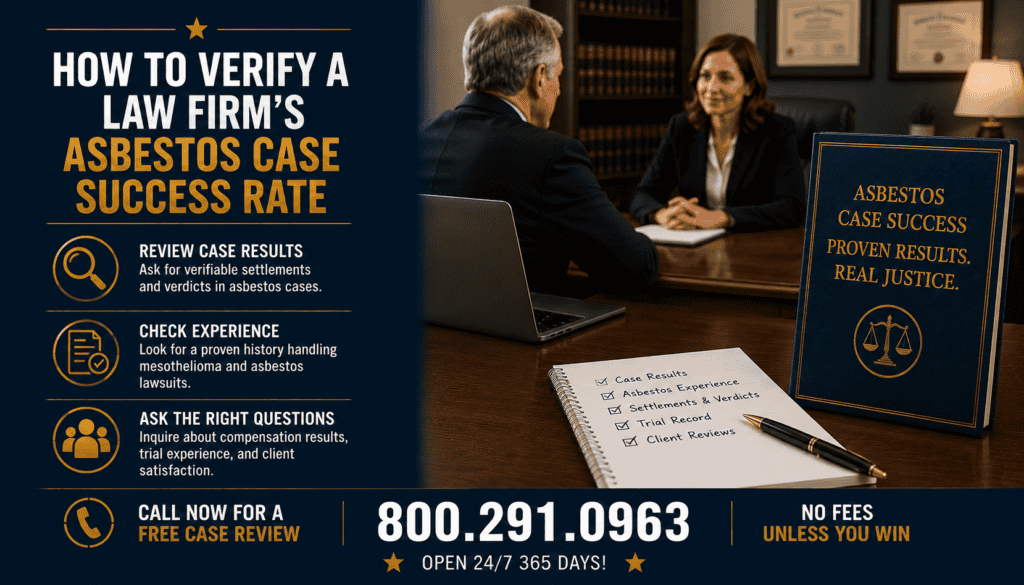
How to Verify a Law Firm’s Asbestos Case Success Rate
Law firm websites may describe verdicts, settlements, years of experience, total recoveries or percentages of successful cases. Those figures can sound precise while measuring very different things. Before relying on a claimed asbestos or mesothelioma “success rate,” ask exactly what was counted, over what period, which attorneys handled the matters, whether the figure includes settlements, and whether unsuccessful or unresolved cases were included.
Independent verification is easier for some claims than others. Public court dockets can confirm many filed cases, motions, judgments and verdict-related records, while private settlements may be confidential or may not disclose payment amounts. State bar records can help verify attorney licensing and public discipline. The goal is not to identify a single “best” firm, but to determine whether a firm’s specific claims are understandable, relevant and supported by verifiable information.
📊 What a “Success Rate” Actually Means
There is no standardized national asbestos-law-firm “success rate” published by the federal courts or a national bar regulator. Firms can use different denominators and definitions, making percentages difficult to compare unless the methodology is disclosed.
| Question | Why it matters |
|---|---|
| What counts as a success? | A settlement, verdict, trust payment, dismissal avoided or any recovery could be counted differently. |
| Which cases are included? | The figure may cover mesothelioma only, all asbestos matters, or other practice areas. |
| What time period? | A lifetime figure and a recent five-year figure describe different records. |
| Are unresolved cases included? | Excluding pending matters changes the denominator. |
| Are referred cases included? | A firm may advertise results from matters involving co-counsel or another firm. |
| Are trust claims included? | Trust payments are different from lawsuit settlements or trial verdicts. |
A percentage without these details should be treated as a marketing claim rather than a standardized performance measure.
❓ Ask the Firm to Define Its Claim
Ask the firm to explain the calculation in plain language. A useful answer should identify the types of cases included, approximate number of matters, relevant dates and what outcome qualified as successful.
Also ask whether the advertised results belong to the specific lawyer or team proposed for your case. A large firm’s historical result may have been obtained by attorneys who are no longer with the organization or by outside co-counsel.
| Question | What a useful answer should clarify |
|---|---|
| How do you calculate this percentage? | Numerator, denominator and definition of success. |
| How many cases does it represent? | Whether the percentage is based on a meaningful number of matters. |
| Which years are included? | How current the claimed record is. |
| Are settlements and verdicts combined? | Whether different outcomes are being grouped together. |
| Were these cases handled by your firm? | Whether results came from the firm, co-counsel or referrals. |
| Can you identify public cases I can verify? | Whether at least some claims can be independently checked. |
🏛️ Verify Public Court Records
Federal court records can be checked through PACER, the Public Access to Court Electronic Records system. PACER states that registered users can search individual federal courts or use its nationwide Case Locator. Searches can identify parties, case numbers, filing and closing dates and the court where a federal case was filed.
After locating a case, review the docket rather than relying on a press release headline. A docket can show filings, court orders and case status. Some documents may be sealed or otherwise unavailable, and many asbestos cases are filed in state courts, which maintain their own record systems.
Older records can also require additional research. U.S. Courts notes that many cases created before 1999 are maintained only in paper form and may be accessed through the filing court or Federal Records Centers.
⚖️ Separate Verdicts From Settlements
A verdict and a settlement are not interchangeable. A verdict is a factfinder’s decision after trial, while a settlement is an agreement resolving disputed claims. A verdict may later be reduced, modified, appealed or settled, so the original headline amount may not equal the claimant’s final recovery.
Private settlement amounts can be difficult or impossible for a consumer to independently verify when confidentiality applies. Ask the firm whether a cited amount is public, whether it represents a verdict or settlement, whether it was later modified, and whether the figure is gross compensation before fees, costs, liens or other deductions.
See Mesothelioma Verdicts and Mesothelioma Settlements & Compensation.
🔎 Look for Comparable Asbestos Cases
A large historical result may be genuine yet have limited relevance to a new claimant. Compare the underlying facts: diagnosis, exposure source, jobsite, defendants, state law, available evidence, damages and whether the matter settled or went to trial.
Ask about experience with cases sharing important features of yours rather than asking only for the firm’s largest recovery. For example, a Navy shipboard exposure case can require different records and defendants than a secondary household exposure case or a construction-product claim.
No prior verdict or settlement guarantees a future result. Even cases involving similar occupations can differ because product identification, corporate history, witnesses, medical facts and jurisdiction vary.
👤 Verify the Lawyers Who Would Handle the Case
Verify the attorneys who would actually be responsible for the matter. State bar directories commonly provide licensing status and may disclose public disciplinary history. If a case could be filed outside the lawyer’s home state, ask whether local counsel or pro hac vice admission would be required.
Do not evaluate the firm solely from awards, badges or third-party rankings. Ask who will conduct the exposure interview, who will make strategic decisions, who will appear in court, and whether the case may be referred or jointly handled with another firm.
📣 Evaluate Advertising and Case-Result Claims
Lawyer advertising is regulated, but exact rules vary by jurisdiction. ABA Model Rule 7.1 provides that a lawyer must not make a false or misleading communication about the lawyer or the lawyer’s services. A communication can be misleading if it contains a material misrepresentation or omits a fact necessary to make the statement considered as a whole not materially misleading.
The ABA Model Rules are models rather than automatically binding law in every state. State supreme courts and bar regulators adopt their own professional-conduct rules, which may differ. When evaluating a law firm’s website, look for clear context around past results and avoid assuming that prominent dollar amounts predict what another claimant will receive.
💳 Review Fees, Costs and Written Agreements
A strong historical record does not replace review of the proposed fee agreement. The ABA recommends discussing how fees are calculated and what other expenses may be charged. Ask about the contingency percentage, litigation costs, responsibility for expenses if there is no recovery, and whether another firm will share the fee.
Read the written agreement before signing and keep a copy. Ask how settlement authority works: the lawyer can advise about an offer, but the client should understand who makes the final decision to accept or reject it under the attorney-client relationship and applicable professional rules.
✅ Law Firm Verification Checklist
Use several independent checks rather than relying on one percentage or testimonial.
| Check | What to verify |
|---|---|
| Success-rate definition | What counts, which cases and which dates. |
| Public cases | Dockets, verdicts, judgments and court orders where available. |
| Attorney licensing | Current status through the relevant state bar or licensing authority. |
| Case similarity | Experience with comparable exposure sources and jurisdictions. |
| Named lawyers | Who would actually handle the case. |
| Settlement claims | Whether amounts are public and independently verifiable. |
| Fees/costs | Written contingency terms and expense responsibilities. |
| Past-results disclaimer | Whether marketing clearly avoids promising the same outcome. |
❓ Frequently Asked Questions
Is there an official national ranking of mesothelioma law firm success rates?
No standardized federal court or national bar database ranks asbestos law firms by a single verified success-rate percentage.
Can I verify a law firm’s federal asbestos cases?
Many federal case dockets can be searched through PACER by party name, case number or other available criteria.
Are all asbestos settlements public?
No. Some settlements and payment amounts are confidential or otherwise unavailable in public court records.
Is a verdict amount always the amount the claimant ultimately receives?
No. Verdicts can be modified, reduced, appealed or followed by settlement, and fees, costs or liens can also affect net proceeds.
Should I trust a percentage shown on a law firm website?
Ask how it was calculated. Without a definition, case count, time period and included outcomes, a percentage is difficult to evaluate or compare.
How can I verify an attorney’s license?
Use the official lawyer-directory or attorney-search service maintained by the relevant state bar or licensing authority.
Do past asbestos results predict my settlement?
No. Prior results can show experience but cannot guarantee compensation in another case with different evidence, defendants, damages and law.
What is more useful than asking for the firm’s biggest verdict?
Ask for experience with cases similar to your exposure history, jurisdiction and defendants, and ask which lawyers would actually handle your matter.
📞 Request a Case Evaluation
Before choosing a firm, ask for a clear explanation of any advertised success rate, identify public cases you can independently check, verify the lawyers’ licensing, compare experience with your type of asbestos exposure, and review the written fee and cost terms.
Call 800.291.0963 for a no-obligation case evaluation. Live chat is available 24/7, 365 days a year. Submit your case here.
📝 Summary
There is no standardized national asbestos-law-firm success-rate measure, so percentages should be evaluated by methodology rather than headline size. Ask what the firm counted, verify public cases through official court records where possible, distinguish settlements from verdicts, check attorney licensing, compare experience with similar cases and review fees and costs. Private settlements and sealed records can limit independent verification, making transparent answers from the firm especially important.
🔗 Confirmed Sources
- PACER — Find a Case
- U.S. Courts — Find a Case (PACER)
- American Bar Association — Model Rule 7.1
- American Bar Association — Questions to Ask a Lawyer
- American Bar Association — Lawyer Fees
General information only—not legal advice. This website is not a law firm. Past results do not guarantee future outcomes.