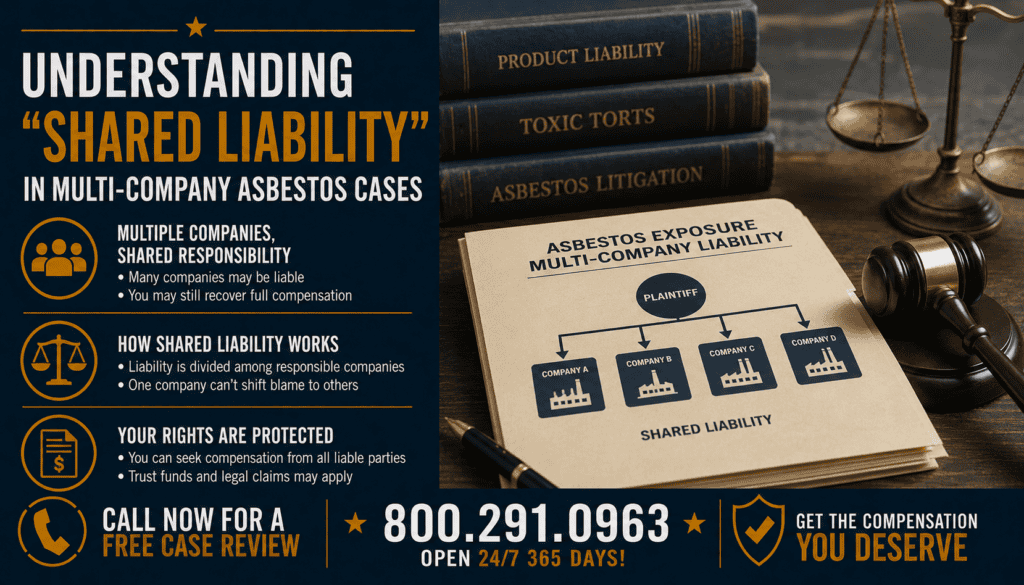
⚖️ Understanding “Shared Liability” in Multi-Company Asbestos Cases
Find out how courts divide responsibility among multiple companies that contributed to asbestos contamination.
Asbestos exposure rarely comes from a single source. Most workers, homeowners, and military personnel encountered asbestos from multiple products, job sites, or manufacturers over the course of their career. Because asbestos was used in thousands of industrial materials—insulation, gaskets, brakes, building products, boilers, turbines, joint compounds, cement, and more—victims often develop mesothelioma after decades of exposure involving several companies.
Courts recognize this complexity and use the legal doctrine of shared liability (also called “apportionment of fault”) to divide responsibility among all companies that contributed to asbestos exposure. This ensures victims can pursue full compensation even when multiple manufacturers were involved—or when some companies have since gone bankrupt.
This article explains how shared liability works, how courts divide responsibility, and how attorneys build multi-defendant asbestos cases that maximize compensation for victims and families.
For help now, call 800.291.0963.
🏭 Why Asbestos Cases Often Involve Multiple Companies
Most asbestos victims were exposed through many different sources over time.
Common scenarios include:
-
A shipyard worker exposed to pipe insulation from one company and gaskets from another
-
A mechanic exposed to brake parts from several manufacturers
-
A factory worker exposed to multiple brands of asbestos insulation
-
A construction worker exposed to drywall mud, joint compound, and cement pipes from different suppliers
-
A power-plant employee exposed to asbestos boilers, turbines, and wiring insulation made by different companies
Because each product type released harmful fibers, courts treat every contributing manufacturer as potentially liable.
📚 How Courts Determine “Shared Liability”
Shared liability spreads responsibility across all companies that contributed to a victim’s exposure. Each defendant is held responsible for the percentage of harm they caused.
Factors courts consider:
1️⃣ Frequency of exposure
How often the victim worked with or around the asbestos-containing product.
2️⃣ Duration of exposure
How many years (or decades) exposure occurred.
3️⃣ Intensity of exposure
Whether the exposure environment was light, moderate, or heavy based on job tasks.
4️⃣ Proximity to the product
Direct handling typically carries more liability than distant exposure.
5️⃣ Product toxicity
Some asbestos-containing materials release far more fibers than others.
6️⃣ Corporate negligence
If a company knew its product was dangerous but did nothing to warn workers, its liability may increase.
Courts analyze all these factors to assign percentages of responsibility to each defendant.
📊 Example of Shared Liability in a Realistic Case Scenario
Consider a shipyard worker diagnosed with mesothelioma after 30 years in engine rooms. He may have been exposed to:
-
Pipe insulation from Manufacturer A
-
Boiler insulation from Manufacturer B
-
Gaskets from Manufacturer C
-
Turbines from Manufacturer D
In this type of case, a jury might assign liability like this:
-
Manufacturer A – 40%
-
Manufacturer B – 25%
-
Manufacturer C – 20%
-
Manufacturer D – 15%
The court ensures each pays its share based on contribution to harm.
🧰 How Attorneys Build Multi-Company Asbestos Cases
Asbestos cases are complex because settlements often involve 5, 10, or even 40 different companies. Experienced attorneys use a streamlined investigative process to identify all responsible parties.
Key steps include:
1. Work-history reconstruction
Attorneys document every job, job site, and position held by the victim.
2. Product identification
Investigators match the victim’s exposure to specific brands of insulation, gaskets, brakes, pumps, boilers, and other products.
3. Document retrieval
Law firms collect:
-
Maintenance logs
-
Blueprint diagrams
-
Equipment lists
-
Procurement contracts
-
Work orders
-
Safety manuals
4. Witness interviews
Co-workers help confirm which products were used and how they were handled.
5. Industrial hygiene analysis
Experts determine how much asbestos each product released.
6. Medical evidence
Pathology reports and imaging confirm the asbestos-related diagnosis.
Together, this evidence supports claims against every responsible company.
🏢 Why Multiple Defendants Strengthen a Case
In asbestos litigation, more defendants often means more compensation.
Benefits include:
-
Claimants can recover from many companies, not just one
-
Cases remain strong even if one defendant rejects liability
-
If a company is bankrupt, trust funds still pay compensation
-
Courts can divide fault even when exposure is decades old
-
Lawsuits often settle faster when multiple defendants want to avoid trial
Victims are not required to prove which company caused the exact fiber that triggered the disease — only that each defendant contributed meaningfully to exposure overall.
💼 How Shared Liability Works With Asbestos Trust Funds
When asbestos manufacturers filed bankruptcy, they created trust funds to compensate victims without going to court.
In multi-company cases:
-
Some responsible companies may be active defendants
-
Others may be bankrupt and handled through trusts
-
Victims often file multiple trust claims
-
Trusts typically assign percentage payouts based on each company’s exposure contribution
This creates a compensation structure similar to shared liability in court.
⚖️ Joint and Several Liability: When One Company Pays More
In some states, courts apply joint and several liability — meaning:
If one company refuses to settle or cannot pay, another defendant may be required to cover the full amount of damages and later collect reimbursement from others.
This protects victims by ensuring they receive full compensation, even if:
-
A company goes out of business
-
A defendant refuses to pay
-
A trust fund runs out of money
Attorneys identify which states allow this rule to maximize recovery.
🧾 What Happens When Companies Deny Responsibility?
Some companies argue:
-
Their product contained “only small amounts” of asbestos
-
Their materials were used infrequently
-
They were not the primary exposure source
-
Other manufacturers are more responsible
Courts typically reject these defenses because:
-
Even small exposures contribute to mesothelioma
-
Asbestos exposure is cumulative
-
Corporate negligence is often well-documented
-
Multiple companies knowingly sold dangerous products
Shared liability ensures no company escapes accountability.
📅 Statute of Limitations in Multi-Company Cases
Most states require asbestos claims to be filed:
-
Within 1–3 years of diagnosis, or
-
Within 1–3 years of death (for wrongful-death cases)
Because multi-company cases require extensive investigation, filing early is crucial to preserving evidence and access to all defendants.
📝 How Victims Can Strengthen Their Multi-Defendant Case
Victims can take several steps to help attorneys establish shared liability:
-
List all jobs and job sites
-
Identify equipment and materials used
-
Gather employment or union records
-
Contact former co-workers
-
Provide medical documentation
-
Record approximate dates of exposure
The more detailed the timeline, the easier it is to identify additional responsible companies.
💰 What Compensation Victims Can Receive
Shared liability does not reduce compensation — it increases it. By pursuing multiple companies, victims can recover:
-
Medical bills (past and future)
-
Pain and suffering
-
Lost wages
-
Reduced earning capacity
-
Travel for treatment
-
In-home nursing support
-
Wrongful-death damages
-
Punitive damages in cases of extreme negligence
Many victims receive multiple settlements, significantly raising total compensation.
📞 Get Help Understanding Shared Liability in Your Asbestos Case
Shared liability allows courts to hold every responsible company accountable for asbestos exposure — not just one. If you or a loved one has mesothelioma or another asbestos-related illness, you may qualify for compensation from multiple defendants and trust funds.
Our legal team specializes in:
-
Identifying all responsible companies
-
Filing multi-defendant asbestos lawsuits
-
Submitting trust fund claims
-
Maximizing total recovery for victims and families
Call 800.291.0963 today to speak with an asbestos-claim specialist.