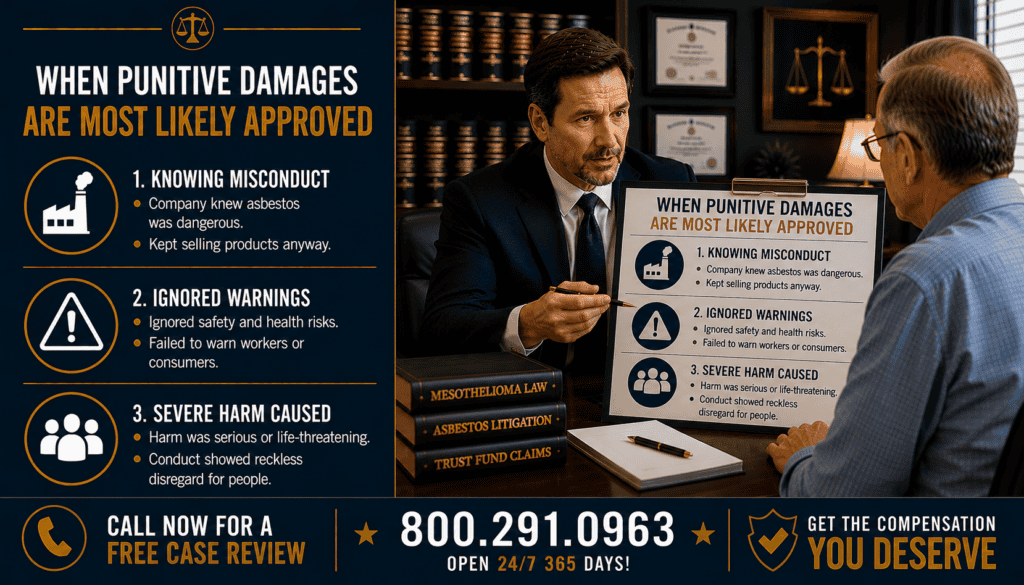
When Punitive Damages Are Most Likely Approved
Punitive damages are not automatically available because a person developed mesothelioma or because asbestos exposure is proved. They generally require evidence of conduct more culpable than the conduct needed for ordinary compensatory liability. Depending on the governing law, the required showing may involve malice, oppression, fraud, reckless disregard, gross negligence or a comparable heightened standard tied to a particular defendant’s actions.
Whether punitive damages are allowed is therefore a legal and evidence-specific question rather than a predictable stage of every asbestos lawsuit. Courts and juries may examine what a defendant knew, how it responded to known risks, whether the conduct was repeated, who within a corporation authorized or ratified it, and whether the applicable burden of proof is satisfied. State law can also restrict availability or impose caps.
⚖️ When Can Punitive Damages Be Awarded?
The Ninth Circuit’s current model punitive-damages instruction explains the basic distinction: punitive damages punish and deter rather than compensate. The instruction permits an award only when the governing substantive standard is met and emphasizes that punitive damages remain discretionary rather than mandatory.
For state-law claims, the exact standard comes from state law. California Civil Code § 3294, for example, permits exemplary damages in qualifying non-contract actions when clear and convincing evidence establishes oppression, fraud or malice. Other states use different terminology, burdens, caps and procedural rules.
See Mesothelioma Damages.
🚨 Evidence of Particularly Culpable Conduct
Punitive damages become legally relevant when the evidence supports a heightened level of wrongdoing under the law governing the claim. The Ninth Circuit model instruction describes conduct that may qualify under particular legal standards as malicious, oppressive or in reckless disregard of a plaintiff’s rights.
That is materially different from proving only that a product contained asbestos, an exposure occurred or a defendant was negligent. The claimant must connect the required culpable conduct to the specific defendant against whom punitive damages are sought.
| Issue | Why it matters |
|---|---|
| Knowledge | What did the defendant know about the relevant risk and when? |
| Response | What actions were taken after the risk was known? |
| Repetition | Was the challenged conduct isolated or repeated? |
| Management involvement | Did the people required by applicable corporate-liability law authorize or ratify the conduct? |
| Proof quality | Does admissible evidence satisfy the required burden? |
📚 Knowledge of a Serious Safety Risk
Evidence that a defendant knew of a serious health or safety risk and nevertheless acted with the level of disregard required by governing law can be important. The U.S. Supreme Court’s punitive-damages jurisprudence treats indifference to or reckless disregard for the health or safety of others as one factor in evaluating reprehensibility.
In an asbestos case, potentially relevant evidence may include internal records, safety communications, testing, warnings, product documents, testimony and other admissible materials concerning the defendant’s knowledge and response. Historical industry knowledge alone does not automatically establish the state of mind of every defendant.
🔁 Repeated Conduct and Reprehensibility
The Supreme Court has identified repeated misconduct versus an isolated incident as another reprehensibility consideration. Repeated conduct can matter when it is properly connected to the conduct that harmed the plaintiff and is admissible under the governing rules.
Courts also distinguish evidence used to evaluate reprehensibility from punishment for injuries to people who are not parties to the case. A punitive award cannot constitutionally be imposed simply to punish a defendant for harm to nonparties.
🏢 Corporate Authorization and Management Conduct
Corporate punitive liability can require more than proof that an employee committed a wrongful act. California Civil Code § 3294, for example, restricts employer punitive liability and, for a corporate employer, requires advance knowledge and conscious disregard, authorization, ratification or an act of oppression, fraud or malice by an officer, director or managing agent under the circumstances specified by the statute.
This makes corporate hierarchy and decision-making evidence potentially important. Documents identifying who made, approved or ratified relevant safety, warning or product decisions may affect whether the statutory standard can be met.
📑 Proof Standards and Defendant-Specific Evidence
The applicable burden of proof can be decisive. California uses a clear-and-convincing-evidence standard under § 3294. The Ninth Circuit model instruction notes that the required burden varies with the underlying claim and that state-law punitive claims must follow the applicable state substantive standard.
Evidence should therefore be organized defendant by defendant. Documents proving exposure may not prove punitive misconduct, and evidence of compensatory loss does not by itself establish the heightened mental state required for punitive damages.
💵 Financial-Condition Evidence
A defendant’s financial condition can become relevant to the amount of punitive damages in some jurisdictions, but access to that evidence may be restricted. California Civil Code § 3295 generally bars specified pretrial financial-condition discovery unless a court authorizes it after the required showing.
Under that California procedure, a court may permit otherwise restricted discovery if the plaintiff establishes a substantial probability of prevailing on the punitive claim. The statute also controls when financial-condition evidence may be presented at trial. These rules illustrate why procedural approval and ultimate entitlement are separate questions.
🏛️ Constitutional and Statutory Limits
Even when a jury awards punitive damages, the amount remains subject to legal review. In State Farm Mutual Automobile Insurance Co. v. Campbell, the Supreme Court identified reprehensibility, the relationship between punitive and compensatory damages, and comparable civil penalties as due-process guideposts.
The Court stated that no rigid mathematical benchmark governs every case, while observing that single-digit multipliers are more likely to satisfy due process than extremely high ratios. States can also impose their own statutory caps or formulas.
See Mesothelioma Punitive Damages by State: Laws and Limits.
🧭 What Usually Is Not Enough by Itself
Several facts can be important to a mesothelioma case without independently establishing punitive liability. A diagnosis proves a medical condition, not a defendant’s malicious or oppressive state of mind. Evidence that a defendant’s product contained asbestos may help establish exposure, but punitive damages require the additional showing specified by applicable law.
| Evidence | What it may establish | What it does not automatically establish |
|---|---|---|
| Mesothelioma diagnosis | Medical diagnosis and treatment | Punitive misconduct by a defendant |
| Asbestos-containing product evidence | Potential source of exposure | Required malicious, oppressive or reckless state of mind |
| Work history | Potential exposure locations and periods | Corporate authorization or ratification |
| Internal corporate records | Potential knowledge and decision-making | Punitive entitlement unless the legal standard is satisfied |
| Compensatory damages | Supported injury-related losses | Automatic right to punitive damages |
For settlement implications, see Why Punitive Damages Change Settlement Strategy.
❓ Frequently Asked Questions
When are punitive damages most likely to be legally available?
They are more likely to be legally available when admissible defendant-specific evidence satisfies the heightened misconduct and proof standards required by the governing law. Availability never guarantees an award.
Does knowingly exposing someone to asbestos automatically prove punitive damages?
No. The evidence must satisfy the precise legal standard for the claim and jurisdiction, including any required state of mind and corporate-liability rules.
Is negligence enough for punitive damages?
Often not. Punitive damages generally require a heightened form of misconduct beyond ordinary negligence, although the exact standard varies by law.
Does California require clear and convincing evidence?
Yes. California Civil Code § 3294 uses a clear-and-convincing-evidence standard for oppression, fraud or malice under that statute.
Can repeated conduct matter?
Yes. The Supreme Court identifies repeated versus isolated misconduct as a reprehensibility factor, subject to limits on punishing a defendant for harm to nonparties.
Can corporate documents help prove punitive damages?
Potentially. They may show knowledge, decisions, authorization or ratification, but their significance depends on admissibility and the governing legal standard.
Can punitive damages be reduced after trial?
Yes. Punitive awards can be reviewed under statutory and constitutional standards and may be reduced or otherwise changed.
Does approval of punitive-damages discovery mean punitive damages will be awarded?
No. Procedural permission to obtain or present evidence is different from proving entitlement to punitive damages at trial.
📞 Submit Your Case
If you or a loved one has a mesothelioma diagnosis, preserve exposure records and any evidence that may identify what specific companies knew, when they knew it and how relevant decisions were made. Punitive-damages analysis is defendant-specific and requires more than proof of diagnosis or asbestos exposure.
Call 800.291.0963 for a no-obligation case evaluation. Live chat is available 24/7, 365 days a year. Submit your case here.
📝 Summary
Punitive damages are most likely to become legally viable when defendant-specific evidence satisfies the heightened misconduct standard imposed by the governing law. Relevant evidence may concern knowledge of serious safety risks, reckless disregard, repeated conduct, corporate authorization or ratification and other facts showing more than ordinary negligence. Even then, punitive damages remain discretionary and subject to proof requirements, state-law restrictions and constitutional review.
🔗 Confirmed Sources
- U.S. Court of Appeals for the Ninth Circuit — Model Jury Instruction 5.5, Punitive Damages
- California Legislature — Civil Code § 3294
- California Legislature — Civil Code § 3295
- U.S. Supreme Court — State Farm Mutual Automobile Insurance Co. v. Campbell, 538 U.S. 408 (2003)
This page provides general information, not legal advice. This website is not a law firm. Punitive-damages availability, proof standards, discovery, corporate liability, statutory limits, settlement value and compensation depend on individual facts, defendants, evidence, jurisdiction and applicable law. No punitive award, settlement, verdict or outcome is guaranteed.