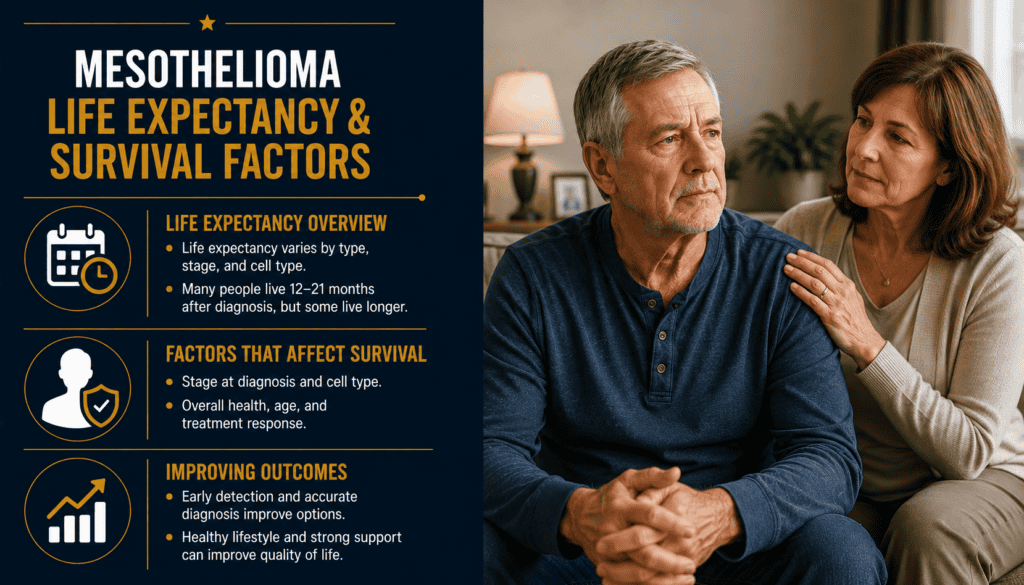
Mesothelioma Life Expectancy & Survival Factors
⏳ Understanding Prognosis, What Affects Survival & How Patients Extend Life
A mesothelioma diagnosis raises one of the most difficult questions:
“How long do I have?”
While no two patients are the same, doctors can estimate life expectancy based on the type of mesothelioma, stage, cell structure, treatment plan, and overall health. This guide explains average survival times, what affects prognosis, and how some patients live much longer than expected.
Our goal is to give patients and families clarity, confidence, and a path forward.
📘 What “Life Expectancy” Means
Life expectancy refers to the average amount of time patients live after diagnosis, based on thousands of reported cases. It is not a fixed rule, and many patients live far longer than expected due to modern treatments — especially immunotherapy.
Because mesothelioma is highly variable, prognosis is influenced by several critical factors discussed below.
⏳ Average Life Expectancy for Mesothelioma
Life expectancy varies by type of mesothelioma and available treatments.
🫁 Pleural Mesothelioma (Lungs)
-
Average: 12–21 months
-
With surgery + treatment: Often 2–4 years
-
Long-term survivors: Some exceed 5–10 years
🩻 Peritoneal Mesothelioma (Abdomen)
-
Average: 24–36 months
-
With CRS + HIPEC surgery: 5–10 years (in many cases)
-
Best overall survival outcomes
❤️ Pericardial Mesothelioma (Heart)
-
Average: 6–12 months
-
Rare but aggressive
⚪ Testicular Mesothelioma
-
Average: 24–48 months
-
Surgery often provides longer survival
-
Recurrence is common but treatable
These are averages — NOT predictions. Many factors can dramatically improve survival.
🧬 Key Survival Factor #1 — Cell Type
Cell structure plays a major role in how fast mesothelioma spreads and how well it responds to treatment.
🔵 Epithelioid (Best Outlook)
-
Slowest-growing
-
Most common (about 70%)
-
Responds well to chemotherapy & immunotherapy
-
Highest survival rates
Patients with epithelioid mesothelioma often experience significantly longer life expectancy.
🟠 Sarcomatoid (More Aggressive)
-
Fast-spreading
-
More resistant to treatment
-
Lower survival (typically shortest prognosis)
Immunotherapy has improved outcomes for some sarcomatoid patients.
🟣 Biphasic (Mixed)
-
Combination of epithelioid and sarcomatoid
-
Prognosis depends on which cell type dominates
Biopsy and pathology reports show the ratio of each cell type.
📊 Key Survival Factor #2 — Stage at Diagnosis
Early detection dramatically improves life expectancy.
Below is how stage affects prognosis.
🟦 Stage 1
-
Tumors localized
-
Surgery is often possible
-
Best survival outcomes
Many Stage 1 patients live several years with combined treatments.
🟧 Stage 2
-
Tumors growing but still limited
-
Many still qualify for surgery
-
Good candidates for multimodal therapy
Survival is still significantly longer than in later stages.
🟥 Stage 3
-
Spread to lymph nodes or nearby organs
-
Surgery possible for select patients
-
Good candidates for immunotherapy
Many Stage 3 patients live longer than expected with aggressive treatment.
⬛ Stage 4
-
Extensive spread or metastasis
-
Surgery usually not recommended
-
Focus on immunotherapy, chemo & comfort care
Some Stage 4 patients respond exceptionally well to immunotherapy and far exceed averages.
💉 Key Survival Factor #3 — Treatment Options
Treatment choice directly affects life expectancy. Patients receiving aggressive or modern treatments often live 2–4 times longer than those who do not.
🟦 Surgical Options
🔧 Pleural Mesothelioma
-
P/D (Pleurectomy/Decortication)
-
EPP (Extrapleural Pneumonectomy)
These surgeries significantly increase survival in early-stage cases.
🔧 Peritoneal Mesothelioma
CRS + HIPEC (Cytoreductive surgery + heated chemotherapy)
-
Often extends life by 5–10+ years
-
Best long-term survival of any mesothelioma treatment
🟧 Chemotherapy
Most common: Pemetrexed + Cisplatin
-
Improves symptoms
-
Slows tumor growth
-
Extends survival
Chemotherapy is used at almost every stage.
🟩 Immunotherapy
Checkpoint inhibitors:
-
Opdivo (nivolumab)
-
Yervoy (ipilimumab)
-
Keytruda (pembrolizumab)
These treatments have changed survival outcomes, especially for:
-
Sarcomatoid cell type
-
Stage 3 and Stage 4 patients
-
Those unable to undergo surgery
Immunotherapy can extend survival for years in responders.
🟨 Radiation Therapy
Used to:
-
Reduce pain
-
Shrink localized tumors
-
Treat areas where cancer spreads
Often combined with surgery or immunotherapy.
🟪 Palliative Treatments
These treatments improve comfort and quality of life:
-
Thoracentesis (draining lung fluid)
-
Paracentesis (draining abdominal fluid)
-
Pain management
-
Oxygen therapy
-
Appetite support
These can greatly improve daily functioning even in advanced stages.
🏥 Key Survival Factor #4 — Treatment at a Specialty Center
Patients treated by mesothelioma specialists live significantly longer because specialists offer:
-
More accurate diagnosis
-
Better staging
-
Advanced surgeries
-
Access to clinical trials
-
HIPEC programs
-
Latest immunotherapy
General oncologists rarely treat mesothelioma, so second opinions are strongly recommended.
💪 Key Survival Factor #5 — Patient Health & Age
Younger, stronger patients often tolerate aggressive treatments better.
Positive survival indicators:
-
Younger than 75
-
Good heart/lung function
-
Non-smoker
-
Active lifestyle
-
Fewer medical conditions
However, many older patients still benefit from immunotherapy and palliative surgery.
📈 Key Survival Factor #6 — Early Symptom Recognition
Delays in diagnosis reduce treatment options.
People often mistake symptoms for:
-
Pneumonia
-
Aging
-
Digestive issues
-
Stress
-
Back strain
Early testing leads to better outcomes.
🧘 Key Survival Factor #7 — Nutrition & Wellness
A strong body withstands treatment better.
Important components:
-
High-protein meals
-
High-calorie foods
-
Hydration
-
Vitamins & minerals
-
Physical activity (as tolerated)
-
Stress reduction
-
Emotional support
Nutrition is directly linked to survival time.
📉 Factors That Reduce Life Expectancy
-
Sarcomatoid cell type
-
Stage 4 disease
-
Extensive organ invasion
-
No treatment
-
Severe weight loss
-
Heart or kidney failure
-
Smoking
-
Chronic health conditions
However, even patients with poor indicators may live longer with modern therapy.
🌟 Stories of Long-Term Survivors
Some patients have lived 10–20 years after diagnosis, especially those who:
-
Received CRS + HIPEC
-
Had epithelioid cell type
-
Responded well to immunotherapy
-
Were diagnosed early
-
Stayed physically active
-
Reassessed treatment options frequently
Long-term survivors exist in every age group.
⚖️ Legal Impact of Life Expectancy
Prognosis affects legal cases in several ways:
💰 Compensation Amount
Late-stage patients typically qualify for:
-
Higher settlements
-
Larger trust fund payouts
-
More substantial damages
🕒 Case Speed
Late-stage cases may be expedited for faster approvals.
📑 Proof of Harm
Prognosis validates:
-
Pain and suffering
-
Loss of income
-
Future care needs
-
Caregiver expenses
Attorneys use medical reports to build the strongest case possible.
📞 🚨 Urgent: Get Legal Help for Mesothelioma or Asbestos Lung Cancer
If you or a loved one is losing sleep, struggling to breathe, or suffering because of mesothelioma or asbestos-related lung cancer, do not wait.
You may qualify for significant financial compensation — but deadlines apply.
⚖️ What Our Legal Team Can Do Right Now
- 🏭 Pinpoint where asbestos exposure occurred
- 🧾 File asbestos trust fund claims worth millions
- 💼 Pursue lawsuits against responsible companies
- 🚀 Fast-track your case due to severe symptoms
- 💰 Recover compensation for treatment, bills & pain
⏳ Time matters. Your rights may depend on acting quickly.
📞 Call Now for Immediate Legal Help: 800.291.0963
Your case review is free, confidential, and available 24/7.
🛑 Disclaimer:
This 50-page guide provides general information only. It should not be used as medical or legal advice. If you suspect mesothelioma or have related symptoms, seek medical evaluation right away. For legal concerns, including asbestos exposure and compensation, consult a licensed attorney.