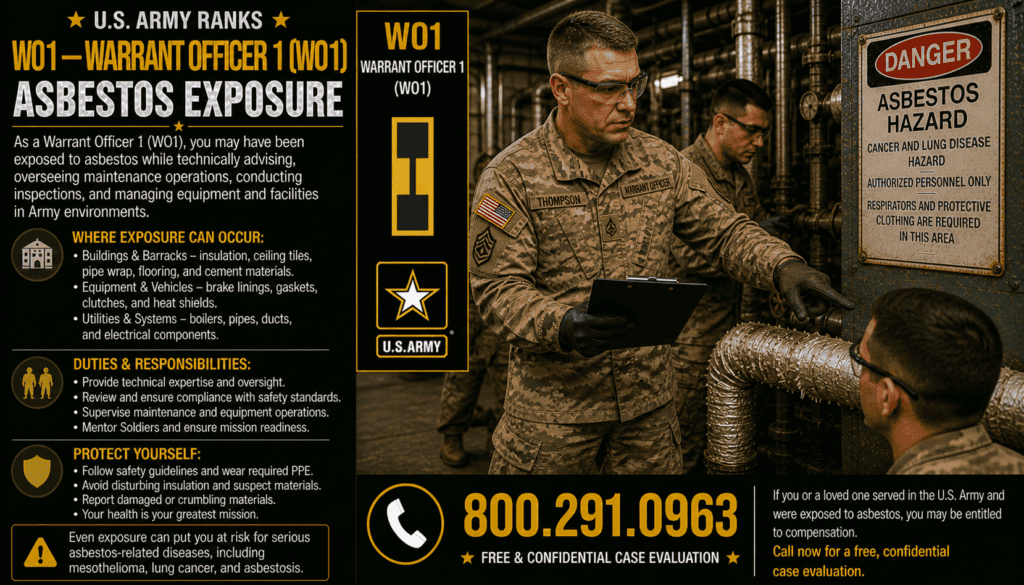
WO1 Army Warrant Officer 1 Asbestos Exposure
WO1 Army Warrant Officers are technically and tactically focused officers whose assignments may involve operating, maintaining, troubleshooting, managing, integrating, and advising on Army systems and equipment. Those technical duties can make equipment, component, maintenance, and prior-service records especially important when investigating historical asbestos exposure.
This guide explains how to investigate possible asbestos exposure during WO1 service, including technical specialties, earlier enlisted duties when applicable, vehicles, maintenance, mechanical and electrical systems, facilities, technical manuals, military records, VA disability evidence, and Army-specific internal resources for documenting a mesothelioma claim.
WO1 Army Warrant Officer Duties and Possible Asbestos Exposure
A WO1 Army Warrant Officer 1 is a technically and tactically focused officer. The Army describes WO1s as technical leaders, trainers, operators, managers, maintainers, sustainers, and advisers. Because warrant officer specialties can involve highly technical systems and equipment, exposure reconstruction should focus on the veteran’s specific warrant officer military occupational specialty, earlier enlisted background when applicable, unit, installation, equipment, facilities, and actual duties.
Rank alone does not establish asbestos exposure. During periods when asbestos-containing materials were widely used in military buildings, vehicles, mechanical systems, and industrial equipment, a WO1 could have worked around older motor pools, maintenance shops, barracks, warehouses, boilers, generators, pipes, insulation, flooring, roofing, cement products, brakes, clutches, gaskets, valves, packing, and other heat-resistant materials. Whether a particular product or component contained asbestos must be established with reliable evidence.
This page is part of the U.S. Army ranks asbestos exposure series and connects WO1 service history with the broader U.S. Army asbestos exposure record.
WO1 Technical Leadership and Exposure Reconstruction
The Army characterizes warrant officers as adaptive technical experts, combat leaders, trainers, and advisers who administer, manage, maintain, operate, and integrate systems and equipment. At WO1, duties are technically and tactically focused and can vary substantially by specialty.
That technical focus can make equipment-level research especially important. A WO1 may personally operate or maintain systems, troubleshoot components, supervise technical work, train soldiers, inspect repairs, or advise commanders and units on equipment readiness.
None of those responsibilities proves asbestos exposure. The history should identify the exact system, component, material, work process, location, frequency, duration, and whether suspected asbestos-containing material was actually disturbed.
Earlier Enlisted Service and WO1 Exposure History
Some Army warrant officers enter the warrant officer cohort after enlisted technical service. When that applies, earlier enlisted duties may be important because they can include years of direct maintenance, repair, construction, logistics, vehicle, utility, or equipment work before appointment as a WO1.
Do not assume that every WO1 had the same prior career path. Use personnel records, MOS history, training records, evaluations, orders, and assignment documents to establish the veteran’s actual progression.
The Army asbestos exposure timeline can provide historical context while individual records establish where the veteran served and when potentially relevant occupational duties occurred.
Army Locations That May Require Asbestos Research
Potential historical settings include Army barracks, training facilities, motor pools, maintenance buildings, warehouses, utility spaces, power plants, construction sites, equipment areas, and other older installation infrastructure.
VA identifies construction, carpentry, demolition, insulation work, flooring, roofing, cement sheet, pipe products, clutch facings, and brake linings among jobs or products associated with possible military asbestos exposure.
Assignment to an older installation does not by itself prove personal exposure. A stronger history identifies the suspected material or component, how it was disturbed, the WO1’s proximity, ventilation, frequency, and duration.
Maintenance, Troubleshooting, and Technical Systems
Many warrant officer specialties involve systems expertise, troubleshooting, maintenance management, equipment readiness, or technical supervision. Depending on specialty, a WO1 may work directly with vehicles, mechanical systems, electrical systems, utilities, communications equipment, aviation support systems, logistics systems, or other Army equipment.
Potential asbestos exposure is most relevant when confirmed asbestos-containing material was removed, cut, drilled, abraded, damaged, replaced, or cleaned up after disturbance. Technical troubleshooting can place personnel near internal components or repair work, but each circumstance requires evidence.
Veterans whose duties involved repair environments can review Army maintenance workers, Army mechanics, and Army maintenance buildings for additional context.
Motor Pools, Vehicles, Brakes, and Clutches
WO1s in maintenance, transportation, ordnance, logistics, or related technical specialties may have worked in or regularly visited Army motor pools. VA identifies servicing friction products such as clutch facings and brake linings among activities associated with possible asbestos exposure.
A WO1 could troubleshoot vehicles, inspect maintenance, supervise repairs, train personnel, evaluate readiness, or have earlier enlisted experience performing hands-on vehicle work. Historical Army trucks and Jeeps and other Army vehicle equipment may require component-specific research.
Do not assume every brake, clutch, gasket, or vehicle component contained asbestos. Technical manuals, part numbers, manufacturer information, procurement records, and replacement history can help identify the actual component and era.
Boilers, Generators, Electrical Systems, and HVAC
Army installations and field operations depended on boilers, generators, electrical equipment, HVAC systems, pumps, valves, and other mechanical systems. Historical versions of some equipment may have incorporated insulation, gaskets, packing, electrical components, or other heat-resistant asbestos-containing materials.
A WO1 with a relevant technical specialty might operate, maintain, inspect, troubleshoot, or supervise work on these systems. Veterans can investigate Army boiler equipment, Army generator equipment, Army electrical equipment, and Army HVAC equipment when those systems correspond with the service record.
Research equipment at the component level. Evidence concerning one gasket, packing material, brake, or insulation layer should not be generalized to an entire machine or system.
Engineering, Construction, and Facility Systems
WO1s in engineer or facility-related technical specialties may have supported construction, utilities, infrastructure, equipment, repair, renovation, or demolition activities. VA identifies construction, carpentry, demolition, insulation work, flooring, roofing, cement sheet, and pipe products among circumstances associated with possible military asbestos exposure.
Older construction products may have included asbestos-containing insulation, cement sheet, flooring, roofing, pipe covering, gaskets, and related materials. Actual composition depends on product, manufacturer, specification, and date.
The Army engineers and Army construction units pages provide additional context when the veteran’s technical specialty involved infrastructure, renovation, demolition, or building work.
Technical Training, Inspections, and Work-Site Presence
Army WO1s can train personnel and provide technical guidance in their specialty. That role may involve demonstrations, troubleshooting, inspections, maintenance reviews, and repeated entry into shops or equipment areas.
Training or inspection responsibilities do not establish exposure by themselves. Exposure research should identify whether potentially asbestos-containing material was disturbed during the activity, whether dust was present, how close the WO1 was, how long the veteran remained, and whether similar events occurred repeatedly.
Older Army training facilities may also warrant investigation when renovation, utility work, mechanical repair, demolition, or damaged legacy materials were present.
Barracks and Older Installation Buildings
WO1s could live and work in older installation buildings during training and operational assignments. Historical research may examine pipe and mechanical insulation, floor tile and mastics, roofing, cement products, boiler materials, and other legacy building components.
VA Public Health states that asbestos-containing material can create a serious health risk when disturbed in a way that releases fibers into the air. Routine occupancy is different from participating in renovation, repair, demolition, maintenance, or cleanup involving disturbed material.
For Army barracks asbestos exposure, document the installation, building number when available, dates, renovations, maintenance activity, damaged materials, and the WO1’s actual proximity to the work.
Logistics, Warehouses, and Technical Parts
WO1s in logistics, maintenance, ordnance, and supply-related specialties may have worked with technical parts, vehicle components, gaskets, mechanical supplies, construction materials, insulation products, and other stock in Army warehouses.
Handling intact packaged material is different from cutting, removing, grinding, or cleaning dust from damaged asbestos-containing material. Product condition, handling method, and proximity to disturbed material matter.
Stock numbers, procurement records, technical manuals, packaging information, photographs, and coworker statements may help identify historical materials. The Army supply personnel asbestos exposure page provides additional occupational context.
Power Plants and Utility Systems
Some WO1 specialties may involve power generation, utilities, engineering, or equipment supporting mechanical infrastructure. Older Army power plants may require investigation of boilers, generators, steam lines, pumps, valves, electrical systems, and insulated piping.
Heat-resistant materials were historically used in high-temperature systems, but each component must be evaluated individually. Engineering specifications, maintenance records, technical manuals, construction documents, and environmental surveys can help identify suspect materials.
Document whether the WO1 personally performed maintenance, troubleshot equipment, supervised nearby, inspected work during repairs, entered mechanical areas repeatedly, or participated in cleanup.
Technical Manuals and Component-Level Evidence
WO1 exposure research can benefit from technical records because warrant officer duties often center on specific systems. Manuals, parts catalogs, maintenance instructions, modification work orders, equipment serial numbers, procurement records, engineering drawings, and manufacturer documents may help identify historical components.
A technical manual showing that a component could use a particular material is not always proof that the specific component encountered by the veteran contained asbestos. Match the document to the equipment model, configuration, time period, and maintenance event whenever possible.
Witness statements from personnel who worked with the WO1 can add context about recurring repairs, dusty conditions, damaged insulation, brake work, gasket replacement, or other tasks, but statements should distinguish personal recollection from later assumptions.
Building a Strong WO1 Exposure History
A detailed exposure statement identifies the installation, unit, warrant officer specialty, dates, building or work area, equipment, component, material, task, frequency, duration, ventilation, and witnesses. It should distinguish hands-on technical work from supervision, training, inspection, troubleshooting, and advisory responsibilities.
Supporting evidence may include personnel records, appointment and training documents, assignment orders, evaluation reports, unit histories, duty records, maintenance documents, work orders, technical manuals, procurement records, environmental reports, photographs, and credible eyewitness statements.
VA states that military occupational specialty and duty location may help establish in-service asbestos exposure. Those facts become more useful when tied to specific duties, materials, components, and documented work practices.
WO1 Army Warrant Officer Exposure-Evidence Checklist
| Question | Details to Document | Potential Evidence |
|---|---|---|
| What was the WO1 specialty? | Warrant officer MOS, technical field, training and assigned systems | Personnel, appointment, training and evaluation records |
| Was there prior enlisted service? | Earlier MOS, ranks, hands-on duties and assignments | DD-214, personnel file, evaluations and orders |
| What equipment was involved? | Model, component, repair task, maintenance event and work location | Technical manuals, parts records, maintenance documents |
| What material or component was involved? | Insulation, pipe covering, gasket, brake, clutch, packing or building material | Specifications, procurement and manufacturer records |
| How often did contact occur? | Single event, periodic maintenance or recurring technical duty | Chronology, unit history, maintenance records |
| What medical evidence exists? | Diagnosis, pathology and documented exposure history | Pathology, oncology and treatment records |
The objective is to connect documented Army service with specific exposure circumstances and medically supported asbestos-related disease rather than relying on WO1 rank alone.
Military Records for Reconstructing WO1 Service
Useful records can include the DD-214, Official Military Personnel File, warrant officer appointment records, MOS and technical training records, assignment history, orders, evaluations, unit documents, maintenance records, work orders, equipment manuals, building records, photographs, and witness statements.
If the WO1 previously served as an enlisted soldier, earlier MOS and assignment records can be especially important because they may identify periods of intensive hands-on technical work. Later warrant officer records can show how the veteran’s responsibilities changed.
The U.S. Army ranks asbestos exposure page provides broader rank context, while the E-9 Army Sergeant Major and Command Sergeant Major asbestos exposure page addresses the senior enlisted rank path separately.
Mesothelioma and Long-Latency Asbestos Disease
VA Public Health states that symptoms of asbestos-related diseases often do not appear until 20 to 50 years after exposure. This long latency can make historical military and occupational records especially important when a veteran receives a diagnosis decades after Army service.
VA identifies mesothelioma and lung cancer among cancers associated with asbestos exposure. Whether a person develops health effects depends on multiple factors, including the amount and duration of exposure.
Veterans concerned about past asbestos contact should discuss their complete military and civilian occupational history with a qualified health care provider. Exposure history does not substitute for medical diagnosis.
VA Disability Compensation for Army WO1 Veterans
VA states that veterans may qualify for disability compensation when they have a health condition caused by asbestos exposure during military service. VA evaluates asbestos claims individually.
VA identifies medical records showing the health condition, service records listing the veteran’s job or specialty, and a doctor’s statement connecting military asbestos contact with the condition as evidence for a claim. Veterans Benefits Administration guidance also states that evidence of military exposure may include military occupational specialty and where the veteran was stationed.
Army veterans can review Army VA benefits for mesothelioma for additional Army-specific information.
Occupational and Environmental Exposure Assessment
VA clinical resources describe military occupational and environmental exposure assessments that can include a clinical records review, a detailed interview concerning military exposure history and risk factors, and education about research on health effects associated with exposures.
For a WO1, a useful exposure history may need to cover warrant officer technical duties, earlier enlisted service when applicable, equipment systems, maintenance tasks, duty stations, deployments, temporary-duty locations, and civilian employment.
A clinical exposure assessment and a disability compensation determination are separate processes. Medical evaluation can help document exposure concerns, but it does not by itself establish service connection or civil liability.
Army Mesothelioma Claims and Other Compensation Options
A VA disability claim is distinct from a private asbestos lawsuit or bankruptcy trust claim. Depending on the complete exposure history, separate processes may evaluate military service, civilian employment, products, manufacturers, contractors, or other potentially responsible entities.
Keep exposure facts consistent across medical histories, VA submissions, trust claims, and civil litigation. Do not identify a manufacturer, employer, building, or product as an exposure source unless evidence supports that statement.
The Army asbestos legal options section contains Army-specific information concerning VA benefits and other potential compensation pathways.
Frequently Asked Questions
Did every WO1 Army Warrant Officer experience asbestos exposure?
No. Rank does not establish exposure. The veteran’s specialty, service era, units, installations, equipment, materials, and actual duties must be evaluated.
What does an Army WO1 do?
The Army describes WO1s as technically and tactically focused officers who serve as technical leaders, trainers, operators, managers, maintainers, sustainers, and advisers.
Why can prior enlisted service matter?
When a WO1 previously served in an enlisted technical specialty, those earlier years may include significant hands-on maintenance or equipment work. The actual personnel record should establish the career path.
Could vehicle brake and clutch work involve asbestos?
Potentially. VA identifies clutch facings and brake linings among friction products associated with possible military asbestos exposure.
Does troubleshooting old Army equipment prove exposure?
No. Evidence should identify the specific component, whether it contained asbestos, how it was disturbed, and the veteran’s proximity, frequency, and duration.
Does serving in an older Army building prove exposure?
No. Building age alone does not establish personal exposure. Records should identify the material and circumstances in which it was damaged or disturbed.
What records can help reconstruct WO1 duties?
Personnel and appointment records, warrant officer specialty and training records, evaluations, orders, maintenance records, technical manuals, parts documents, work orders, photographs, and credible witness statements may help.
Can an Army warrant officer with mesothelioma seek VA disability compensation?
Potentially. VA states that veterans with a health condition caused by asbestos contact during military service may qualify when applicable requirements are met.
Should a veteran disturb suspected asbestos to identify it?
No. Do not disturb suspected asbestos-containing material. Identification and assessment should rely on appropriate records and qualified professionals.
Review Your WO1 Army Service and Exposure History
If you or a family member has been diagnosed with mesothelioma after Army service, gather the DD-214, personnel file, warrant officer appointment and specialty records, prior enlisted records when applicable, technical training documents, assignment records, evaluations, unit history, installation records, vehicle and equipment documents, maintenance records, technical manuals, work orders, witness statements, pathology reports, treatment records, VA correspondence, and civilian employment history. Build the chronology around the systems and components the veteran actually operated, maintained, troubleshot, supervised, inspected, or trained others to use rather than WO1 rank alone.
Call 800.291.0963 for a no-obligation case evaluation. Talk to a real person 24/7, 365 days a year. You can also submit your case here.
Many mesothelioma law firms handle qualifying civil cases on a contingency-fee basis; confirm fees and expenses with the firm you retain. Mesothelioma Help Center is not a law firm and does not provide legal or medical advice.
Summary
WO1 Army Warrant Officer rank does not by itself prove asbestos exposure. A useful history identifies the warrant officer specialty, prior enlisted duties when applicable, units, installations, dates, buildings, vehicles, systems, equipment, components, hands-on technical tasks, maintenance, troubleshooting, training, inspections, and the circumstances in which documented asbestos-containing material may have been disturbed.
Veterans diagnosed with mesothelioma should preserve military and civilian exposure records, technical documentation, medical evidence, and witness information. VA disability compensation and other potential compensation pathways have separate requirements and should be evaluated using accurate and consistent evidence.
🔗 Confirmed Sources
- U.S. Army — Warrant Officer Ranks
- U.S. Department of Veterans Affairs — Veterans Asbestos Exposure
- Veterans Benefits Administration — Asbestos Exposure Compensation
- VA Public Health — Asbestos
- VA WRIISC — Military Occupational and Environmental Exposure Assessments
Disclaimer: General information only—not legal or medical advice. This website is not a law firm. Record availability, asbestos identification, exposure, VA eligibility, liability, and deadlines vary by individual circumstances. Do not disturb suspected asbestos. Past results do not guarantee future outcomes.