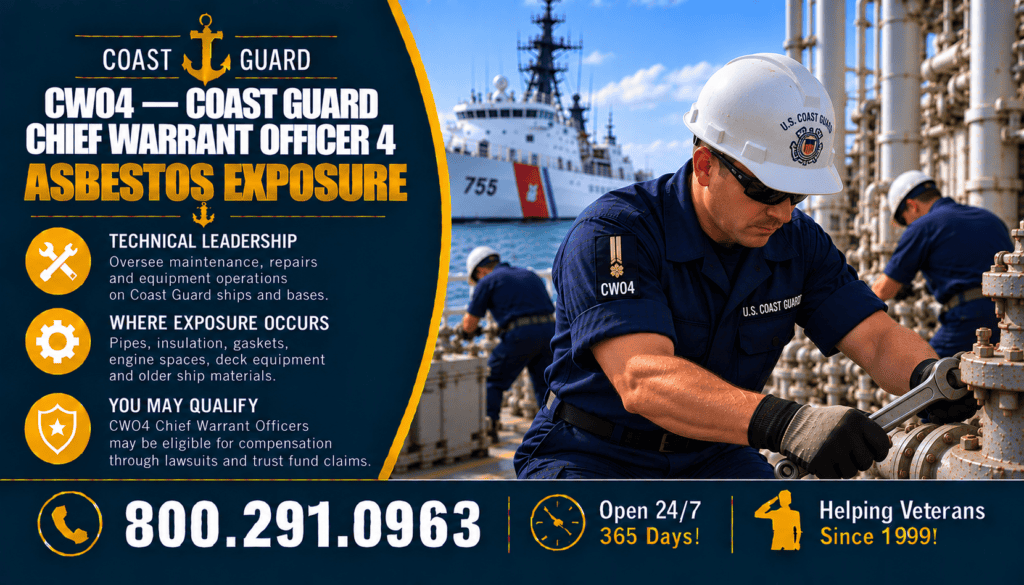
O-4 – Coast Guard Lieutenant Commander (LCDR) Asbestos Exposure
⚠️ Asbestos Risks for Coast Guard Lieutenant Commander (LCDR) Veterans
Coast Guard Lieutenant Commanders (LCDRs) serve as senior officers responsible for high-level leadership across engineering, operations, logistics, safety, communications, and shipboard administration. Many LCDRs act as executive officers, the second-in-command aboard cutters, or as department heads overseeing major functional units. Their work requires oversight of maintenance schedules, inspection operations, personnel management, readiness evaluations, and coordination of mission-critical activities.
For LCDRs who served during the 1960s through the early 1990s, asbestos exposure was common—even unavoidable. Most Coast Guard cutters, bases, hangars, and support facilities built before modern regulations heavily incorporated asbestos-containing materials (ACM), including insulation, pipe lagging, gaskets, structural panels, engine-room components, fireproofing materials, deck tiles, wiring insulation, and ductwork. As leaders, LCDRs spent decades walking these spaces, supervising repairs, conducting inspections, and working in administrative offices lined with ACM.
Although LCDRs perform fewer hands-on repairs than junior personnel, their constant presence in contaminated compartments created chronic asbestos exposure, contributing to elevated risks for mesothelioma, lung cancer, and asbestosis decades later.
🛠 Typical Duties of a Coast Guard Lieutenant Commander (LCDR)
🧭 Senior Department Head or Executive Officer
LCDRs commonly serve as:
-
Executive officers aboard cutters
-
Senior engineering department heads
-
Senior operations officers
-
Senior logistics, communications, or navigation leaders
-
Aviation support leaders at air stations
-
Mission readiness officers at shore commands
These responsibilities place LCDRs at the center of ship operations and require them to move frequently through all major compartments—many filled with ACM.
⚓ Direct Oversight of Engineering & Maintenance Operations
LCDRs supervise or coordinate:
-
propulsion system maintenance
-
boiler and steam plant operations
-
electrical system overhauls
-
structural repairs
-
HVAC and ventilation work
-
safety and damage control operations
Even though enlisted personnel perform the physical repairs, LCDRs inhale fibers released during maintenance, inspections, and readiness checks.
📋 Administrative Oversight & Command Operations
LCDRs manage:
-
personnel evaluation systems
-
departmental planning
-
safety and training programs
-
maintenance and supply schedules
-
equipment readiness reports
While administrative duties may seem low-risk, older Coast Guard administrative buildings used asbestos in:
-
floor tiles
-
ceiling panels
-
insulation
-
duct systems
-
wallboard materials
Fibers released from aging materials circulated throughout command offices.
🔧 Regular Compartment Walk-Throughs & Inspections
As senior officers, LCDRs perform:
-
engineering and machinery-space inspections
-
fire safety assessments
-
readiness walk-throughs
-
compartment cleanliness inspections
-
environmental and structural reviews
-
pre-deployment safety checks
All of these tasks routinely took place in ACM-lined compartments.
🛳 Coordination of Drydock, Shipyard, & Overhaul Projects
LCDRs often serve as the primary leadership point-of-contact during:
-
drydock overhaul periods
-
insulation removal and replacement
-
hull cutting and welding
-
full machinery refits
-
piping and valve replacement
-
boiler reconstruction
-
electrical modernization
Shipyard periods consistently contained some of the highest recorded asbestos concentrations in Coast Guard history.
📡 Oversight of Electronics, Navigation & Communications Systems
LCDRs supervise ETs and EMs working on:
-
radar equipment
-
navigation consoles
-
power distribution panels
-
communication systems
-
electrical circuits
These systems frequently contained heat-resistant asbestos materials for arc protection.
🏛 Leadership Positions at Older Coast Guard Bases
LCDRs assigned to shore commands worked inside facilities built before asbestos restrictions, including:
-
administrative headquarters
-
engineering shops
-
mechanical rooms
-
boiler houses
-
training buildings
-
storage warehouses
-
supply depots
Many of these locations contained asbestos in ceilings, walls, floors, and mechanical systems.
🧱 Asbestos Exposure Risks for Coast Guard LCDR Personnel
1. Older Base Buildings
LCDRs completing administrative and leadership duties were exposed daily to airborne fibers from:
-
deteriorating ceiling tiles
-
floor tile adhesives
-
HVAC ducting
-
boiler room insulation
-
electrical panels
-
structural wallboards
Even routine office work carried risk in pre-1980 buildings.
2. Legacy Cutter Infrastructure
Most cutters assigned to LCDRs during their careers were constructed with extensive ACM, including:
-
engine-room pipe lagging
-
boiler insulation
-
turbine coverings
-
pump and valve packing
-
heat-resistant gaskets
-
deck tile backing
-
soundproofing panels
-
fireproofed bulkheads
Vibration, heat, and age caused these materials to degrade and shed fibers continuously.
3. Machinery Space Exposure
LCDRs inspected or oversaw:
-
engine rooms
-
generator rooms
-
pump rooms
-
boiler spaces
-
auxiliary machinery areas
These compartments historically recorded some of the highest concentrated asbestos levels aboard cutters.
4. Electrical System Exposure
Asbestos remained embedded in:
-
switchboards
-
wiring insulation
-
breaker assemblies
-
arc-resistant panels
-
electrical control centers
LCDRs supervising electrical division operations encountered asbestos whenever panels were opened, repaired, or replaced.
5. Fireproofing & Safety Equipment
Asbestos fireproofing was used in:
-
fire curtains
-
emergency heat shields
-
thermal gloves
-
bulkhead linings
-
deck coatings
LCDRs inspecting damage control equipment encountered aged and crumbling asbestos materials.
6. Ventilation & Air Handling Systems
Fibers spread throughout ships via:
-
ductwork
-
fan rooms
-
blower systems
-
HVAC units
-
engine air intake vents
Inspections and readiness checks exposed LCDRs to airborne fibers.
7. Shipyard & Depot-Level Repair Cycles
Drydock periods produced extreme exposure levels due to:
-
widespread insulation stripping
-
steam pipe repair
-
gasket removal
-
compartment demolition
-
hull cutting and grinding
-
boiler teardown and rebuild
LCDRs supervised or coordinated nearly all of these processes.
📊 Why LCDR Veterans Have Strong Asbestos Claims
Access to Every Major Shipboard Compartment
LCDRs visit all spaces, from administrative areas to engine rooms.
Supervisory & Long-Term Exposure
Even without hands-on work, leadership presence during repairs leads to heavy inhalation of fibers.
Multiple Overhauls Throughout Career
LCDRs typically experience several drydock cycles—each a major exposure event.
High-Rank Exposure in Both Shipboard & Shore Facilities
They split time between cutters and old Coast Guard bases—both filled with ACM.
Duties Align Perfectly with Known ACM Locations
Technical manuals and cutter blueprints confirm asbestos applications in compartments LCDRs supervised.
📂 Evidence Used in LCDR Asbestos Claims
📁 Service Records & Assignment History
Confirms supervisory roles tied to engineering, operations, and administration.
🛳 Cutter Blueprints & Technical Manuals
Identify exact ACM locations in:
-
insulation
-
mechanical systems
-
electrical systems
-
structural materials
🧰 Maintenance Logs & Evaluation Reports
Document LCDR presence during repairs.
⚓ Drydock Records & Shipyard Documentation
Show involvement in overhaul cycles.
📜 Witness Testimony
From MKs, EMs, ETs, DCs, BMs, and fellow officers.
💼 Example Compensation Awards for LCDRs
Case Example 1 — LCDR Executive Officer
Exposure across administrative and engineering spaces
$4.2M compensation
Case Example 2 — LCDR Engineering Department Head
Legacy cutter infrastructure exposure
$3.9M compensation
Case Example 3 — LCDR Shore Command Leader
Base building ACM exposure
$3.6M compensation
💙 Compensation & Benefits for LCDR Veterans
💵 Asbestos Trust Funds
Part of the national $30+ billion compensation system.
⚖ Legal Claims Against Manufacturers Only
Never filed against the Coast Guard.
❤️ Survivor Benefits for Families (VA DIC)
Available for spouses and dependents.
📞 Get Help Identifying Your Coast Guard LCDR Asbestos Exposure
LCDR officers encountered asbestos across cutters, bases, administrative buildings, and maintenance operations. Their claims are exceptionally strong due to documented ACM use in Coast Guard infrastructure.
📞 Call 800.291.0963 for a free case review today.