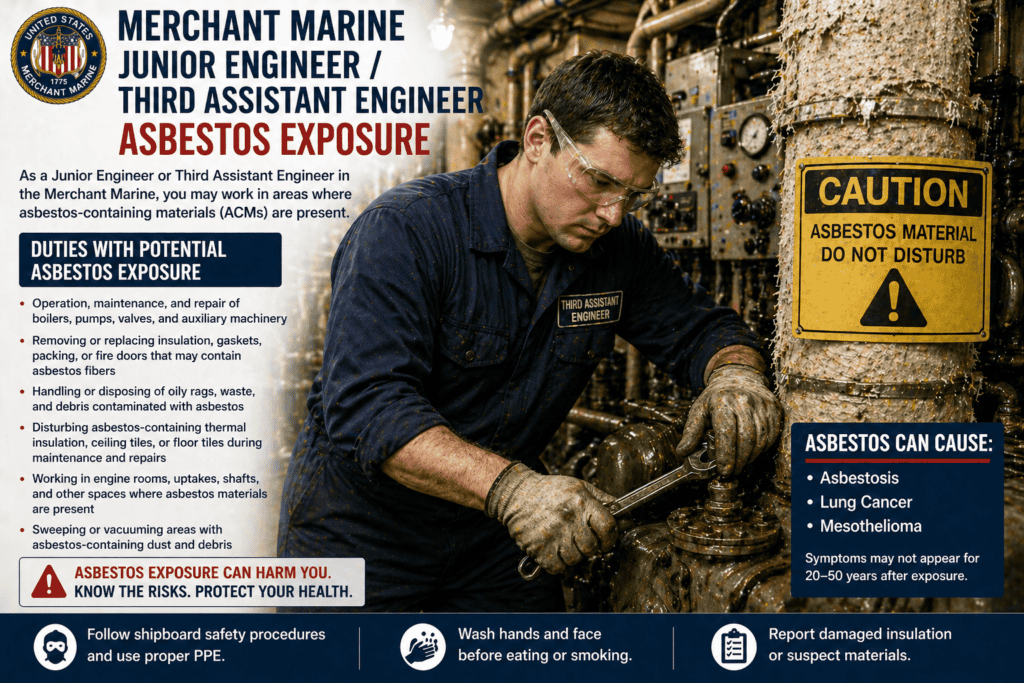
Merchant Marine Junior Engineer / Third Assistant Engineer Asbestos Exposure
A Merchant Marine Junior Engineer / Third Assistant Engineer is an early-career licensed engineering officer who can perform engine-room watchstanding, machinery rounds, maintenance, troubleshooting, and repair support under more senior engineering officers. Depending on the vessel, era, and crew structure, this role may involve close work around pumps, valves, piping, generators, auxiliary machinery, engines, boilers, and other systems.
Because junior engineers can spend substantial time in machinery spaces and may perform hands-on maintenance, historical asbestos exposure can be an important issue to investigate on older merchant vessels. That does not mean every Junior Engineer or Third Assistant Engineer was exposed. Exposure depends on the specific vessel, service dates, equipment, tasks, materials, repair conditions, frequency, proximity, and supporting evidence.
This page is part of the Merchant Marines Ranks Asbestos Exposure hub within the broader Merchant Marines Asbestos Exposure silo. Related engineering pages include Merchant Marine Second Assistant Engineer Asbestos Exposure, Merchant Marine First Assistant Engineer Asbestos Exposure, and Merchant Marine Chief Engineer Asbestos Exposure.
⚙️ Junior Engineer / Third Assistant Engineer Role
The Third Assistant Engineer is generally one of the junior licensed officers in the engineering department. Duties can include standing watches, monitoring machinery, recording operating data, inspecting auxiliary systems, assisting with repairs, and carrying out maintenance directed by senior engineers.
For asbestos exposure analysis, the junior status can be significant because early-career engineers may spend more time performing or assisting with hands-on work. The key question is whether that work involved asbestos-containing insulation, gaskets, packing, or other components.
| Junior Engineering Duty | Possible Exposure Pathway | Evidence to Review |
|---|---|---|
| Engine-room watchstanding | Repeated presence around piping, machinery, pumps, valves, boilers, and generators | Watch schedules, engineering logs, vessel plans |
| Machinery rounds | Close inspection of equipment and insulated systems throughout machinery spaces | Duty records, logbooks, coworker testimony |
| Maintenance assistance | Hands-on gasket, packing, valve, pump, piping, or machinery work | Work orders, parts records, maintenance logs |
| Cleaning and repair support | Presence during scraping, removal, disassembly, or cleanup around older materials | Maintenance procedures, witness statements, repair files |
| Shipyard overhaul | Work near concentrated insulation, piping, mechanical, and electrical repairs | Shipyard records, contractor files, overhaul specifications |
🛠️ Possible Asbestos Exposure Pathways
Asbestos was historically used in some marine products because of its heat- and fire-resistant properties. Depending on the ship, manufacturer, component, and era, asbestos-containing materials could be associated with some pipe insulation, boiler materials, gaskets, pump and valve packing, machinery insulation, electrical materials, and fire-resistant products.
A Junior Engineer or Third Assistant Engineer could potentially experience direct exposure while removing, scraping, replacing, cutting, or cleaning up around an asbestos-containing product. Bystander exposure could also occur when senior engineers, machinists, pipe workers, electricians, or shipyard workers disturbed such materials nearby.
The strongest evidence identifies the exact vessel, system, task, material, and service period rather than relying on an engine-room title alone.
🕒 Watchstanding and Machinery Rounds
Watchstanding and machinery rounds can require junior engineering officers to move continuously through engine-room spaces, monitoring operating conditions and responding to equipment problems. These duties can place them near hot piping, pumps, valves, machinery, generators, boilers, and auxiliary systems.
Routine monitoring
Simply being present near old equipment does not prove exposure. Risk depends on whether nearby asbestos-containing materials were damaged, deteriorated, removed, or otherwise disturbed.
Equipment adjustments
Junior engineers may adjust valves, pumps, controls, or machinery during a watch. If maintenance required disturbing asbestos-containing gaskets, packing, or insulation, the details of that work can be important.
Responding to machinery problems
Unplanned failures can lead to disassembly and emergency repair work. Engineering logs and casualty reports may help document the systems and materials involved.
🔧 Hands-On Maintenance and Repair Support
Hands-on maintenance may be one of the most important differences between a junior engineering role and senior supervisory positions. Third Assistant Engineers may assist with pumps, valves, piping, generators, auxiliary machinery, and other systems as part of routine maintenance or troubleshooting.
Potential asbestos exposure could occur if a historical gasket, packing material, insulation product, or other component actually contained asbestos and was cut, scraped, removed, replaced, or cleaned up. Product composition varied by manufacturer and era, so it should never be assumed.
Maintenance records, parts lists, equipment manuals, work orders, coworker testimony, and shipyard records can help reconstruct the work performed.
🔩 Materials and Equipment to Investigate
The categories below are investigative starting points rather than findings that asbestos was present. Material composition varied by product, manufacturer, model, installation date, and replacement history.
| Equipment or Material | Potential Historical Asbestos Component | Evidence to Investigate |
|---|---|---|
| Pumps | Some historical packing and gaskets | Parts lists, maintenance logs, manufacturer records |
| Valves | Some historical packing and flange gaskets | Work orders, product records, repair files |
| Piping systems | Some pipe insulation and flange materials | Piping diagrams, insulation specifications, maintenance records |
| Boilers and steam systems | Some historical insulation, refractory, gaskets, or heat-resistant materials | Boiler records, specifications, overhaul files |
| Engines and generators | Some gaskets, seals, electrical or thermal insulation components | Equipment manuals, parts documentation, repair records |
| Auxiliary machinery | Some packing, gaskets, insulated connections, or related components | Maintenance files, equipment specifications, manufacturer data |
Use the Merchant Marine Equipment Asbestos Exposure hub for equipment-specific investigation.
🏗️ Shipyard and Overhaul Exposure
Shipyard and dry-dock periods can involve major work on propulsion, piping, insulation, electrical systems, boilers, generators, pumps, valves, and structural components. Junior engineering officers may assist with testing, inspection, maintenance, cleanup, or preparation of machinery before and after repairs.
If asbestos-containing materials were removed during overhaul, exposure could depend on the officer’s location, frequency and duration of presence, ventilation, and the work practices used by shipyard crews.
Review Merchant Marine Shipyards Asbestos Exposure and Merchant Marine Dry Docks Asbestos Exposure when those settings appear in the work history. The Merchant Marine Facilities Asbestos Exposure hub can help organize other shoreside exposure research.
The Merchant Marine Ships Asbestos Exposure hub and Merchant Marine Asbestos Exposure Timeline can provide vessel and historical context.
📋 Evidence for a Junior Engineer / Third Assistant Engineer Exposure History
Because asbestos-related diseases can develop decades after exposure, reconstructing an early engineering career may require combining several historical sources.
| Evidence | What It May Help Establish |
|---|---|
| Merchant mariner credentials | Third Assistant Engineer or junior engineering endorsement and career progression |
| Employment and vessel records | Ships, employers, and dates of service |
| Watch schedules and engineering logs | Assignments, machinery conditions, and repair events |
| Maintenance and work orders | Specific equipment and tasks performed |
| Equipment manuals and parts lists | Components used in machinery during the relevant era |
| Shipyard and dry-dock files | Major overhaul and contractor work |
| Manufacturer and product records | Whether specific gaskets, packing, insulation, or other components contained asbestos |
| Coworker testimony | Hands-on duties, proximity, frequency, and working conditions |
| Medical records | Diagnosis and relevant medical history |
The strongest evidence connects the Junior Engineer / Third Assistant Engineer to a specific ship, system, maintenance task, and asbestos-containing material rather than relying only on rank.
🫁 Asbestos-Related Health Risks
Inhalation of asbestos fibers is associated with mesothelioma, lung cancer, and asbestosis. These diseases can have long latency periods, so historical engine-room work may remain medically relevant many years later.
A diagnosis alone does not establish asbestos causation. Medical evaluation may consider occupational exposure history, smoking history, other risk factors, imaging, pathology, and additional clinical evidence.
See Merchant Marine Asbestos Exposure Health Risks for the dedicated health-risk page.
Need help now? If a Merchant Marine Junior Engineer / Third Assistant Engineer or family member is trying to reconstruct possible asbestos exposure, Call 800.291.0963, use our 24/7 live chat, or Submit Your Case. Vessel names, service dates, watch schedules, engineering logs, equipment records, repair tasks, coworkers, and product information can be important starting points.
⚖️ Legal Options and Claim Investigation
A Merchant Marine Junior Engineer / Third Assistant Engineer diagnosed with an asbestos-related disease may be able to investigate legal options depending on the facts and evidence. Potential claims can depend on diagnosis, exposure history, product identification, responsible companies, jurisdiction, and filing deadlines.
The Merchant Marine Asbestos Exposure Legal Options hub covers Merchant Marine mesothelioma lawsuits, asbestos trust fund claims, wrongful death lawsuits, and statutes of limitations. Compensation is not automatic, and engineering service alone does not establish liability.
What a case investigation may examine
- Diagnosis and pathology records.
- Merchant mariner credentials and engineering endorsements.
- Vessel names and dates of service.
- Engine-room watchstanding and machinery-round duties.
- Pump, valve, piping, generator, boiler, and auxiliary-equipment work.
- Shipyard, dry-dock, and overhaul periods.
- Product, manufacturer, contractor, and shipyard records.
- Coworker and witness statements.
- Jurisdiction and applicable filing deadlines.
❓ Frequently Asked Questions
What does a Merchant Marine Third Assistant Engineer do?
A Third Assistant Engineer is a junior licensed engineering officer who may stand engine-room watches, perform machinery rounds, assist with maintenance and repairs, and work on auxiliary systems under senior engineering officers.
Is a Junior Engineer the same as a Third Assistant Engineer?
Terminology can vary by employer, vessel, and era. When reconstructing a work history, use the exact title shown in mariner credentials and employment records and document the actual duties performed.
Were all Third Assistant Engineers exposed to asbestos?
No. The engineering title does not prove exposure. Investigators must identify the vessel, products, systems, tasks, service dates, and evidence involved.
Could hands-on maintenance create asbestos exposure?
Potentially, if the work disturbed an asbestos-containing gasket, packing material, insulation product, or other component. Product composition varied, so asbestos content must be established.
Why are pumps and valves relevant?
Some historical marine pumps and valves used asbestos-containing packing or gaskets. Whether a particular component contained asbestos depends on manufacturer, model, era, and replacement history.
What records help reconstruct exposure?
Useful evidence can include mariner credentials, vessel assignments, watch schedules, engineering logs, work orders, equipment manuals, parts lists, shipyard records, manufacturer documents, coworker testimony, and medical records.
Can asbestos exposure be relevant to lung cancer?
Yes. Asbestos is a recognized cause of lung cancer, but a diagnosis alone does not establish asbestos causation. Medical and occupational evidence should be evaluated together.
Can a family investigate a claim after a Third Assistant Engineer dies?
Possibly. Depending on diagnosis, exposure evidence, responsible parties, jurisdiction, and filing deadlines, surviving family members may be able to investigate wrongful death or other asbestos-related claims.
☎️ Help for Merchant Marine Junior Engineers, Third Assistant Engineers, and Families
If you or a family member served as a Merchant Marine Junior Engineer / Third Assistant Engineer and later developed mesothelioma or lung cancer, an exposure investigation can examine vessel assignments, engine-room watches, machinery rounds, maintenance tasks, overhaul periods, products, manufacturers, and available historical evidence.
Call 800.291.0963 to discuss a Merchant Marine asbestos exposure history. Live chat is available 24/7, 365 days a year. You can also Submit Your Case online.
There is no guarantee that a diagnosis or work history will qualify for compensation. Eligibility depends on the facts, evidence, responsible parties, jurisdiction, and filing deadlines.
⚕️ Legal & Medical Information Disclaimer
This page provides general educational information and is not medical or legal advice. It does not establish diagnosis, asbestos exposure, causation, liability, eligibility, or compensation. Consult qualified medical and legal professionals for guidance specific to your situation.