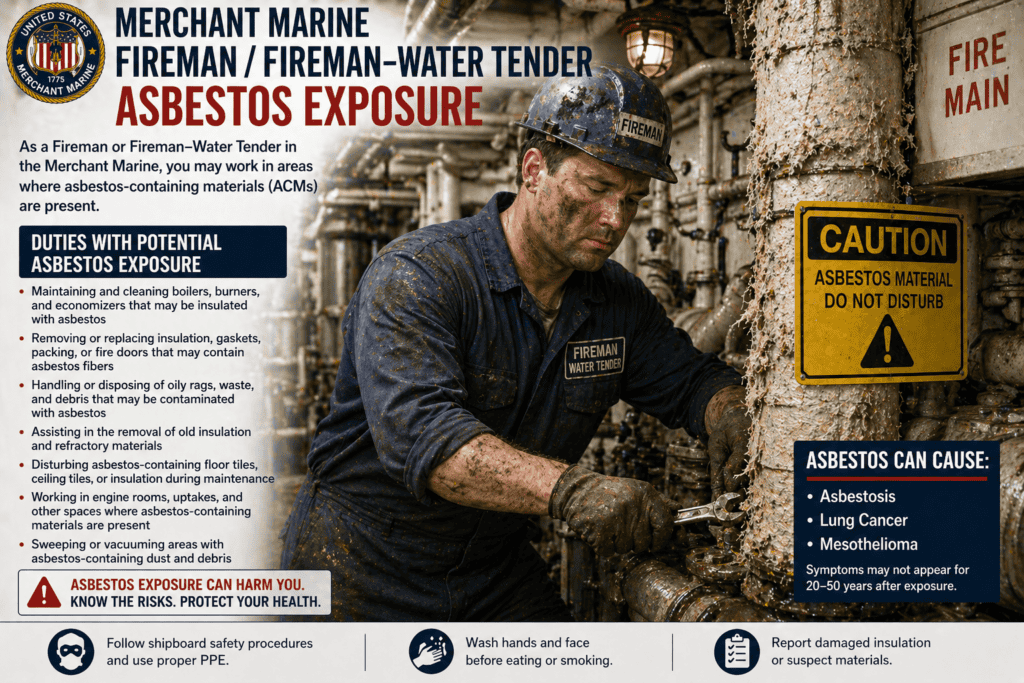
Merchant Marine Fireman / Fireman–Water Tender (FWT) Asbestos Exposure
⚠️ Asbestos Risks for Merchant Marine Firemen & Fireman–Water Tenders (FWTs)
The Fireman/Water Tender—commonly called FWT—is one of the most historically asbestos-exposed occupations in the U.S. Merchant Marine. From World War II through the late 1990s, nearly every merchant vessel relied on steam propulsion, making the Fireman responsible for operating, monitoring, and maintaining the boilers that powered the entire ship.
Because boilers, steam lines, heat shields, valves, pumps, and fireboxes were insulated with massive quantities of asbestos, FWTs worked in the single most contaminated space aboard most merchant ships—the fire room.
Every day, Firemen:
-
stood within feet of asbestos-lined boilers
-
chipped, scraped, and cleaned refractory brick
-
monitored steam pressure near insulated piping
-
replaced gaskets, packing, and boiler components
-
cleaned up debris generated by repairs
-
worked in extreme heat, vibration, and poor ventilation
This combination created some of the highest asbestos exposure levels in maritime history, leading many former FWTs to later develop mesothelioma, asbestos lung cancer, pleural scarring, and asbestosis.
🛠️ Typical Duties of a Merchant Marine Fireman / Water Tender (FWT)
🔥 Operating Boilers & Maintaining Steam Pressure
Firemen operated:
-
scotch marine boilers
-
water-tube boilers
-
auxiliary boilers
These systems were wrapped in:
-
asbestos block insulation
-
asbestos cement
-
refractory brick
-
heat-resistant tapes, felts, and blankets
Every adjustment, pressure reading, and firing routine occurred inches from ACM materials.
🧱 Working Directly on Boiler Insulation & Refractory
Fire rooms contained vast amounts of:
-
asbestos firebrick
-
refractory mortar
-
boiler insulation
-
combustion-chamber linings
When materials cracked from heat cycles (which they frequently did), FWTs were assigned to:
-
chip away old refractory
-
patch insulating cement
-
remove damaged lagging
-
clear dust and debris
This maintenance produced heavy airborne fibers.
⚙️ Monitoring Fuel Atomizers, Burners & Firebox Systems
FWTs inspected and maintained:
-
burners
-
ignition systems
-
atomizers
-
fire doors
-
viewing ports
These components were surrounded by deteriorating asbestos boards and fireproof insulation.
🧼 Cleaning Boiler Flats & Fire Room Deck Plates
Daily cleaning required FWTs to wipe or sweep:
-
insulation pieces
-
refractory dust
-
gasket fragments
-
asbestos cement chips
With nearly continuous boiler vibration and heat, the fire room generated new dust daily.
🔧 Assisting with Boiler Repairs & Overhauls
During:
-
shipyard overhauls
-
mid-voyage boiler problems
-
tear-outs
-
refractory relining
FWTs were often the personnel helping engineers with:
-
removing boiler doors
-
clearing insulation
-
replacing gaskets
-
repacking valves
-
cleaning fire tubes
Shipyard repair periods were some of the highest-intensity exposures ever documented in maritime occupations.
🚢 Managing Steam Systems & Auxiliary Lines
Because Firemen managed steam production, they frequently worked on or near:
-
steam lines
-
auxiliary piping
-
superheater units
-
economizers
All were insulated with asbestos cloth, cement, tape, and wrappings.
🧱 Asbestos Exposure Risks for Merchant Marine Firemen / Water Tenders
1. Boiler Insulation (Primary Exposure Source)
Boilers were almost entirely covered in:
-
asbestos block insulation
-
asbestos cement
-
woven asbestos blankets
Heat, vibration, and normal operation caused these materials to deteriorate daily.
2. Firebrick & Refractory ACM
Fireboxes were lined with:
-
asbestos firebrick
-
refractory cement
-
high-heat mortar
Firemen chipped, scraped, and replaced these materials—one of the most dangerous tasks for asbestos inhalation.
3. Steam-System Pipe Wrapping
Steam pipes running throughout the fire room were wrapped with:
-
asbestos lagging
-
cloth tape
-
cement wrap
-
woven insulation
Every steam-pressure check placed FWTs directly beside these materials.
4. Boiler Door Gaskets & Packing
FWTs routinely worked with:
-
asbestos gaskets
-
asbestos rope packing
-
flange seals
-
manhole & handhole cover insulation
Removing these components released large amounts of friable dust.
5. Asbestos in Valves, Pumps, & Feed Systems
Systems required for steam production used:
-
packing rings
-
asbestos-lined pumps
-
insulated feedwater lines
Failures in these systems created sudden bursts of asbestos-filled dust.
6. Contaminated Fire Room Ventilation
Ventilation blowers pulled dust from:
-
steam pipes
-
boiler casings
-
refractory surfaces
-
lagging debris
This created a constant haze of airborne fibers in the fire room.
7. Shipyard Overhauls
During drydock:
-
boilers were opened
-
refractory was torn out
-
insulation was removed
-
steam lines were stripped
-
large piles of lagging accumulated
Firemen working nearby inhaled extremely high fiber concentrations.
📊 Why Fireman / Water Tender Claims Are Among the Strongest
🔥 1. Highest-intensity asbestos job in the engine department
Firemen had more direct contact with ACM than nearly any other rating.
🔥 2. Daily exposure in confined high-heat compartments
The fire room was one of the most contaminated workspaces aboard ship.
🔥 3. Frequent interaction with friable insulation
Insulation and refractory materials were constantly cracking or failing.
🔥 4. Extensive maintenance documentation
Boiler logs, repair records, and shipyard notes strongly support exposure.
🔥 5. Historical recognition
Firemen are legally recognized as an extremely high-risk maritime occupation.
📂 How Merchant Marine Firemen Prove Asbestos Exposure
📄 Merchant Mariner Documents
-
Fireman
-
Fireman/Water Tender
-
Junior Engineer trainee
-
QMED
-
Coast Guard discharge certificates
📘 Boiler & Engine Room Blueprints
Show asbestos use in:
-
refractory
-
combustion chambers
-
steam lines
-
casings
🛠 Shipyard Repair Records
Evidence of:
-
refractory tear-outs
-
insulation replacement
-
boiler access maintenance
👷 Witness Statements
Engineers, Wipers, Oilers, and fellow Firemen confirm:
-
visible refractory dust
-
crumbling insulation
-
cracked boiler coatings
-
asbestos debris on decks
💼 Compensation Examples for Firemen / Water Tenders
📌 Case 1 — WWII-Era Fireman
Massive refractory removal during overhauls.
Compensation: $4.8M
📌 Case 2 — 1960s Tanker FWT
Daily work beside rupturing insulation on steam lines.
Compensation: $4.4M
📌 Case 3 — 1970s Bulk Carrier Fireman
Heavy exposure to boiler gaskets, packing, and refractory cement.
Compensation: $4.2M
💙 Benefits for Merchant Marine Firemen
💵 Asbestos Trust Funds
Over $30 billion remains.
⚖ Legal Claims Against Product Manufacturers
Not against the Merchant Marine or U.S. government.
❤️ Survivor Claims
Families may also qualify.
❓ Frequently Asked Questions
🟦 Is Fireman/Water Tender the most asbestos-exposed job at sea?
Yes—Firemen are widely considered the #1 most exposed engine-room rating.
🟦 Does boiler cleaning cause exposure?
Extremely. Refractory dust is one of the most dangerous ACM materials.
🟦 Do I qualify if I never handled asbestos directly?
Yes. Just working inside the fire room qualifies.
📞 Get Help Identifying Your Asbestos Exposure as a Merchant Marine Fireman / Water Tender
If you served in the fire room—operating boilers, tending water levels, managing steam systems, or working near refractory tear-outs—you were exposed to asbestos daily. Specialists can identify every ACM material on your vessels and help pursue financial compensation.
📞 Call 800.291.0963 for a free Merchant Marine exposure review.