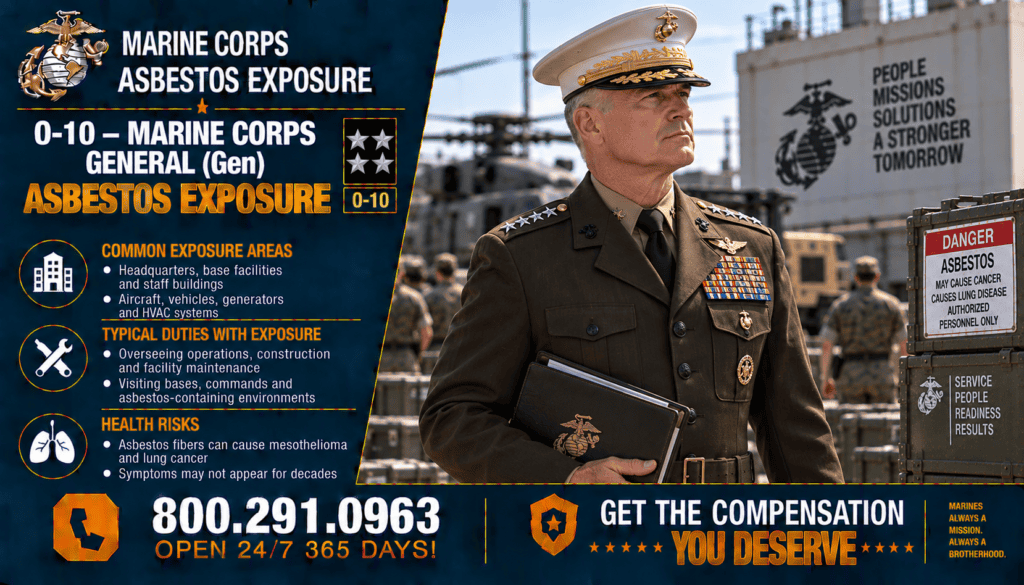
O-10 Marine Corps General (GEN) Asbestos Exposure
A U.S. Marine Corps General (O-10) is the highest commissioned officer grade in the Marine Corps. General officers can hold senior command, staff, planning, operational, and administrative responsibilities involving major Marine Corps organizations, installations, training commands, logistics, aviation, and other military activities.
Potential asbestos exposure for a Marine Corps General would usually be evaluated differently from exposure involving mechanics, construction personnel, or other hands-on trades. A senior officer may have spent time at older bases, headquarters, barracks, training facilities, maintenance areas, aviation facilities, industrial buildings, ships, or other locations where asbestos-containing materials were historically used. Earlier assignments before reaching general officer rank may also be important.
That does not mean every Marine Corps General was exposed to asbestos. Exposure must be connected to the individual’s actual duty stations, career history, buildings, equipment, maintenance or construction activity, and evidence that asbestos-containing materials were present and disturbed.
This page is part of the U.S. Marine Corps Ranks Asbestos Exposure hub within the broader U.S. Marine Corps Asbestos Exposure silo. Related senior officer pages include O-9 Marine Corps Lieutenant General (LTGEN) Asbestos Exposure, O-8 Marine Corps Major General (MAJGEN) Asbestos Exposure, O-7 Marine Corps Brigadier General (BGEN) Asbestos Exposure, and O-6 Marine Corps Colonel (COL) Asbestos Exposure.
🎖️ O-10 General Role and Senior Command Responsibilities
Marine Corps General is the O-10 officer grade. Duties depend on assignment and period of service, but an O-10 may serve in very senior command or staff positions involving large organizations, installations, operational forces, planning, logistics, personnel, training, and readiness.
For asbestos exposure analysis, rank alone is not enough. A General’s career may span decades and include earlier assignments as a junior officer, field-grade officer, commander, staff officer, or installation leader. Those earlier periods may provide more specific exposure pathways than the final O-10 assignment.
| Duty or Setting | Possible Exposure Pathway | Evidence to Review |
|---|---|---|
| Senior installation command | Presence in older headquarters, barracks, offices, maintenance facilities, power plants, or utility buildings | Duty records, base histories, building records |
| Operational command | Travel and temporary duty at older bases, ships, field facilities, or overseas installations | Orders, travel records, command histories |
| Facility inspections | Entry into construction, maintenance, engineering, or industrial spaces during inspection or oversight | Inspection reports, facility records, witness statements |
| Earlier career assignments | More direct contact with vehicles, aircraft, buildings, equipment, or maintenance areas before senior promotion | Personnel files, unit records, occupational history |
| Renovation or construction periods | Presence near disturbance of older insulation, flooring, panels, piping, roofing, or mechanical systems | Construction records, renovation files, contractor documents |
🛠️ Possible Asbestos Exposure Pathways
Asbestos was historically used in many military and industrial building products because of its resistance to heat and fire. Depending on the era and facility, asbestos-containing materials could include some pipe insulation, boiler insulation, flooring, roofing, wall or ceiling products, fireproofing, gaskets, packing, electrical materials, and other construction or equipment components.
A Marine Corps General could potentially experience bystander or environmental exposure while working in older buildings or visiting maintenance and industrial areas where asbestos-containing materials were damaged, removed, or renovated. Earlier career assignments could also involve more direct contact with equipment, vehicles, ships, aircraft, or construction environments.
Simply serving at an older installation does not prove asbestos exposure. A credible history should identify the specific duty station, building, work area, renovation or maintenance event, frequency, duration, and evidence that asbestos was actually present.
🏢 Bases, Headquarters, and Military Facilities
Senior Marine Corps officers can serve at major installations, headquarters facilities, training centers, aviation stations, depots, logistics centers, and other military locations. Many military buildings constructed during the 20th century used materials that may have contained asbestos.
Potentially relevant locations can include older barracks, administrative buildings, boiler rooms, power plants, maintenance shops, warehouses, communications spaces, vehicle facilities, aviation buildings, and utility systems.
The key issue is not simply whether asbestos existed somewhere on a base. An exposure investigation should identify where the officer worked, how frequently the officer entered particular facilities, whether materials were disturbed, and whether records support asbestos content in those areas.
🏗️ Inspections, Construction, and Maintenance Oversight
Senior officers may inspect facilities, review readiness, tour maintenance areas, oversee major commands, or participate in construction and modernization planning. These responsibilities can bring a General into spaces that are outside normal office environments.
Facility tours and inspections
Visits to maintenance shops, engineering spaces, utility plants, hangars, warehouses, and older buildings may be relevant if asbestos-containing materials were being disturbed or had deteriorated.
Renovation and modernization
Older military buildings may undergo renovations involving flooring, ceiling materials, piping, insulation, wall systems, roofing, or mechanical equipment. If asbestos-containing materials were removed, proximity and timing become important.
Emergency response and damaged facilities
Fires, storms, structural damage, or other incidents can disturb building materials. Exposure claims tied to these events should be supported by incident records and material evidence.
⚙️ Equipment and Materials to Investigate
Not every military building, vehicle, aircraft, or component contained asbestos. Material composition varied by manufacturer, model, installation date, replacement history, facility, and era. The categories below are investigative starting points only.
| Material or Equipment | Potential Historical Asbestos Use | Evidence to Investigate |
|---|---|---|
| Boilers and steam systems | Some historical insulation, gaskets, packing, and refractory materials | Building plans, boiler records, maintenance files |
| Pipe systems | Some historical thermal insulation and flange gaskets | Piping diagrams, insulation specifications, repair records |
| Flooring and interior materials | Some historical resilient flooring, panels, ceiling materials, or related products | Construction records, renovation files, material specifications |
| Electrical and fire-resistant materials | Some historical heat-resistant electrical or fireproofing products | Electrical plans, product records, facility specifications |
| Vehicles and equipment | Some historical friction, gasket, insulation, or heat-resistant components | Maintenance manuals, parts records, manufacturer documents |
| Aircraft and aviation facilities | Some historical heat-resistant components and building materials | Aircraft maintenance records, hangar records, technical manuals |
🗂️ Earlier Marine Corps Assignments and Cumulative Exposure
For an O-10 General, the most important asbestos exposure may have occurred decades before reaching the highest officer grade. A General’s career could include assignments at multiple bases, training centers, operational units, ships, aviation facilities, headquarters, or overseas locations.
Exposure reconstruction should therefore examine the entire career rather than only the final command. Earlier positions may have involved more frequent contact with maintenance areas, tactical vehicles, older barracks, field facilities, ships, or equipment.
Related senior-rank pages can help document that progression:
- O-9 Marine Corps Lieutenant General (LTGEN) Asbestos Exposure
- O-8 Marine Corps Major General (MAJGEN) Asbestos Exposure
- O-7 Marine Corps Brigadier General (BGEN) Asbestos Exposure
- O-6 Marine Corps Colonel (COL) Asbestos Exposure
Each duty station and assignment should be evaluated separately rather than assuming the same exposure conditions throughout a career.
📋 Evidence for a Marine Corps General Exposure History
Because asbestos-related diseases can develop decades after exposure, reconstructing a General’s exposure history may require military, facility, occupational, and medical records.
| Evidence | What It May Help Establish |
|---|---|
| Official military personnel records | Ranks, duty stations, assignments, units, and service dates |
| Orders and travel records | Temporary duty, inspections, deployments, and facility visits |
| Base and building records | Construction dates, materials, renovations, and maintenance history |
| Unit and command histories | Locations, operations, facilities, and major events |
| Maintenance and renovation files | Disturbance or removal of older building and equipment materials |
| Manufacturer and product records | Whether a particular product or component contained asbestos |
| Coworker or witness testimony | Work locations, inspections, facility conditions, and proximity to disturbed materials |
| Medical records | Diagnosis and relevant medical history |
The strongest evidence connects the Marine Corps General to a particular duty station, facility, assignment, event, and asbestos-containing material rather than relying only on rank.
🫁 Asbestos-Related Health Risks
Inhalation of asbestos fibers is associated with mesothelioma, lung cancer, and asbestosis. These diseases can have long latency periods, which means military exposure from decades earlier may still be medically relevant.
A diagnosis alone does not establish asbestos causation. Medical evaluation may consider the service member’s occupational and environmental exposure history, smoking history, other risk factors, imaging, pathology, and additional clinical evidence.
Veterans who believe they encountered asbestos during Marine Corps service should discuss their military occupational and duty-station history with a qualified medical professional.
Need help now? If a Marine Corps General, veteran, or family member is trying to reconstruct a possible military asbestos exposure history, Call 800.291.0963, use our 24/7 live chat, or Submit Your Case. Duty stations, service dates, assignments, buildings, renovation periods, units, and witness information can be important starting points.
⚖️ Legal Options and Claim Investigation
A Marine Corps General or veteran diagnosed with an asbestos-related disease may be able to investigate legal or benefits options depending on the facts and evidence. Eligibility can depend on diagnosis, service history, asbestos exposure evidence, responsible companies, jurisdiction, and filing deadlines.
Potential avenues may include claims involving asbestos product manufacturers or bankruptcy trusts, and eligible veterans may also investigate VA benefits. A diagnosis, rank, or Marine Corps service history alone does not guarantee compensation or benefits.
What a case investigation may examine
- Diagnosis and pathology records.
- Marine Corps personnel and service records.
- Duty stations, units, and assignment history.
- Base buildings, headquarters, barracks, maintenance areas, and other facilities.
- Renovation, maintenance, construction, or demolition activity.
- Vehicles, aircraft, equipment, products, and manufacturers.
- Coworker and witness statements.
- Potential responsible companies and asbestos trusts.
- Jurisdiction and applicable filing deadlines.
❓ Frequently Asked Questions
What rank is a Marine Corps General?
General is the O-10 commissioned officer grade in the U.S. Marine Corps and is above Lieutenant General (O-9).
Were all Marine Corps Generals exposed to asbestos?
No. Rank alone does not prove asbestos exposure. Evidence must identify the General’s duty stations, work areas, career history, and asbestos-containing materials involved.
Could a General encounter asbestos without performing maintenance work?
Possibly. Senior officers could spend time in older buildings, maintenance areas, industrial facilities, ships, aviation facilities, or renovation zones. Whether this created meaningful exposure depends on the specific conditions and evidence.
Why are earlier assignments important for an O-10 asbestos claim?
A General usually has a long military career. Earlier assignments may have involved more direct contact with older bases, vehicles, aircraft, ships, field facilities, or maintenance environments than the final senior command.
What military buildings may be relevant?
Investigators may review older barracks, headquarters, boiler rooms, power plants, maintenance shops, warehouses, aviation facilities, communications buildings, and utility systems. Whether a specific building contained asbestos must be verified.
What records help reconstruct Marine Corps asbestos exposure?
Useful records can include personnel files, orders, unit histories, base records, building plans, renovation files, maintenance records, product documents, witness testimony, and medical records.
Can asbestos exposure be relevant to lung cancer?
Yes. Asbestos is a recognized cause of lung cancer, but a diagnosis alone does not establish asbestos causation. Medical and service-exposure evidence should be evaluated together.
Can surviving family members investigate a claim?
Possibly. Depending on diagnosis, exposure evidence, responsible parties, jurisdiction, and filing deadlines, surviving family members may be able to investigate wrongful death or other asbestos-related claims.
☎️ Help for Marine Corps Generals, Veterans, and Families
If you or a family member served in the U.S. Marine Corps and later developed mesothelioma or lung cancer, an exposure investigation can examine the full military career, including earlier ranks, duty stations, buildings, inspections, maintenance areas, equipment, renovations, and available historical records.
Call 800.291.0963 to discuss a Marine Corps asbestos exposure history. Live chat is available 24/7, 365 days a year. You can also Submit Your Case online.
There is no guarantee that a diagnosis or service history will qualify for compensation or VA benefits. Eligibility depends on the facts, evidence, responsible parties, jurisdiction, applicable benefit rules, and filing deadlines.
⚕️ Legal & Medical Information Disclaimer
This page provides general educational information and is not medical or legal advice. It does not establish diagnosis, asbestos exposure, causation, liability, VA eligibility, or compensation. Consult qualified medical and legal professionals for guidance specific to your situation.
🔎 SEO Indexing Tags and Page Rating
SEO Title:
Meta Description: Learn how an O-10 Marine Corps General may have encountered asbestos at older bases, facilities, and earlier assignments. Call 800.291.0963; 24/7 chat, 365 days a year.