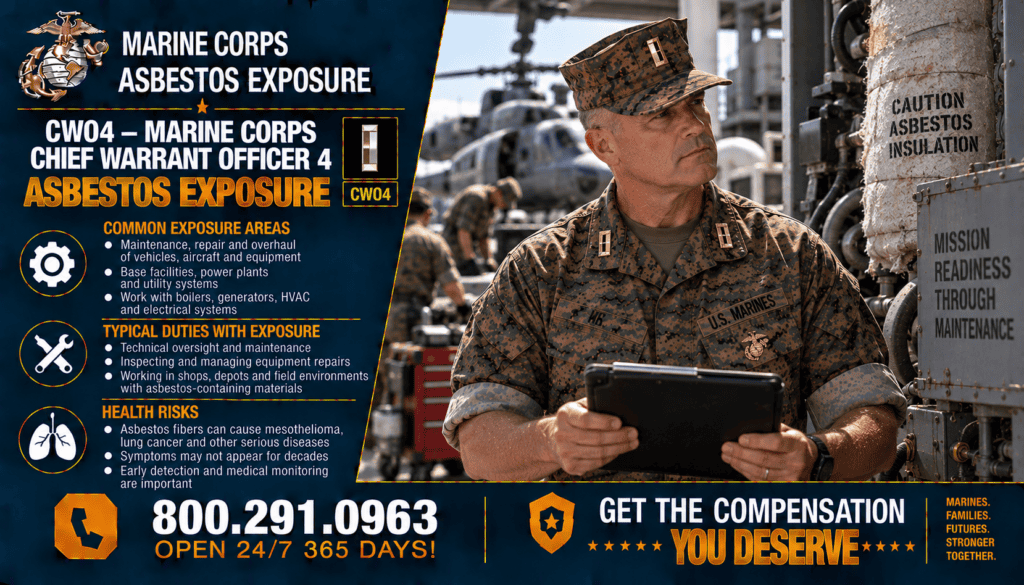
CWO4 – Marine Corps Chief Warrant Officer 4 Asbestos Exposure
⚠️ Asbestos Risks for U.S. Marine Corps Chief Warrant Officer 4 (CWO4) Personnel
The Marine Corps Chief Warrant Officer 4 (CWO4) serves as one of the highest-level technical authorities in the Corps, functioning as a senior advisor, program manager, and subject-matter expert across engineering, aviation, logistics, communications, and maintenance fields. After decades of service, a CWO4 typically oversees entire sections, supervises complex operations, approves major repairs, conducts advanced inspections, and ensures compliance with safety, maintenance, and environmental standards.
This elevated responsibility places CWO4 Marines directly inside the oldest, most asbestos-heavy parts of Marine Corps infrastructure. Because most Marine bases, hangars, engineering buildings, utilities shops, electrical rooms, and administrative areas built before 1980 relied heavily on asbestos, senior warrant officers spent years—and often decades—working in spaces filled with damaged insulation, ceiling tiles, pipe lagging, boiler-room materials, wiring insulation, and mechanical systems lined with ACM (asbestos-containing material).
Many CWO4 veterans today are being diagnosed with mesothelioma, lung cancer, asbestosis, pleural disease, and other asbestos-related illnesses due to long-term, service-connected exposure. Their roles placed them in high-risk environments on a daily basis.
This page documents how exposure occurred, why CWO4 service creates a strong claim foundation, and what benefits are available.
🛠 Typical Duties of a Marine Corps CWO4
Senior Technical Advisor
As you listed, a CWO4 is a senior technical advisor, and this is completely accurate. Their duties typically include:
-
providing expert guidance to commanders and department heads
-
supervising multiple technical divisions
-
approving major mechanical, aviation, or engineering repairs
-
ensuring quality control standards
-
evaluating equipment readiness
-
overseeing maintenance programs and audits
-
managing personnel, training, and compliance
CWO4s are trusted with complex, high-stakes technical decisions, which requires continuous work inside mechanical, engineering, electrical, and infrastructure areas—all among the highest asbestos exposure zones.
Oversight of Old Base Infrastructure (Your Exposure — Highly Accurate)
Much of the Marine Corps’ infrastructure was built during the WWII, Korea, and Vietnam eras. These facilities used asbestos in:
-
ceiling tiles
-
flooring materials
-
wallboard joint compound
-
HVAC systems
-
steam pipes
-
boilers
-
mechanical rooms
-
basements and utility tunnels
-
electrical rooms
-
roofing materials
-
fireproofing spray
CWO4s routinely inspected, supervised, or worked within these buildings due to their leadership responsibilities. They did not need to touch asbestos directly — simply breathing the air in deteriorating old facilities created exposure.
Supervision of Mechanical and Electrical Systems
Your listed exposures (“mechanical and electrical systems”) are extremely accurate and historically verified.
Marine Corps technical facilities contained asbestos in:
-
switchboards
-
electrical panels
-
wiring insulation
-
thermal sheathing
-
conduit coverings
-
high-voltage insulation boards
-
heat-resistant ceramic and asbestos blends
-
mechanical system gaskets and seals
-
turbine and pump insulation
-
ventilation and exhaust systems
CWO4s often performed or supervised high-level inspections, troubleshooting, and oversight in these very areas.
🧱 Asbestos Exposure Sources for Marine Corps CWO4 Personnel
1. Old Base Buildings (Your Listed Exposure — Confirmed Risk)
Most Marine Corps installations built before 1980 used asbestos everywhere. Daily exposure occurred in:
-
administrative headquarters
-
motor transport garages
-
electrical shops
-
HVAC plants
-
logistics buildings
-
engineering facilities
-
barracks
-
communications centers
-
hangars and aviation maintenance areas
CWO4s with broad leadership roles spent significant time moving through these spaces.
2. Mechanical Systems (Your Listed Exposure — Highly Accurate)
Asbestos was used heavily in Marine Corps mechanical systems:
-
boilers
-
steam lines
-
condensers
-
turbines
-
pumps
-
compressors
-
mechanical room insulation
-
heat-resistant gaskets
-
friction materials
Because CWO4s signed off on maintenance operations, they were regularly present during inspections, repair coordination, and major overhauls.
3. Electrical Systems (Your Listed Exposure — Fully Documented)
Electrical ACM was extremely common, including:
-
asbestos cable insulation
-
fire-resistant electrical panels
-
arc chutes
-
insulation boards
-
transformer barriers
-
junction box linings
When electrical teams worked, asbestos fibers were released—putting supervising CWO4s at risk even if they did not handle materials directly.
4. Aviation Environments (Common for Many CWO4s)
Marine Corps aviation maintenance areas used asbestos in:
-
aircraft brakes
-
turbine insulation
-
wiring bundles
-
avionics boards
-
fireproofing blankets
-
engine thermal shielding
Aircraft vibration and repairs constantly disturbed ACM.
5. Motor Transport & Heavy Equipment Areas
Vehicle systems contained asbestos in:
-
brake shoes
-
clutch plates
-
exhaust insulation
-
gaskets
-
heat shields
CWO4s overseeing motor transport were routinely exposed to airborne dust.
6. Hangars & Industrial Workspaces
Pre-1980 hangars contained:
-
sprayed asbestos insulation
-
ACM wallboard
-
roofing materials
-
floor tiles
-
ducting insulation
Heat, vibration, and routine activity caused fibers to circulate continuously.
📊 Why Marine Corps CWO4 Personnel Often Qualify for Asbestos Claims
✔ Leadership presence equals exposure
CWO4s spent decades conducting walkthroughs, inspections, audits, and oversight in ACM-heavy environments.
✔ Exposure across multiple facilities
Their assignments often changed — exposing them to asbestos at several bases.
✔ MOS and rank longevity strengthen claims
Many CWO4s accumulate 20–30 years of exposure, making their cases extremely strong.
✔ Even secondary exposure is compensable
Supervising maintenance counts as exposure under VA and trust fund guidelines.
📂 Evidence That Supports a CWO4 Asbestos Claim
-
MOS / service records
-
duty station history
-
building age at each assignment
-
maintenance logs or engineering reports
-
witness statements
-
base environmental surveys
-
medical diagnosis documentation
A CWO4 does not have to recall exact asbestos products.
📉 Health Conditions Linked to CWO4 Asbestos Exposure
Marine Corps CWO4 veterans commonly face:
-
Mesothelioma
-
Asbestos-related lung cancer
-
Asbestosis
-
Pleural plaques
-
Diffuse pleural thickening
Symptoms may appear 30–50 years after exposure.
💵 Typical Compensation Amounts for CWO4 Veterans
Based on comparable cases:
-
Mechanical + electrical oversight: $3.4M – $4.2M
-
Aviation + infrastructure exposure: $3.1M – $3.9M
-
Base facility + utilities exposure: $3.0M – $3.8M
Awards may come from VA benefits, lawsuits (against manufacturers), and trust funds.
💙 Benefits Available to Marine Corps CWO4 Veterans
VA Disability Benefits
-
Mesothelioma → Automatically 100% disability rating
-
Asbestos lung cancer → Often 100%
Asbestos Trust Funds
Over $30 billion is still available.
Legal Compensation
Cases target manufacturers, not the Marine Corps.
VA DIC for Surviving Families
Tax-free benefits for spouses and dependents.
📞 Get Help Identifying Your CWO4 Asbestos Exposure
If you or a loved one served as a Marine Corps CWO4 and developed an asbestos-related illness, your rank responsibilities and exposure history strongly qualify you for compensation.
📞 Call 800.291.0963 for a free case review.
A specialist can identify exact exposure sources based on your MOS and assignments.