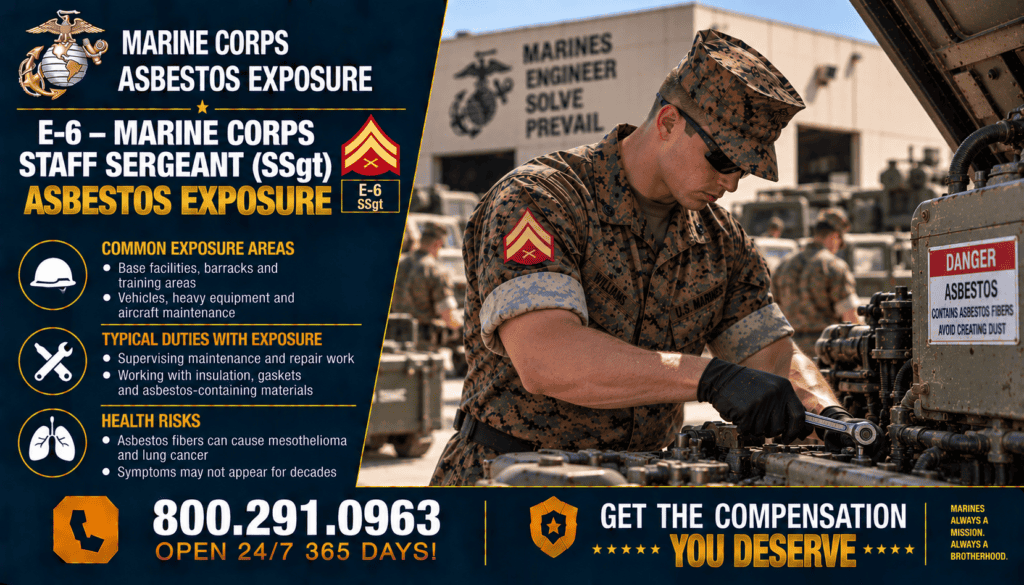
E-6 – Marine Corps Staff Sergeant (SSgt) Asbestos Exposure
⚠️ Asbestos Risks for U.S. Marine Corps Staff Sergeant (SSgt) Personnel
The rank of Staff Sergeant (SSgt) is a pivotal leadership level in the United States Marine Corps. As an E-6, the SSgt is a seasoned noncommissioned officer responsible for platoon-level leadership, technical supervision, maintenance management, and mission execution across engineering, logistics, motor transport, aviation support, infantry support, and base operations.
Because SSgts are both leaders and technical supervisors, they spend extensive time in motor pools, engineering facilities, hangars, aircraft maintenance bays, logistics warehouses, and older base structures—areas built during decades when asbestos-containing materials (ACM) were standard across all branches of the U.S. military.
From the 1940s through the late 1980s, asbestos was heavily used in:
-
aircraft insulation
-
turbines
-
HVAC ducts
-
boiler rooms
-
pipe wrap
-
brake pads and clutch parts
-
gaskets and engine seals
-
electrical boards
-
fireproofing blankets
-
barracks and administrative buildings
Marine Corps SSgts, because of their dual supervisory and operational duties, were often exposed to asbestos daily—sometimes for years.
🛠 Typical Duties of a Marine Corps Staff Sergeant (SSgt)
Platoon-Level Leadership in Engineering, Logistics, and Motor Transport
As an SSgt, responsibilities include:
-
leading engineering or motor transport platoons
-
coordinating complex maintenance operations
-
scheduling shop work and inspections
-
enforcing safety practices
-
evaluating equipment performance
-
training junior NCOs and enlisted personnel
Even when SSgts are not performing repairs personally, they are physically present in the same high-exposure spaces, inhaling the same airborne asbestos fibers released during maintenance and renovation work.
Maintenance Oversight and Technical Supervision
Staff Sergeants directly supervise:
-
vehicle engine overhauls
-
brake and clutch work
-
aircraft component repairs
-
power equipment servicing
-
HVAC and boiler maintenance
-
engineering shop operations
Before asbestos restrictions, these workplaces contained:
-
asbestos brake assemblies
-
clutch facings
-
gasket and seal materials
-
engine insulation
-
fireproofing boards
-
ACM floor and ceiling tiles
Every time a part was scraped, cracked, drilled, sanded, or replaced, asbestos fibers were released.
SSgts walked in and out of these shops constantly, meaning prolonged exposure was inevitable.
Aviation, Hangar, and Flightline Supervision
SSgts serving in aviation maintenance or avionics units encountered asbestos in:
-
turbine and exhaust systems
-
engine bay insulation
-
brake systems
-
avionics fireproof panels
-
cockpit thermal barriers
-
protective blankets
Hangars—many built before 1980—contained:
-
asbestos fireproofing
-
insulation above rafters
-
ACM wallboard
-
contaminated ventilation
Even supervising aircraft operations exposed SSgts to airborne fibers circulating across the hangar floor.
Engineering and Utilities Duties
Engineering-focused SSgts worked around:
-
boiler equipment
-
steam lines
-
power plants
-
pipe chases
-
facility HVAC systems
-
electrical switchboards
Marine Corps bases built in the 1950s–1970s used asbestos for:
-
thermal insulation
-
pipe wrap
-
ceiling and floor tiles
-
adhesives
-
fireproof wallboards
Whether SSgts performed repairs or supervised others, exposure in these confined mechanical rooms was extremely high.
Logistics and Warehouse Leadership
In logistics units, SSgts oversaw:
-
storage of materials that included ACM
-
handling old equipment lined with asbestos
-
repair of palletized machinery
-
packaging/transport of older components
Many logistics warehouses had asbestos-insulated:
-
rafters
-
heating systems
-
overhead pipes
-
loading bay doors
Dust from deteriorating ACM was common in these environments.
🧱 Asbestos Exposure Risks for Marine Corps Staff Sergeants (SSgt)
1. Aviation Facility ACM (Your Listed Exposure — Correct & Significant)
Aviation facilities used asbestos extensively in:
-
turbine and exhaust heat shielding
-
brake assemblies
-
avionics panels
-
wiring insulation
-
fireproof blankets
SSgts supervising:
-
powerline shops
-
airframes
-
engines
-
avionics
-
support equipment maintenance
were constantly exposed to asbestos dust released during aircraft repairs and hangar operations.
2. HVAC and Boiler Systems on Base
Your second listed point is one of the most dangerous exposures.
Older Marine bases used asbestos for:
-
boiler insulation
-
steam line wrapping
-
furnace cement
-
HVAC duct lining
-
fireproofing around heating rooms
Staff Sergeants overseeing engineering Marines were exposed during:
-
boiler servicing
-
pipe insulation removal
-
ductwork repairs
-
building renovations
-
emergency mechanical fixes
Confined HVAC and boiler rooms created high-concentration asbestos environments.
3. Mechanical and Electrical Shop Exposure
Almost every Marine facility before 1980 used asbestos in:
-
electrical panel boards
-
transformers
-
wiring insulation
-
gaskets
-
valves
-
engine components
-
clutch systems
-
generators
SSgts supervising daily operations encountered airborne fibers stirred up from:
-
sanding gaskets
-
replacing seals
-
drilling engine mounts
-
removing insulation
-
repairing electrical housings
Even when not the person doing the hands-on work, proximity alone exposed SSgts to dangerous asbestos levels.
📊 Why Marine Corps SSgts Have Strong Asbestos Claims
✔ Daily presence in high-risk maintenance spaces
Staff Sergeants were in shops, hangars, motor pools, and engineering rooms every day.
✔ Long military careers before asbestos bans
Most SSgts served 8–12 years before promotion, often well within the asbestos-heavy years.
✔ Leadership roles add exposure
Even if SSgts didn’t physically remove ACM, their supervisory duties placed them directly in contamination zones.
✔ Documented asbestos components in Marine Corps vehicles and aircraft
Maintenance manuals clearly list asbestos-containing parts.
✔ MOS alone often proves exposure
Courts and VA adjudicators routinely approve claims based solely on MOS history.
📂 Evidence That Helps Marine Corps Staff Sergeants Win Claims
-
MOS records showing engineering, motor T, logistics, or aviation work
-
Shop location or base construction records
-
Fellow Marine statements
-
Photographs of equipment containing ACM
-
Technical manuals listing asbestos parts
-
Shipyard/drydock service documents
Even if the Marine does not remember specific parts, exposure can be proven historically.
📉 Health Consequences of Asbestos Exposure
Marine Corps SSgts have later developed:
-
Mesothelioma
-
Asbestos lung cancer
-
Asbestosis
-
Pleural plaques
-
Scarring and chronic respiratory disorders
Symptoms often take 20–50 years to appear.
💼 Compensation Examples for Staff Sergeant-Level Exposure
Comparable Marine Corps cases have resulted in combined compensation (VA + trust funds + legal claims) such as:
-
$3.6 million — aviation mechanics
-
$3.1 million — HVAC and boiler system exposure
-
$3.4 million — motor T shop exposure
-
$2.9 million — engineering utilities personnel
These are examples, not guarantees.
💰 Benefits Available for Marine Corps SSgts with Asbestos Illness
💙 VA Disability Compensation
Mesothelioma → 100% disability
Asbestos lung cancer also frequently qualifies.
💵 Asbestos Trust Funds
Over $30 billion remains available.
⚖ Lawsuits (Against Manufacturers)
Claims target manufacturers of asbestos components—not the Marine Corps or federal government.
❤️ VA Dependency & Indemnity Compensation (DIC)
For surviving spouses and dependents.
📞 Get Help Identifying Your Asbestos Exposure as a Marine Corps Staff Sergeant
If you or a loved one served as a Marine Corps SSgt and later developed an asbestos-related illness, your MOS and service history likely establish strong evidence for exposure.
📞 Call 800.291.0963 for a free, confidential case review.
A specialist can identify every asbestos source connected to your career.