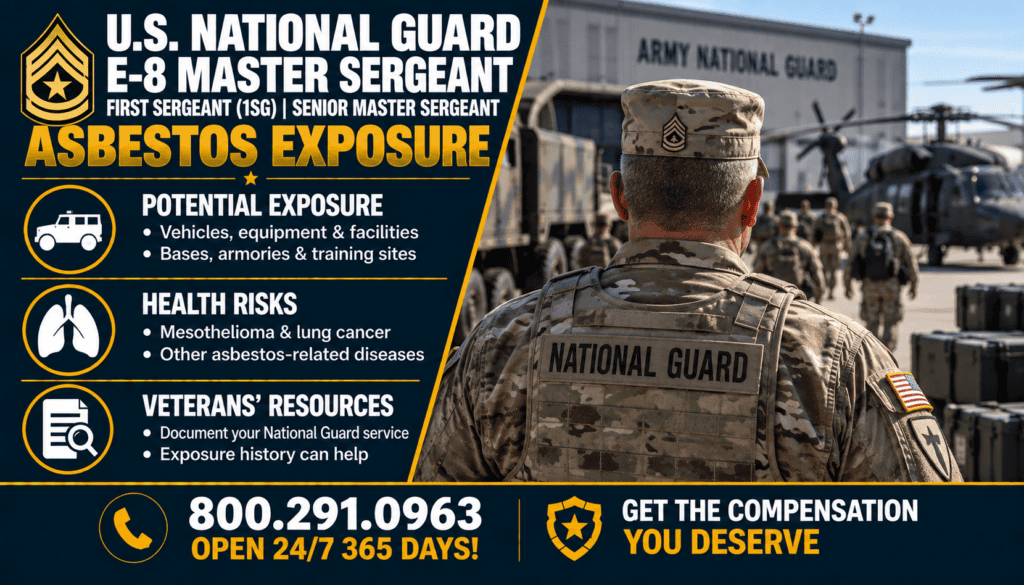
E-8 – Nat Guard Master Sergeant (MSG) / First Sergeant (1SG) / Senior Master Sergeant (SMSgt)
🛠️ Senior enlisted advisor and facility operations supervisor
Asbestos Exposure
⚠️ Pre-1980 training buildings
⚠️ Base offices and housing
Asbestos Exposure Risks for Senior Enlisted Leaders in the National Guard
An E-8 in the National Guard—Army Master Sergeant (MSG) or First Sergeant (1SG), or Air Guard Senior Master Sergeant (SMSgt)—serves as a senior enlisted leader responsible for supervising operations, overseeing facilities, ensuring unit readiness, and evaluating infrastructure conditions across multiple buildings. Their duties place them inside older administrative buildings, training centers, armories, base housing, and structural facilities constructed during decades when asbestos use was widespread.
Because E-8 personnel maintain responsibility for facility readiness and operational supervision, they frequently enter older structures to assess issues, respond to maintenance concerns, evaluate safety hazards, or guide modernization projects. These spaces often contain deteriorating asbestos materials in ceilings, flooring, drywall, insulation, HVAC ductwork, and electrical systems.
The full scope of E-8 leadership and facility operations responsibilities
How pre-1980 training buildings, offices, and housing created asbestos exposure
Why senior enlisted advisors encountered prolonged airborne fiber hazards across installations
Long-term health dangers
VA disability, asbestos trust fund eligibility, and legal options
The Senior Leadership Role of an E-8 in the National Guard
E-8 leaders serve as key advisors to commanders and oversee broad facility and operational functions.
Typical Responsibilities of a National Guard E-8 Include:
-
🏛️ supervising facility operations and maintenance priorities
-
🧰 evaluating infrastructure issues across multiple buildings
-
🪖 overseeing personnel training and readiness support
-
📋 coordinating repair schedules and contractor access
-
🔧 inspecting armories, training centers, offices, and storage areas
-
🧱 assessing building conditions before unit activities
-
🛠️ providing guidance during renovations or modernization projects
-
🧹 ensuring safe and functional working environments for units
Because E-8s oversee large facility footprints, they repeatedly enter areas with aging materials.
Why E-8 Personnel Faced Significant Asbestos Exposure
Senior enlisted leaders routinely operate in:
-
older training buildings
-
administrative offices
-
operational spaces
-
pre-1980 barracks or base housing
-
armories and readiness centers
-
maintenance or logistics areas
All of these environments historically contained asbestos-containing materials (ACM).
Exposure Source #1: Pre-1980 Training Buildings
Training structures built between the 1940s and 1970s contain asbestos in:
-
🧩 ceiling tiles
-
👣 vinyl floor tiles
-
🧱 drywall joint compound
-
❄️ HVAC duct insulation
-
🔌 wiring and electrical panels
How E-8 Leaders Are Exposed
MSGs, 1SGs, and SMSgts often:
-
inspect training rooms
-
evaluate building readiness
-
supervise renovation or repair projects
-
address mold, leaks, or structural issues
-
direct teams into older, deteriorated training areas
Disturbance of any damaged ACM causes airborne fiber release.
Exposure Source #2: Base Offices and Housing
Many Guard offices, administrative buildings, and base housing units were built before asbestos regulations changed.
Common ACM includes:
-
ceiling texture
-
floor adhesives
-
transite wall panels
-
pipe wrap
-
furnace and boiler insulation
Why E-8 Leaders Are at Risk
Their duties often require:
-
walking through offices to evaluate damage
-
directing cleanup or repair personnel
-
inspecting housing units for habitability or maintenance needs
-
responding to occupant complaints
-
overseeing safety after leaks or system failures
Older office buildings often hide asbestos behind panels, tiles, or ducting.
Exposure Source #3: Oversight of Facility Operations
E-8s frequently manage building safety at the installation level.
Exposure increases during:
-
HVAC failures
-
electrical outages
-
plumbing leaks revealing hidden insulation
-
ceiling tile collapse
-
flooring deterioration
-
emergency facility responses
These events often uncover friable asbestos.
Exposure Source #4: Coordination With Contractors and Maintenance Teams
Senior enlisted leaders supervise or observe contractor work involving:
-
floor tile removal
-
drywall and ceiling repairs
-
HVAC duct replacement
-
electrical system upgrades
-
asbestos abatement oversight
Even standing nearby during contractor work exposes leaders to airborne fibers.
Exposure Source #5: Multiple-Building Movement Across Installations
MSGs, 1SGs, and SMSgts move between numerous buildings each week:
-
training centers
-
readiness centers
-
administrative facilities
-
maintenance areas
-
barracks or housing
Each building increases cumulative asbestos exposure risk.
Long-Term Health Risks for National Guard E-8 Personnel
Asbestos diseases often appear 20–50 years after exposure.
Diseases Include:
-
🫁 Mesothelioma
-
🫀 Asbestos-related lung cancer
-
🌫️ Asbestosis
-
🩻 Pleural plaques and fibrosis
Multiple buildings and long service increase total exposure.
VA Disability Benefits for E-8 Asbestos Exposure
The VA recognizes facility oversight and infrastructure management as credible sources of exposure.
Evidence That Strengthens a VA Claim:
-
📄 records showing building inspections or facility oversight
-
🧱 documentation of older training or administrative buildings
-
💬 statements from personnel regarding unsafe building conditions
-
📝 contractor logs or renovation reports
-
🩺 medical evidence linking illness to asbestos exposure
Mesothelioma automatically qualifies for a 100% disability rating.
Asbestos Trust Fund & Legal Compensation for National Guard E-8 Veterans
Over $30 billion is available in asbestos trust funds from product manufacturers—not the military.
Compensation Options Include:
-
💵 asbestos trust fund payouts
-
⚖️ lawsuits against asbestos manufacturers
-
👨👩👧 survivor claims
-
🎖️ VA disability benefits (separate from legal compensation)
E-8s often qualify due to their high frequency of facility exposure.
📞 Free Case Review for National Guard E-8 Veterans
If you served as an E-8 MSG, 1SG, or SMSgt in the National Guard and later developed mesothelioma, asbestos lung cancer, or asbestosis, you may qualify for significant compensation.
📞 Call 800.291.0963 now for a free, confidential case review.
A specialist will help document your exposure history and identify every eligible compensation source.