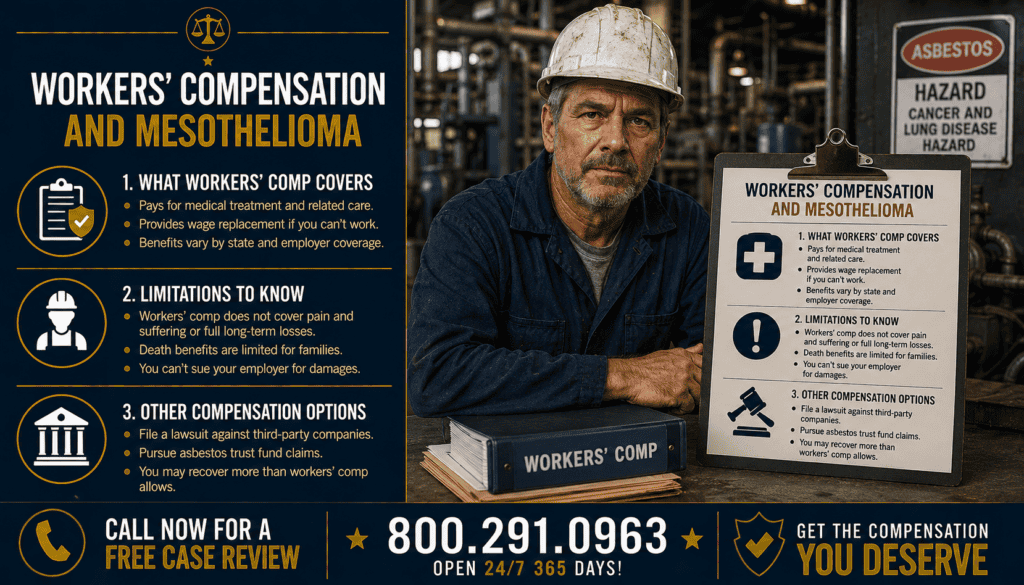
Workers’ Compensation and Mesothelioma
Workers’ compensation may provide benefits when mesothelioma is connected to occupational asbestos exposure, but the applicable system depends on the worker’s employment. Most private-sector workers are governed by state workers’ compensation laws, while federal civilian employees and certain maritime workers may fall under federal programs. Eligibility, benefits, filing rules and the relationship to other asbestos claims vary significantly by jurisdiction and employment status.
The U.S. Department of Labor recognizes mesothelioma as an example of an occupational disease that can result from workplace asbestos exposure under the Longshore and Harbor Workers’ Compensation Act. DOL also notes that occupational diseases may have long latency periods and can become apparent after retirement. A useful claim analysis therefore begins with the worker’s employment category, asbestos-exposure history, diagnosis and the rules of the compensation system that actually applies.
⚖️ Workers’ Compensation and Mesothelioma
Workers’ compensation is not one national program with identical rules. State systems generally govern private and state/local employment, while federal statutes cover defined groups such as federal civilian employees and many longshore or harbor workers. A mesothelioma diagnosis alone does not establish workers’ compensation eligibility; the claim must satisfy the requirements of the applicable program.
Start with the Mesothelioma Compensation Types hub. Identify every employer, jobsite and employment period because a long-latency occupational disease can raise questions about which employer, insurer or compensation system is responsible.
| Worker category | Potential system |
|---|---|
| Private-sector worker | Applicable state workers’ compensation system |
| State/local public employee | Applicable state or local compensation rules |
| Federal civilian employee | Federal Employees’ Compensation Act (FECA) |
| Qualifying longshore/harbor worker | Longshore and Harbor Workers’ Compensation Act (LHWCA) |
| Some overseas federal contractors | Defense Base Act, depending on coverage |
🏭 Mesothelioma as an Occupational Disease
DOL defines an occupational disease under the Longshore program as an illness or medical condition developing from exposure to harmful workplace conditions or substances and specifically identifies mesothelioma resulting from asbestos exposure as an example. DOL also recognizes that these diseases can have long latency periods.
For a mesothelioma workers’ compensation claim, reconstruct the worker’s asbestos exposure rather than relying only on the occupation title. Relevant details may include employers, departments, jobsites, dates, tasks, products, insulation, machinery, coworkers and industrial-hygiene information.
🗺️ State Workers’ Compensation Systems
State workers’ compensation laws differ on occupational-disease coverage, filing procedures, benefit calculations, proof requirements, responsible employers or insurers, and the interaction between workers’ compensation and civil claims. A rule from one state should not be applied to another.
Because mesothelioma can appear decades after asbestos exposure, the worker may have lived or worked in several states. Employment location, exposure location, employer history and other jurisdictional facts can matter. Review Mesothelioma Lawsuits in All 50 States as a starting point for state-specific research, while checking the relevant state workers’ compensation agency for current compensation rules.
🏛️ Federal Employees and FECA
The Federal Employees’ Compensation Act covers work-related injuries and occupational diseases of civilian federal employees. DOL states that FECA can provide medical care, wage-loss compensation, vocational rehabilitation, schedule awards in qualifying cases and survivor benefits. Federal employees filing an occupational-disease claim generally use Form CA-2 through ECOMP.
DOL’s FECA guidance defines an occupational disease as a condition produced by continued or repeated exposure to elements of the work environment over more than one workday or shift. Its procedure manual also contains specific development guidance for asbestos-related disease claims.
| Evidence | Purpose |
|---|---|
| Federal employment records | Establish agency, position and dates |
| CA-2 occupational-disease filing | Initiates the federal occupational-disease claim |
| Exposure evidence | Documents asbestos-related workplace conditions |
| Medical report | Documents diagnosis and medical relationship to employment |
⚓ Longshore, Harbor and Shipyard Workers
The LHWCA provides workers’ compensation protection for qualifying maritime employees and occupational diseases related to covered employment. DOL states that the Act provides medical benefits, compensation for lost wages and rehabilitation services, and survivor benefits when a work-related injury causes death.
DOL’s Longshore FAQ specifically identifies mesothelioma from asbestos exposure as an occupational disease and states that benefits may be available even when symptoms or disability do not appear until after retirement. Coverage still depends on the Act’s employment and situs/status requirements and the facts of the individual case.
💵 Types of Workers’ Compensation Benefits
Workers’ compensation benefits differ by program but can include medical treatment, wage-loss or disability compensation and survivor benefits. DOL states that FECA pays medical expenses and compensation benefits to injured federal workers and survivors. Under the LHWCA, medical benefits, lost-wage compensation and rehabilitation services may be available to covered workers.
Workers’ compensation benefits should not be equated with civil lawsuit damages. Compensation statutes use their own benefit formulas and eligibility requirements, while tort claims can involve different categories of damages and different responsible parties.
| Benefit | General purpose |
|---|---|
| Medical benefits | Covered treatment for accepted work-related disease |
| Disability/wage loss | Compensation for qualifying loss of earning capacity or disability |
| Rehabilitation | Services available under certain programs |
| Survivor/death benefits | Benefits for qualifying survivors under applicable law |
🗂️ Evidence for an Occupational Mesothelioma Claim
A workers’ compensation mesothelioma claim generally requires evidence of employment, workplace asbestos exposure, diagnosis and the required causal relationship under the governing law. DOL’s FECA claim guidance states that occupational-disease submissions may require a medical report describing the condition and explaining how it was caused by claimed work factors.
Preserve employment and payroll records, Social Security work history when relevant, union records, military or federal personnel files, job descriptions, product and equipment evidence, coworker statements, industrial-hygiene records and medical documentation. See the Mesothelioma Lawsuit Evidence & Documentation hub.
| Link | Possible documentation |
|---|---|
| Employment | Personnel, payroll, union or Social Security records |
| Workplace asbestos | Product, equipment, facility and industrial-hygiene evidence |
| Worker contact | Job duties, work practices and coworker testimony |
| Diagnosis | Pathology, imaging and treating-clinician records |
| Medical relationship | Qualified medical evidence required by the applicable program |
🔗 Workers’ Compensation and Other Asbestos Claims
Workers’ compensation can interact with other asbestos compensation sources, but the rules are not uniform. Depending on applicable law and the responsible parties, questions can arise about claims against asbestos product manufacturers, premises defendants, bankruptcy trusts or other third parties.
Do not assume that receiving workers’ compensation either permits or prevents every other asbestos claim. Exclusivity, subrogation, liens, credits and offsets are jurisdiction-specific. Review Mesothelioma Claims and What Are Asbestos Trust Funds? for related compensation pathways.
⏱️ Filing Deadlines and Latent Disease
Occupational-disease deadlines require special attention because asbestos diseases can appear long after exposure. DOL’s Longshore guidance expressly recognizes long latency. Under FECA, DOL explains that the filing period for a latent condition is tied to when an employee with compensable disability knew or reasonably should have known of a possible relationship between the medical condition and employment, subject to the statute’s detailed rules.
State systems use their own notice and filing provisions, so the FECA rule should not be generalized to private-sector claims. Record diagnosis dates, when a work relationship was first suspected, last exposure dates, retirement dates and all relevant employment periods, then check the governing program promptly.
❓ Frequently Asked Questions
Can mesothelioma qualify as an occupational disease?
Yes. DOL specifically identifies mesothelioma resulting from asbestos exposure as an occupational disease under its Longshore guidance.
Can a retired worker still have a workers’ compensation claim?
Potentially. DOL states that Longshore occupational-disease benefits may be available even when symptoms or disability do not occur until after retirement. Other systems have their own rules.
Does every mesothelioma worker use the same workers’ compensation program?
No. Coverage depends on employment status, location, occupation and applicable state or federal law.
What program covers civilian federal employees?
Work-related occupational diseases of civilian federal employees may fall under FECA, administered by the U.S. Department of Labor’s Office of Workers’ Compensation Programs.
Can shipyard workers have federal workers’ compensation coverage?
Qualifying maritime workers may be covered by the LHWCA, depending on the Act’s coverage requirements and the facts.
What evidence is important?
Employment records, workplace asbestos evidence, job-duty information, coworker evidence and medical documentation can be important.
Can workers’ compensation be combined with other asbestos claims?
Sometimes other claims may exist, but exclusivity, liens, offsets, subrogation and third-party rules depend on the governing law.
Is workers’ compensation for mesothelioma guaranteed?
No. Coverage, occupational exposure, medical evidence, timeliness and other statutory requirements must be satisfied under the applicable program.
📞 Submit Your Case
If you or a loved one has a mesothelioma diagnosis and a history of occupational asbestos exposure, gather a complete work history before evaluating compensation options. Include employers, jobsites, job titles, dates, tasks, products, equipment, coworkers, union or federal records and medical documentation. Identifying whether state workers’ compensation, FECA, Longshore or another system applies is an important early step.
Call 800.291.0963 for a no-obligation case evaluation. Live chat is available 24/7, 365 days a year. Submit your case here.
📝 Summary
Workers’ compensation may provide benefits for mesothelioma linked to occupational asbestos exposure, but the correct system depends on the worker’s employment. State workers’ compensation laws generally govern many private-sector claims, while FECA covers civilian federal employees and the LHWCA covers qualifying maritime workers. Long latency makes accurate work and exposure histories especially important. Eligibility, benefits, deadlines and interaction with other asbestos claims depend on the applicable law, and no outcome is guaranteed.
🔗 Confirmed Sources
- U.S. Department of Labor — Longshore and Harbor Workers’ Compensation Act FAQs
- U.S. Department of Labor — LHWCA Compliance Assistance
- U.S. Department of Labor — Federal Employees’ Compensation Program
- U.S. Department of Labor — How to File a Federal Workers’ Compensation Claim
- U.S. Department of Labor — Federal Employees’ Compensation Act
- U.S. Department of Labor — FECA Procedure Manual, Asbestos-Related Diseases
This page provides general information, not legal or medical advice. This website is not a law firm. Workers’ compensation coverage, eligibility, benefits, filing deadlines and interaction with other claims depend on individual facts and applicable state or federal law. No outcome is guaranteed.