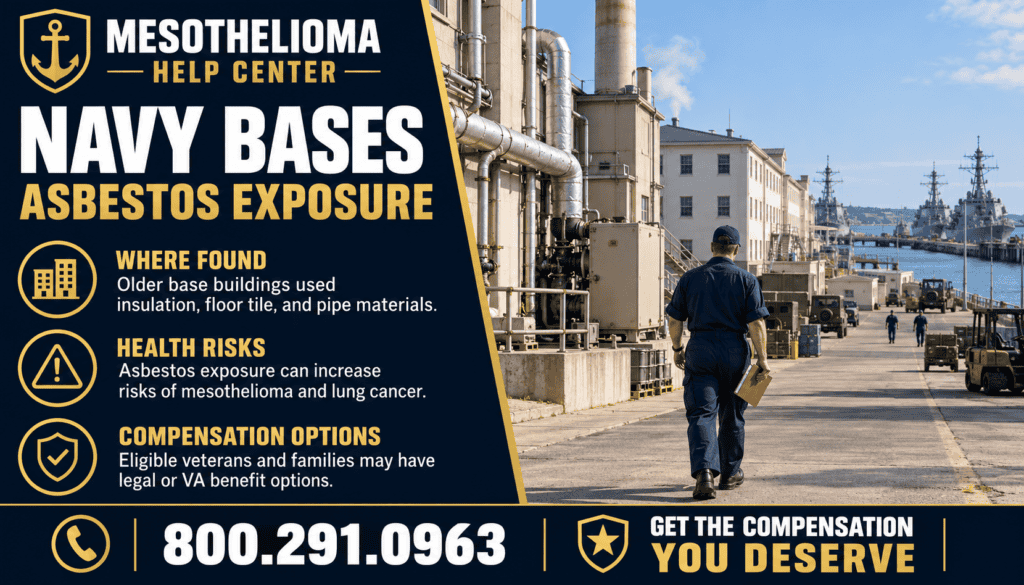
⚓ Navy Bases Asbestos Exposure
U.S. Navy bases have supported ships, aircraft, training, housing, medical care, maintenance, utilities, logistics, and thousands of military and civilian workers. Many installations include buildings and infrastructure constructed during periods when asbestos was widely used for insulation, fire resistance, heat protection, and other industrial and construction purposes.
Serving or working at a Navy base does not by itself prove asbestos exposure. A supportable exposure history should identify the installation, dates, occupation or Navy rating, buildings or work areas, specific tasks, and asbestos-containing materials that were present and disturbed. This hub organizes the major Navy base exposure pathways within our broader U.S. Navy Asbestos Exposure resource.
🏢 Older Navy Buildings and Infrastructure
Older military facilities may contain legacy asbestos-containing materials that remain in place. EPA states that asbestos in good condition and left undisturbed is unlikely to present the same health risk as material that is damaged or disturbed and releases airborne fibers.
Depending on the specific building and era, an investigation may examine:
- Thermal-system insulation on pipes, boilers, tanks, ducts, and other equipment.
- Floor and ceiling materials including certain historical tiles, backing, adhesives, and surfacing products.
- Roofing and siding including some shingles, felts, and cement products.
- Fire- and heat-resistant products used in mechanical or utility spaces.
- Wall, patching, and coating materials where asbestos content is documented.
- Mechanical components such as certain historical gaskets, packing, and insulation products.
EPA cautions that asbestos cannot reliably be identified simply by looking at a suspect material. Building surveys, laboratory testing, specifications, renovation records, and abatement files can provide stronger evidence.
Housing and living-space histories can be researched through Navy Barracks Asbestos Exposure and Navy Base Housing Asbestos Exposure.
⚙️ Maintenance Shops and Utility Systems
Navy bases depend on heating, ventilation, plumbing, steam, electrical, vehicle, and mechanical systems. Personnel who maintained these systems may have encountered older insulating and heat-resistant products differently from people whose duties did not involve maintenance.
Potential work areas can include boiler rooms, mechanical rooms, utility tunnels, pipe runs, HVAC spaces, electrical rooms, vehicle shops, equipment-maintenance buildings, warehouses, and repair facilities.
VA identifies pipefitters, welders, boiler operators, construction workers, insulation workers, and renovation or demolition specialists among military occupations with potential asbestos exposure. VA also recognizes historical asbestos use in gaskets, valves, cements, adhesives, floor and pipe coverings, friction products, and heat-resistant fabrics.
The Navy Equipment Asbestos Exposure, Navy Vehicles Asbestos Exposure, and Navy Occupations Asbestos Exposure hubs can help narrow an investigation to the actual equipment and work performed.
📍 Navy Base Exposure Locations
Different areas of a Navy installation can present very different historical exposure questions. The following resources focus on major facility types and specific Navy-base environments:
San Diego Naval Base
San Diego Naval Base Asbestos Exposure examines the installation’s long history of ship support, repair, maintenance, and older shore facilities.
Naval air stations and aircraft hangars
Naval Air Stations & Aircraft Hangars Asbestos Exposure covers older hangar construction, aviation maintenance, ground-support equipment, utility systems, and renovation work. Veterans with aircraft-related duties can also review Navy Aircraft Asbestos Exposure.
Decommissioning and inactive-ship yards
Navy Decommissioning Yards Asbestos Exposure addresses ship inactivation, equipment removal, preservation, storage, and work around legacy materials on older vessels and yard facilities.
Naval hospitals and medical facilities
Naval Hospital Facilities Asbestos Exposure examines older medical buildings, mechanical systems, renovation work, and the different exposure circumstances of maintenance personnel, clinical staff, patients, and contractors.
Barracks and base housing
Navy Barracks Asbestos Exposure and Navy Base Housing Asbestos Exposure focus on living quarters and legacy construction materials. Routine occupancy should not be equated automatically with harmful asbestos exposure; disturbance and condition of the material matter.
Overseas Navy bases
Navy Overseas Bases Asbestos Exposure helps veterans reconstruct exposure histories involving installations outside the United States, where building ages, construction practices, maintenance histories, and records can differ.
👷 Navy Personnel and Civilian Workers
Exposure potential depended heavily on actual work. A person assigned to administrative duties could have had a different exposure history from a pipefitter, electrician, boiler operator, mechanic, construction worker, facility-maintenance employee, or contractor working around disturbed legacy materials.
Military exposure histories can include Navy ratings, commands, duty stations, training, temporary assignments, and specific work details. Civilian workers may need additional records from employers, unions, contractors, payroll systems, or Social Security employment histories.
Secondhand or take-home exposure can also require investigation when workers historically carried asbestos dust on clothing or personal items. Such claims depend on the actual work, material, exposure circumstances, jurisdiction, and evidence rather than occupation alone.
The Navy Occupations Asbestos Exposure hub provides job-specific pathways for reconstructing duties.
🛠️ Renovation, Demolition, and Asbestos Disturbance
Disturbance is a central issue in building-related asbestos exposure. EPA states that renovation or replacement of utility systems can increase the potential for disturbing asbestos-containing material. Current federal asbestos rules also establish inspection and work-practice requirements for many regulated renovation and demolition projects.
Historical exposure investigations can therefore examine projects such as:
- Removing pipe or boiler insulation.
- Replacing old flooring, ceiling materials, or roofing.
- Opening walls and ceilings for electrical, plumbing, or HVAC upgrades.
- Removing boilers, tanks, ducts, pumps, or other mechanical systems.
- Demolishing obsolete buildings or facility sections.
- Repairing damaged asbestos-containing materials.
- Working nearby while another trade disturbed documented asbestos-containing material.
Modern asbestos regulations and abatement practices should not automatically be projected backward onto earlier decades. For a historical claim, records from the period of service or employment are more useful than assumptions based on current conditions.
🫁 Mesothelioma and Asbestos-Related Health Risks
VA states that asbestos exposure can present a serious health risk when asbestos-containing material is disturbed and fibers become airborne. Asbestos-related illnesses can include mesothelioma, lung cancer, asbestosis, and pleural disease.
The delay between exposure and disease is important for Navy veterans. VA reports that symptoms of asbestos-related diseases often do not appear until 20 to 50 years after exposure. A person stationed at an older Navy installation decades ago may therefore develop disease much later.
A diagnosis does not identify the exposure source by itself. A complete history should consider military service, civilian employment, home renovation, family or household exposure, and other relevant sources.
Veterans can review Navy Asbestos Exposure Health Risks, Navy Asbestos Exposure Timeline, and the Navy Medical & Health Asbestos Exposure hub.
📂 Evidence and Navy Base Records
A strong Navy base exposure history connects the person to a specific installation, building or work area, time period, task, and asbestos-containing material. Evidence can come from multiple sources.
- Military personnel records: DD-214, ratings, commands, assignments, duty stations, and service dates.
- Civilian employment records: employer, union, contractor, payroll, or Social Security documentation.
- Facility records: building plans, asbestos surveys, inspection reports, renovation files, abatement records, and environmental documents.
- Maintenance records: work orders, utility projects, equipment repairs, and contractor documentation.
- Product evidence: specifications, technical manuals, manufacturer literature, procurement records, and invoices.
- Witness statements: firsthand accounts from coworkers, supervisors, contractors, or other service members.
- Medical evidence: pathology, imaging, diagnostic reports, physician records, and treatment history.
The Navy Records & Documentation for Asbestos Exposure and Documents Needed for Navy Asbestos Claims pages can help organize these records.
VA benefits and legal options
VA states that veterans may qualify for disability compensation when they have a health condition caused by asbestos exposure during military service. VA requires evidence of the health condition, military asbestos contact, and a connection between the two. See Navy VA Benefits for Mesothelioma.
Depending on evidence identifying private-company products or operations, other potential options may include a Navy Veterans Mesothelioma Lawsuit or Navy Asbestos Trust Fund Claim. The Navy Asbestos Legal Options hub explains these separate systems. No VA benefit, settlement, trust payment, or legal recovery is guaranteed.
⚓ Get Help Reviewing Navy Base Asbestos Exposure
If you or a family member served or worked at a U.S. Navy base and has been diagnosed with mesothelioma, asbestos-related lung cancer, or another asbestos-related disease, the installation, dates, occupation, buildings, work areas, maintenance or renovation duties, equipment, materials, and medical records can help determine whether a supportable exposure history can be developed.
Call 800.291.0963 to discuss the Navy service and exposure history. Live chat is available 24/7, 365 days a year. You can also Submit Your Case. No compensation, VA benefit, settlement, trust payment, or legal outcome is guaranteed.
⚕️ Legal & Medical Information Disclaimer
This page provides general educational information and is not legal or medical advice. It does not establish asbestos exposure, diagnosis, causation, liability, VA eligibility, trust eligibility, or entitlement to compensation. Consult a qualified medical professional about health concerns and a licensed attorney about legal rights and filing deadlines.