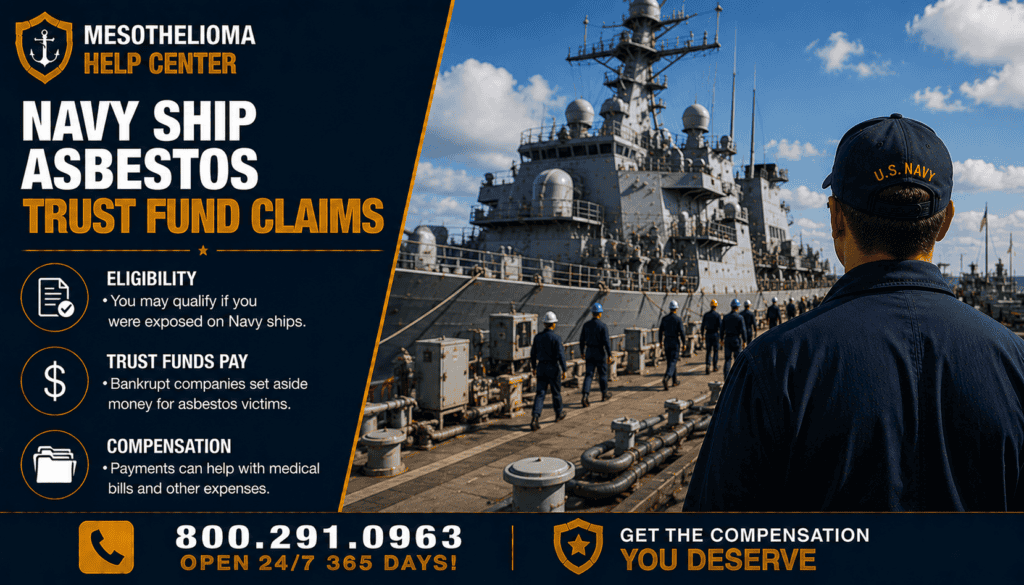
⚖️ Navy Asbestos Trust Fund Claims
U.S. Navy veterans diagnosed with mesothelioma, asbestos-related lung cancer, or another asbestos-related disease may have a potential claim against one or more asbestos bankruptcy trusts when evidence connects their exposure to a company covered by a trust. These claims are separate from Department of Veterans Affairs benefits and are also different from lawsuits against companies that remain legally available as defendants.
Trust eligibility is not automatic because someone served aboard a Navy ship or worked at a Navy base. Each trust has its own medical, exposure, product, site, occupation, and filing requirements. A strong claim begins by reconstructing the veteran’s Navy service and identifying the companies or products that may be connected to the exposure. This page explains that process within our broader U.S. Navy Asbestos Exposure resource.
⚓ Navy Asbestos Trust Fund Claims Overview
Asbestos bankruptcy trusts exist because some companies facing asbestos liabilities reorganized through bankruptcy. Federal bankruptcy law provides a framework under 11 U.S.C. § 524(g) for certain asbestos liabilities to be addressed through trusts. The specific trust documents then establish how present and future claims are reviewed and paid.
For Navy veterans, the central issue is usually whether evidence can connect the veteran to asbestos-containing products, equipment, materials, or operations associated with a company covered by a trust. Navy service can help establish the time and place of exposure, but it does not by itself establish trust eligibility.
Veterans who are still determining which legal paths may apply can begin with the Navy Asbestos Legal Options hub. Our Veterans’ Rights Under Federal Asbestos Compensation Laws page provides additional background on the distinction between military benefits and private-company asbestos claims.
🏦 How Asbestos Bankruptcy Trusts Work
An asbestos trust is not a general government compensation program for everyone exposed to asbestos. It is associated with the liabilities addressed through a particular company’s bankruptcy process. Claimants must satisfy the requirements established by that trust.
Trust procedures vary. Depending on the trust, requirements may address the diagnosed disease, exposure dates, occupation, work site, product identification, duration or circumstances of exposure, medical documentation, and other criteria. Trust documents can also establish different review procedures and payment rules.
A claimant therefore should not assume that qualifying for one asbestos trust means qualifying for another. Evidence should be matched to the requirements of each trust being considered.
Trust funds also need to account for future claimants who may develop asbestos-related disease years later. The Department of Justice has described the role of future-claimant protections in asbestos bankruptcy proceedings, reflecting the long latency associated with asbestos-related disease.
✅ Who May Qualify for a Navy Asbestos Trust Claim?
Eligibility depends on the specific trust. In general, a Navy veteran or other claimant may need to establish a qualifying asbestos-related disease and a qualifying exposure history connected to the company represented by the trust.
Relevant facts may include the veteran’s diagnosis, Navy service dates, ship or base assignments, occupation or rating, work areas, maintenance duties, products or machinery encountered, exposure dates, and supporting medical and product evidence.
Some veterans had asbestos exposure both during Navy service and in civilian employment. A complete exposure history should include both. Omitting civilian work or other exposure can make the history incomplete and may create inconsistencies among claims.
No one should assume eligibility based solely on a diagnosis, Navy service, a particular rating, or service aboard an older ship. Trust criteria must be applied to the actual evidence.
📂 Evidence Needed for Navy Asbestos Trust Claims
Trust evidence requirements differ, but Navy claimants commonly benefit from organizing several categories of records. Our Documents Needed for Navy Asbestos Claims page provides a broader evidence checklist.
- Military service records: DD-214, personnel records, ratings, training, ships, bases, and duty assignments.
- Exposure records: shipyard, repair, overhaul, base, or work records that help establish where exposure could have occurred.
- Product evidence: technical manuals, equipment specifications, invoices, procurement records, catalogs, manufacturer documents, or other reliable product identification.
- Occupational evidence: records or testimony explaining the veteran’s actual work and how asbestos-containing materials may have been disturbed.
- Witness statements: firsthand accounts from shipmates, coworkers, supervisors, or others familiar with the work.
- Medical evidence: pathology, diagnostic reports, imaging, physician records, and other documentation required for the claimed disease.
The Navy Records & Documentation for Asbestos Exposure, Navy Ship Exposure Evidence Guide, and Requesting Shipyard & Base Work Records pages can help reconstruct older service histories.
A useful evidence chain is: Navy assignment → work location → task → asbestos-containing product or material → company connected to the trust → qualifying diagnosis.
🔄 Claims Involving Multiple Asbestos Trusts
A veteran may have encountered products associated with more than one asbestos company over a military and civilian work history. If more than one applicable trust exists and the evidence satisfies each trust’s requirements, multiple trust claims may potentially be considered.
That does not mean every claimant qualifies for multiple trusts. Each claim requires its own support. Exposure statements should also be complete and consistent across trust claims and any related litigation.
Federal asbestos bankruptcy proceedings have placed attention on transparency concerning claims made to multiple trusts and in civil litigation. This is another reason to build one accurate exposure history rather than treating each claim as an isolated narrative.
⚖️ Trust Claims, Lawsuits, and VA Benefits
Asbestos trust claims, civil lawsuits, and VA disability benefits are different systems.
Asbestos trust claims
Trust claims seek compensation under the rules of a bankruptcy trust associated with a particular company’s asbestos liabilities.
Civil asbestos lawsuits
A lawsuit may seek damages from legally responsible companies that remain subject to civil claims. Product identification, causation, jurisdiction, defenses, and other requirements depend on the case. See Navy Veterans Mesothelioma Lawsuit.
VA disability compensation
VA compensation is based on service-connected disability rather than private-company liability. VA states that an asbestos claimant needs medical records stating the health condition, service records listing the job or specialty, and a doctor’s statement connecting military asbestos exposure to the condition. See Navy VA Benefits for Mesothelioma.
A veteran may potentially have rights under more than one system, depending on the evidence and applicable rules. Filing one type of claim should not be assumed to guarantee—or automatically eliminate—another.
⏳ Trust Filing Requirements and Deadlines
Each asbestos trust operates under its own governing documents and claim procedures. Deadlines and requirements can differ based on the trust, disease, exposure history, and other circumstances.
Civil lawsuits are also subject to statutes of limitations that vary by jurisdiction and case facts. Veterans should not assume that the availability of a trust claim extends a lawsuit deadline or that collecting records pauses a filing period.
The Navy Asbestos Statute of Limitations page explains why deadline review should occur early. Families dealing with a deceased veteran can also review Navy Wrongful Death Asbestos Lawsuits because different deadlines and claimant requirements may apply.
❓ Navy Asbestos Trust Fund Claims FAQ
What is an asbestos trust fund?
An asbestos bankruptcy trust is a mechanism created through a company’s bankruptcy process to address qualifying asbestos liabilities under trust-specific rules.
Does Navy service automatically qualify a veteran for an asbestos trust?
No. The claimant generally needs evidence connecting a qualifying disease and exposure history to a company covered by the specific trust.
Can a Navy veteran file claims with more than one asbestos trust?
Potentially, when the evidence independently satisfies the requirements of more than one trust. Eligibility must be evaluated trust by trust.
What records can help support a Navy trust claim?
Service records, ship or base assignments, technical manuals, equipment and product records, shipyard documents, witness statements, and medical evidence may all be useful depending on the trust.
Is an asbestos trust claim the same as a lawsuit?
No. A trust claim follows the procedures of a bankruptcy trust. A civil lawsuit proceeds against legally available defendants under applicable law.
Are VA benefits the same as asbestos trust compensation?
No. VA disability compensation is based on service-connected disability. Trust claims are based on the requirements of individual asbestos bankruptcy trusts.
Is compensation guaranteed if a veteran has mesothelioma?
No. A diagnosis is important medical evidence, but trust eligibility, exposure proof, product identification, filing requirements, and other criteria still must be satisfied.
⚓ Get Help Reviewing Navy Asbestos Trust Fund Claims
If you or a family member served in the U.S. Navy and has been diagnosed with mesothelioma, asbestos-related lung cancer, or another asbestos-related disease, identifying ships, bases, ratings, duties, equipment, products, manufacturers, and civilian employment can help determine whether any asbestos bankruptcy trusts deserve investigation.
Call 800.291.0963 to discuss the Navy service and exposure history. Live chat is available 24/7, 365 days a year. You can also Submit Your Case. No compensation, VA benefit, settlement, trust payment, or legal outcome is guaranteed.
⚕️ Legal & Medical Information Disclaimer
This page provides general educational information and is not legal or medical advice. Trust eligibility, evidence requirements, payment rules, and deadlines vary by trust and individual circumstances. Consult a qualified medical professional about health concerns and a licensed attorney about legal rights and filing requirements.