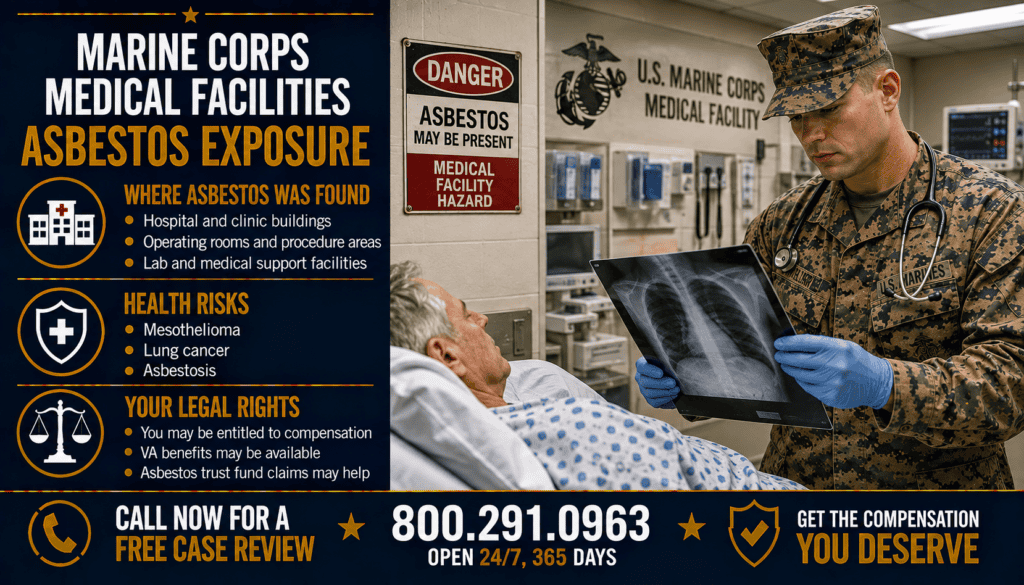
⚓ Marine Corps Medical Facilities Asbestos Exposure
Marine Corps medical facilities often occupied buildings with heating, ventilation, plumbing, and electrical systems that were maintained over many decades. Historic asbestos risk in these facilities concerns the condition and disturbance of particular building materials, not the mere act of receiving medical care.
Patients, corpsmen, clinical staff, maintenance personnel, and contractors had different potential contact patterns. Establishing exposure requires a building, renovation period, material identification, and credible evidence that fibers entered occupied air.
🧭 Exposure Context
Older medical buildings can contain materials associated with steam heating, plumbing, ventilation, flooring, and fire protection. Their presence is not proof that patients or staff inhaled asbestos. Risk depends on disturbance, fiber release, location, and duration. For broader context, compare the distinct duties and locations described in Marine Corps Bases Asbestos Exposure; the page does not replace a person-specific exposure history.
A medical facility may serve Marine personnel while being staffed by Navy medical workers and civilian employees. Those groups have different employment records and potentially different benefit systems; identifying the person’s actual role is therefore a necessary first step. The related Marine Corps Barracks Asbestos Exposure page provides a separate look at that equipment or setting, which should not be assumed to match every Marine’s assignment.
📍 Where Exposure May Have Occurred
The locations below describe plausible historical contact points, not a finding that every Marine Corps site contained asbestos. A site survey, dated maintenance file, or identified component is needed to establish which materials were present and whether work could have released fibers. Readers reviewing service histories can also examine Marine Corps HVAC Equipment Asbestos Exposure for another relevant route of contact with older materials.
| Work Area or Setting | Why Exposure May Have Occurred |
|---|---|
| Boiler and mechanical rooms | Insulation on heating lines and equipment disturbed during service |
| Treatment-wing corridors | Ceiling or wall materials affected by documented renovation work |
| Maintenance closets and service shafts | Pipe elbows, valves, and HVAC components accessed by trades |
| Older utility tunnels | Thermal insulation on steam or condensate distribution lines |
Different trades entered these spaces for different reasons. Someone stationed nearby may have only indirect contact, while the person cutting, grinding, stripping, or cleaning an affected material may have performed the work most relevant to airborne dust. Work logs can distinguish these situations. A related discussion appears in Marine Corps Boiler Equipment Asbestos Exposure, but any individual case still needs its own dates, tasks, and product evidence.
🛠️ How Exposure Could Have Happened
Distinguish Patient Presence From Maintenance Exposure
A Marine receiving routine treatment was not necessarily exposed to asbestos. Risk assessment asks whether suspect material was damaged, whether work released fibers, how ventilation carried dust, and whether the person was present during the event. Facilities records are more informative than a broad statement that a clinic was old. The circumstances discussed under Marine Corps Pump Equipment Asbestos Exposure may help identify which records to request without treating a possible exposure as confirmed.
Hospital departments and building wings can have separate renovation histories. Floor plans help locate which patient or staff areas were adjacent to the reported work. For broader context, compare the distinct duties and locations described in Marine Corps Electrical Equipment Asbestos Exposure; the page does not replace a person-specific exposure history.
Trace Hospital Utility Systems
Heating plants, pipe chases, and mechanical rooms were typical locations for historical thermal insulation. Repairing a leaking valve or removing old lagging can differ substantially from walking through a corridor where intact materials remained undisturbed. The OSHA hospital facilities guidance identifies boilers, pipe insulation, and building renovation as relevant examples. The related Marine Corps Power Facilities Asbestos Exposure page provides a separate look at that equipment or setting, which should not be assumed to match every Marine’s assignment.
Mechanical rooms can be locked or restricted; access records help distinguish tradespeople from occasional visitors. Maintenance methods and containment are critical facts. Readers reviewing service histories can also examine Marine Corps Maintenance Buildings Asbestos Exposure for another relevant route of contact with older materials.
Consider Renovation and Infection-Control Barriers
Healthcare buildings are frequently remodeled to accommodate new clinical equipment or services. A reconstruction of a particular project should look for abatement notices, contractor logs, containment plans, and air-monitoring records. Dust-control barriers matter, but their presence alone does not prove asbestos contamination. A related discussion appears in Marine Corps Base Housing Asbestos Exposure, but any individual case still needs its own dates, tasks, and product evidence.
The type of renovation matters: painting an intact surface differs from drilling, demolition, or removing thermal insulation. The circumstances discussed under Marine Corps Electricians Asbestos Exposure may help identify which records to request without treating a possible exposure as confirmed.
Identify Which Workers Entered Service Spaces
Civilian facilities staff, Navy medical personnel, Marine support staff, and outside contractors may have performed different tasks. Job descriptions and work orders can show who removed insulation, maintained air handlers, repaired plumbing, or cleaned after construction. Service status affects benefits and legal routes. For broader context, compare the distinct duties and locations described in Marine Corps Maintenance Crews Asbestos Exposure; the page does not replace a person-specific exposure history.
Contractor payroll and facility work orders may exist even when individual military personnel files do not describe the building repair. The related Marine Corps Asbestos Exposure Health Risks page provides a separate look at that equipment or setting, which should not be assumed to match every Marine’s assignment.
Assess Possible Indirect Exposure
A person might encounter dust carried from a nearby repair activity, but an indirect-exposure theory requires more than proximity to a building. Dates, door locations, airflow, cleaning methods, and documented disturbance all affect the evaluation. Readers reviewing service histories can also examine Marine Corps VA Benefits for Mesothelioma for another relevant route of contact with older materials.
Potential dust migration requires attention to doors, temporary barriers, ventilation, and the timing of occupancy rather than assuming that all nearby rooms shared the same conditions. A related discussion appears in Marine Corps Mesothelioma Lawsuit, but any individual case still needs its own dates, tasks, and product evidence.
📁 Records and Evidence
An exposure chronology should place documents in order and distinguish firsthand observation from later inference. Medical records establish the disease; service and workplace records help establish the setting; product records may identify the source. These are related but separate evidentiary questions. The circumstances discussed under Marine Corps Family Secondhand Asbestos Exposure may help identify which records to request without treating a possible exposure as confirmed. In Marine medical facilities, the building wing, renovation date, and the person’s role must be established separately.
| Record or Evidence | What It Can Establish |
|---|---|
| Facility renovation and abatement files | When and where suspect materials were disturbed |
| Building plans and mechanical schedules | Locations of heating, duct, and plumbing systems |
| Personnel duty rosters | Whether a person was assigned to the relevant wing or trade |
| Air monitoring and incident reports | Measured conditions and recorded containment problems |
When official records are incomplete, contemporaneous photographs, unit newsletters, former coworker statements, and dated personal notes may help establish context. A witness should describe what they actually saw rather than assert that a product contained asbestos without supporting information. For broader context, compare the distinct duties and locations described in U.S. Marine Corps Asbestos Exposure; the page does not replace a person-specific exposure history.
🩺 Mesothelioma and Asbestos-Related Lung Cancer
Mesothelioma
Mesothelioma is a malignancy of the lining around the lungs or other body cavities. Asbestos exposure is an established cause, and diagnosis can follow exposure by decades. A pathology report and specialist review are important because symptoms such as chest pain, breathlessness, and fluid accumulation can resemble other conditions. The related Marine Corps Asbestos Exposure Timeline page provides a separate look at that equipment or setting, which should not be assumed to match every Marine’s assignment.
Asbestos-Related Lung Cancer
⚖️ Compensation and VA Benefits
A potentially relevant pathway involves facility maintenance or renovation. Whether it supports a legal or benefits claim depends on the available evidence, the applicable rules, and the individual’s status. It is important to distinguish an exposure scenario from a documented exposure and from a compensable injury.
A potentially relevant pathway involves possible migration of dust into occupied rooms. Whether it supports a legal or benefits claim depends on the available evidence, the applicable rules, and the individual’s status. It is important to distinguish an exposure scenario from a documented exposure and from a compensable injury.
A potentially relevant pathway involves handling of contaminated materials or work clothing. Whether it supports a legal or benefits claim depends on the available evidence, the applicable rules, and the individual’s status. It is important to distinguish an exposure scenario from a documented exposure and from a compensable injury.
❓ Frequently Asked Questions
Does this Marine Corps assignment prove asbestos exposure?
Can asbestos illness appear years after leaving the Marines?
Yes. Asbestos-related diseases may have long latency periods, sometimes several decades. Medical evaluation is needed to determine the diagnosis. In Marine medical facilities, the building wing, renovation date, and the person’s role must be established separately.
What documents should I collect first?
Does the VA automatically approve asbestos-related claims?
No. VA reviews asbestos claims individually and generally requires evidence of exposure, a diagnosed condition, and a medical connection. In Marine medical facilities, the building wing, renovation date, and the person’s role must be established separately.
Can a veteran pursue a lawsuit and VA benefits?
Potentially. The programs have different legal requirements; counsel and an accredited VA representative can explain how they apply to an individual case. In Marine medical facilities, the building wing, renovation date, and the person’s role must be established separately.
What if the asbestos product manufacturer is unknown?
Worksite records, manuals, purchase records, and former coworkers may help identify products. An unknown manufacturer should not be replaced by an unsupported guess. In Marine medical facilities, the building wing, renovation date, and the person’s role must be established separately.
Can surviving family members seek compensation?
Some survivors may qualify for legal or VA survivor benefits, depending on eligibility, causation, filing deadlines, and the applicable law. In Marine medical facilities, the building wing, renovation date, and the person’s role must be established separately.
Are all older military buildings or machines asbestos hazards?
No. Asbestos content, condition, disturbance, and exposure opportunities vary. Age alone cannot establish airborne asbestos exposure. In Marine medical facilities, the building wing, renovation date, and the person’s role must be established separately.
🗂️ Practical Next Steps
Write a dated timeline of assignments, buildings, equipment, and the work personally performed. Distinguish what is remembered from what is confirmed in records. In Marine medical facilities, the building wing, renovation date, and the person’s role must be established separately.
Ask the treating clinician to document the diagnosis and discuss the significance of the occupational history. Preserve imaging, pathology, and relevant specialist reports. In Marine medical facilities, the building wing, renovation date, and the person’s role must be established separately.
Request appropriate military records and, where relevant, facility work orders, maintenance manuals, and contractor documentation. Record the source of each document. In Marine medical facilities, the building wing, renovation date, and the person’s role must be established separately.
For legal questions, seek timely advice from a lawyer familiar with asbestos litigation and applicable state deadlines. For VA benefits, an accredited representative can explain required evidence and filing options. In Marine medical facilities, the building wing, renovation date, and the person’s role must be established separately.
📝 Summary
Medical-facility exposure assessment should focus on documented renovation or maintenance, the exact wing or service space, and the people present when suspect materials were disturbed. Being treated in an older clinic does not itself establish exposure.
📚 Confirmed Sources
The following government resources explain general asbestos health risks, building and workplace exposure mechanisms, and VA evidence requirements. They do not verify asbestos exposure at a specific Marine Corps location or prove an individual claim. In Marine medical facilities, the building wing, renovation date, and the person’s role must be established separately.
- VA Veterans Asbestos Exposure — federal guidance on VA claims and documentation.
- VA Public Health: Asbestos — federal guidance on VA claims and documentation.
- OSHA: Asbestos Standard — federal guidance on asbestos materials and workplace risks.
- OSHA: Asbestos in Hospitals — federal guidance on asbestos materials and workplace risks.
- VA: Evidence Needed — federal guidance on VA claims and documentation.
Find out if you may qualify for asbestos compensation today. In Marine medical facilities, the building wing, renovation date, and the person’s role must be established separately.
Call 800.291.0963 — Help is available 24/7/365. 25+ years of experience. In Marine medical facilities, the building wing, renovation date, and the person’s role must be established separately.
This information is educational, not medical or legal advice. Mesothelioma Help Center is not a law firm or medical provider and does not determine legal or VA eligibility.