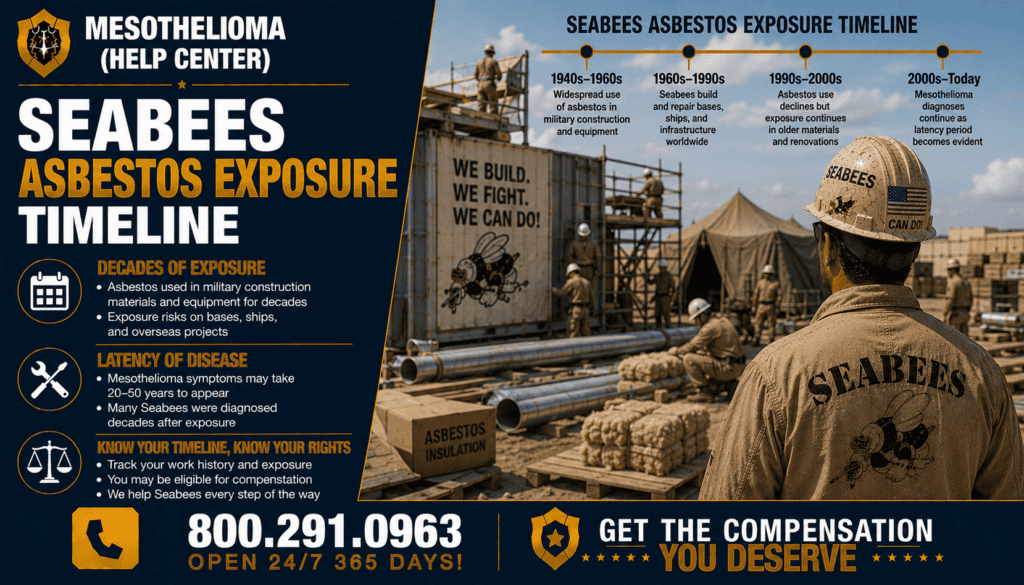
🗓️ Seabees Asbestos Exposure Timeline
A detailed asbestos exposure timeline can help U.S. Navy Seabees and their families organize decades of military construction, maintenance, equipment and job history into a clear sequence. Because asbestos-related diseases can develop many years after exposure, identifying when, where and how exposure may have occurred is often central to VA, trust fund and civil asbestos investigations.
A useful timeline should not simply list years of military service. It should connect each period of service to the veteran’s battalion or detachment, base or deployment, project, job or rating, equipment, materials, nearby trades and known exposure events.
This page is part of the broader U.S. Navy Seabees Asbestos Exposure guide and the Seabees Asbestos Exposure History & Risk hub.
🧭 How to Use a Seabee Asbestos Exposure Timeline
The goal of a timeline is to turn a long military and civilian work history into a sequence that can be checked against records, products, equipment and medical evidence.
- Start with enlistment and discharge dates.
- List each battalion, unit or detachment.
- Add every base, deployment and major project.
- Record the veteran’s job, rating and daily duties.
- Identify equipment and building systems worked on.
- List materials that may have contained asbestos.
- Identify nearby trades and shared work areas.
- Add civilian jobs after military service.
- Add diagnosis and treatment dates.
- Attach supporting records to each timeline period.
📅 Service Periods and Exposure History to Investigate
| Timeline Period | What to Record | Why It Matters |
|---|---|---|
| Training and early service | Schools, bases, initial assignments | May identify first occupational exposure pathways. |
| Battalion assignments | Unit, rating, project, duty location | Connects work history to specific construction activity. |
| Overseas deployments | Country, installation, dates, mission | Helps reconstruct remote or temporary construction work. |
| Wartime assignments | Conflict period, project, repair duties | May involve accelerated construction and maintenance. |
| Cold-weather assignments | Heating, boiler, utility and building work | Can highlight thermal-insulation exposure pathways. |
| Later military service | Maintenance, supervision, renovation work | Can reveal repeated or cumulative exposure. |
| Civilian employment | Trade, employer, products, worksites | Important for separating military and civilian exposure. |
| Diagnosis period | Symptoms, diagnosis date, pathology | Helps connect exposure history to claim and benefit timing. |
Related pages include Seabees Overseas Construction Asbestos Exposure, Seabees Wartime Construction Asbestos Exposure and Seabees Cold Weather Construction Asbestos Exposure.
👷 Jobs, Materials and Equipment to Place on the Timeline
Each time period should include the veteran’s actual duties and the equipment or materials encountered.
👷 Construction Workers
Building, renovation and demolition work may involve older flooring, roofing, siding, wall materials and cement products. See Seabees Construction Workers Asbestos Exposure.
🔌 Electricians
Electrical panels, wiring systems, generators and power equipment may warrant investigation. See Seabees Electricians Asbestos Exposure.
🔧 Mechanics
Vehicle and equipment work may involve brakes, clutches, gaskets and other components. See Seabees Mechanics Asbestos Exposure.
🔩 Pipefitters
Pipe insulation, pumps, valves, gaskets, packing and boilers may be central to the timeline. See Seabees Pipefitters Asbestos Exposure.
🔥 Welders
Hot work near insulated piping, boilers and heat-resistant materials may warrant investigation. See Seabees Welders Asbestos Exposure.
🚜 Heavy Equipment Operators
Heavy machinery and vehicles may involve historical friction and sealing components. See Seabees Heavy Equipment Operators Asbestos Exposure.
⚙️ Equipment & Machinery
Boilers, generators, pumps, HVAC systems, electrical equipment, vehicles and construction machinery can each be added to the timeline. See the Seabees Equipment & Machinery Asbestos Exposure hub.
📍 Construction Sites and Duty Stations to Document
Exposure timelines become more useful when each job is tied to a specific worksite.
- Military bases.
- Airfield construction sites.
- Ports and harbor facilities.
- Barracks construction and renovation.
- Warehouses and storage facilities.
- Power facilities.
- Hospital construction.
- Base housing.
For each site, record the installation name, building or project, approximate dates, duties performed and known coworkers.
🏠 Family and Secondhand Exposure Timeline
A separate household timeline can be useful when a spouse or family member may have experienced secondhand asbestos exposure.
- Record where the family lived during each assignment.
- Identify whether work clothes were brought home.
- Record who washed or handled uniforms.
- Note whether tools or equipment were brought into the home.
- Document commuting and family-vehicle use.
- Record periods of repeated close household contact.
📂 Records and Evidence to Gather
- DD-214 and personnel records.
- Battalion and deployment records.
- Duty-station and project histories.
- Job or rating documentation.
- Construction plans and work orders.
- Equipment manuals and parts catalogs.
- Product and manufacturer records.
- Photographs and letters.
- Coworker and supervisor statements.
- Medical, pathology and treatment records.
Attach evidence to the corresponding timeline period whenever possible instead of keeping all records in one undated file.
🫁 Latency and Health Timeline
Asbestos-related diseases can develop decades after exposure. A health timeline can help organize the period between military service and diagnosis.
- Record the last known asbestos exposure period.
- Document later civilian exposure separately.
- Record respiratory symptoms and testing dates.
- Record imaging, biopsy and pathology dates.
- Record the formal diagnosis date.
- Record treatment and oncology history.
For broader health information, see Seabees Asbestos Exposure Health Risks.
⚖️ Legal and Benefits Timeline
The exposure timeline can also support review of multiple compensation options.
🎖️ VA Benefits
Military service and medical chronology may support a VA service-connection review. See Seabees VA Benefits for Mesothelioma.
⚖️ Mesothelioma Lawsuits
Worksite, product and manufacturer evidence can help identify potentially responsible companies. See U.S. Seabees Mesothelioma Lawsuit.
🏦 Asbestos Trust Fund Claims
Product identification may connect exposure periods to relevant bankruptcy trusts. See Seabees Asbestos Trust Fund Claims.
⏳ Filing Deadlines
Diagnosis and death dates can be important when evaluating legal deadlines. See Seabees Asbestos Statute of Limitations.
💬 Need Help Building a Seabee Asbestos Exposure Timeline?
The strongest timeline connects each period of service to a specific battalion, worksite, job, equipment, material, product and date.
Call 800.291.0963, use live chat 24/7, 365 days a year, or Submit Your Case for a free, confidential review.
❓ Seabees Asbestos Exposure Timeline Questions
Why is an asbestos exposure timeline useful?
It organizes military and civilian exposure into a sequence that can be matched to records, products, equipment and medical evidence.
What should be included in a Seabee exposure timeline?
Battalions, bases, deployments, projects, jobs, equipment, materials, coworkers, civilian employment and medical dates.
Should civilian asbestos exposure be included?
Yes. Civilian exposure should be documented separately so the full exposure history can be evaluated accurately.
Can family secondhand exposure be added to the timeline?
Yes. Household locations, laundry routines, work clothing and other transfer pathways can be documented by date.
What if exact dates are unknown?
Approximate date ranges can still be useful when clearly identified as estimates and later checked against records.
Which documents are most important?
Personnel records, deployment records, project files, work orders, equipment manuals, photographs, coworker statements and medical records can all be valuable.
Can an exposure timeline help with VA and legal claims?
Potentially. It can help organize the evidence used to evaluate VA service connection, lawsuits, trust funds and filing deadlines.
🚀 Turn Decades of Seabee Service Into a Clear Exposure Record
📞 Build the Timeline Before Important Evidence Is Lost
If you or a loved one served with the U.S. Navy Seabees and later developed mesothelioma or asbestos-related lung cancer, reconstructing the exposure timeline can make the next steps much clearer.
- Service dates — enlistment, battalions, deployments and discharge.
- Exposure periods — projects, materials, equipment and nearby trades.
- Medical timeline — symptoms, diagnosis and treatment.
- Evidence — records, manuals, photographs and witnesses.
Call 800.291.0963 now, use live chat 24/7/365, or Submit Your Case for a free, confidential case review.
⚕️ Legal & Medical Information Disclaimer
This page provides general educational information and is not legal or medical advice. A reconstructed timeline does not by itself prove asbestos exposure or establish a legal or VA claim.