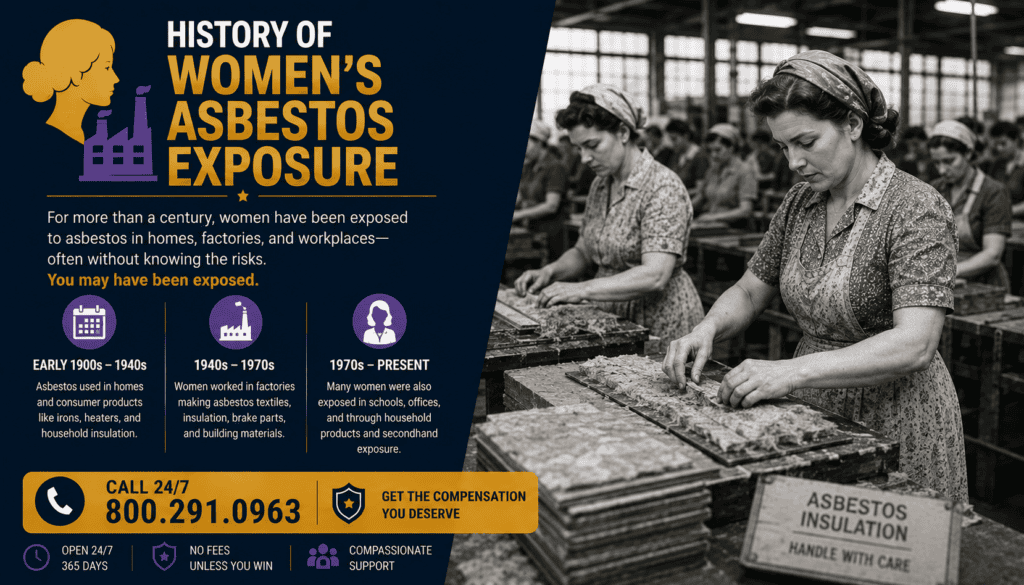
History of Women’s Asbestos Exposure
The history of women’s asbestos exposure extends well beyond traditionally recognized male industrial trades. Women encountered asbestos through their own employment, work in older buildings, household contact with workers who brought fibers home, renovation and maintenance activities, and historically asbestos-containing products. These pathways can overlap and may have occurred decades before an asbestos-related disease was diagnosed.
CDC research on mesothelioma mortality in women emphasizes that occupational exposure may occur outside classic heavy-industry jobs and that nonwork pathways include older building materials, naturally occurring asbestos and take-home exposure from family members. Understanding this broader history can help families reconstruct exposures that were never documented at the time.
📜 Women’s Asbestos Exposure in Historical Context
Asbestos was widely incorporated into insulation, fire-resistant materials, construction products, friction materials and other products because of its heat resistance and durability. Exposure histories therefore reflect where and how materials were manufactured, installed, repaired, disturbed and cleaned—not simply a worker’s job title.
Exposure Was Not Limited to Asbestos Manufacturing
People could encounter fibers while working around installed insulation, repairing equipment, cleaning dusty work areas, renovating buildings or handling products containing asbestos.
Women’s Histories Can Include Several Pathways
A woman might have had direct occupational exposure, later handled a family member’s contaminated work clothing and also lived or worked in an older building containing asbestos materials. Each pathway should be evaluated separately.
Long Latency Can Hide the Connection
The National Cancer Institute notes that asbestos-related conditions can take 10 to 40 years or more to appear. As a result, a diagnosis today can require investigation of jobs, homes and family occupations from decades earlier.
🏭 Women in Asbestos-Exposed Workplaces
Historical occupational exposure among women was not confined to one industry. Potential exposure depended on the materials present and the work being performed.
| Work setting | Potential historical pathway |
|---|---|
| Manufacturing | Production materials, insulation, machinery and maintenance dust |
| Textile operations | Asbestos-containing textiles or contaminated production areas |
| Schools and public buildings | Older insulation, flooring, surfacing materials and renovation dust |
| Hospitals and institutions | Boilers, piping, mechanical rooms and older building materials |
| Offices in older buildings | Maintenance or renovation disturbing installed materials |
| Industrial support work | Cleaning, inspection, clerical or support work near dusty operations |
Job Title Alone Is Not Enough
A clerical, custodial, healthcare or support title does not reveal whether the person worked near maintenance, renovation or industrial processes. Exposure reconstruction should focus on the actual environment and tasks.
Cleaning Could Resuspend Settled Dust
CDC has noted that occupational exposure can occur when previously installed friable asbestos-containing materials are disturbed during maintenance or renovation, as well as when settled fibers are resuspended through activities such as dusting, sweeping or cleaning.
Building Age Can Be Relevant
Current OSHA rules treat certain thermal-system insulation and sprayed- or troweled-on surfacing materials in buildings constructed no later than 1980 as presumed asbestos-containing material unless rebutted under the standard. This current regulatory presumption can help explain why older facilities warrant investigation, but it does not prove a particular historical exposure.
⚓ Wartime & Industrial Employment
Periods of large-scale industrial production brought many women into manufacturing and support roles. When evaluating a particular worker, the relevant question is whether asbestos-containing products or dusty asbestos work were present in her actual work environment.
Shipbuilding and Repair Environments
Ships historically used substantial amounts of heat-resistant insulation and other asbestos materials. Women employed in or around shipyards could potentially have worked near trades disturbing insulation, piping or machinery materials.
Factories and Production Plants
Asbestos could be present in process equipment, boilers, piping, insulation, gaskets and building materials. A worker who did not directly install asbestos might still have worked near repair or maintenance activities.
Support Roles Can Matter
Timekeeping, inspection, cleaning, material handling, healthcare and administrative roles may have placed workers in or near industrial spaces. The physical work location can therefore be as important as the formal job title.
A Historical Industry Does Not Prove Individual Exposure
Evidence that an industry commonly used asbestos is useful background, but a case-specific history should identify the facility, department, tasks, products, proximity and relevant years whenever possible.
🏠 Take-Home & Family Exposure
Take-home exposure is an important part of the history of women’s asbestos exposure. NIOSH describes take-home exposure as workplace contaminants entering homes and vehicles on a worker’s skin, hair, clothing and shoes, where family members can then be exposed.
Work Clothing
Historically, workers could return home wearing dusty clothes. Family members who shook out, handled or laundered those garments could encounter fibers carried from the workplace.
Shoes, Hair, Skin and Personal Items
NCI identifies shoes, clothing, skin and hair as pathways by which asbestos fibers could be brought into a home. Tools and vehicles can also be relevant when reconstructing household contamination.
The Worker’s Job History Becomes Part of the Woman’s History
For a secondary-exposure investigation, records concerning a husband, parent or other household worker can be essential. Employers, jobsites, occupations, products and dates may help identify the original source.
Modern Prevention Reflects What Was Learned
NIOSH now recommends measures such as changing clothing and shoes before leaving work, separating contaminated work clothing and showering where appropriate to reduce take-home contamination.
See Legal Options After Secondary Household Asbestos Exposure.
🧹 Household, Buildings & Consumer Products
Women’s historical exposure can also involve asbestos-containing materials in homes, public buildings and consumer settings. The presence of a material does not automatically establish that fibers became airborne or that a particular person was exposed.
Older Building Materials
Historically used asbestos materials included insulation, flooring, surfacing materials and other construction products. Renovation, repair or deterioration can be important when evaluating whether fibers may have been released.
Household Renovation
Removing old flooring, disturbing insulation, sanding or demolition can create different exposure circumstances from simply living near intact material.
Consumer Product Histories
Some historical products used asbestos, but formulations changed. A product name or category should not be treated as proof that the version used by a particular woman contained asbestos.
Do Not Disturb Suspected Materials
Historical investigation should rely on records, photographs and qualified assessment rather than cutting, scraping or collecting suspected asbestos-containing material without proper controls.
Explore Women’s Consumer Products & Household Asbestos Exposure.
🔎 Why Women’s Exposure Was Often Overlooked
Asbestos disease research and public awareness have often centered on occupations with heavily male workforces, including shipbuilding, construction and certain manufacturing trades. That focus can obscure exposure pathways affecting women.
Occupational Labels Can Miss Proximity Exposure
A woman may not have been an insulator or pipefitter but could have worked in the same building, production area or maintenance environment.
Household Work Was Rarely Recorded as Exposure
Laundering a worker’s clothing or cleaning dust from the home typically did not generate employment or industrial-hygiene records, making later reconstruction dependent on family testimony and the worker’s occupational history.
CDC Data Show Multiple Pathways Need Consideration
CDC’s analysis of malignant mesothelioma mortality among U.S. women during 1999–2020 discussed occupational, environmental, indoor building-material and take-home pathways. This supports investigating exposure histories more broadly than a list of classic industrial job titles.
Do Not Infer Exposure From Gender
The goal is not to replace one stereotype with another. Each woman’s actual jobs, residences, family work histories and product encounters should be documented independently.
🛡️ Changing Workplace Protections
U.S. workplace asbestos regulation became progressively more protective as evidence about health risks accumulated. OSHA’s regulatory history shows how permissible exposure limits were lowered over time.
Early OSHA Regulation
OSHA’s 1994 rulemaking history states that its initial 1971 standard included an 8-hour permissible exposure limit of 12 fibers per cubic centimeter. A December 1971 emergency standard reduced the limit, and a 1972 final standard set an 8-hour limit of 5 fibers per cubic centimeter.
Later Reductions
The 8-hour limit was reduced to 2 fibers per cubic centimeter in 1976 and to 0.2 in the 1986 standards. OSHA’s 1994 final rule reduced the 8-hour time-weighted-average permissible exposure limit to 0.1 fiber per cubic centimeter.
Current Standards Cover Multiple Industries
OSHA currently maintains asbestos standards for general industry, construction and shipyard employment. Requirements can include exposure assessment, regulated areas, engineering and work-practice controls, respiratory protection, training and medical surveillance under specified conditions.
Current Rules Do Not Prove Historical Violations
A modern exposure limit should not be applied retroactively as proof that an employer violated the law decades earlier. Historical conduct must be evaluated under the law, knowledge and standards relevant to the period at issue.
📂 Reconstructing Historical Exposure Today
Because many exposures occurred decades ago, a useful history combines records with firsthand testimony and careful chronology.
| Evidence source | What it may help establish |
|---|---|
| Employment records | Employer, occupation, facility and dates |
| Family employment history | Potential take-home source |
| Residence records | Where household exposure may have occurred |
| Union or military records | Assignments, trades and work locations |
| Product catalogs/invoices | Potential product presence and time period |
| Photographs | Work areas, products, clothing and equipment |
| Witness testimony | Firsthand tasks, dust and household routines |
Build a Lifetime Timeline
List jobs, homes, family members’ occupations, renovation projects and remembered products by year or approximate period.
Separate Facts From Assumptions
If a product brand is uncertain, record what is actually remembered rather than guessing. Historical records can then be used to test possible identifications.
Preserve Sources
Keep original documents and record where photographs, records and product information came from. Provenance can matter when evidence is later evaluated.
Connect the History to Legal Options Carefully
A historical exposure narrative can help identify potential defendants, bankruptcy trusts or compensation systems, but exposure evidence does not by itself establish legal liability.
See How to Document Your Asbestos Exposure History and Women’s Asbestos Legal Options.
❓ Frequently Asked Questions
Were women historically exposed to asbestos at work?
Yes. Potential occupational exposure depended on the workplace, materials and tasks, including manufacturing and work in older buildings where asbestos materials were disturbed.
Could women be exposed without directly handling asbestos?
Yes. Proximity to maintenance, renovation, cleaning or dusty industrial work can be relevant depending on the circumstances.
What is take-home asbestos exposure?
It is exposure to asbestos fibers transported from a workplace into a home or vehicle on items such as clothing and shoes or on a worker’s body.
Why is laundering work clothing important historically?
Handling contaminated work clothing could provide a pathway for household exposure. The worker’s job and product history should also be documented.
Were older schools, hospitals and offices potential exposure settings?
Older buildings could contain asbestos materials. Whether a particular person was exposed depends on material condition, disturbance, location and other facts.
Does working in an old building prove asbestos exposure?
No. Building age can guide investigation, but it does not prove that asbestos was present, disturbed or inhaled by a particular worker.
When did OSHA begin regulating asbestos?
OSHA’s regulatory history identifies an initial federal workplace asbestos limit in 1971, followed by progressively stricter standards in later decades.
Why can women’s exposure be difficult to reconstruct?
Relevant events can be decades old, and household or proximity exposures may not have generated formal workplace records.
What records can help today?
Employment and residence histories, family work records, union documents, photographs, product records and knowledgeable witnesses can all help.
Does historical exposure automatically establish a lawsuit?
No. A legal claim requires the evidence and elements required by the governing jurisdiction, including defendant-specific issues where applicable.
📞 Request a Case Evaluation
If a woman diagnosed with mesothelioma or another asbestos-related disease may have encountered asbestos through work, a family member’s occupation, an older building or a historical product, reconstructing the complete timeline can help identify records, companies and potential compensation options that warrant investigation.
Call 800.291.0963 for a no-obligation case evaluation and to talk to a real person 24/7, 365 days a year. Many mesothelioma law firms handle qualifying cases on a contingency-fee basis; confirm the terms with the firm you retain. Submit your case here.
📝 Summary
The history of women’s asbestos exposure includes direct occupational contact, proximity to dusty work, take-home contamination, older buildings, renovation and historical products. Because these pathways were not always recognized or documented, modern exposure reconstruction should examine the woman’s own work and residences as well as the occupations of household members. The goal is a fact-based timeline that distinguishes historical asbestos use from evidence of the individual woman’s actual exposure.
🔗 Confirmed Sources
- CDC MMWR — Malignant Mesothelioma Mortality in Women, United States, 1999–2020
- CDC/NIOSH — About Take-Home Exposures
- National Cancer Institute — Asbestos Exposure and Cancer Risk
- OSHA — 1994 Occupational Exposure to Asbestos Final Rule and Regulatory History
- OSHA — Asbestos Standards
Disclaimer: General information only—not legal or medical advice. This website is not a law firm. Exposure, liability and deadlines vary by case and jurisdiction. Do not disturb suspected asbestos. Past results do not guarantee future outcomes.