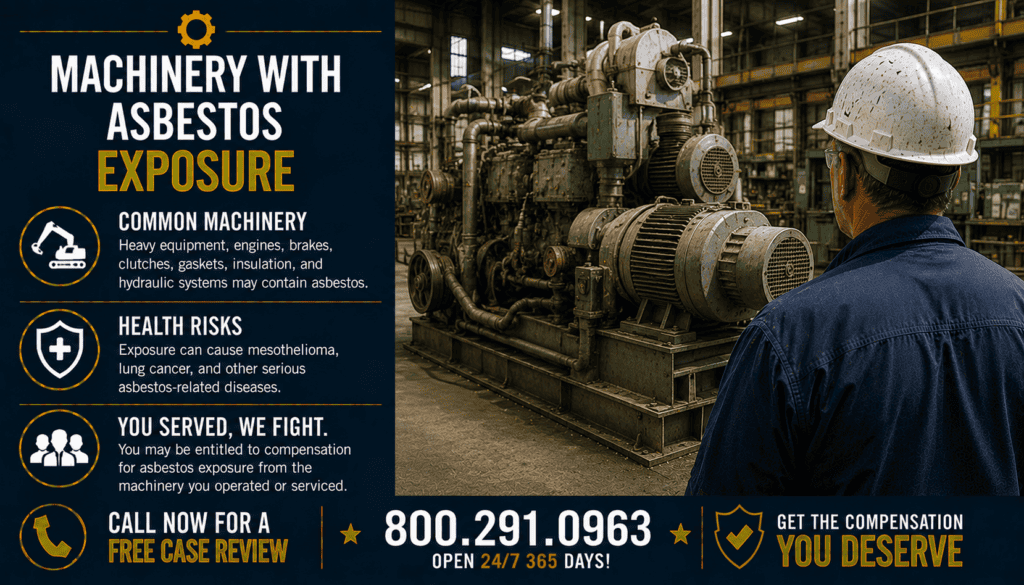
Machinery With Asbestos Exposure
For decades, asbestos was used in industrial, military, and commercial machinery to insulate parts, prevent fires, and resist wear. Mechanics, machine operators, engineers, and maintenance workers were often exposed to asbestos fibers during repair or operation—especially before the 1990s. Over time, these exposures led to serious illnesses like mesothelioma, asbestos-related lung cancer, and asbestosis. This guide explains how machinery-based exposure occurred, what parts contained asbestos, and what legal rights and compensation options may be available.
⚙️ Machinery-Related Asbestos Exposure – What You’ll Learn From This Page:
🧰 Asbestos was commonly used in machinery components—like gaskets, brake linings, insulation, seals, and packing—across heavy equipment including boilers, turbines, compressors, and pumps
🔧 Exposure occurred during routine maintenance and repair, such as removing old gaskets, servicing brakes, stripping insulation, or rebuilding engines and pumps.
🌬️ Confined and poorly ventilated workspaces—machine rooms, engine bays, boiler houses—amplified risk by trapping asbestos dust near workers.
👷 Mechanics, machinists, millwrights, plant operators, and equipment techs were most affected, especially if they handled aging machinery made before the early 1990s.
💰 Diagnoses of mesothelioma, lung cancer, or asbestosis linked to machinery exposure may qualify for trust fund payouts, lawsuits, or veterans’ benefits.
From the 1930s to the late 1980s, asbestos was considered essential in machinery that generated high heat or pressure. It was commonly used in gaskets, insulation, valves, brake pads, and seals. Many of these materials deteriorated over time or were disturbed during maintenance—releasing dangerous asbestos fibers into the air.
Because asbestos-related illnesses take 20 to 50 years to develop, many workers are only now being diagnosed.
Estimated Number of People Exposed to Asbestos-Containing Machinery in the U.S.
Machinery such as industrial generators, compressors, turbines, and heavy mining equipment often contained asbestos components like gaskets and insulation. Workers operating and repairing this machinery faced significant exposure risks.
| Machinery Type | Estimated Number of Workers Exposed |
|---|---|
| Industrial and Mining Machinery | Approximately 150,000 workers exposed while operating or repairing asbestos-containing machinery. |
Total Estimated Exposure: Over 150,000 U.S. workers were exposed to asbestos through asbestos-containing machinery.
Workers were most at risk when servicing, maintaining, or working near these asbestos-containing parts:
- Gaskets & Seals: Used in pumps, engines, boilers, and compressors. Asbestos helped withstand extreme heat and pressure.
- Brake Linings & Clutches: Common in heavy machinery like bulldozers, cranes, forklifts, and generators.
- Insulation Wraps: Covered hot parts of turbines, pipes, and mechanical housings.
- Boilers & Furnaces: Internal parts were lined with asbestos to prevent heat loss or fire.
- Valves & Flanges: Sealed using asbestos gaskets, especially in chemical plants and refineries.
- Motors & Engines: Asbestos was used in wiring insulation and engine heat shields.
- Pumps: Many contained asbestos gaskets and seals to manage friction and pressure.
- Turbines: Often wrapped in asbestos insulation to handle high thermal output.
- Control Panels: Electrical control systems used asbestos for fire resistance.
- Dryers & Presses: Found in textile mills, paper plants, and manufacturing machinery.
Even if the machinery was used decades ago, it’s still possible to prove exposure through job records, part lists, and legal documentation.
✅ Common Ways to Prove Exposure:
- Employment history at industrial sites, plants, refineries, or shipyards
- Job title such as mechanic, machinist, engineer, or equipment operator
- Medical diagnosis of mesothelioma or asbestos-related disease
- Parts manuals or maintenance logs showing asbestos-containing materials
- Co-worker statements confirming product usage or working conditions
- Legal help identifying brands and trust funds related to the machinery you worked with
Workers diagnosed with asbestos illnesses from machinery exposure may be entitled to financial compensation through trust funds, lawsuits, or VA claims.
✅ You may be eligible if:
- You worked with or near machinery built before 1990
- You were exposed to gaskets, brake pads, insulation, or other asbestos components
- You’ve been diagnosed with mesothelioma, asbestos lung cancer, or asbestosis
- A loved one died from an asbestos-related illness tied to machinery exposure
- You performed repairs, maintenance, or demolition work involving heavy equipment
Most victims are eligible for compensation from multiple asbestos trust funds or settlements.
Even decades after exposure, families affected by machinery-related asbestos can still access support and compensation.
✅ Workers and Families May Qualify For:
- Asbestos trust fund payouts for specific product manufacturers
- Wrongful death or personal injury settlements
- VA benefits if exposed during military machinery work
- Reimbursement for funeral and medical costs
- Secondhand exposure claims for family members affected by work clothes
- Free legal help to file and document claims
- Monthly payments to help surviving spouses or children
📞 If you or a loved one worked on or near asbestos-containing machinery, and later developed mesothelioma or another asbestos-related illness, you may be eligible for significant compensation. Contact us for a free case review—no fees unless you win.
Machinery Types with Asbestos Exposure
From construction sites to industrial plants, asbestos was once a common material found in machinery across dozens of industries due to its heat resistance and durability. However, this widespread use came at a high cost—putting countless workers at risk of serious illness. The following list highlights 50 types of machinery where asbestos exposure was most likely, showing how routine maintenance, repairs, or even daily operation could disturb asbestos-containing components and release toxic fibers into the ower Generation & Electrical Machinery
Power-generation and electrical machinery relied on asbestos to control heat, prevent arcing, and reduce fire risk. Exposure occurred during rewinds, insulation removal, gasket scraping, cabinet access, and shutdown maintenance inside confined vaults, basements, and power rooms.
⚡ Electrical Switchgear Machinery
Arc barriers and gasketed panels released asbestos during cutovers, upgrades, and cabinet cleaning.
⚙️ Generator Set Machinery
Insulated exhausts and gaskets released asbestos during overhauls, retrofits, and teardown work.
⚡ Turbine Machinery
Lagging and gasket materials released asbestos during casing splits and maintenance outages.
⚙️ Electric Motor Machinery
Asbestos slot liners released fibers during rewinds and motor disassembly.
⚛️ Reactor Vessel Machinery
High-temperature gaskets released asbestos during vessel access and inspections.
🔌 Transformer Machinery
Asbestos insulating boards released fibers during rebuilds and oil-sampling access.
🧯 Circuit Breaker Machinery
Asbestos arc chutes released fibers during refurbishment and internal cleaning.
⚡ Bus Duct Machinery
Asbestos insulation released fibers during duct opening and electrical renovations.
⚙️ Motor Control Center (MCC) Machinery
Panel liners released asbestos during starter swaps and cabinet servicing.
🔋 Emergency Power Inverter Machinery
Heat shields released asbestos during battery replacement and inspections.
🔥 Boiler, Furnace & High-Heat Machinery
Boilers and high-heat machinery used asbestos insulation, refractory, rope, and gaskets to withstand extreme temperatures. Fibers were released during relining, shutdown maintenance, burner servicing, valve repairs, and demolition in boiler rooms and furnace spaces.
🔥 Boiler Machinery
Lagging and block insulation released asbestos during retubing and jacket removal.
🔥 Steam Boiler Machinery
Handhole gaskets released asbestos during shutdown repairs.
🚿 Water Heater Machinery
Asbestos jackets released fibers during removal and replacement.
🔥 Foundry Furnace Machinery
Refractory linings released asbestos during relining and teardown.
🔥 Industrial Furnace Machinery
Blanket insulation released fibers during burner pulls.
🔥 Heat Treating Furnace Machinery
Door seals released asbestos during retort servicing.
🧪 Glass Furnace Machinery
Crown insulation released asbestos during refractory repairs.
🧯 Incinerator Machinery
Refractory materials released asbestos during ash handling.
🔥 Heat Exchanger Machinery
Insulation and gaskets released asbestos during bundle pulls.
🔥 Economizer Machinery
Lagging released asbestos during access-panel maintenance.
🔥 Superheater / Reheater Machinery
Insulation released asbestos during tube repairs.
🧱 Refractory Mixer & Gun Machinery
Asbestos dust released during refractory mixing and gunning.
🍞 Oven, Kiln & Drying Machinery
Ovens, kilns, and dryers incorporated asbestos panels, door seals, and expansion joints for thermal control. Repairs and temperature-system servicing released fibers into production areas and surrounding workspaces.
🍞 Bakery Oven Machinery
Door ropes released asbestos during burner service.
🔥 Industrial Oven Machinery
Gaskets released asbestos during door rebuilds.
🧱 Brick Kiln Machinery
Refractory linings released asbestos during relining.
🪵 Kiln Dryer Machinery (Lumber)
Asbestos panels released fibers during chamber repairs.
🧱 Ceramic Kiln Machinery
Insulation released asbestos during brick replacement.
🏭 Curing Oven Conveyor Machinery
Insulation released asbestos during belt servicing.
🧯 Smokehouse / Curing Chamber Machinery
Door seals released asbestos during gasket scraping.
🏭 Industrial Manufacturing & Production Machinery
Manufacturing machinery used asbestos for friction control, vibration dampening, and heat resistance. Workers inhaled fibers during operation, rebuilds, brake servicing, and cleaning of pits, guards, and enclosures.
🛠️ Fabrication Press Machinery
Heat pads released asbestos during platen rebuilds.
🔨 Hydraulic Press Machinery
Pads released asbestos during cylinder service.
🧲 Press Brake Machinery
Brake linings released asbestos during relining.
🧰 Punch Press Machinery
Brake components released asbestos during rebuilds.
⚙️ Stamping Line Machinery
Clutch systems released asbestos during maintenance.
🧪 Injection Molding Machine Machinery
Insulation released asbestos during heater servicing.
🧵 Loom Machinery
Brake linings released asbestos during tension adjustments.
🏭 Rolling Mill Machinery
Brake components released asbestos during servicing.
🔨 Forging Hammer Machinery
Insulated components released asbestos during repairs.
🖨️ Printing Press Machinery
Heat shields released asbestos during teardown.
⚙️ Gearbox Machinery
Asbestos gaskets released fibers during disassembly.
🧰 Shear Machine Machinery
Brake components released asbestos during adjustments.
🔪 Grinding, Machining & Surface-Finishing Machinery
Machining equipment released asbestos through friction, abrasion, and heat buildup. Exposure occurred during grinding, guard removal, spindle service, belt changes, and cleanup of asbestos-containing components.
🔪 Grinding Machine Machinery
Heat shields released asbestos during wheel changes.
🔩 Lathe Machinery
Brake pads released asbestos during spindle service.
🪚 Milling Machine Machinery
Gaskets released asbestos during head servicing.
🧰 Floor Buffer / Sander Machinery
Sanding disturbed asbestos floor materials.
🪚 Cut-Off Saw Machinery
Brake pads released asbestos during servicing.
🧰 Drum Sander Machinery
Asbestos components released fibers during belt changes.
🌬️ HVAC, Cooling & Refrigeration Machinery
HVAC systems used asbestos insulation, vibration pads, and gaskets to manage airflow and temperature. Fibers were released during retrofits, maintenance, and demolition, spreading through air-handling systems.
🌬️ Cooling Tower Machinery
Asbestos panels released fibers during fan repairs.
❄️ Refrigeration Unit Machinery
Insulated panels released asbestos during compressor service.
🌬️ Air Handling Unit (AHU) Machinery
Insulation released asbestos during panel removal.
🛢️ Air Compressor Machinery
Valve gaskets released asbestos during teardown.
🌀 Blower & Fan Machinery
Vibration pads released asbestos during bearing changes.
🌡️ Chiller Machinery
Pipe insulation released asbestos during overhauls.
🌬️ Ventilation Ductwork Machinery
Fireproofing released asbestos during renovations.
🏗️ Construction, Concrete & Demolition Machinery
Construction and demolition machinery disturbed asbestos through vibration, cutting, and compressed air. Exposure occurred during repairs and work disturbing asbestos-containing building materials.
🌀 Concrete Mixer Machinery
Insulated housings released asbestos during gearbox repairs.
⛏️ Drill Press Machinery
Brake pads released asbestos during servicing.
🔧 Jackhammer (Pneumatic Breaker) Machinery
Seals released asbestos during teardown.
🪚 Demolition Saw Machinery
Friction parts released asbestos during servicing.
🧰 Concrete Grinder Machinery
Grinding disturbed asbestos-containing materials.
🚗 Automotive & Mobile Equipment Machinery
Automotive and mobile equipment released asbestos from brakes, clutches, and gaskets. Grinding and compressed-air cleaning generated high airborne fiber concentrations.
🚗 Automotive Service Machinery
Brake work released asbestos during grinding.
🛞 Brake Lathe Machinery
Machining aerosolized asbestos dust.
🚜 Excavator Machinery
Brakes released asbestos during field repairs.
🚜 Farm Tractor Machinery
Clutches released asbestos during rebuilds.
🛻 Truck Brake Service Machinery
Brake shoe work released asbestos fibers.
🏍️ Motorcycle Brake Service Machinery
Legacy pads released asbestos during replacement.
🚢 Maritime, Rail & Material-Handling Machinery
Transportation machinery concentrated asbestos in engines, brakes, and hoisting systems. Exposure occurred during overhauls in shipyards, rail shops, and enclosed machinery spaces.
🚢 Ship Engine Machinery
Lagging released asbestos during overhauls.
🚂 Rail Yard Machinery
Brake components released asbestos during shop repairs.
🏗️ Gantry / Mobile Crane Machinery
Brake linings released asbestos during servicing.
⚓ Winch & Capstan Machinery
Clutch facings released asbestos during relining.
🧰 Cable Pulling & Winch Machinery
Brake systems released asbestos during adjustments.
🧰 Conveyor Drive Machinery
Brake assemblies released asbestos during maintenance.
🛗 Elevator Machinery
Brake shoes released asbestos during modernization.
🪜 Escalator Machinery
Drive brakes released asbestos during servicing.
⛏️ Mining, Refinery & Heavy Process Machinery
Heavy process machinery relied on asbestos to withstand pressure, chemicals, and heat. Fibers were released during shutdowns, gasket scraping, relining, and equipment teardown.
⛏️ Mining Crusher Machinery
Friction parts released asbestos during relining.
🛢️ Pump Machinery (Industrial)
Packing released asbestos during seal replacement.
🧪 Refinery Process Unit Machinery
Insulation released asbestos during turnarounds.
🛢️ Storage Tank Machinery (Heated)
Insulation released asbestos during access repairs.
🏭 Paper Mill Machinery
Dryer insulation released asbestos during shutdowns.
🧯 Dust Collection Machinery
Gaskets released asbestos during bag changes.
🧰 Valve Actuator Machinery
Gaskets released asbestos during servicing.
🧰 Compressor Station Machinery
Insulation released asbestos during maintenance.
🔩 Welding & Specialty Fabrication Machinery
Fabrication equipment used asbestos heat shields and insulated housings. Exposure occurred during servicing and component replacement near high-temperature workstations.
🔩 Welding Machine Machinery
Heat shields released asbestos during servicing.
🧰 Welding Bench & Heat Shield Machinery
Asbestos pads released fibers during bench repairs.
FAQs About Asbestos Exposure in Machinery
Q. What types of machinery contained asbestos?
Many industrial and military machines used asbestos for its heat resistance and durability. This includes turbines, engines, compressors, valves, boilers, pumps, and brake systems. Asbestos was often found in insulation, gaskets, seals, and friction parts.
Q. Who was at risk of asbestos exposure from machinery?
Workers who built, operated, repaired, or maintained machinery—such as mechanics, machinists, engineers, factory workers, and military personnel—were often exposed to asbestos dust during routine tasks or breakdowns.
Q. How did exposure occur while working on machinery?
Exposure happened when asbestos materials—like gaskets or insulation—were cut, sanded, or removed, releasing invisible fibers into the air. These fibers were then inhaled or settled on clothing, tools, and surrounding areas.
Q. What are the health risks of asbestos exposure from machinery?
Long-term exposure can lead to life-threatening diseases such as mesothelioma, lung cancer, and asbestosis. These illnesses typically develop decades after the initial exposure.
Q. Is it possible my past machinery work involved asbestos even if I didn’t know?
Yes. Asbestos was used in thousands of machinery parts until the late 1980s. If you worked around heavy machinery before 1990, there’s a strong chance you were exposed—even if you didn’t handle asbestos directly.
Q. What legal rights do I have if I was exposed to asbestos in machinery?
You may have the right to file a legal claim and pursue compensation through asbestos trust funds, personal injury lawsuits, or VA benefits if you are a veteran. These claims can help cover your medical costs, lost wages, and other damages.
Q. How do I know if I qualify for compensation?
Qualification often depends on your work history, medical diagnosis, and type of exposure. An experienced asbestos attorney can help assess your case and determine the best legal path forward.
Q. How can I get legal help today?
If you or someone you love has been diagnosed with mesothelioma or another asbestos-related illness, call us now for a free consultation. Our team can help you explore your legal options and pursue financial compensation—with no upfront fees required.
Mesothelioma Claims Process: From Filing to Settlement
The mesothelioma claims process can seem overwhelming, but understanding each step can make it easier to navigate. Here’s an easy-to-follow guide to help you understand the process, from filing your claim to receiving compensation.
Step 1: Consult with an Experienced Mesothelioma Lawyer
The first step in the mesothelioma claims process is to consult with an experienced mesothelioma lawyer. This lawyer specializes in asbestos-related cases and can guide you through the legal process. They will evaluate your case, explain your legal options, and help you determine whether you are eligible for compensation. Choosing a lawyer with experience in mesothelioma cases increases your chances of success.
Step 2: Gather Medical and Work History
Once you’ve chosen your lawyer, the next step is to gather your medical and work history. You’ll need to provide your medical records that confirm your mesothelioma diagnosis and documents showing where and when you were exposed to asbestos. Your lawyer will help you collect employment records and any other relevant documents that establish the connection between your exposure and your illness. This step is essential to building a strong case.
Step 3: Investigate the Asbestos Exposure
In this step, your lawyer will work to identify the specific companies and products responsible for your asbestos exposure. This is done by investigating your work history, where you lived, and which asbestos-containing materials you were in contact with. Your lawyer will research which manufacturers or employers were involved and whether they can be held legally accountable. This investigation is crucial for determining who will be the target of your claim.
Step 4: Filing the Mesothelioma Claim
After gathering all necessary information, your lawyer will file the mesothelioma claim on your behalf. This may involve filing a lawsuit against the companies responsible for your exposure, or it could involve filing a claim with an asbestos trust fund, which is a compensation fund set up by companies that have gone bankrupt due to asbestos liabilities. Your lawyer will ensure that all necessary documentation is submitted to support your claim and increase the chances of success.
Step 5: Discovery and Negotiation
Once the claim is filed, the discovery process begins. During this phase, both parties (you and the defendants) will exchange information and evidence related to the case. This process may involve depositions, document requests, and expert witness testimony. After discovery, your lawyer will enter into settlement negotiations with the defendant(s). Many mesothelioma cases are settled out of court to avoid lengthy trials. Your lawyer will negotiate on your behalf to secure the best possible settlement.
Step 6: Settlement or Trial
Most mesothelioma claims are settled out of court, which means you will receive compensation without a trial. If a fair settlement can’t be reached, the case will proceed to trial. During a trial, both sides present evidence and arguments to a judge or jury, who will then make a decision. While a trial can take longer, a favorable verdict can result in a larger settlement. However, many mesothelioma cases are settled before reaching trial, providing quicker compensation.
Step 7: Receiving Compensation
After settlement or trial, you will receive compensation for your mesothelioma diagnosis. Compensation may cover medical expenses, lost wages, pain and suffering, and other damages resulting from your illness. If your claim is successful, you will receive a financial payout. This compensation is essential for managing the costs of treatment, and it provides some financial relief for you and your family. Your lawyer will help you understand how much you are entitled to and ensure that the funds are distributed appropriately.
Step 8: Post-Settlement Support
After you receive compensation, your lawyer will continue to support you by ensuring that all aspects of your claim are completed, and they will address any additional legal concerns that may arise. If you are receiving compensation from an asbestos trust fund, your lawyer will help you navigate the disbursement process. Post-settlement support ensures that all final steps are handled efficiently and that you can focus on your health and well-being.
Final Thoughts
The mesothelioma claims process can be lengthy, but with the help of a skilled attorney, you can secure the compensation you deserve. Whether your claim involves filing a lawsuit or a trust fund claim, following each step carefully will ensure that your legal rights are protected and that you get the support you need during this challenging time.
If you or someone you love has been diagnosed with mesothelioma, you may be entitled to compensation. Call 800.291.0963 for a free, no-obligation case evaluation with a dedicated mesothelioma lawyer who can help guide you through the legal process and get the support you deserve.