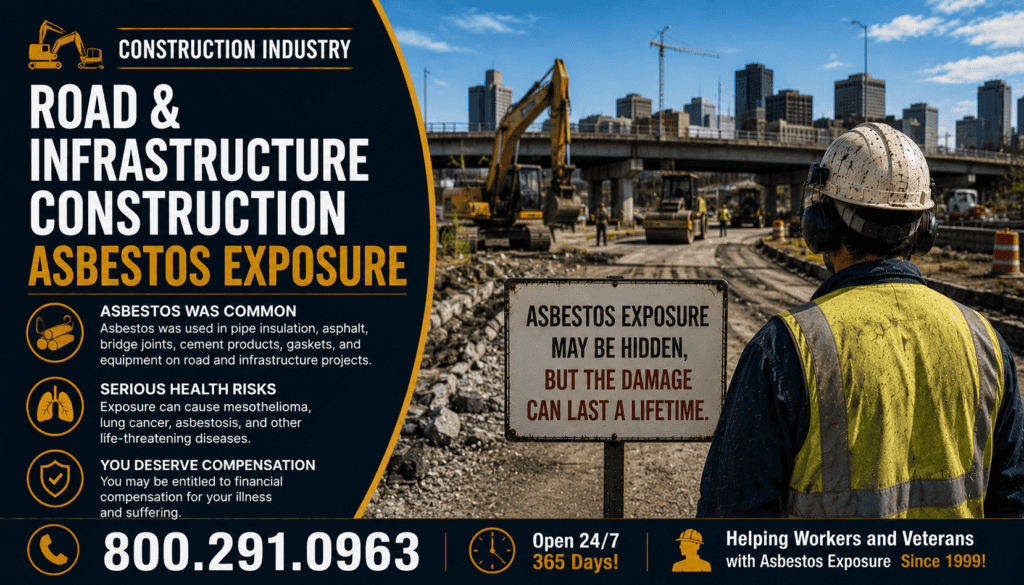
🏗️ Road & Infrastructure Construction Asbestos Exposure
Commercial construction and demolition crews may encounter legacy asbestos materials while altering offices, stores, warehouses, and other older buildings. Identifying the building era, demolition sequence, contractor responsibilities, and material disturbance helps distinguish plausible exposure from simple presence at a worksite.
This guide examines bridge rehabilitation, utility-pipe replacement, tunnel refurbishment, pavement removal, and equipment maintenance in Road and infrastructure construction included highways, bridges, tunnels, municipal utility corridors, and transit approaches, identifies relevant materials such as sprayed fireproofing, pipe insulation, floor tile and mastic, ceiling systems, and older mechanical gaskets, and explains practical steps for people diagnosed with mesothelioma or asbestos-related lung cancer. The records that matter most include transportation agency plans, bid specifications, pipe inventories, utility maps, subcontractor records, and demolition surveys.
🏭 Where Asbestos Was Found
Facilities and Historical Context
Road and infrastructure construction included highways, bridges, tunnels, municipal utility corridors, and transit approaches. Historic asbestos-containing materials were not present at every site, but construction and maintenance records can help identify where they were installed. The most useful starting point is the project period, the specific employer, and the equipment or building materials handled.
Related background: Mechanics Asbestos Lung Cancer. Use this guide to compare occupations, work areas, and historical materials relevant to the documented job history.
Related background: Railroad Asbestos Exposure. Use this guide to compare occupations, work areas, and historical materials relevant to the documented job history.
Work Areas and Shared Air
Areas worth reviewing include bridge decks, utility trenches, tunnel service rooms, pump stations, and roadway demolition zones. An employee did not need to install insulation personally to be nearby when another crew disturbed older material.
Renovations and Equipment Changes
Project phases included bridge rehabilitation, utility-pipe replacement, tunnel refurbishment, pavement removal, and equipment maintenance. Exposure questions depend on the actual material, task, work controls, and whether fibers entered the breathing zone.
👷 Workers and Daily Jobs
Trades and Responsibilities
Workers who may have encountered suspect materials include road crews, heavy-equipment mechanics, utility installers, bridge workers, demolition laborers, and inspectors. Job titles alone cannot establish asbestos exposure; duties, dates, and proximity to dusty work matter.
Related background: Car Mechanics Asbestos Exposure. Use this guide to compare occupations, work areas, and historical materials relevant to the documented job history.
Related background: Railroad Mesothelioma Lawsuit. Use this guide to compare occupations, work areas, and historical materials relevant to the documented job history.
Contractors and Nearby Staff
Contractors and employees often worked together in bridge decks, utility trenches, tunnel service rooms, pump stations, and roadway demolition zones. Nearby crews may have shared the air during insulation removal, cutting, equipment repair, or debris handling.
Changes Across a Career
Build a chronological account of jobs involving bridge rehabilitation, utility-pipe replacement, tunnel refurbishment, pavement removal, and equipment maintenance. Distinguish direct handling from work beside other trades and record whether respiratory protection and isolation were used.
🧱 Products and Equipment
Materials That Require Verification
Materials to investigate include older asbestos-cement water pipe, some historical asphalt products, bridge expansion-joint materials, brake and clutch parts, and insulated utility equipment. These categories are historical possibilities rather than proof that any particular product contained asbestos.
Related background: Pipelayers Asbestos Exposure. Use this guide to compare occupations, work areas, and historical materials relevant to the documented job history.
Related background: Bridgestone/Firestone Inc. Asbestos Exposure. Use this guide to compare occupations, work areas, and historical materials relevant to the documented job history.
Machinery and Building Systems
Equipment and building systems in bridge decks, utility trenches, tunnel service rooms, pump stations, and roadway demolition zones were sometimes maintained during bridge rehabilitation, utility-pipe replacement, tunnel refurbishment, pavement removal, and equipment maintenance. Supplier records, equipment models, and installation dates can narrow the relevant products.
How to Identify an Older Product
Photographs, specifications, packaging, and sampling reports can help establish composition. Do not disturb suspect material to identify it; qualified inspectors and accredited laboratories can assess samples safely.
🌫️ How Exposure Occurred
Disturbance and Airborne Dust
Cutting, scraping, tearing out, or otherwise disturbing asbestos-containing older asbestos-cement water pipe, some historical asphalt products, bridge expansion-joint materials, brake and clutch parts, and insulated utility equipment could release respirable fibers. The highest concern is work that makes dust from confirmed or presumed asbestos materials.
Related background: Pipefitters Asbestos Exposure. Use this guide to compare occupations, work areas, and historical materials relevant to the documented job history.
Related background: Armored Vehicle Launched Bridge Asbestos Exposure. Use this guide to compare occupations, work areas, and historical materials relevant to the documented job history.
Bystander and Cleanup Exposure
Other trades working in bridge decks, utility trenches, tunnel service rooms, pump stations, and roadway demolition zones might have been exposed without handling the product themselves. Dust on clothing and shared workspaces may also matter in reconstructing past exposures.
Relevant Safety Standards
OSHA construction asbestos rules apply to many demolition, repair, renovation, and maintenance tasks; appropriate controls depend on the specific activity. Review 29 CFR 1926.1101 rather than assuming every job used the same standard.
🩺 Mesothelioma After Workplace Exposure
Understanding a Mesothelioma Diagnosis
Mesothelioma is a cancer linked to asbestos exposure, often diagnosed decades after the work occurred. People with a diagnosis and a history of Road and infrastructure construction included highways, bridges, tunnels, municipal utility corridors, and transit approaches should discuss occupational history with their care team.
Related background: Demolition Asbestos Trust Funds. Use this guide to compare occupations, work areas, and historical materials relevant to the documented job history.
Related background: Construction Sites Asbestos Exposure. Use this guide to compare occupations, work areas, and historical materials relevant to the documented job history.
Medical and Occupational Timelines
A useful timeline records the years, employers, and projects involving bridge rehabilitation, utility-pipe replacement, tunnel refurbishment, pavement removal, and equipment maintenance. Medical records and exposure evidence answer different questions and should be organized separately.
Questions to Ask Your Care Team
Ask your clinician about pathology confirmation, specialist review, treatment options, and whether occupational history should be documented in your records.
🫁 Asbestos-Related Lung Cancer
Asbestos-Related Lung Cancer
Asbestos exposure can contribute to lung cancer risk. A person who worked around older asbestos-cement water pipe, some historical asphalt products, bridge expansion-joint materials, brake and clutch parts, and insulated utility equipment should share their occupational history with clinicians, alongside smoking history and other risk factors.
Related background: Demolition Mesothelioma Lawsuit. Use this guide to compare occupations, work areas, and historical materials relevant to the documented job history.
Related background: Construction Trades Asbestos Exposure. Use this guide to compare occupations, work areas, and historical materials relevant to the documented job history.
Information Worth Preserving
Preserve imaging, pathology, employment history, and details about work in bridge decks, utility trenches, tunnel service rooms, pump stations, and roadway demolition zones. These records may be relevant to medical care and to a separate legal review.
Legal and Medical Questions Are Separate
A diagnosis does not by itself establish the identity of an asbestos product or a responsible company. Product, workplace, and medical evidence should be evaluated on their own merits.
📋 Work History and Evidence
Employment and Project Records
Begin with transportation agency plans, bid specifications, pipe inventories, utility maps, subcontractor records, and demolition surveys. Include employment dates, supervisors, union or pension records, and the names of coworkers who remember specific work.
Related background: Railroad Track & Infrastructure Asbestos Exposure. Use this guide to compare occupations, work areas, and historical materials relevant to the documented job history.
Related background: Heavy Equipment Operators Asbestos Exposure. Use this guide to compare occupations, work areas, and historical materials relevant to the documented job history.
Product and Site Documentation
Build a project-by-project record of bridge rehabilitation, utility-pipe replacement, tunnel refurbishment, pavement removal, and equipment maintenance. Note locations, tools, materials, contractors, and whether work happened during renovation, shutdown, or routine maintenance.
Witnesses and a Clear Timeline
Keep original copies of documents and photographs. If a project was publicly funded or regulated, relevant specifications and permits may be held by agencies or archives.
⚖️ Compensation and Legal Options
Potential Legal Paths
People diagnosed with mesothelioma or asbestos-related lung cancer after work involving Road and infrastructure construction included highways, bridges, tunnels, municipal utility corridors, and transit approaches may wish to ask about asbestos lawsuits, bankruptcy trust claims, or other potentially applicable remedies.
Related background: Infrastructure & Bridge Demolition Asbestos Exposure. Use this guide to compare occupations, work areas, and historical materials relevant to the documented job history.
Related background: Army Heavy Equipment Operators Asbestos Exposure. Use this guide to compare occupations, work areas, and historical materials relevant to the documented job history.
Time Limits and Jurisdiction
Potential claims depend on the work history, product identification, defendants, jurisdiction, and filing deadlines. A lawyer can evaluate whether transportation agency plans, bid specifications, pipe inventories, utility maps, subcontractor records, and demolition surveys help support a case.
What a Consultation Can Cover
Workers should not assume that one claim route excludes every other route. Eligibility, deadlines, offsets, and evidence requirements differ and require individualized advice.
🔎 Practical Steps for Workers and Families
Reconstruct the Job
List dates and specific assignments involving bridge rehabilitation, utility-pipe replacement, tunnel refurbishment, pavement removal, and equipment maintenance. Include locations such as bridge decks, utility trenches, tunnel service rooms, pump stations, and roadway demolition zones, names of supervisors, and whether the job was a routine service call, a major overhaul, or a demolition project.
Confirm the Material
For sprayed fireproofing, pipe insulation, floor tile and mastic, ceiling systems, and older mechanical gaskets, seek documentation rather than assuming asbestos content. Historical material lists, invoices, and qualified inspection reports can help distinguish suspect products from verified asbestos-containing materials.
Protect Current Workers
If a present-day project involves suspect asbestos material in Road and infrastructure construction included highways, bridges, tunnels, municipal utility corridors, and transit approaches, stop disturbance and follow applicable inspection and safety procedures. Do not dry-sweep, drill, sand, or collect samples without appropriate training and controls.
Organize Questions for Professionals
Separate medical questions from legal questions. Bring a diagnosis summary to the clinical team and a chronological work history to a qualified attorney. Ask each professional which missing documents would materially change their assessment.
🧰 Detailed Exposure Review Checklist
Exact Work Location
Identify the building, vessel, floor, department, or work bay involved. Within Road and infrastructure construction included highways, bridges, tunnels, municipal utility corridors, and transit approaches, the same employer may have operated many facilities with different building dates and equipment. Site plans and photographs help prevent confusion between similarly named locations.
Dates and Material Changes
List the years when sprayed fireproofing, pipe insulation, floor tile and mastic, ceiling systems, and older mechanical gaskets was installed, maintained, or removed. The original installation date may differ from the period when fibers were released. Repairs, upgrades, and substitutions can change the materials involved.
Who Performed the Work
Distinguish employees, subcontractors, and visiting repair crews. During bridge rehabilitation, utility-pipe replacement, tunnel refurbishment, pavement removal, and equipment maintenance, different companies may have controlled the work area, supplied materials, or performed cleanup. Contracts and invoices can identify these roles.
How Dust Was Controlled
Record whether workers used containment, local exhaust, wet methods, suitable respiratory protection, and regulated-area signs. These details matter for evaluating a historical exposure account; present-day work must follow applicable safety requirements.
What Happened After the Job
Ask whether debris was bagged, swept, vacuumed with suitable equipment, or transported elsewhere. Work clothing, tools, and adjacent rooms can be relevant to a careful account, but avoid assuming that contamination occurred without evidence.
Medical Follow-Through
People with symptoms or a known exposure history should discuss concerns with a licensed healthcare professional. There is no single test that retrospectively proves which workplace caused a cancer. A clinician can advise on appropriate evaluation and treatment.
Legal Follow-Through
A legal review can address the identity of responsible parties, the governing jurisdiction, filing deadlines, and available compensation mechanisms. A worker should not assume that a past employer is automatically liable or that every historic product creates a valid claim.
🧭 Site-Specific Work History Questions
Which specific locations did the worker enter? List bridge decks, utility trenches, tunnel service rooms, pump stations, and roadway demolition zones. A location name alone is insufficient: note what machinery was present, who maintained it, whether surfaces were enclosed, and whether visible dust followed a particular activity.
What changed during the project? Document bridge rehabilitation, utility-pipe replacement, tunnel refurbishment, pavement removal, and equipment maintenance. Installation, maintenance, renovation, and removal have different exposure patterns. A dated photograph of an intact system may show what was present, while an outage or demolition log may explain when that system was disturbed.
Which products require closer examination? Start with older asbestos-cement water pipe, some historical asphalt products, bridge expansion-joint materials, brake and clutch parts, and insulated utility equipment. A material category cannot confirm asbestos content. Procurement files, manufacturer records, contemporaneous labels, and qualified sampling results are stronger than assumptions based solely on age.
Who else was on the job? Identify road crews, heavy-equipment mechanics, utility installers, bridge workers, demolition laborers, and inspectors. Many projects relied on overlapping subcontractors. A worker may recall a task performed by another crew, but the chronology should distinguish first-hand observation from information learned later.
What documentation can still be obtained? Search for transportation agency plans, bid specifications, pipe inventories, utility maps, subcontractor records, and demolition surveys. Retired coworkers, union records, pension statements, project owners, and historical archives can sometimes fill gaps when a company has closed or project files are missing.
What was the condition of the material? Intact, undisturbed asbestos-containing material does not present the same airborne exposure scenario as damaged insulation or material cut by power tools. The distinction matters for an accurate account and should not be obscured by broad statements about the entire facility.
What protective measures were used? Record any enclosure, wet method, local exhaust ventilation, respiratory protection, warning signs, air monitoring, and decontamination practices that workers remember. Absence of a remembered control does not establish a violation, but it helps identify records worth requesting.
What happened after the work? Workers should record whether dust was cleaned by dry sweeping, compressed air, HEPA equipment, or wet methods; whether work clothes were taken home; and whether other trades entered the area before cleanup. These details can inform a historical exposure assessment.
How should a family organize the account? Create a dated table with employer, site, role, tasks, potential products, coworkers, and supporting documents. Mark uncertain details as uncertain. A consistent chronology is more useful than an overstated account.
What should happen after a diagnosis? Prioritize appropriate medical care, request copies of pathology and imaging, and discuss the occupational history with the clinical team. Legal advice about deadlines and potential compensation is separate from diagnosis and treatment decisions.
❓ Frequently Asked Questions
Does Working at This Type of Site Prove Asbestos Exposure?
No. A worksite name is a starting point. Exposure depends on whether asbestos-containing material was present, whether it was disturbed, and the person’s actual tasks and proximity.
What Documents Should I Gather First?
Begin with employment dates and transportation agency plans, bid specifications, pipe inventories, utility maps, subcontractor records, and demolition surveys. Medical records, coworker contacts, and product details can then be added to a dated timeline.
Can Someone Who Did Not Handle Asbestos Have Been Exposed?
Potentially. Work near demolition, insulation removal, or poor cleanup may have created bystander exposure, but the specific conditions and materials must be established.
Can I Pursue a Claim Years After the Work?
Some asbestos-related illnesses develop decades later. Filing rules differ by jurisdiction and type of claim, so a qualified attorney should assess deadlines promptly.
What if I Have Lung Cancer Rather Than Mesothelioma?
Asbestos-related lung cancer may be relevant to legal options, but medical causation and exposure history require individual assessment. Seek medical care and qualified legal guidance.
📚 Confirmed Sources
- OSHA Asbestos Standard for Shipyards
- OSHA Asbestos Standard for Construction
- OSHA Asbestos Standard for General Industry
🧭 Summary
For people who worked in older school buildings and school district facilities, an accurate exposure history identifies the facility, job dates, materials, and tasks. A mesothelioma or lung cancer diagnosis deserves medical attention, while any possible claim needs individualized legal review. Preserve school asbestos management plans, AHERA inspection records, employment dates, room assignments, and renovation notices where possible.
Mesothelioma Help Center is not a law firm or medical provider and does not determine legal or VA eligibility. This information is not individualized medical or legal advice.