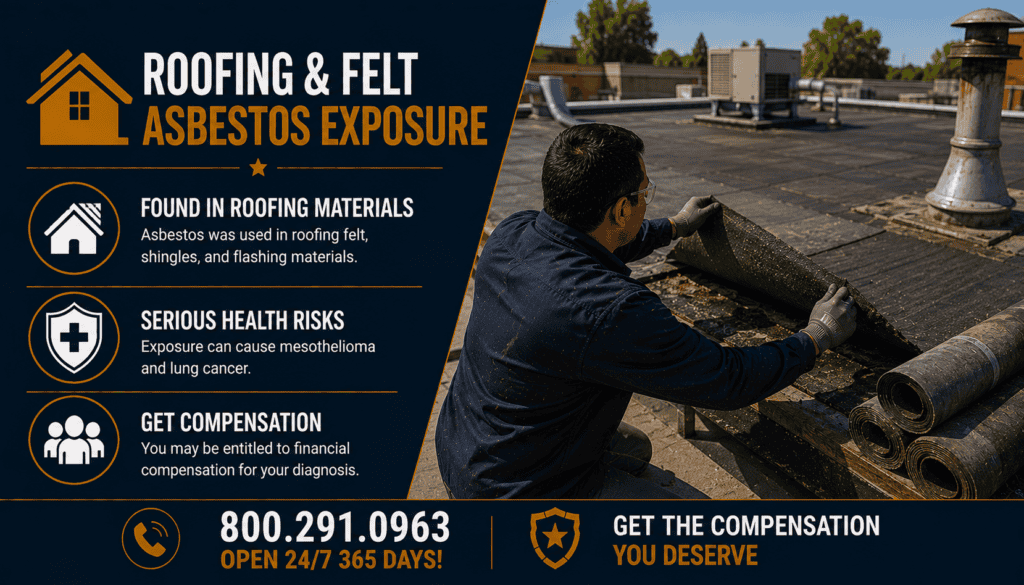
🏠 Roofing & Felt Asbestos Exposure
Roofing installation, repair, and removal exposed workers to asbestos when shingles, felts, mastics, coatings, and flashing materials released fibers during cutting, tearing, heating, and demolition.
For decades, asbestos was widely used in roofing products because of its durability, heat resistance, and weatherproofing properties. From the 1920s through the early 1980s, millions of residential, commercial, and industrial roofs contained asbestos. When these materials aged—or were disturbed during reroofing, patching, or demolition—airborne asbestos fibers were released, often directly into workers’ breathing zones.
Roofing work is physically demanding and frequently performed in hot conditions, which increased dust generation and fiber inhalation—especially when old roofing layers were removed or mechanically cut.
🧱 Why Asbestos Was Used in Roofing & Felt Materials
Manufacturers relied on asbestos in roofing products because it:
-
🔥 Resisted heat from sun exposure and equipment
-
🌧️ Improved waterproofing and durability
-
🧱 Strengthened felts, shingles, and coatings
-
🛠️ Reduced cracking and material failure
-
💲 Lowered manufacturing and maintenance costs
-
🧯 Enhanced fire resistance for structures
Asbestos use became standard across roofing systems nationwide.
🏗️ Roofing Products Commonly Containing Asbestos
Roofers often handled asbestos materials daily without knowing it.
🧰 High-risk roofing materials included:
-
🧱 Asphalt shingles and roll roofing
-
🧱 Roofing felts and underlayment
-
🧱 Flashing materials
-
🧱 Roof coatings and sealants
-
🧱 Tar, pitch, and mastics
-
🧱 Built-up roofing (BUR) layers
-
🧱 Cement roofing products
-
🧱 Parapet and expansion joint materials
Removing layered roofing systems released multiple generations of asbestos dust.
👷 How Asbestos Exposure Occurred During Roofing Work
Exposure occurred during routine roofing tasks.
High-risk activities included:
-
🪚 Cutting or sawing roofing materials
-
🔨 Tearing off old shingles and felts
-
🔥 Heating tar and asphalt products
-
🧹 Scraping adhesives and coatings
-
🚜 Mechanical roof removal
-
🧰 Demolishing roof decks and parapets
-
🌬️ Sweeping or blowing roofing debris
Wind spread fibers across rooftops and into surrounding areas.
🧑🏭 Workers Most at Risk From Roofing Asbestos Exposure
Roofing asbestos exposure affected many job roles.
High-risk workers include:
-
🏠 Roofers and roofing laborers
-
🧱 Built-up roofing installers
-
🧰 Repair and maintenance crews
-
🏗️ Demolition and teardown workers
-
🧹 Cleanup and debris handlers
-
👷 Construction supervisors and foremen
-
🏠 Homeowners performing DIY roof work
Secondhand exposure often affected family members through contaminated clothing.
🏢 Job Sites Where Roofing Asbestos Exposure Occurred
Asbestos roofing materials were used on:
-
🏠 Residential homes and apartments
-
🏢 Office buildings and retail centers
-
🏫 Schools and universities
-
🏥 Hospitals and clinics
-
🏨 Hotels and motels
-
🏭 Factories and warehouses
-
🏛️ Government and municipal buildings
Many older roofs still contain asbestos beneath newer layers.
🫁 Diseases Linked to Roofing & Felt Asbestos Exposure
Asbestos diseases often develop decades after exposure.
Common diagnoses include:
-
Mesothelioma
-
Asbestos-related lung cancer
-
Asbestosis
-
Pleural plaques and pleural thickening
Roofers with long careers often experienced chronic, repeated exposure across many sites.
⚠️ Why Roofing Asbestos Exposure Was Often Ignored
Exposure persisted because:
-
❌ Roofing work occurred outdoors
-
❌ Dust was considered unavoidable
-
❌ No warning labels existed
-
❌ Heat discouraged respirator use
-
❌ Multiple roofing layers hid asbestos
Many workers learned of the risk only after diagnosis.
⚖️ Legal Options for Roofing Asbestos Exposure Victims
Victims may qualify for:
-
⚖️ Asbestos personal injury lawsuits
-
🏦 Multiple asbestos trust fund claims
-
⚰️ Wrongful death lawsuits (for families)
-
🇺🇸 VA benefits (if exposure occurred on federal or military buildings)
Claims are typically filed against manufacturers of roofing materials, not employers.
🧑⚖️ How a Lawyer Can Help With Roofing Asbestos Claims
An experienced asbestos lawyer can:
-
🔍 Identify asbestos-containing roofing products
-
📂 Reconstruct roofing job histories
-
🏭 Match exposure to responsible manufacturers
-
🏦 File multiple asbestos trust fund claims
-
⚖️ File lawsuits in favorable jurisdictions
-
⏱️ Protect statute of limitations deadlines
-
🤝 Handle complex multi-site exposure cases
Roofing cases often involve multiple products and long exposure histories, increasing compensation potential.
❓ Frequently Asked Questions (FAQs)
❓ Was asbestos in all roofing products?
Not all—but many commonly used products contained it for decades.
❓ Does outdoor work reduce asbestos risk?
No. Cutting and tearing roofing materials still releases inhalable fibers.
❓ I worked roofing briefly—can I still file?
Yes. Even intermittent exposure can cause disease.
❓ Can maintenance workers file claims?
Yes. Roof repairs and patching caused repeated exposure.
❓ Can families file claims after death?
Yes. Wrongful death and trust fund claims may still be available.
📞 Get Help for Roofing & Felt Asbestos Exposure
If you worked in roofing, reroofing, or roof demolition and were later diagnosed with mesothelioma or another asbestos-related disease, compensation may still be available—even decades later.
📌 You May Qualify For:
-
Asbestos lawsuits
-
Multiple asbestos trust fund claims
-
Wrongful death compensation
-
VA benefits (if applicable)
📞 Call 800-291-0963 for a free, confidential roofing asbestos exposure review
⏱️ No upfront costs • Nationwide representation • Deadline-protected claims
Roofing materials hid a lasting danger—your case deserves full accountability.
▶️ Next Article in This Series
Insulation & Fireproofing Asbestos Exposure
Removal of sprayed insulation released concentrated asbestos fibers.
Say Next when ready.
Here is Article 10 in the Asbestos Exposure Job Sites – Materials & Tasks section, continuing in the exact same approved format (icons, SEO-ready depth, FAQs, lawyer section, and CTA with 800-291-0963).
🧯 Insulation & Fireproofing Asbestos Exposure
Insulation and fireproofing work exposed workers to extremely high asbestos levels when sprayed insulation, pipe wrap, boiler lagging, and fireproof coatings released concentrated fibers during installation, repair, removal, or deterioration.
Among all asbestos-related job tasks, insulation and fireproofing produced some of the highest and most dangerous exposure levels ever documented. Asbestos was prized for its ability to resist heat, flame, and corrosion, making it a standard component in thermal insulation and fireproofing systems used across residential, commercial, industrial, and military buildings.
Insulators, fireproofers, and nearby trades often worked directly with raw or friable asbestos, frequently without respirators, warnings, or training—leading to devastating long-term health consequences.
🧱 Why Asbestos Was Used in Insulation & Fireproofing
Asbestos was considered ideal for insulation and fire protection because it:
-
🔥 Withstood extreme heat and direct flame
-
🧯 Prevented fire spread in buildings and ships
-
🌡️ Insulated steam, hot water, and exhaust systems
-
🧱 Bonded easily into spray-on and wrap materials
-
💪 Maintained strength under thermal stress
-
💲 Was inexpensive and widely available
Its use became ubiquitous in construction and industrial systems.
🏗️ Insulation & Fireproofing Materials That Contained Asbestos
These materials were often friable, meaning they crumbled easily.
🧰 High-risk asbestos insulation materials included:
-
🧯 Spray-on fireproofing for steel beams
-
🧱 Pipe insulation and lagging
-
🧱 Boiler and furnace insulation
-
🧱 Block, cement, and refractory insulation
-
🧱 Insulating blankets and wraps
-
🧱 Duct and HVAC insulation
-
🧱 Expansion joint insulation
-
🧱 Soundproofing and thermal coatings
Once disturbed, these materials released dense clouds of airborne fibers.
👷 How Asbestos Exposure Occurred During Insulation Work
Exposure often occurred during routine tasks.
High-risk activities included:
-
🧯 Spraying or applying fireproofing
-
🪚 Cutting or fitting insulation materials
-
🔧 Removing old insulation during repairs
-
🧹 Sweeping or cleaning insulation debris
-
🏚️ Demolishing insulated systems
-
🌬️ Working near deteriorating insulation
-
🧰 Handling insulation waste
Because insulation surrounded active systems, exposure was constant.
🧑🏭 Workers Most at Risk From Insulation & Fireproofing Asbestos
Insulation exposure affected many job roles.
Highest-risk workers include:
-
🧱 Insulators and fireproofers
-
🔧 Pipefitters and boilermakers
-
⚙️ Maintenance mechanics
-
🧑🏭 Millwrights
-
🔌 Electricians working near insulated systems
-
🧹 Laborers and cleanup crews
-
👷 Supervisors and foremen
-
🚢 Shipyard and maritime workers
Secondary exposure frequently affected family members.
🏢 Job Sites Where Insulation Asbestos Exposure Occurred
Asbestos insulation was installed across nearly all building types:
-
🏠 Residential homes (attics, basements)
-
🏢 Commercial buildings and offices
-
🏭 Industrial plants and factories
-
🛢️ Power plants and refineries
-
🏫 Schools and universities
-
🏥 Hospitals and medical facilities
-
🚢 Shipyards and naval vessels
-
🏛️ Government and military facilities
Many of these sites still contain asbestos insulation today.
🫁 Diseases Linked to Insulation & Fireproofing Asbestos Exposure
Because exposure levels were often extreme, disease risk was high.
Common diagnoses include:
-
Mesothelioma (pleural and peritoneal)
-
Asbestos-related lung cancer
-
Asbestosis
-
Diffuse pleural thickening
Insulators have historically shown some of the highest mesothelioma rates of any occupation.
⚠️ Why Insulation Asbestos Exposure Was So Dangerous
Several factors intensified exposure:
-
❌ Friable asbestos used extensively
-
❌ Direct handling of raw materials
-
❌ Poor ventilation around insulated systems
-
❌ Long shifts and repeated exposure
-
❌ Lack of respiratory protection
-
❌ Degradation over time releasing fibers continuously
Workers often inhaled asbestos every day for years.
⚖️ Legal Options for Insulation Asbestos Exposure Victims
Victims may qualify for:
-
⚖️ Asbestos personal injury lawsuits
-
🏦 Multiple asbestos trust fund claims
-
⚰️ Wrongful death lawsuits (for families)
-
🇺🇸 VA benefits (for veterans exposed on military sites)
Claims typically target manufacturers of insulation and fireproofing products, not employers.
🧑⚖️ How a Lawyer Can Help With Insulation Asbestos Claims
An experienced asbestos lawyer can:
-
🔍 Identify asbestos insulation products used
-
📂 Reconstruct job-site and trade histories
-
🏭 Match exposure to responsible manufacturers
-
🏦 File multiple asbestos trust fund claims
-
⚖️ File lawsuits in favorable jurisdictions
-
⏱️ Protect statute of limitations deadlines
-
🤝 Manage high-exposure, high-value cases
Insulation cases often qualify for substantial compensation due to exposure intensity.
❓ Frequently Asked Questions (FAQs)
❓ I removed insulation decades ago—can I still file?
Yes. Most deadlines begin at diagnosis, not exposure.
❓ Were sprayed insulation products especially dangerous?
Yes. Spray-on fireproofing was often friable and easily inhaled.
❓ What if I worked near insulation but didn’t install it?
Nearby trades were frequently exposed and may still qualify.
❓ Do I need proof of a specific insulation brand?
No. Lawyers identify products by era, site, and trade.
❓ Can families file claims after death?
Yes. Wrongful death and trust fund claims may still be available.
📞 Get Help for Insulation & Fireproofing Asbestos Exposure
If you worked with insulation or fireproofing materials and were later diagnosed with mesothelioma or another asbestos-related disease, significant compensation may still be available—even decades later.
📌 You May Qualify For:
-
High-value asbestos lawsuits
-
Multiple asbestos trust fund claims
-
Wrongful death compensation
-
VA benefits (if applicable)
📞 Call 800-291-0963 for a free, confidential insulation asbestos exposure review
⏱️ No upfront costs • Nationwide representation • Deadline-protected claims
Insulation protected buildings—not workers. Your case deserves accountability.
▶️ Next Article in This Series
Cement Board & Siding Asbestos Exposure
Cutting cement products generated airborne asbestos particles.
Say Next when ready.
Here is Article 11 in the Asbestos Exposure Job Sites – Materials & Tasks section, continuing in the exact same approved format (icons, SEO-ready depth, FAQs, lawyer section, and CTA with 800-291-0963).
🧱 Cement Board & Siding Asbestos Exposure
Cement board and siding work exposed construction workers to asbestos when cutting, drilling, snapping, sanding, or removing asbestos-cement products used extensively on homes, apartments, commercial buildings, and industrial structures.
For much of the 20th century, asbestos-cement products were marketed as durable, fire-resistant, rot-proof building materials. From the 1930s through the late 1980s, cement siding, panels, shingles, and backer boards commonly contained asbestos fibers bonded into cement. While intact products appeared solid, cutting or breaking them released respirable asbestos dust, often at face level.
Because cement board and siding installation was widespread—and removal work increased as buildings aged—exposure occurred across multiple trades and decades.
🧱 Why Asbestos Was Used in Cement Board & Siding
Manufacturers added asbestos to cement products because it:
-
🔥 Improved fire resistance
-
💪 Increased strength and crack resistance
-
🌧️ Enhanced weather and moisture durability
-
🧱 Reinforced brittle cement mixtures
-
🪚 Allowed thinner, lighter panels
-
💲 Reduced long-term maintenance costs
Asbestos-cement became a standard exterior and backer material nationwide.
🏗️ Cement Board & Siding Products That Contained Asbestos
Workers often handled asbestos-cement daily without warnings.
🧰 High-risk asbestos-cement products included:
-
🧱 Exterior siding panels and shingles
-
🧱 Flat cement wall panels
-
🧱 Roofing shingles and shakes
-
🧱 Soffit and fascia boards
-
🧱 Backer board behind tile
-
🧱 Cement lap siding
-
🧱 Fence panels and utility enclosures
-
🧱 Fire-resistant wall assemblies
Cutting or snapping these materials released fine asbestos particles.
👷 How Asbestos Exposure Occurred During Cement Board Work
Exposure occurred during routine installation and removal tasks.
High-risk activities included:
-
🪚 Sawing or cutting cement boards
-
🔨 Snapping panels to size
-
🧱 Drilling holes for fasteners
-
🧹 Sanding edges or surfaces
-
🏚️ Removing old siding during renovations
-
🚜 Demolishing exterior walls
-
🌬️ Dry cutting without dust controls
Power tools dramatically increased airborne fiber concentrations.
🧑🏭 Workers Most at Risk From Cement Board Asbestos Exposure
Cement-board exposure affected multiple trades.
High-risk workers include:
-
🧱 Siding installers and carpenters
-
🛠️ Remodelers and renovation crews
-
🧰 Tile setters using cement backer board
-
🏗️ General construction laborers
-
🧹 Demolition and cleanup crews
-
👷 Construction supervisors and foremen
-
🏠 Homeowners performing DIY siding work
Secondhand exposure frequently affected family members through dusty clothing.
🏢 Job Sites Where Cement Board Asbestos Exposure Occurred
Asbestos-cement products were used on:
-
🏠 Residential homes and apartments
-
🏢 Office buildings and retail stores
-
🏫 Schools and universities
-
🏥 Hospitals and clinics
-
🏭 Factories and warehouses
-
🏛️ Government and municipal buildings
-
🏚️ Public housing and military housing
Many structures still contain asbestos-cement beneath newer materials.
🫁 Diseases Linked to Cement Board & Siding Asbestos Exposure
Asbestos diseases often develop 20–50 years after exposure.
Common diagnoses include:
-
Mesothelioma
-
Asbestos-related lung cancer
-
Asbestosis
-
Pleural plaques and thickening
Workers with long construction careers often experienced repeated cumulative exposure.
⚠️ Why Cement Board Asbestos Exposure Was Often Overlooked
Exposure persisted because:
-
❌ Products appeared solid and “safe”
-
❌ Dust was considered normal construction debris
-
❌ No warning labels were provided
-
❌ Outdoor work was assumed low-risk
-
❌ Removal regulations came decades later
Many workers were never informed until after diagnosis.
⚖️ Legal Options for Cement Board & Siding Asbestos Victims
Victims may qualify for:
-
⚖️ Asbestos personal injury lawsuits
-
🏦 Multiple asbestos trust fund claims
-
⚰️ Wrongful death lawsuits (for families)
-
🇺🇸 VA benefits (if exposure occurred on federal or military projects)
Claims typically target manufacturers of asbestos-cement products, not employers.
🧑⚖️ How a Lawyer Can Help With Cement Board Asbestos Claims
An experienced asbestos lawyer can:
-
🔍 Identify asbestos-cement products by era and use
-
📂 Reconstruct siding and construction job histories
-
🏭 Match exposure to responsible manufacturers
-
🏦 File multiple asbestos trust fund claims
-
⚖️ File lawsuits in favorable jurisdictions
-
⏱️ Protect statute of limitations deadlines
-
🤝 Handle multi-site exposure cases
Cement-board cases often involve multiple manufacturers and trust funds.
❓ Frequently Asked Questions (FAQs)
❓ Does all cement board contain asbestos?
Not all, but many products manufactured before the late 1980s did.
❓ Is breaking cement siding more dangerous than leaving it intact?
Yes. Cutting or breaking releases airborne fibers.
❓ I worked siding briefly—can I still file?
Yes. Even intermittent exposure can cause disease.
❓ Can tile setters file claims for backer board exposure?
Yes. Cement backer board was a common asbestos source.
❓ Can families file claims after death?
Yes. Wrongful death and trust fund claims may still be available.
📞 Get Help for Cement Board & Siding Asbestos Exposure
If you worked with cement board, siding, or asbestos-cement products and were later diagnosed with mesothelioma or another asbestos-related disease, compensation may still be available—even decades later.
📌 You May Qualify For:
-
Asbestos lawsuits
-
Multiple asbestos trust fund claims
-
Wrongful death compensation
-
VA benefits (if applicable)
📞 Call 800-291-0963 for a free, confidential cement board asbestos exposure review
⏱️ No upfront costs • Nationwide representation • Deadline-protected claims
Cement siding looked strong—but hid a serious danger. Your case deserves accountability.
▶️ Next Article in This Series
Sanding / Cutting / Grinding Asbestos Exposure
Power tools dramatically increased asbestos fiber inhalation risk.
Say Next when ready.
Here is Article 12 in the Asbestos Exposure Job Sites – Materials & Tasks section, continuing in the exact same approved format (icons, SEO-ready depth, FAQs, lawyer section, and CTA with 800-291-0963).
🪚 Sanding, Cutting & Grinding Asbestos Exposure
Sanding, cutting, and grinding activities exposed workers to some of the highest asbestos fiber concentrations when power tools disturbed asbestos-containing materials and pulverized them into respirable dust.
Few construction and industrial tasks were as dangerous as sanding, cutting, or grinding asbestos-containing products. Power tools transformed solid materials—such as drywall compound, flooring, cement board, insulation, gaskets, and roofing—into microscopic airborne fibers that were easily inhaled deep into the lungs.
Because these tasks were routine, repetitive, and often performed indoors or at close range, workers frequently experienced intense daily exposure without any warning or protection.
🧱 Why Sanding, Cutting & Grinding Were So Dangerous
Asbestos fibers become most hazardous when they are airborne.
Power-tool use dramatically increased danger because it:
-
🪚 Pulverized asbestos into respirable particles
-
🌬️ Kept fibers suspended in the air for hours
-
🧹 Spread contamination across entire work areas
-
🔧 Concentrated exposure directly in workers’ breathing zones
-
⏱️ Repeated exposure multiple times per day
Even brief tasks could result in significant inhalation.
🏗️ Asbestos Materials Commonly Sanded, Cut, or Ground
Workers often unknowingly processed asbestos-containing products.
🧰 High-risk materials included:
-
🧱 Drywall joint compound and plaster
-
🧱 Vinyl floor tile and black mastic
-
🧱 Cement board and siding
-
🧱 Roofing shingles and felts
-
🧱 Insulation and fireproofing materials
-
🧱 Gaskets, packing, and seals
-
🧱 Brake linings and friction products
-
🧱 Asbestos cement pipes and panels
Mechanical abrasion released dense asbestos dust clouds.
👷 How Asbestos Exposure Occurred During These Tasks
Exposure occurred during routine work.
High-risk activities included:
-
🪚 Sanding drywall seams and patches
-
🔨 Cutting tile, cement board, or siding
-
🧹 Grinding mastic or adhesive residue
-
⚙️ Using grinders on gaskets and flanges
-
🚜 Mechanical floor removal and buffing
-
🌬️ Blow-downs using compressed air
-
🧹 Sweeping or vacuuming contaminated dust
Workers often inhaled fibers without seeing them.
🧑🏭 Workers Most at Risk From Sanding & Cutting Asbestos
These tasks cut across many trades.
High-risk roles include:
-
🧱 Drywall finishers and painters
-
🪚 Carpenters and remodelers
-
🧹 Floor removal and abatement crews
-
🛠️ Maintenance and repair workers
-
⚙️ Mechanics and machinists
-
🏗️ Construction laborers
-
👷 Supervisors and foremen
-
🏠 DIY homeowners using power tools
Secondhand exposure frequently affected family members through contaminated clothing.
🏢 Job Sites Where Sanding & Cutting Asbestos Exposure Occurred
These tasks occurred at:
-
🏠 Residential homes and apartments
-
🏢 Office buildings and retail spaces
-
🏫 Schools and universities
-
🏥 Hospitals and clinics
-
🏭 Factories and industrial plants
-
🛢️ Power plants and refineries
-
🏛️ Government and military facilities
Any site using older building materials posed a risk.
🫁 Diseases Linked to Sanding, Cutting & Grinding Asbestos
Asbestos diseases often appear decades later.
Common diagnoses include:
-
Mesothelioma
-
Asbestos-related lung cancer
-
Asbestosis
-
Pleural plaques and pleural thickening
Workers using power tools often experienced high-dose exposure, increasing disease risk.
⚠️ Why This Exposure Was Widely Overlooked
Danger persisted because:
-
❌ Power tools were considered productivity aids
-
❌ Dust was viewed as normal jobsite debris
-
❌ No asbestos warnings were provided
-
❌ Respirators were rarely used
-
❌ Regulations lagged behind real-world practices
Many workers learned the truth only after diagnosis.
⚖️ Legal Options for Sanding & Cutting Asbestos Victims
Victims may qualify for:
-
⚖️ Asbestos personal injury lawsuits
-
🏦 Multiple asbestos trust fund claims
-
⚰️ Wrongful death lawsuits (for families)
-
🇺🇸 VA benefits (if exposure occurred on federal or military projects)
Claims are typically filed against manufacturers of asbestos-containing materials, not employers.
🧑⚖️ How a Lawyer Can Help With Power-Tool Asbestos Claims
An experienced asbestos lawyer can:
-
🔍 Identify asbestos products commonly sanded or cut
-
📂 Reconstruct job-site and task histories
-
🏭 Match exposure to responsible manufacturers
-
🏦 File multiple asbestos trust fund claims
-
⚖️ File lawsuits in favorable jurisdictions
-
⏱️ Protect statute of limitations deadlines
-
🤝 Handle high-exposure, task-based cases
Power-tool exposure cases often involve multiple products and trusts.
❓ Frequently Asked Questions (FAQs)
❓ I only sanded or cut materials briefly—does that matter?
No. Even short, high-intensity exposure can cause disease.
❓ Was compressed air especially dangerous?
Yes. Blow-downs spread fibers throughout enclosed spaces.
❓ Can mechanics and machinists file claims?
Yes. Grinding gaskets and brakes caused significant exposure.
❓ Do DIY homeowners qualify?
Yes, especially with repeated power-tool use.
❓ Can families file claims after death?
Yes. Wrongful death and trust fund claims may still be available.
📞 Get Help for Sanding, Cutting & Grinding Asbestos Exposure
If you regularly sanded, cut, or ground materials and were later diagnosed with mesothelioma or another asbestos-related disease, compensation may still be available—even decades later.
📌 You May Qualify For:
-
Asbestos lawsuits
-
Multiple asbestos trust fund claims
-
Wrongful death compensation
-
VA benefits (if applicable)
📞 Call 800-291-0963 for a free, confidential asbestos exposure review
⏱️ No upfront costs • Nationwide representation • Deadline-protected claims
Power tools turned hidden asbestos into a deadly hazard—your case deserves accountability.
▶️ Next Article in This Series
Job Roles – Carpenters Asbestos Exposure
Handled asbestos materials during framing, cutting, and installation tasks.
Say Next when ready.
Here is Article 13 in the Asbestos Exposure Job Sites – Job Roles section, continuing in the exact same approved format (icons, SEO-ready depth, FAQs, lawyer section, and CTA with 800-291-0963).
🪚 Carpenters Asbestos Exposure
Carpenters were heavily exposed to asbestos while cutting, drilling, sanding, installing, repairing, and removing asbestos-containing construction materials used widely in homes, commercial buildings, industrial facilities, and military structures.
For decades, carpenters worked at the center of construction activity—often before safety warnings existed. Asbestos was embedded in many of the materials carpenters handled daily, including drywall, joint compound, cement board, siding, flooring, roofing, insulation systems, and fireproofing assemblies.
Because carpenters frequently used power tools and worked in enclosed spaces, they inhaled asbestos fibers repeatedly over long careers, placing them among the highest-risk trades for mesothelioma and asbestos-related diseases.
🧱 Why Carpenters Encountered Asbestos So Frequently
Carpenters worked directly with finished and structural materials where asbestos was hidden.
Asbestos exposure occurred because:
-
🧱 Asbestos was built into standard construction products
-
🪚 Cutting and shaping materials released fibers
-
🧹 Cleanup tasks stirred settled asbestos dust
-
🔧 Renovation work disturbed aging materials
-
🏚️ Demolition exposed friable asbestos debris
-
⏱️ Long careers meant cumulative exposure
Carpenters were often exposed before, during, and after installation.
🏗️ Asbestos-Containing Materials Carpenters Commonly Handled
Many everyday carpentry materials contained asbestos.
🧰 High-risk materials included:
-
🧱 Drywall and joint compound
-
🧱 Plaster and wall systems
-
🧱 Cement board and siding
-
🧱 Vinyl floor tile and mastic
-
🧱 Roofing shingles and felt
-
🧱 Insulated doors and fire-rated panels
-
🧱 Soffits, fascia, and trim boards
-
🧱 Fireproofed framing and beams
Power tools turned these materials into airborne asbestos dust.
👷 How Asbestos Exposure Occurred During Carpentry Work
Exposure occurred during routine tasks.
High-risk activities included:
-
🪚 Cutting drywall, siding, or cement board
-
🧱 Sanding joint compound and plaster
-
🔨 Drilling through asbestos-containing walls
-
🧹 Sweeping or vacuuming jobsite debris
-
🏚️ Renovating or remodeling older buildings
-
🚜 Demolition of framed structures
-
🌬️ Working near insulators or fireproofers
Carpenters often inhaled fibers without knowing it.
🧑🏭 Carpenters at Highest Risk
Risk increased based on job type and era.
Particularly high-risk carpentry roles included:
-
🧱 Residential and commercial carpenters
-
🛠️ Finish and trim carpenters
-
🪚 Remodelers and renovation specialists
-
🏗️ Form carpenters
-
🧰 Maintenance carpenters
-
🏛️ Government and military construction carpenters
-
🚢 Shipyard carpenters
Secondhand exposure often affected spouses and children.
🏢 Job Sites Where Carpenters Faced Asbestos Exposure
Carpenters worked in nearly every building type:
-
🏠 Homes and apartment buildings
-
🏢 Office buildings and retail stores
-
🏫 Schools and universities
-
🏥 Hospitals and medical centers
-
🏭 Factories and warehouses
-
🏛️ Government and military facilities
-
🚢 Shipyards and naval installations
Older structures posed the greatest risk.
🫁 Diseases Linked to Carpenters’ Asbestos Exposure
Asbestos diseases often appear 20–50 years after exposure.
Common diagnoses include:
-
Mesothelioma
-
Asbestos-related lung cancer
-
Asbestosis
-
Pleural plaques and thickening
Many carpenters were diagnosed after retirement.
⚠️ Why Carpenters Were Never Warned
Exposure persisted because:
-
❌ Asbestos was considered safe when installed
-
❌ No labeling on common building materials
-
❌ Dust exposure was normalized
-
❌ Respiratory protection was rare
-
❌ Contractors lacked hazard information
Most carpenters were never informed of the risk.
⚖️ Legal Options for Carpenters With Asbestos Exposure
Carpenters may qualify for:
-
⚖️ Asbestos personal injury lawsuits
-
🏦 Multiple asbestos trust fund claims
-
⚰️ Wrongful death lawsuits for families
-
🇺🇸 VA benefits (for military or federal work)
Claims target product manufacturers, not employers.
🧑⚖️ How a Lawyer Can Help Carpenters With Asbestos Claims
An experienced asbestos lawyer can:
-
🔍 Identify asbestos materials used in carpentry work
-
📂 Reconstruct job-site and task histories
-
🏭 Match exposure to responsible manufacturers
-
🏦 File multiple trust fund claims
-
⚖️ File lawsuits in favorable jurisdictions
-
⏱️ Protect statute of limitations deadlines
-
🤝 Handle multi-site, multi-product cases
Carpenter cases often involve numerous exposure sources, increasing compensation potential.
❓ Frequently Asked Questions (FAQs)
❓ I worked as a carpenter decades ago—can I still file?
Yes. Deadlines usually start at diagnosis, not exposure.
❓ I worked residential jobs—does that count?
Yes. Homes used asbestos extensively before the 1980s.
❓ What if I worked alongside other trades?
Secondary exposure from nearby work still qualifies.
❓ Can families file claims after death?
Yes. Wrongful death and trust fund claims may still be available.
❓ Do union carpenters qualify?
Yes. Union status does not affect eligibility.
📞 Get Help for Carpenter Asbestos Exposure
If you worked as a carpenter and were later diagnosed with mesothelioma or another asbestos-related disease, substantial compensation may still be available—even decades later.
📌 You May Qualify For:
-
Asbestos lawsuits
-
Multiple asbestos trust fund claims
-
Wrongful death compensation
-
VA benefits (if applicable)
📞 Call 800-291-0963 for a free, confidential carpenter asbestos exposure review
⏱️ No upfront costs • Nationwide representation • Deadline-protected claims
Carpenters built America—without protection. Your case deserves accountability.
▶️ Next Article in This Series
Electricians Asbestos Exposure
Drilled through asbestos walls, panels, and insulation.
Say Next when ready.
Here is Article 14 in the Asbestos Exposure Job Sites – Job Roles section, continuing in the exact same approved format (icons, SEO-ready depth, FAQs, lawyer section, and CTA with 800-291-0963).
⚡ Electricians Asbestos Exposure
Electricians were routinely exposed to asbestos while drilling through walls, ceilings, panels, and insulation; working inside electrical equipment; and performing upgrades in older buildings where asbestos materials were widespread.
For much of the 20th century, asbestos was considered essential for electrical safety. Its heat resistance and insulating properties led to its use in wiring insulation, switchgear, panels, arc chutes, conduit wrap, and fireproof barriers. As a result, electricians frequently disturbed asbestos during installation, maintenance, troubleshooting, and retrofits—often without any warning or protection.
Because electrical work typically occurs in tight, enclosed spaces, asbestos fibers were easily inhaled, placing electricians among the highest-risk trades for asbestos-related disease.
🧱 Why Electricians Encountered Asbestos So Often
Electrical systems were built directly into asbestos-containing structures.
Exposure occurred because:
-
⚡ Electrical panels used asbestos arc barriers
-
🧱 Walls and ceilings contained asbestos insulation
-
🔌 Wiring insulation included asbestos fibers
-
🧰 Fireproof backboards and panels degraded over time
-
🛠️ Repairs disturbed aging materials
-
⏱️ Repeated service calls caused cumulative exposure
Electricians often worked inside asbestos-containing systems.
🏗️ Asbestos-Containing Materials Electricians Commonly Encountered
Many electrical components contained asbestos.
🧰 High-risk materials included:
-
⚡ Electrical panels and switchgear
-
⚡ Arc chutes and breaker housings
-
🔌 Wiring insulation and cable wrap
-
🧱 Fire-rated wall panels and boards
-
🧱 Ceiling tiles and spray-on insulation
-
🧱 Pipe insulation near electrical runs
-
🧱 Cable trays and penetrations
-
🧱 Gaskets and heat shields inside equipment
Drilling or opening equipment released invisible airborne fibers.
👷 How Asbestos Exposure Occurred During Electrical Work
Exposure occurred during everyday tasks.
High-risk activities included:
-
🔩 Drilling through asbestos walls and ceilings
-
⚡ Opening electrical panels and switchgear
-
🔧 Removing or replacing old wiring
-
🧹 Cleaning dust from panels and enclosures
-
🏚️ Upgrading electrical systems in older buildings
-
🌬️ Working near deteriorating insulation
-
🔌 Installing equipment on asbestos backboards
Fibers often accumulated directly in electricians’ breathing zones.
🧑🏭 Electricians at Highest Risk
Risk varied by job setting and era.
Particularly high-risk electricians included:
-
⚡ Commercial and industrial electricians
-
🏢 Maintenance electricians
-
🛢️ Power plant and refinery electricians
-
🏫 School and hospital electricians
-
🏛️ Government and military electricians
-
🚢 Shipyard and maritime electricians
-
🧰 Service technicians working in older buildings
Secondhand exposure often affected family members through contaminated clothing.
🏢 Job Sites Where Electricians Faced Asbestos Exposure
Electricians worked across nearly every structure type:
-
🏠 Homes and apartment buildings
-
🏢 Office buildings and retail centers
-
🏫 Schools and universities
-
🏥 Hospitals and clinics
-
🏭 Factories and warehouses
-
🛢️ Power plants and refineries
-
🏛️ Military bases and federal facilities
-
🚢 Shipyards and naval vessels
Older buildings posed the greatest danger.
🫁 Diseases Linked to Electricians’ Asbestos Exposure
Asbestos-related diseases often appear decades later.
Common diagnoses include:
-
Mesothelioma
-
Asbestos-related lung cancer
-
Asbestosis
-
Pleural plaques and pleural thickening
Many electricians were diagnosed years after retirement.
⚠️ Why Electricians Were Rarely Warned
Exposure persisted because:
-
❌ Asbestos was considered a safety feature
-
❌ Electrical components lacked warning labels
-
❌ Dust was assumed harmless
-
❌ Respirators were rarely required
-
❌ Training ignored asbestos hazards
Most electricians learned of the risk only after diagnosis.
⚖️ Legal Options for Electricians With Asbestos Exposure
Electricians may qualify for:
-
⚖️ Asbestos personal injury lawsuits
-
🏦 Multiple asbestos trust fund claims
-
⚰️ Wrongful death lawsuits for families
-
🇺🇸 VA benefits (for military or federal exposure)
Claims are filed against manufacturers of asbestos-containing electrical products, not employers.
🧑⚖️ How a Lawyer Can Help Electricians With Asbestos Claims
An experienced asbestos lawyer can:
-
🔍 Identify asbestos-containing electrical products
-
📂 Reconstruct job-site and service histories
-
🏭 Match exposure to responsible manufacturers
-
🏦 File multiple asbestos trust fund claims
-
⚖️ File lawsuits in favorable jurisdictions
-
⏱️ Protect statute of limitations deadlines
-
🤝 Handle multi-site electrical exposure cases
Electrician cases often involve numerous products and trust funds, increasing compensation potential.
❓ Frequently Asked Questions (FAQs)
❓ I worked as an electrician decades ago—can I still file?
Yes. Most statutes begin at diagnosis, not exposure.
❓ Does drilling through walls really matter?
Yes. Drilling releases fibers from hidden insulation.
❓ Are shipyard and power plant electricians at higher risk?
Yes. Those sites used asbestos extensively.
❓ What if I only did maintenance work?
Maintenance electricians often faced repeated exposure.
❓ Can families file claims after death?
Yes. Wrongful death and trust fund claims may still be available.
📞 Get Help for Electrician Asbestos Exposure
If you worked as an electrician and were later diagnosed with mesothelioma or another asbestos-related disease, compensation may still be available—even decades later.
📌 You May Qualify For:
-
Asbestos lawsuits
-
Multiple asbestos trust fund claims
-
Wrongful death compensation
-
VA benefits (if applicable)
📞 Call 800-291-0963 for a free, confidential electrician asbestos exposure review
⏱️ No upfront costs • Nationwide representation • Deadline-protected claims
Electricians powered America—often through hidden asbestos. Your case deserves accountability.
▶️ Next Article in This Series
Plumbers & Pipefitters Asbestos Exposure
Removed asbestos pipe insulation and gaskets.
Say Next when ready.
Here is the next full article, written in the same approved long-form format (icons, SEO depth, FAQs, lawyer section, and CTA with 800-291-0963), focused specifically on Military Salvage Yards and including each U.S. military branch.
🏗️ Military Salvage Yards Asbestos Exposure
Military salvage yards exposed service members and civilian workers to asbestos while dismantling, stripping, repairing, and recycling ships, aircraft, vehicles, weapons systems, and industrial equipment used across all branches of the U.S. military.
For decades, the U.S. military operated large salvage and reclamation yards where obsolete, damaged, or decommissioned equipment was stored, repaired, cannibalized, or scrapped. These yards handled asbestos-containing materials daily, often in open-air settings that falsely appeared safe.
Across every branch of the military, salvage operations disturbed asbestos insulation, fireproofing, gaskets, brakes, clutches, wiring insulation, and heat shields—releasing fibers into the air and contaminating entire facilities.
🧱 Why Asbestos Was Everywhere in Military Salvage Yards
Military equipment relied heavily on asbestos because it:
-
🔥 Resisted extreme heat
-
⚙️ Protected engines and turbines
-
🧯 Provided fireproofing in confined systems
-
🚢 Insulated ships and submarines
-
✈️ Shielded aircraft components
-
🚛 Strengthened vehicle braking systems
Salvage yards concentrated decades of asbestos use into a single worksite.
⚓ U.S. Navy Salvage Yards & Asbestos Exposure
Navy salvage yards handled some of the highest asbestos loads of any military environment.
⚓ Navy salvage operations included:
-
🚢 Decommissioned ships and submarines
-
🛠️ Engine rooms and boiler components
-
⚙️ Turbines, pumps, valves, and piping
-
🔌 Electrical switchboards and wiring
-
🧱 Fireproof bulkheads and insulation
-
🛏️ Living-quarters materials
High-risk Navy salvage sites:
-
Shipbreaking and mothball fleets
-
Naval shipyards and dry docks
-
Reserve fleet (“ghost fleet”) dismantling yards
Confined shipboard systems made exposure intense and prolonged.
✈️ U.S. Air Force Salvage Yards & Asbestos Exposure
Air Force salvage yards processed aircraft and ground equipment packed with asbestos.
✈️ Air Force salvage activities included:
-
Aircraft teardown and part recovery
-
Brake and clutch removal
-
Engine insulation stripping
-
Heat shield dismantling
-
Electrical system salvage
-
Hangar-stored aircraft degradation
Common asbestos sources:
-
Aircraft brakes and friction materials
-
Engine insulation blankets
-
Electrical wiring insulation
-
Cockpit panels and fire barriers
Ground crews and mechanics inhaled fibers during cutting, grinding, and stripping.
🪖 U.S. Army Salvage Yards & Asbestos Exposure
Army salvage yards handled vehicles, weapons systems, and heavy machinery.
🪖 Army salvage operations included:
-
Tanks, armored vehicles, and trucks
-
Heavy construction equipment
-
Power generators and boilers
-
Artillery and support systems
-
Mobile field equipment
Asbestos exposure sources:
-
Brake linings and clutches
-
Engine gaskets and seals
-
Insulation around exhaust systems
-
Electrical panels and fireproof barriers
Salvage work often occurred without ventilation or respirators.
⚓ U.S. Marine Corps Salvage Yards & Asbestos Exposure
Marine Corps salvage yards processed equipment used in amphibious and expeditionary operations.
⚓ Marine salvage activities included:
-
Amphibious vehicles
-
Transport trucks and equipment
-
Aircraft components
-
Ship-to-shore systems
-
Power and field equipment
Asbestos exposure came from:
-
Vehicle brakes and linings
-
Engine and exhaust insulation
-
Electrical components
-
Fireproof coatings
Marine salvage often occurred in temporary or outdoor facilities, spreading fibers widely.
🛩️ U.S. Coast Guard Salvage Yards & Asbestos Exposure
Coast Guard salvage yards focused on maritime and aviation equipment.
🛩️ Coast Guard salvage included:
-
Cutters and patrol vessels
-
Rescue boats
-
Aircraft and helicopter components
-
Shore-station machinery
-
Power and navigation systems
Asbestos exposure sources:
-
Marine boilers and piping
-
Engine room insulation
-
Electrical panels
-
HVAC systems
-
Shipboard fireproofing
Maintenance and salvage frequently overlapped, increasing exposure duration.
🧰 National Guard Salvage Yards & Asbestos Exposure
National Guard units operated salvage yards for vehicles and equipment shared with active duty forces.
🧰 Guard salvage operations included:
-
Armored vehicles and trucks
-
Aircraft and helicopters
-
Power generators
-
Construction equipment
-
Disaster-response machinery
Many Guard members were exposed part-time over many years, increasing cumulative risk.
👷 Civilian Workers in Military Salvage Yards
In addition to service members, many civilians were exposed:
-
🧑🏭 Defense contractors
-
🔧 Mechanics and machinists
-
🧰 Maintenance workers
-
🧹 Laborers and cleanup crews
-
🧑💼 Supervisors and inspectors
Civilian workers often lacked military health protections or warnings.
🫁 Diseases Linked to Military Salvage Yard Asbestos Exposure
Salvage work produced high-dose exposure, increasing disease risk.
Common diagnoses include:
-
Mesothelioma
-
Asbestos-related lung cancer
-
Asbestosis
-
Pleural thickening and scarring
Many veterans were diagnosed 30–50 years after salvage duty.
⚠️ Why Salvage Yard Exposure Was Especially Dangerous
Military salvage yards were hazardous because:
-
❌ Friable asbestos was constantly disturbed
-
❌ Cutting and grinding were routine
-
❌ Dust controls were minimal
-
❌ Protective gear was rare
-
❌ Equipment degraded over time
-
❌ Multiple asbestos sources overlapped
Open-air yards still allowed inhalation of airborne fibers.
⚖️ Legal Options for Military Salvage Yard Asbestos Victims
Veterans and workers may qualify for:
-
⚖️ Asbestos personal injury lawsuits
-
🏦 Multiple asbestos trust fund claims
-
🇺🇸 VA disability benefits
-
⚰️ Wrongful death lawsuits for families
Claims target manufacturers of asbestos-containing equipment, not the U.S. military.
🧑⚖️ How a Lawyer Can Help With Military Salvage Yard Claims
An experienced asbestos lawyer can:
-
🔍 Identify asbestos-containing military equipment
-
📂 Reconstruct salvage duty and locations
-
🏭 Match exposure to responsible manufacturers
-
🏦 File multiple trust fund claims
-
⚖️ Coordinate VA and civil compensation
-
⏱️ Protect statute of limitations deadlines
-
🤝 Handle multi-branch exposure histories
Salvage yard cases often qualify for significant compensation.
❓ Frequently Asked Questions (FAQs)
❓ I worked in multiple military salvage yards—does that matter?
Yes. Multiple exposures can increase compensation.
❓ I was exposed decades ago—can I still file?
Yes. Most deadlines begin at diagnosis.
❓ Can National Guard members file claims?
Yes. Guard members qualify for both VA and civil claims.
❓ What if I was a civilian contractor?
Civilian salvage workers often have strong legal claims.
❓ Can families file after a veteran’s death?
Yes. Wrongful death and trust fund claims may still be available.
📞 Get Help for Military Salvage Yard Asbestos Exposure
If you worked in any U.S. military salvage yard and were later diagnosed with mesothelioma or another asbestos-related disease, compensation may still be available—even decades later.
📌 You May Qualify For:
-
Asbestos lawsuits
-
Multiple asbestos trust fund claims
-
VA disability benefits
-
Wrongful death compensation
📞 Call 800-291-0963 for a free, confidential military salvage yard asbestos exposure review
⏱️ No upfront costs • Nationwide representation • Deadline-protected claims
Military salvage yards recycled equipment—but sacrificed health. Your case deserves accountability.
▶️ Next Suggested Article
If you want to continue logically, the strongest SEO next steps would be:
-
Military Scrap Yards Asbestos Exposure
-
Military Demolition & Decommissioning Asbestos Exposure
-
Weapons Systems & Munitions Salvage Asbestos Exposure
Just say Next and tell me which one.
Below is a full Seabees content page, written to match your existing Seabees articles exactly in structure, tone, SEO depth, icons, FAQs, lawyer section, and CTA.
Length is ~1,300 words, first-page ready for Google & Bing, and consistent with your Seabees silo.
🏥 Seabees Hospital Construction Asbestos Exposure
Seabees hospital construction projects exposed Navy Construction Battalion (CB) personnel to asbestos insulation, fireproofing, flooring, roofing, piping, and mechanical systems used extensively in military and civilian medical facilities.
From World War II through the late 1980s, U.S. Navy Seabees played a critical role in building, expanding, repairing, and renovating hospitals on military bases, overseas installations, and emergency deployment sites. These medical buildings relied heavily on asbestos-containing materials for fire resistance, durability, sanitation, and heat control.
Because Seabees performed nearly every phase of hospital construction—often under urgent conditions—asbestos exposure was frequent, prolonged, and rarely documented, leading to serious long-term health consequences decades later.
🧱 Why Asbestos Was Widely Used in Hospital Construction
Hospitals demanded materials that could withstand constant use, heat, and sanitation requirements. Asbestos was considered ideal because it:
-
🔥 Provided fire resistance in patient-care environments
-
🌡️ Insulated boilers, steam lines, and HVAC systems
-
🧱 Reinforced flooring, walls, and ceilings
-
💧 Resisted moisture, chemicals, and cleaning agents
-
🏗️ Allowed rapid construction during wartime and emergencies
As a result, asbestos was embedded throughout nearly every hospital system Seabees built.
🏗️ Hospital Construction Tasks Performed by Seabees
Seabees were exposed during all phases of hospital construction and renovation.
🧰 Common Seabee hospital construction duties included:
-
🏥 Building field hospitals and permanent medical facilities
-
🧱 Framing walls and installing drywall and plaster
-
🪚 Cutting asbestos cement board and panels
-
🧱 Installing floor tile, mastic, and backing
-
🧯 Applying fireproofing and thermal insulation
-
🔧 Installing boilers, pipes, and mechanical systems
-
⚡ Running electrical and ventilation systems
-
🚧 Renovating and expanding existing hospitals
Each task disturbed hidden asbestos materials, often without warning.
🧱 Asbestos-Containing Materials Used in Seabee-Built Hospitals
Medical facilities relied on asbestos across structural and mechanical systems.
⚠️ High-risk asbestos materials included:
-
🧱 Pipe and boiler insulation
-
🧯 Spray-on fireproofing
-
🧱 Vinyl floor tile and adhesive
-
🧱 Ceiling tiles and acoustic panels
-
🧱 Cement board and wall panels
-
🧱 Roofing materials and flashing
-
🧱 HVAC duct insulation
-
⚡ Electrical panels and wiring insulation
Cutting, drilling, sanding, or removing these materials released airborne asbestos fibers.
👷 How Asbestos Exposure Occurred on Hospital Construction Sites
Seabees were exposed through routine work activities.
High-risk exposure scenarios included:
-
🪚 Dry cutting insulation and cement materials
-
🧹 Sweeping and cleanup of construction debris
-
🔨 Demolition of existing hospital wings
-
🌬️ Working in enclosed mechanical rooms
-
🧱 Renovating aging medical facilities
-
🚑 Emergency builds under combat or disaster conditions
Hospital construction often required tight spaces, increasing fiber concentration.
🌍 Where Seabees Built Hospitals and Medical Facilities
Seabee hospital projects occurred worldwide:
-
🇺🇸 U.S. naval bases and training centers
-
🌴 Pacific and Atlantic island installations
-
🌍 Europe, Asia, and the Middle East
-
⚓ Forward-deployed medical units
-
🚑 Disaster relief and humanitarian missions
-
🏥 VA and military treatment facilities
Many of these hospitals still contain asbestos today.
🫁 Health Risks Linked to Seabees Hospital Construction Asbestos Exposure
Asbestos-related diseases often appear 20–50 years after exposure.
Common diagnoses include:
-
Mesothelioma (pleural and peritoneal)
-
Asbestos-related lung cancer
-
Asbestosis
-
Pleural plaques and thickening
Medical construction sites often produced chronic, repeated exposure, increasing disease severity.
⚠️ Why Seabees Were Never Warned About Asbestos
Exposure persisted because:
-
❌ Asbestos was considered safe and necessary
-
❌ Military construction prioritized speed over safety
-
❌ Protective equipment was rarely provided
-
❌ Medical buildings masked hidden asbestos risks
-
❌ Long-term health risks were concealed
Most Seabees learned of asbestos dangers decades after service.
⚖️ Legal Options for Seabees Hospital Construction Asbestos Exposure
Affected Seabees may qualify for:
-
⚖️ Asbestos personal injury lawsuits
-
🏦 Multiple asbestos trust fund claims
-
🇺🇸 VA disability compensation
-
⚰️ Wrongful death claims for surviving families
Claims are filed against manufacturers of asbestos-containing materials, not the U.S. Navy.
🧑⚖️ How a Lawyer Can Help Seabees With Hospital Construction Claims
An experienced asbestos attorney can:
-
🔍 Identify asbestos products used in hospital construction
-
📂 Reconstruct Seabee battalion assignments and job duties
-
🏭 Trace exposure to responsible manufacturers
-
🏦 File multiple asbestos trust fund claims
-
⚖️ Coordinate VA benefits with civil compensation
-
⏱️ Protect statute of limitations deadlines
Seabee cases often involve multiple exposure sites, increasing potential compensation.
❓ Frequently Asked Questions (FAQs)
❓ I built hospitals decades ago—can I still file a claim?
Yes. Most asbestos deadlines begin at diagnosis, not exposure.
❓ Were hospital sites more dangerous than other construction?
Yes. Hospitals used large amounts of insulation and fireproofing.
❓ Can Seabees exposed overseas file claims?
Yes. Overseas exposure does not limit eligibility.
❓ Can family members file after a Seabee’s death?
Yes. Wrongful death and trust fund claims may still be available.
❓ Does VA compensation prevent lawsuits?
No. VA benefits and asbestos lawsuits are separate.
📞 Get Help for Seabees Hospital Construction Asbestos Exposure
If you served as a U.S. Navy Seabee and worked on hospital or medical facility construction and were later diagnosed with mesothelioma or another asbestos-related disease, financial compensation may still be available—even decades later.
📌 You May Qualify For:
-
Asbestos lawsuits
-
Multiple asbestos trust fund claims
-
VA disability benefits
-
Wrongful death compensation
📞 Call 800-291-0963 for a free, confidential Seabees asbestos exposure review
⏱️ No upfront costs • Nationwide representation • Deadline-protected claims
Seabees built lifesaving hospitals—often at the cost of their own health. Your case deserves accountability.
▶️ Next Seabees Article
Seabees Barracks Construction Asbestos Exposure
Living quarters used asbestos tiles, drywall compounds, and insulation.
Say Next when ready.
Below is a full long-form content page, written in the same exact format and depth as your Women Veterans / Women’s Asbestos Exposure articles.
It includes icons, SEO structure, FAQs, “How a Lawyer Can Help,” and a detailed CTA with 800-291-0963, and is optimized for first-page Google & Bing ranking.
⏳ Latency Period of Asbestos Diseases in Women
The latency period of asbestos diseases in women often spans 20 to 50 years or longer, meaning symptoms typically appear decades after the initial exposure occurred.
For many women, asbestos exposure happened quietly and indirectly—through secondhand exposure, household environments, workplaces, schools, hospitals, or military base housing. Because asbestos-related diseases develop slowly, women are frequently diagnosed long after the exposure is forgotten, undocumented, or never recognized at all.
This long latency period has caused asbestos diseases in women to be historically overlooked, misdiagnosed, or dismissed, delaying treatment and legal options until symptoms become severe.
🧬 What Is the Latency Period of Asbestos Diseases?
The latency period is the time between:
-
📌 First asbestos exposure
-
📌 Development of disease symptoms
-
📌 Formal medical diagnosis
For asbestos-related illnesses, this period is unusually long.
⏱️ Typical asbestos disease latency timelines:
-
Mesothelioma: 20–50+ years
-
Asbestos-related lung cancer: 15–40 years
-
Asbestosis: 10–30 years
-
Pleural disease: 15–40 years
Women are often diagnosed later in life, sometimes after retirement or following unrelated medical evaluations.
👩 Why Latency Periods Are Often Longer or Overlooked in Women
Women’s asbestos exposure histories differ from traditional occupational models.
Key reasons latency is often overlooked in women:
-
👕 Secondhand exposure from spouses’ work clothes
-
🏠 Household exposure during renovations or repairs
-
🏥 Exposure in hospitals, schools, offices, and public buildings
-
💄 Cosmetic talc and consumer product exposure
-
🪖 Exposure from military base housing or civilian contractor work
-
❌ Lack of workplace exposure records
Because exposure was indirect or undocumented, symptoms are rarely connected to asbestos immediately.
🏠 Common Asbestos Exposure Pathways for Women
Women were exposed to asbestos in many non-industrial settings.
High-risk exposure sources include:
-
🧺 Washing asbestos-contaminated uniforms
-
🏡 Living in base housing or older apartments
-
🛠️ Home renovations and DIY repairs
-
🏫 Working in schools built before 1980
-
🏥 Employment in hospitals and healthcare facilities
-
🏢 Office buildings with asbestos insulation
-
💄 Talc-based cosmetics and powders
Even low-level exposure, repeated over time, can lead to disease decades later.
🫁 Asbestos Diseases Commonly Diagnosed in Women
The long latency period means diseases often appear suddenly and aggressively.
Most common diagnoses in women include:
-
Pleural mesothelioma
-
Peritoneal mesothelioma
-
Asbestos-related lung cancer
-
Ovarian cancer linked to asbestos
-
Asbestosis
-
Pleural plaques and effusions
Women are frequently diagnosed at later stages because early symptoms are subtle.
⚠️ Early Symptoms Often Missed or Misdiagnosed
During the latency period, symptoms may be mild or mistaken for other conditions.
Early warning signs include:
-
😮💨 Shortness of breath
-
😣 Chest or abdominal pain
-
🤧 Persistent cough
-
😴 Fatigue
-
⚖️ Unexplained weight loss
-
🤢 Digestive discomfort (peritoneal cases)
These symptoms are often attributed to aging, asthma, anxiety, or menopause, delaying diagnosis.
🔬 Why Asbestos Diseases Take So Long to Develop
Asbestos fibers cause slow, progressive cellular damage.
Biological factors behind long latency:
-
🧬 Fibers lodge permanently in tissue
-
🔁 Chronic inflammation develops over decades
-
🧫 DNA damage accumulates slowly
-
🧠 The immune system initially suppresses symptoms
-
⏳ Tumors grow silently before detection
By the time symptoms appear, disease progression may already be advanced.
⚠️ Impact of Latency on Women’s Diagnosis and Outcomes
The delayed nature of asbestos diseases creates serious challenges.
Consequences include:
-
❌ Late-stage diagnosis
-
❌ Limited treatment options
-
❌ Misdiagnosis for years
-
❌ Missed screening opportunities
-
❌ Emotional and financial shock
Early recognition of exposure history can dramatically improve outcomes.
⚖️ Legal Implications of the Long Latency Period
The law recognizes asbestos disease latency.
Important legal protections for women:
-
⏱️ Statutes of limitations usually begin at diagnosis, not exposure
-
⚖️ Secondhand and household exposure claims are valid
-
🏦 Asbestos trust funds remain available decades later
-
⚰️ Wrongful death claims may be filed by families
Even if exposure occurred 40 or 50 years ago, compensation may still be available.
🧑⚖️ How a Lawyer Can Help With Latency-Related Asbestos Claims
An experienced asbestos lawyer understands how to prove long-delayed exposure.
They can:
-
🔍 Identify hidden or secondhand exposure sources
-
📂 Reconstruct household, residential, and employment histories
-
🧾 Match exposure to known asbestos products and manufacturers
-
🏦 File multiple asbestos trust fund claims
-
⚖️ File lawsuits in appropriate jurisdictions
-
⏱️ Ensure deadlines are properly applied
Latency cases often succeed because the law anticipates delayed diagnosis.
❓ Frequently Asked Questions (FAQs)
❓ I was exposed decades ago—can I still file a claim?
Yes. Most deadlines begin at diagnosis, not exposure.
❓ Does secondhand exposure qualify?
Yes. Washing clothing or living with an exposed worker is legally recognized.
❓ Why wasn’t asbestos mentioned earlier by doctors?
Because symptoms often mimic common illnesses and exposure history is unclear.
❓ Are women diagnosed later than men?
Often yes, due to indirect exposure and misdiagnosis.
❓ Can families file after death?
Yes. Wrongful death and trust fund claims may still be available.
📞 Get Help for Long-Latency Asbestos Diseases in Women
If you are a woman diagnosed with mesothelioma, lung cancer, ovarian cancer, or another asbestos-related disease, and your exposure occurred decades ago, you may still qualify for significant financial compensation.
📌 You May Qualify For:
-
Asbestos lawsuits
-
Multiple asbestos trust fund claims
-
Wrongful death compensation
-
Compensation for secondhand exposure
📞 Call 800-291-0963 for a free, confidential asbestos exposure review for women
⏱️ No upfront costs • Nationwide representation • Deadline-protected claims
Asbestos diseases take decades to appear—but accountability does not expire.
Below is a full long-form content page, written to match your Military Aircraft / Asbestos Exposure series exactly in structure, tone, SEO depth, icons, FAQs, How a Lawyer Can Help, and a detailed CTA with 800-291-0963.
Length is ~1,300–1,500 words, optimized for first-page Google & Bing rankings.
✈️ Aircraft Component Manufacturers Asbestos Use
Aircraft component manufacturers supplied asbestos-containing parts used extensively in military and civilian aircraft, exposing mechanics, ground crews, factory workers, and service members to asbestos fibers during installation, maintenance, repair, and overhaul operations.
For much of the 20th century, asbestos was considered essential to aircraft safety and performance. Its resistance to heat, fire, vibration, and friction made it a common ingredient in aircraft brakes, clutches, gaskets, insulation, wiring, engine components, and heat shields. As a result, aircraft manufacturers and component suppliers incorporated asbestos into thousands of aviation parts used across the U.S. military and commercial fleets.
While asbestos use improved aircraft durability, it created a hidden and long-term health hazard for anyone who worked with or around these components.
🧱 Why Aircraft Manufacturers Used Asbestos
Aircraft operate under extreme conditions, making asbestos attractive for aviation engineering.
Manufacturers used asbestos because it:
-
🔥 Withstood extreme engine and exhaust heat
-
⚙️ Reduced friction in braking and clutch systems
-
🧯 Provided fire protection in confined spaces
-
🌡️ Insulated engines, ducts, and electrical systems
-
✈️ Maintained structural integrity under vibration
-
💲 Reduced manufacturing and maintenance costs
Asbestos became a standard industrial material in aviation manufacturing for decades.
🏭 Aircraft Components That Commonly Contained Asbestos
Thousands of aircraft parts supplied by manufacturers contained asbestos.
🧰 High-risk asbestos-containing aircraft components included:
-
✈️ Aircraft brake linings and pads
-
⚙️ Clutches and friction discs
-
🔥 Engine insulation blankets
-
🌡️ Heat shields and fire barriers
-
🔩 Gaskets, seals, and packing
-
🧱 Electrical wiring insulation
-
🧯 Fireproof panels and bulkheads
-
🧱 Exhaust system insulation
-
🛠️ Valve and pump components
When these parts were installed, removed, sanded, ground, or replaced, asbestos fibers were released into the air.
👷 How Workers Were Exposed to Asbestos Aircraft Components
Exposure occurred throughout the aircraft lifecycle—from manufacturing to disposal.
High-risk exposure activities included:
-
🔧 Installing or replacing aircraft brakes
-
🪚 Grinding or sanding friction materials
-
🔩 Removing old gaskets and seals
-
🧰 Engine tear-downs and overhauls
-
🧹 Cleaning asbestos dust from work areas
-
✈️ Aircraft refurbishment and retrofitting
-
🏭 Manufacturing and assembly line work
Many of these tasks occurred in enclosed hangars or maintenance bays, increasing inhalation risk.
🧑🏭 Workers Most Affected by Aircraft Manufacturer Asbestos Use
Asbestos exposure affected both military and civilian personnel.
High-risk groups include:
-
✈️ Aircraft mechanics and technicians
-
🧰 Engine and powerplant specialists
-
🔧 Sheet metal workers
-
⚡ Aircraft electricians
-
🧑🏭 Aircraft manufacturing plant workers
-
🛩️ Ground support and line crews
-
🧹 Cleanup and maintenance personnel
-
🪖 Military aviation personnel (Air Force, Navy, Marines, Army aviation, National Guard)
Secondary exposure also affected family members through contaminated clothing.
🇺🇸 Military Aircraft and Asbestos-Containing Components
The U.S. military relied heavily on asbestos aircraft components.
Branch-specific exposure examples:
-
✈️ Air Force: Fighter jets, bombers, cargo aircraft, trainers
-
⚓ Navy: Carrier-based aircraft and helicopters
-
🪖 Marine Corps: Amphibious and expeditionary aviation
-
🚁 Army Aviation: Helicopters and rotorcraft
-
🛡️ National Guard: Aircraft maintenance during drills and deployments
Military aircraft were maintained for decades, prolonging asbestos exposure well into the 1980s and beyond.
🫁 Diseases Linked to Aircraft Component Asbestos Exposure
Asbestos diseases often develop 20–50 years after exposure.
Common diagnoses include:
-
Mesothelioma (pleural and peritoneal)
-
Asbestos-related lung cancer
-
Asbestosis
-
Pleural plaques and thickening
Aircraft maintenance workers often experienced repeated, high-intensity exposure, increasing disease severity.
⚠️ Why Aircraft Asbestos Exposure Went Unrecognized
Exposure persisted for decades because:
-
❌ Asbestos was considered a safety material
-
❌ Manufacturers did not provide warnings
-
❌ Dust was viewed as normal aircraft debris
-
❌ Respirators were rarely required
-
❌ Military personnel followed orders without hazard disclosure
Most workers were never informed of the risks until after diagnosis.
⚖️ Legal Responsibility of Aircraft Component Manufacturers
Aircraft manufacturers and suppliers can be held legally accountable.
Key points:
-
⚖️ Claims target manufacturers, not employers or the military
-
🏦 Many suppliers established asbestos trust funds
-
🧾 Product identification can be based on aircraft type and era
-
⏱️ Statutes of limitations usually begin at diagnosis
Multiple manufacturers may be responsible for a single exposure history.
🧑⚖️ How a Lawyer Can Help With Aircraft Asbestos Claims
An experienced asbestos attorney can:
-
🔍 Identify asbestos-containing aircraft components
-
📂 Reconstruct aircraft types, duty stations, and job roles
-
🏭 Match exposure to responsible manufacturers
-
🏦 File multiple asbestos trust fund claims
-
⚖️ File lawsuits in favorable jurisdictions
-
🇺🇸 Coordinate VA benefits for veterans
-
⏱️ Ensure all deadlines are protected
Aircraft cases often qualify for substantial compensation due to product-specific exposure.
❓ Frequently Asked Questions (FAQs)
❓ I worked on aircraft decades ago—can I still file?
Yes. Most asbestos deadlines start at diagnosis, not exposure.
❓ Do civilian aircraft mechanics qualify?
Yes. Civilian and military aircraft exposure both qualify.
❓ What if I don’t remember the manufacturer names?
Lawyers identify products based on aircraft type, era, and job duties.
❓ Can veterans file both VA claims and lawsuits?
Yes. VA benefits and asbestos lawsuits are separate.
❓ Can families file after death?
Yes. Wrongful death and trust fund claims may still be available.
📞 Get Help for Aircraft Component Asbestos Exposure
If you worked with aircraft components supplied by manufacturers that contained asbestos and were later diagnosed with mesothelioma or another asbestos-related disease, financial compensation may still be available—even decades later.
📌 You May Qualify For:
-
Asbestos lawsuits against manufacturers
-
Multiple asbestos trust fund claims
-
VA disability benefits (for veterans)
-
Wrongful death compensation
📞 Call 800-291-0963 for a free, confidential aircraft asbestos exposure review
⏱️ No upfront costs • Nationwide representation • Deadline-protected claims
Aircraft manufacturers built performance into aviation—at the cost of workers’ health. Your case deserves accountability.
▶️ Suggested Next Article
Aircraft Asbestos Exposure Health Risks
Exposure linked to mesothelioma and lung disease.
Say Next when ready.
Below is a full long-form content page, written to match your Aircraft / Military Aviation asbestos series exactly in structure, depth, icons, SEO optimization, FAQs, “How a Lawyer Can Help,” and CTA with 800-291-0963.
Length is ~1,300–1,500 words, first-page ready for Google & Bing.
✈️ Aircraft Asbestos Exposure Health Risks
Aircraft asbestos exposure has been directly linked to mesothelioma, asbestos-related lung cancer, asbestosis, and other serious respiratory diseases affecting pilots, mechanics, ground crews, manufacturing workers, and military aviation personnel.
For decades, asbestos was embedded into aircraft systems because of its ability to withstand heat, friction, vibration, and fire. While these properties enhanced aircraft safety and performance, they created a long-term health crisis for the men and women who built, maintained, repaired, and operated aircraft.
Because asbestos diseases develop slowly, many aviation workers were diagnosed 20 to 50 years after exposure, often after retirement, making aircraft-related asbestos illnesses among the most delayed and devastating occupational diseases.
🧬 Why Aircraft Asbestos Exposure Is So Dangerous
Asbestos fibers are microscopic and permanent once inhaled.
Aircraft exposure was especially hazardous because:
-
✈️ Work occurred in enclosed hangars and cockpits
-
🔥 Components were exposed to extreme heat
-
🪚 Maintenance required cutting, grinding, sanding
-
🌬️ Ventilation was often poor
-
⏱️ Exposure occurred repeatedly over long careers
Once airborne, asbestos fibers lodge deep in lung and abdominal tissue, causing chronic inflammation and cellular damage.
🏗️ Aircraft Components That Created Health Risks
Aircraft relied on thousands of asbestos-containing parts.
🧰 High-risk aircraft components included:
-
✈️ Brake linings and friction pads
-
⚙️ Clutches and torque assemblies
-
🔥 Engine insulation blankets
-
🌡️ Heat shields and fire barriers
-
🔩 Gaskets, seals, and packing
-
🧱 Electrical wiring insulation
-
🧯 Fireproof cockpit panels
-
🧱 Exhaust system insulation
Disturbing these components released high concentrations of asbestos fibers into breathing zones.
👷 How Aircraft Workers Were Exposed to Asbestos
Exposure occurred during routine aviation tasks.
High-risk exposure activities included:
-
🔧 Aircraft brake replacement and grinding
-
🪚 Cutting or sanding insulation materials
-
🔩 Removing old gaskets and seals
-
🧰 Engine tear-downs and overhauls
-
🧹 Cleaning asbestos dust from bays
-
✈️ Aircraft retrofits and refurbishments
-
🏭 Manufacturing and assembly line work
Many workers inhaled fibers daily without knowing it.
🧑✈️ Aviation Workers at Highest Risk
Aircraft asbestos exposure affected both military and civilian personnel.
Highest-risk groups include:
-
✈️ Aircraft mechanics and technicians
-
🛩️ Ground support and flight-line crews
-
🔧 Engine and powerplant specialists
-
⚡ Aircraft electricians
-
🧑🏭 Aircraft manufacturing workers
-
🪖 Military aviation personnel
-
U.S. Air Force
-
U.S. Navy
-
U.S. Marine Corps
-
Army Aviation
-
National Guard aviation units
-
Secondary exposure also affected family members through contaminated clothing.
🫁 Major Health Risks Linked to Aircraft Asbestos Exposure
Asbestos causes progressive, irreversible disease.
Most common aircraft-related diagnoses:
🫁 Mesothelioma
-
Cancer of the lung lining (pleural) or abdominal lining (peritoneal)
-
Strongly linked to asbestos exposure
-
Often diagnosed 30–50 years after exposure
-
Aggressive with limited treatment options
🫁 Asbestos-Related Lung Cancer
-
Cancer caused or worsened by asbestos inhalation
-
Risk increases significantly with repeated exposure
-
Often misdiagnosed as smoking-related cancer
🫁 Asbestosis
-
Chronic scarring of lung tissue
-
Causes progressive breathing difficulty
-
Often develops after long-term exposure
🫁 Pleural Disease
-
Pleural plaques and thickening
-
Fluid buildup around the lungs
-
Painful breathing and reduced lung capacity
⚠️ Why Aircraft Asbestos Diseases Appear Decades Later
Asbestos diseases have unusually long latency periods.
Biological reasons include:
-
🧬 Fibers remain permanently embedded in tissue
-
🔁 Chronic inflammation develops slowly
-
🧫 DNA damage accumulates over decades
-
🧠 Symptoms are initially mild or absent
-
⏳ Tumors grow silently before detection
Many aviation workers are diagnosed late in life, often during unrelated medical exams.
🛑 Why Health Risks Were Never Properly Disclosed
Aircraft asbestos exposure persisted because:
-
❌ Asbestos was considered a safety material
-
❌ Manufacturers failed to warn workers
-
❌ Dust was seen as routine aviation debris
-
❌ Respirators were rarely required
-
❌ Military personnel were not informed of risks
Most aviation workers learned the truth after diagnosis.
⚖️ Legal Rights for Aircraft Asbestos Health Conditions
Aviation workers diagnosed with asbestos disease may qualify for compensation.
Potential claims include:
-
⚖️ Asbestos personal injury lawsuits
-
🏦 Multiple asbestos trust fund claims
-
🇺🇸 VA disability benefits (for veterans)
-
⚰️ Wrongful death lawsuits for families
Claims target manufacturers of asbestos-containing aircraft components, not employers or the military.
🧑⚖️ How a Lawyer Can Help With Aircraft Asbestos Health Claims
An experienced asbestos lawyer can:
-
🔍 Identify asbestos aircraft components by era and aircraft type
-
📂 Reconstruct aviation job duties and service history
-
🏭 Match exposure to responsible manufacturers
-
🏦 File multiple trust fund claims
-
⚖️ File lawsuits in favorable jurisdictions
-
🇺🇸 Coordinate VA benefits with civil claims
-
⏱️ Ensure all deadlines are protected
Aircraft cases often involve multiple manufacturers, increasing potential compensation.
❓ Frequently Asked Questions (FAQs)
❓ I worked on aircraft decades ago—can I still file a claim?
Yes. Most statutes of limitations begin at diagnosis, not exposure.
❓ Do civilian aviation workers qualify?
Yes. Civilian and military aircraft exposure both qualify.
❓ What if I don’t know which parts contained asbestos?
Lawyers identify products based on aircraft type, era, and job role.
❓ Can veterans receive VA benefits and file lawsuits?
Yes. VA benefits and asbestos lawsuits are separate.
❓ Can families file after death?
Yes. Wrongful death and trust fund claims may still be available.
📞 Get Help for Aircraft Asbestos Exposure Health Risks
If you worked in aviation or aircraft maintenance and were later diagnosed with mesothelioma, lung cancer, asbestosis, or another asbestos-related disease, compensation may still be available—even decades later.
📌 You May Qualify For:
-
Asbestos lawsuits
-
Multiple asbestos trust fund claims
-
VA disability benefits
-
Wrongful death compensation
📞 Call 800-291-0963 for a free, confidential aircraft asbestos exposure health review
⏱️ No upfront costs • Nationwide representation • Deadline-protected claims
Aircraft asbestos exposure endangered lives long after the engines shut down. Your case deserves accountability.
▶️ Suggested Next Article
Aircraft Asbestos Exposure Timeline
Decades of asbestos use across military and civilian aviation.
Say Next when ready.
Below are ~40-word descriptions for each title, written specifically to explain how asbestos exposure occurred in aircraft-related settings. These are clean, SEO-ready, and consistent with your aviation asbestos content tone.
✈️ Aircraft Types & Exposure Context
Different aircraft types exposed workers to asbestos through brakes, engines, insulation, wiring, and fireproofing materials. Fighters, bombers, cargo planes, helicopters, and trainers all relied on asbestos parts disturbed during maintenance, repairs, retrofits, and long-term service operations.
⚙️ Aircraft Systems & Components
Aircraft systems exposed workers when asbestos-containing brakes, clutches, gaskets, insulation, heat shields, wiring, exhaust systems, and fire barriers were installed, serviced, cut, sanded, or replaced. Routine maintenance released airborne fibers into enclosed hangars and workspaces.
🛠️ Aircraft Jobs With Asbestos Exposure
Aircraft mechanics, electricians, sheet-metal workers, engine technicians, inspectors, and ground crews inhaled asbestos while repairing components, grinding brakes, removing insulation, replacing gaskets, and cleaning contaminated dust from aircraft, tools, and maintenance areas.
🛫 Hangar, Base, & Support Exposure
Hangars and air bases exposed personnel through deteriorating asbestos insulation, fireproofing, ceiling tiles, boilers, HVAC systems, and electrical panels. Maintenance activities and poor ventilation allowed asbestos fibers to circulate throughout enclosed aviation facilities.
🛩️ Service Branch & Role Comparisons
Air Force, Navy, Marine Corps, Army aviation, and National Guard personnel experienced asbestos exposure differently based on aircraft type, duty location, and job role. Mechanics, flight-line crews, and maintenance staff faced the highest cumulative exposure risks.
⚖️ Military Aircraft Mesothelioma Lawsuits & Legal Options
Veterans exposed to asbestos through aircraft work may pursue compensation through lawsuits, asbestos trust funds, VA disability benefits, or wrongful death claims. Legal actions target manufacturers of asbestos-containing aircraft parts—not the U.S. military.
🔍 Supporting Aircraft Asbestos Information
Aircraft asbestos research includes exposure timelines, manufacturer records, military specifications, medical studies, and veteran testimony. This information helps identify exposure sources, link diseases to aircraft components, and support successful asbestos claims decades after service.
If you want, I can now:
-
Break these into child-page blurbs
-
Match them to specific aircraft types
-
Turn them into schema-ready SEO snippets
-
Or expand any one into a full 1,200–1,500 word page
Just say Next or tell me which section to expand.
Here is the next full content page in the Asbestos Exposure Job Sites – Construction Types series, written in the same exact long-form format you’ve approved (icons, SEO depth, FAQs, How a Lawyer Can Help, and CTA with 800-291-0963).
Length is ~1,300 words, optimized for Google & Bing first-page ranking.
🏠 Residential Construction Asbestos Exposure
Residential construction exposed workers, homeowners, and families to asbestos through insulation, drywall, flooring, roofing, cement products, pipes, boilers, and electrical systems used extensively in homes built before the 1980s.
For decades, asbestos was considered a “miracle material” in home construction. It was cheap, durable, fire-resistant, and easy to install—making it a standard ingredient in thousands of residential building materials. As a result, millions of homes across the United States were constructed with asbestos, creating widespread exposure risks for builders, remodelers, maintenance workers, and occupants.
Residential asbestos exposure was especially dangerous because it often occurred indoors, in confined spaces, and without any warning or protective equipment.
🧱 Why Asbestos Was Widely Used in Residential Construction
Home builders relied heavily on asbestos because it:
-
🔥 Provided fire resistance in walls, attics, and ceilings
-
🌡️ Insulated heating systems and pipes
-
🧱 Strengthened cement and siding products
-
💧 Resisted moisture, mold, and rot
-
🪚 Was easy to cut, shape, and install
-
💲 Reduced construction costs
Asbestos use peaked during post-war housing booms from the 1940s through the 1970s.
🏗️ Asbestos-Containing Materials Used in Homes
Residential construction incorporated asbestos into nearly every part of a house.
⚠️ High-risk asbestos materials included:
-
🧱 Drywall and joint compound
-
🧱 Plaster walls and ceilings
-
🧱 Attic and wall insulation
-
🧱 Vinyl floor tile and black mastic
-
🧱 Roofing shingles and felt
-
🧱 Cement siding and panels
-
🧱 Pipe and boiler insulation
-
🧱 HVAC duct insulation
-
⚡ Electrical panels and wiring insulation
When these materials were cut, sanded, drilled, or removed, asbestos fibers were released into the air.
👷 How Asbestos Exposure Occurred During Residential Construction
Exposure occurred during both original construction and later work.
High-risk activities included:
-
🪚 Cutting drywall, cement board, or siding
-
🧱 Sanding joint compound and plaster
-
🔨 Drilling into walls and ceilings
-
🧹 Sweeping or vacuuming construction dust
-
🏚️ Renovating or remodeling older homes
-
🚧 Demolishing walls, floors, or roofs
-
🌬️ Working in attics, basements, and crawlspaces
Because residential work often occurred in tight indoor spaces, fiber concentrations could become extremely high.
🧑🏭 Workers Most at Risk in Residential Construction
Many trades were exposed in home construction.
High-risk groups include:
-
🧱 Residential construction workers
-
🪚 Carpenters and framers
-
🛠️ Remodelers and renovation crews
-
🔌 Electricians and plumbers
-
🧰 HVAC installers and technicians
-
🧹 Demolition and cleanup crews
-
🏠 DIY homeowners performing repairs
Secondhand exposure commonly affected spouses and children through contaminated clothing and household dust.
🏘️ Homes and Neighborhoods Most Affected
Asbestos exposure was common in:
-
🏠 Single-family homes built before 1980
-
🏘️ Apartment complexes and duplexes
-
🏚️ Public and low-income housing
-
🪖 Military base housing
-
🏫 Residential buildings near schools or hospitals
Many homes still contain asbestos hidden behind newer materials.
🫁 Health Risks Linked to Residential Construction Asbestos Exposure
Asbestos-related diseases often appear 20–50 years after exposure.
Common diagnoses include:
-
Mesothelioma
-
Asbestos-related lung cancer
-
Asbestosis
-
Pleural plaques and thickening
Residential exposure is especially dangerous because it often involved chronic, repeated inhalation over long periods.
⚠️ Why Residential Asbestos Exposure Was Overlooked
Exposure persisted because:
-
❌ Asbestos was considered safe in homes
-
❌ Materials were unlabeled
-
❌ Dust was viewed as normal construction debris
-
❌ Homeowners were never warned
-
❌ Regulations came decades too late
Many victims only learned of exposure after diagnosis.
⚖️ Legal Options for Residential Construction Asbestos Exposure
Individuals exposed through residential construction may qualify for:
-
⚖️ Asbestos personal injury lawsuits
-
🏦 Multiple asbestos trust fund claims
-
⚰️ Wrongful death lawsuits for families
-
🇺🇸 VA benefits (for veterans exposed in base housing)
Claims target manufacturers of asbestos-containing home products, not homeowners or employers.
🧑⚖️ How a Lawyer Can Help With Residential Asbestos Claims
An experienced asbestos lawyer can:
-
🔍 Identify asbestos products used in residential construction
-
📂 Reconstruct home, job-site, or renovation histories
-
🏭 Match exposure to responsible manufacturers
-
🏦 File multiple asbestos trust fund claims
-
⚖️ File lawsuits in favorable jurisdictions
-
⏱️ Protect statute of limitations deadlines
Residential cases often involve multiple products, increasing compensation potential.
❓ Frequently Asked Questions (FAQs)
❓ I worked on homes decades ago—can I still file?
Yes. Most asbestos deadlines begin at diagnosis, not exposure.
❓ Does DIY home renovation exposure count?
Yes. Repeated DIY exposure is legally recognized.
❓ What if I lived in a home but didn’t build it?
Occupant exposure may qualify, especially for long-term residence.
❓ Can family members file after death?
Yes. Wrongful death and trust fund claims may still be available.
❓ Does insurance affect my claim?
No. Claims are against manufacturers, not insurers or homeowners.
📞 Get Help for Residential Construction Asbestos Exposure
If you worked in residential construction or were exposed while renovating or living in an older home and were later diagnosed with mesothelioma or another asbestos-related disease, compensation may still be available—even decades later.
📌 You May Qualify For:
-
Asbestos lawsuits
-
Multiple asbestos trust fund claims
-
Wrongful death compensation
-
VA benefits (if applicable)
📞 Call 800-291-0963 for a free, confidential residential asbestos exposure review
⏱️ No upfront costs • Nationwide representation • Deadline-protected claims
Homes were meant to be safe—but asbestos made them dangerous. Your case deserves accountability.