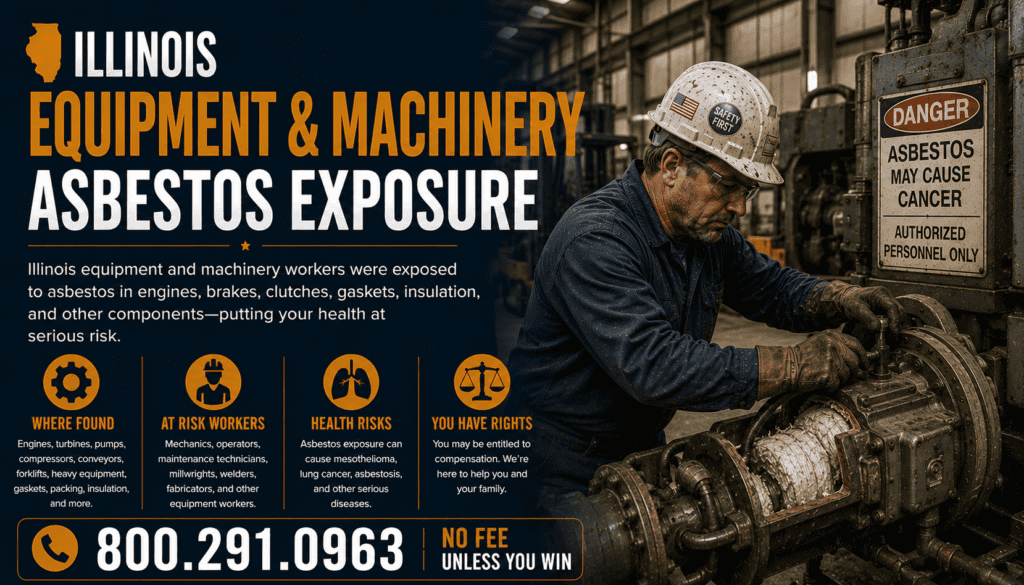
🏭 Illinois Equipment and Machinery Asbestos Exposure
For much of the twentieth century, Illinois workers were routinely exposed to asbestos while operating, maintaining, repairing, rebuilding, and installing industrial equipment and heavy machinery. Manufacturing plants, steel mills, refineries, power plants, paper mills, food processing facilities, chemical plants, and thousands of other industrial workplaces depended on equipment that contained asbestos because it resisted heat, prevented fires, and insulated machinery operating under extreme conditions.
Before asbestos regulations were implemented, manufacturers incorporated asbestos into pumps, compressors, boilers, valves, motors, generators, furnaces, ovens, conveyor systems, brakes, clutches, gaskets, packing materials, insulation, and countless other mechanical components. During routine maintenance and major equipment overhauls, these asbestos-containing materials were often cut, removed, scraped, drilled, or replaced, releasing microscopic asbestos fibers into the air.
Many former Illinois industrial workers were later diagnosed with mesothelioma, asbestos lung cancer, and asbestosis decades after their occupational exposure.
If you worked around industrial equipment in Illinois, you may also find our Illinois Asbestos Exposure Sites page helpful for identifying additional facilities where asbestos exposure commonly occurred.
🏭 Equipment and Machinery Throughout Illinois Industries
Illinois has long been one of America’s largest manufacturing states. Thousands of factories, steel mills, power plants, refineries, warehouses, transportation facilities, and industrial plants relied on heavy equipment and machinery to keep production running around the clock.
Industrial equipment was commonly used in:
- Manufacturing plants
- Steel mills
- Foundries
- Power plants
- Oil refineries
- Chemical plants
- Paper mills
- Food processing facilities
- Automobile plants
- Railroad repair shops
- Machine shops
- Warehouses
- Government facilities
- Military installations
- Water treatment plants
- Cement plants
- Grain processing facilities
- Textile mills
- Glass manufacturing plants
- Commercial buildings
Many of these facilities continued operating asbestos-containing machinery well into the late twentieth century.
🔥 Why Asbestos Was Used in Industrial Equipment
Industrial machinery operated under tremendous heat, pressure, friction, and continuous vibration. Manufacturers relied on asbestos because it helped protect equipment from failure while improving operating efficiency.
Asbestos was commonly used because it provided:
- Excellent heat resistance
- Fire protection
- Thermal insulation
- Electrical insulation
- Chemical resistance
- Durability
- Wear resistance
- Long service life
Asbestos became a standard material throughout nearly every major category of industrial equipment.
Common asbestos-containing products included:
- Pipe insulation
- Mechanical insulation
- Gaskets
- Valve packing
- Pump packing
- Brake linings
- Clutch facings
- Thermal cement
- Block insulation
- Rope insulation
- Fireproof panels
- Heat shields
- Electrical insulation
- Refractory materials
- Expansion joints
- Mechanical seals
- Spray-applied fireproofing
- Motor insulation
- Generator insulation
- Boiler insulation
⚙️ Heavy Industrial Machinery
Illinois manufacturing facilities depended on heavy industrial machinery to produce steel, chemicals, paper products, food products, machinery, automobiles, and countless other products.
Common machinery included:
- Production equipment
- Hydraulic presses
- Mechanical presses
- Stamping machines
- Rolling mills
- Conveyors
- Crushers
- Mixers
- Industrial dryers
- Processing equipment
Maintenance personnel frequently removed worn insulation, replaced mechanical components, and rebuilt equipment containing asbestos materials.
🔩 Pumps, Compressors, and Mechanical Equipment
Industrial facilities relied on pumps and compressors to move liquids, steam, oil, chemicals, compressed air, and other materials throughout manufacturing operations.
Common equipment included:
- Steam pumps
- Water pumps
- Air compressors
- Vacuum pumps
- Hydraulic pumps
- Pressure pumps
- Rotary compressors
- Blowers
- Mechanical seals
- Pressure vessels
Routine maintenance often disturbed asbestos-containing gaskets, packing materials, insulation, and heat-resistant components.
⚡ Motors, Generators, and Electrical Equipment
Large industrial machines commonly relied on electrical equipment insulated with asbestos-containing materials.
Workers frequently serviced:
- Electric motors
- Industrial generators
- Transformers
- Control panels
- Switchgear
- Circuit breakers
- Electrical cabinets
- Motor starters
- Cable insulation
- Electrical control systems
Electricians and maintenance mechanics regularly encountered asbestos while upgrading or repairing older industrial equipment.
🔥 Industrial Furnaces and High-Temperature Equipment
Many Illinois industrial facilities operated equipment capable of reaching extremely high temperatures.
Common high-temperature equipment included:
- Industrial furnaces
- Heat-treating furnaces
- Industrial ovens
- Kilns
- Melting furnaces
- Annealing furnaces
- Industrial dryers
- Curing ovens
- Heat exchangers
- Thermal processing equipment
These systems commonly contained asbestos insulation, refractory brick, thermal cement, and other heat-resistant materials.
🔧 Equipment Maintenance and Repair
Routine equipment maintenance represented one of the largest sources of occupational asbestos exposure.
Maintenance personnel regularly performed:
- Pump rebuilding
- Compressor repairs
- Valve replacement
- Motor rebuilding
- Generator repairs
- Machinery alignment
- Bearing replacement
- Gasket replacement
- Packing replacement
- Equipment overhauls
Many repairs required removing deteriorated asbestos insulation before maintenance work could begin.
Workers responsible for repairing industrial mechanical systems may also find our Illinois Factory Workers Asbestos Exposure page helpful because many manufacturing facilities contained similar asbestos-containing equipment.
👷 Occupations with High Equipment and Machinery Asbestos Exposure
Many different occupations routinely worked around asbestos-containing industrial equipment.
Higher-risk occupations included:
- Maintenance mechanics
- Millwrights
- Industrial mechanics
- Machinery repair technicians
- Pipefitters
- Steamfitters
- Boilermakers
- Electricians
- Welders
- Machinists
- Factory maintenance workers
- Plant engineers
- Equipment operators
- Industrial laborers
- Mechanical contractors
- Power plant workers
- Building engineers
- HVAC technicians
- Utility workers
- Stationary engineers
Many employees spent decades maintaining aging machinery that contained asbestos insulation and asbestos-containing mechanical components.
👨👩👧 Secondary (Take-Home) Asbestos Exposure
Workers who repaired industrial equipment frequently carried asbestos fibers home on:
- Work clothing
- Boots
- Gloves
- Hard hats
- Tool bags
- Hand tools
- Personal vehicles
Family members could unknowingly inhale asbestos fibers while:
- Washing contaminated work clothing
- Shaking dusty uniforms
- Cleaning boots
- Vacuuming vehicles
- Handling contaminated tools
- Greeting workers after shifts
Some spouses and children later developed mesothelioma despite never working around industrial equipment themselves.
Families researching legal options should also review our Illinois Mesothelioma Lawsuits page.
⚙️ Asbestos-Containing Equipment and Machinery Used Throughout Illinois
For decades, Illinois workers routinely operated, repaired, rebuilt, installed, and maintained industrial equipment and heavy machinery that contained asbestos. Because manufacturing equipment generated high temperatures, friction, pressure, and vibration, manufacturers incorporated asbestos into countless mechanical components to improve durability, reduce heat transfer, and prevent equipment failures.
Maintenance personnel were repeatedly exposed while replacing worn parts, rebuilding machinery, removing insulation, repairing pumps, replacing gaskets, servicing compressors, and overhauling industrial equipment.
Common asbestos-containing machinery components included:
- Pipe insulation
- Mechanical insulation
- Gaskets
- Valve packing
- Pump packing
- Bearings
- Bushings
- Brake linings
- Clutch facings
- Heat shields
- Expansion joints
- Fireproof panels
- Thermal cement
- Refractory insulation
- Electrical insulation
- Motor insulation
- Generator insulation
- Spray-applied fireproofing
- Rope insulation
- Block insulation
Many of these asbestos-containing materials remained in service throughout Illinois factories and industrial facilities for decades before maintenance or modernization projects disturbed them.
Workers involved in installing or repairing industrial equipment should also review our Illinois Construction Workers Mesothelioma page.
⚙️ Pumps, Compressors, and Mechanical Equipment
Industrial facilities throughout Illinois depended on pumps, compressors, and other mechanical equipment to move water, steam, oil, chemicals, compressed air, and other materials throughout manufacturing operations.
Many of these systems incorporated asbestos because of its heat resistance and sealing properties.
Common asbestos-containing equipment included:
- Centrifugal pumps
- Steam pumps
- Water pumps
- Air compressors
- Vacuum pumps
- Hydraulic pumps
- Pressure pumps
- Rotary compressors
- Air handling equipment
- Mechanical seals
Routine maintenance commonly required:
- Replacing gaskets
- Repacking pumps
- Rebuilding compressors
- Removing insulation
- Replacing mechanical seals
- Repairing pressure systems
These repairs frequently released airborne asbestos fibers.
🔩 Bearings, Bushings, and Rotating Equipment
Heavy industrial machinery relied on bearings and bushings that operated under tremendous loads and high operating temperatures.
Maintenance personnel regularly serviced:
- Roller bearings
- Sleeve bearings
- Journal bearings
- Bronze bushings
- Bearing housings
- Shaft assemblies
- Drive systems
- Gearboxes
- Conveyor rollers
- Rotating equipment
Repairing adjacent insulated equipment often disturbed asbestos-containing materials surrounding these mechanical systems.
🔧 Valves, Gaskets, and Packing Materials
Nearly every industrial machine contained valves, flanges, pumps, and pressure connections that required asbestos-containing sealing materials.
Common asbestos-containing products included:
- Flange gaskets
- Valve gaskets
- Pump gaskets
- Valve packing
- Pump packing
- Expansion joints
- Mechanical seals
- High-temperature seals
- Steam valve packing
- Pressure vessel gaskets
Maintenance workers routinely scraped old gasket material from metal surfaces before installing new components, creating significant asbestos dust.
Workers who routinely repaired steam systems should also review our Illinois Pipefitters Mesothelioma Lawsuit page.
⚡ Motors, Generators, and Electrical Equipment
Large industrial machines frequently relied on electric motors and generators insulated with asbestos-containing materials.
Common equipment included:
- Electric motors
- Industrial generators
- Control panels
- Switchgear
- Circuit breakers
- Transformers
- Electrical cabinets
- Motor starters
- Cable insulation
- Electrical control systems
Electricians and maintenance mechanics often encountered asbestos while upgrading, repairing, or replacing aging electrical equipment.
🔥 Industrial Furnaces, Ovens, and High-Temperature Equipment
Many Illinois manufacturing facilities operated equipment capable of reaching extremely high temperatures.
To withstand this heat, manufacturers lined equipment with asbestos-containing refractory materials.
Common equipment included:
- Industrial furnaces
- Heat-treating furnaces
- Drying ovens
- Kilns
- Annealing furnaces
- Melting furnaces
- Industrial dryers
- Curing ovens
- Heat exchangers
- Thermal processing equipment
Routine rebuilding and refractory replacement frequently disturbed asbestos insulation.
🏭 Equipment Overhauls and Plant Shutdowns
Scheduled maintenance shutdowns often exposed workers to the highest levels of airborne asbestos.
During major overhauls, maintenance crews commonly performed:
- Complete machinery rebuilds
- Pump replacement
- Compressor rebuilding
- Valve replacement
- Motor replacement
- Generator repairs
- Pipe replacement
- Insulation removal
- Mechanical upgrades
- Equipment modernization
Multiple trades frequently worked simultaneously throughout industrial facilities, increasing both direct and bystander asbestos exposure.
🔨 Machinery Repair Shops
Machine shops and maintenance departments repaired equipment from throughout manufacturing facilities.
Common repair activities included:
- Welding
- Machining
- Grinding
- Bearing replacement
- Pump rebuilding
- Compressor repairs
- Motor rebuilding
- Shaft repairs
- Valve rebuilding
- Mechanical fabrication
Although the machinery itself often required repairs, removing nearby asbestos insulation before maintenance frequently generated dangerous airborne asbestos fibers.
👷 Occupations with Increased Equipment and Machinery Asbestos Exposure
Many occupations routinely worked around industrial equipment throughout Illinois.
Higher-risk occupations included:
- Maintenance mechanics
- Millwrights
- Industrial mechanics
- Machinery repair technicians
- Pipefitters
- Steamfitters
- Boilermakers
- Electricians
- Welders
- Machinists
- Plant engineers
- Factory maintenance workers
- Equipment operators
- Industrial laborers
- Mechanical contractors
- Power plant workers
- Building engineers
- HVAC technicians
- Utility workers
- Stationary engineers
Many employees spent decades repairing aging industrial machinery that contained extensive asbestos insulation and asbestos-containing mechanical components.
👨👩👧 Secondary (Take-Home) Asbestos Exposure
Workers who repaired industrial equipment frequently carried asbestos fibers home on:
- Work clothing
- Boots
- Gloves
- Hard hats
- Tool bags
- Hand tools
- Personal vehicles
Family members could unknowingly inhale asbestos fibers while:
- Washing contaminated work clothing
- Cleaning dusty boots
- Vacuuming vehicles
- Handling contaminated tools
- Shaking uniforms
- Greeting workers after shifts
Some spouses and children later developed mesothelioma despite never working in industrial facilities.
📋 Documenting Equipment and Machinery-Related Asbestos Exposure
Many former industrial workers cannot remember every asbestos-containing machine or component they encountered decades ago. Fortunately, successful asbestos claims often rely on employment records, maintenance logs, equipment repair histories, union records, coworker testimony, and historical evidence documenting the widespread use of asbestos throughout industrial machinery and manufacturing equipment.
Helpful documentation may include:
- Employer records
- Employment dates
- Job titles
- Facility names
- Equipment maintenance records
- Machinery repair logs
- Union membership records
- Coworker statements
- Medical records
- Social Security employment history
Workers should focus on identifying the facilities where they worked, the machinery they maintained, and the types of industrial equipment they repaired rather than attempting to remember every asbestos-containing manufacturer or individual product.