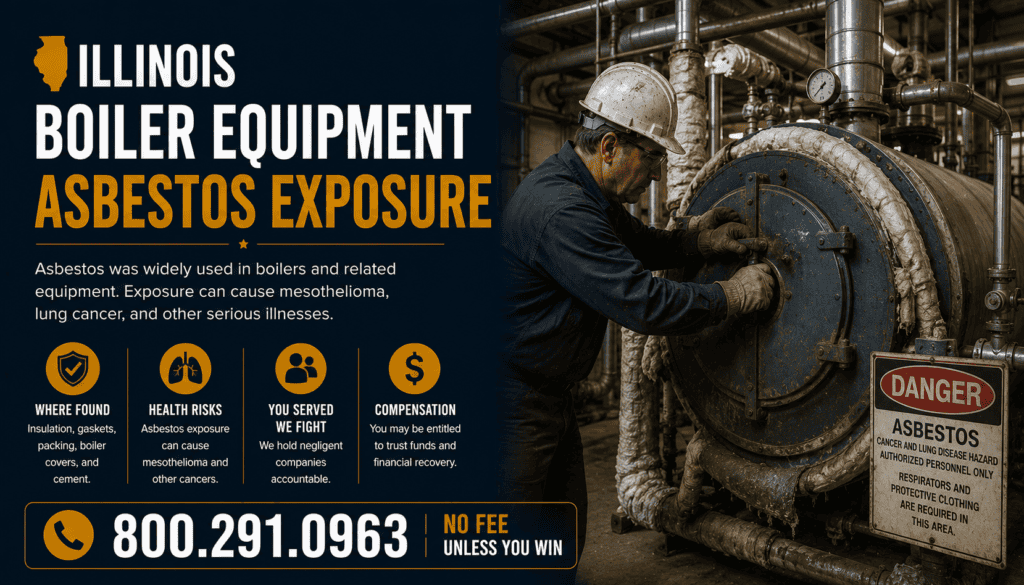
🔥 Illinois Boiler Equipment Asbestos Exposure
Boiler equipment used in Illinois power plants, factories, commercial buildings and institutional facilities historically incorporated asbestos for thermal insulation, sealing and fire resistance. Boiler insulation, refractory materials, gaskets, packing and connected steam piping could release fibers when repaired or removed.
Boiler operators, boilermakers, pipefitters, maintenance workers, insulators and contractors diagnosed with mesothelioma or asbestos-related lung cancer may have encountered asbestos decades earlier during boiler installation, inspection, cleaning, repair, overhaul or replacement.
🔥 Illinois Boiler Equipment Asbestos Exposure
Illinois Boiler Equipment Asbestos Exposure developed extensive shipbuilding, overhaul, repair and maintenance operations that relied on high-temperature equipment, steam systems, fire-resistant construction and mechanical insulation. Asbestos-containing materials were historically used nationwide because they resisted heat, flame, friction and chemical damage.
Workers could breathe fibers when insulation, gaskets, packing, fireproofing, flooring, cement products or friction materials were cut, drilled, scraped, sanded, removed or damaged. Maintenance, repair, renovation and demolition could create dust from older materials that had remained in place for years.
Exposure was not limited to people who directly handled asbestos. Nearby workers could share dusty areas, and fibers could be carried home on clothing, shoes, hair, tools and belongings. Family members who handled contaminated work clothes could experience secondary exposure.
See Virginia asbestos exposure and mesothelioma lawsuit information for broader statewide information.
🏗️ Where This Equipment Was Used
Across Illinois Boiler Equipment Asbestos Exposure, ship repair, overhaul, machinery maintenance, insulation work and confined-space operations created varied historical exposure environments. Potential historical exposure settings included steam and process piping, pipe insulation, valves and flanges, pumps and gaskets, boilers and mechanical rooms, maintenance and shutdown work.
Mechanical rooms could contain insulated boilers and steam lines, pumps, valves and gaskets. Industrial facilities could use furnaces, ovens, turbines and machinery with insulation, gaskets or packing. Transportation facilities could contain friction components and insulated equipment, while older public and commercial buildings could contain fireproofing, floor tile, ceiling products and mechanical insulation.
Exposure could differ greatly within one workplace. Job duties, department, years worked, equipment serviced, nearby trades and shutdown or renovation activity all influenced whether a person encountered asbestos dust.
| Setting | Potential Sources | Workers Nearby |
|---|---|---|
| Industrial/manufacturing | Boilers, furnaces, piping, pumps, valves, gaskets, packing | Mechanics, machinists, millwrights, pipe trades |
| Transportation/institutional | Friction products, insulated equipment, steam systems | Transportation, maintenance and facility workers |
| Utilities | Boiler insulation, turbines, steam piping, pumps, valves | Boilermakers, pipefitters, electricians, operators |
| Construction/buildings | Fireproofing, flooring, ceilings, cement products, HVAC insulation | Construction trades, custodians, maintenance workers |
👷 Workers Who Serviced This Equipment
Occupations commonly associated with historical exposure include Pipefitters, Boilermakers, Electricians, Millwrights, mechanics, machinists, welders, plumbers, insulators, operating engineers, construction workers, demolition workers, custodians and maintenance personnel.
Electricians could work around generators, switchgear, heat-resistant components and fireproofed spaces. Millwrights and mechanics repaired pumps, valves and machinery. Pipefitters and boilermakers worked around steam lines, boilers, insulation, gaskets and packing. Construction trades could disturb fireproofing, flooring, cement products and mechanical insulation.
People diagnosed today may be recalling jobs held 30, 40 or 50 years ago. Writing down employers, exact work locations, departments, coworkers, unions, equipment and major shutdown or renovation projects can preserve useful exposure information for medical discussions, benefits applications and compensation questions.
⚙️ Asbestos Components & Materials
Potential historical sources included boiler and pipe insulation, pump and valve packing, gaskets, refractory materials, fireproofing, floor tile, roofing, cement products, joint compounds, electrical insulation and some older brake and clutch components.
Boilers and steam systems often required extensive heat insulation. Pumps and valves used replaceable gaskets and packing. Factories and utilities used high-temperature machinery, while commercial and institutional buildings used fire-resistant materials around structural steel, mechanical rooms and utility spaces.
| Product/Equipment | How Fibers Could Be Released | Activities |
|---|---|---|
| Pipe/boiler insulation | Cutting, deterioration, removal | Pipe work, boiler repair |
| Gaskets/packing | Scraping and removal | Pump, valve, flange repair |
| Building products | Drilling, sanding, renovation, demolition | Construction and maintenance |
| Friction components | Removal, grinding, dusty cleanup | Vehicle or equipment repair |
🔎 Common Equipment Components & Exposure Tasks
Important exposure details can include the employer or facility, dates worked, job title, equipment or system involved, maintenance task, products handled and nearby trades performing dusty repair or removal work.
| Equipment or Component | Potential Asbestos Sources | How Materials Could Be Disturbed |
|---|---|---|
| Boiler Insulation | Older insulation, gaskets, packing, refractory, friction or heat-resistant materials associated with the task or equipment | Repair, removal, overhaul, cutting, scraping, replacement or nearby maintenance |
| Refractory Materials | Older insulation, gaskets, packing, refractory, friction or heat-resistant materials associated with the task or equipment | Repair, removal, overhaul, cutting, scraping, replacement or nearby maintenance |
| Door And Access Gaskets | Older insulation, gaskets, packing, refractory, friction or heat-resistant materials associated with the task or equipment | Repair, removal, overhaul, cutting, scraping, replacement or nearby maintenance |
| Steam Piping | Older insulation, gaskets, packing, refractory, friction or heat-resistant materials associated with the task or equipment | Repair, removal, overhaul, cutting, scraping, replacement or nearby maintenance |
| Valves And Pumps | Older insulation, gaskets, packing, refractory, friction or heat-resistant materials associated with the task or equipment | Repair, removal, overhaul, cutting, scraping, replacement or nearby maintenance |
| Boiler Overhaul And Removal | Older insulation, gaskets, packing, refractory, friction or heat-resistant materials associated with the task or equipment | Repair, removal, overhaul, cutting, scraping, replacement or nearby maintenance |
Because mesothelioma and asbestos-related lung cancer can develop decades after exposure, reconstructing older maintenance practices and equipment histories can help identify where asbestos exposure may have occurred.
🫁 Mesothelioma After Asbestos Exposure
Mesothelioma is a rare cancer of the mesothelium, the thin tissue lining certain organs. Pleural mesothelioma affects the lining around the lungs and is the most common form; peritoneal mesothelioma develops in the abdominal lining.
Asbestos exposure is the principal established cause of malignant mesothelioma. Disease can develop decades after exposure, so a diagnosis today may relate to work, military service or household exposure many years earlier.
Symptoms can include shortness of breath, chest pain, persistent cough, fatigue, unexplained weight loss and fluid around the lungs. These symptoms can have many causes. Diagnosis commonly includes imaging followed by biopsy and pathology review.
Patients can ask their medical team about disease type and stage, specialist care, treatment options, symptom management and clinical trials. Treatment may include surgery for selected patients, chemotherapy, immunotherapy, radiation and supportive care.
🩺 Asbestos-Related Lung Cancer
Asbestos-related lung cancer is different from mesothelioma. Lung cancer begins in lung tissue, while pleural mesothelioma begins in the lining around the lungs. Asbestos is an established cause of lung cancer, and disease can appear many years after exposure.
Possible symptoms include persistent or worsening cough, coughing up blood, chest pain, shortness of breath, fatigue, unexplained weight loss or repeated chest infections. Persistent symptoms should be discussed with a qualified medical professional.
Smoking is the leading cause of lung cancer, but asbestos is an independent lung-cancer hazard. Smoking combined with asbestos exposure can raise risk substantially. A smoking history does not make occupational, military or household asbestos exposure irrelevant.
Treatment depends on cancer type, stage, tumor characteristics and overall health and may include surgery, radiation, chemotherapy, immunotherapy, targeted therapy and supportive care.
💼 Mesothelioma & Asbestos Lung Cancer Compensation Options
People diagnosed with mesothelioma or asbestos-related lung cancer after exposure at Illinois Boiler Equipment Asbestos Exposure may have questions about financial assistance and compensation. Depending on individual circumstances, possible sources can include asbestos lawsuits, bankruptcy trust funds, veterans’ benefits and other benefits or insurance programs.
Asbestos bankruptcy trusts were established by certain companies that previously manufactured or supplied asbestos-containing products. Each trust has its own medical and exposure requirements. Some people may potentially qualify for more than one source when exposure involved multiple products or companies.
Filing deadlines and legal requirements depend on diagnosis, claim type and individual circumstances. Anyone considering legal options should obtain guidance about deadlines that apply to their own situation.
🎖️ Illinois Veterans, Asbestos Exposure & VA Benefits
Veterans living at Illinois Boiler Equipment Asbestos Exposure may have histories involving military service, civilian employment or both. Asbestos was historically used in military ships, bases, vehicles, aircraft, boiler rooms, mechanical systems and buildings.
Review U.S. Military Veterans Asbestos Exposure and Military Bases Asbestos Exposure. A veteran with an asbestos-related disease connected to military service may be eligible for VA disability benefits. VA benefits are separate from eligible claims involving private asbestos manufacturers or bankruptcy trusts.
Useful service information includes branch, duty stations, ships, military occupation or rating, dates of service and equipment or buildings where duties were performed. Medical questions should be discussed with qualified clinicians and VA eligibility questions with an accredited representative or qualified benefits professional.
❓ Frequently Asked Questions
Can asbestos exposure at Illinois Boiler Equipment Asbestos Exposure cause mesothelioma?
Asbestos exposure is the principal established cause of malignant mesothelioma, and occupational, military and household exposure can remain relevant decades later.
Is asbestos-related lung cancer the same as mesothelioma?
No. Lung cancer begins in lung tissue; mesothelioma develops in the mesothelial lining.
Which industries had potential asbestos exposure?
Historical settings included steam and process piping, pipe insulation, valves and flanges, pumps and gaskets, boilers and mechanical rooms, maintenance and shutdown work.
Which workers were commonly exposed?
Pipefitters, boilermakers, electricians, millwrights, mechanics, machinists, insulators, construction workers and maintenance personnel are among occupations associated with historical exposure.
Can family members have secondhand exposure?
Yes. Fibers could historically be carried home on dusty clothing, shoes, hair, tools and belongings.
Does smoking rule out asbestos-related lung cancer?
No. Smoking and asbestos are separate lung-cancer hazards, and both histories are medically important.
Can veterans receive VA benefits?
Veterans may qualify when an asbestos-related condition is connected to military service and VA requirements are met.
What can I do after a diagnosis?
Follow your medical team’s recommendations, keep pathology and imaging records, write down past jobs and military service, and learn about medical, benefits and compensation resources that may apply.
📌 Summary
Illinois Boiler Equipment Asbestos Exposure’s history of steam and process piping, pipe insulation, valves and flanges, pumps and gaskets, boilers and mechanical rooms, maintenance and shutdown work created settings where workers and families could encounter asbestos. For someone diagnosed with mesothelioma or asbestos-related lung cancer, understanding past exposure can provide useful context for medical conversations and help identify potential compensation, trust fund and veterans’ resources.
☎️ Review Your Asbestos Exposure History
If you or a family member has been diagnosed with mesothelioma or asbestos-related lung cancer, help is available.
Find out if you may qualify for asbestos compensation today.
Call 800.291.0963
Help is available 24 hours a day, 7 days a week, 365 days a year.
With 25+ years of experience helping people affected by asbestos exposure, Mesothelioma Help Center provides information about potential asbestos compensation, asbestos trust funds, veterans’ benefits, and other available resources.
Submit Your Case Here to provide information about your asbestos exposure and diagnosis, or use the form below to get help today.
Mesothelioma Help Center is not a law firm or medical provider and does not determine legal or VA eligibility.