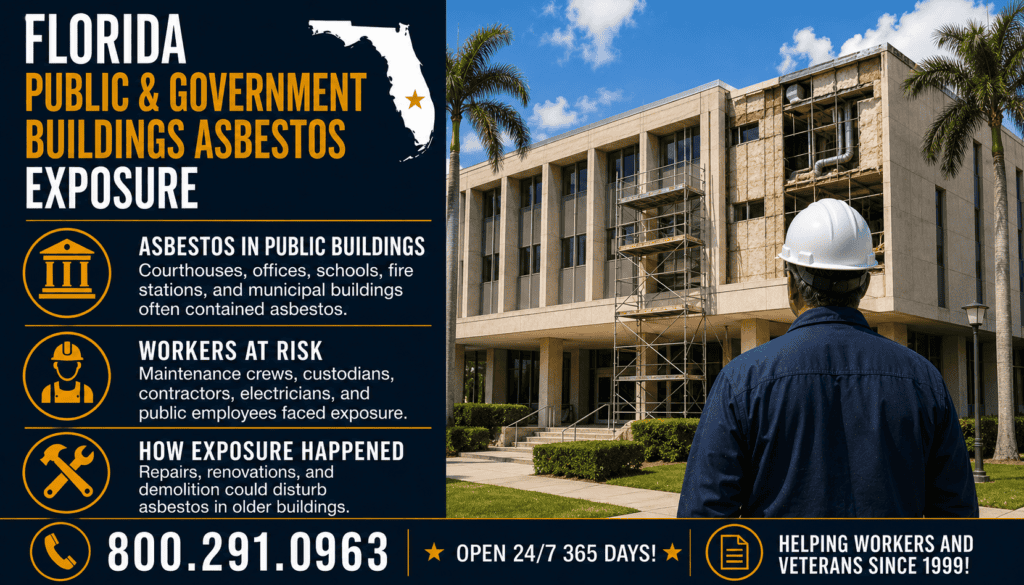
Florida Public & Government Buildings Asbestos Exposure
Florida public and government building asbestos exposure research should identify the specific property, building area, work activity and time period involved. The age of a courthouse, school, office, municipal building or other public property can guide research, but it does not prove asbestos was present or disturbed.
Renovation, maintenance, repair and demolition histories can be especially important because building systems and finishes change over time. A useful exposure history connects records for the physical property to the person’s actual work or presence there.
Florida Public & Government Buildings Exposure Overview
This page focuses on public and government properties within Florida Asbestos Exposure Sites & Industries. Site research should distinguish a building’s construction history from later additions, renovations and abatement.
Property ownership or agency control can also change. Records should be matched to the correct physical address, building, department and dates rather than relying only on a facility name.
Public Building Types & Work Areas
Potential research settings include government offices, courthouses, schools, public-safety buildings, municipal facilities and other publicly operated properties. Relevant areas can include mechanical rooms, utility spaces, ceilings, floors, walls and service corridors when records support the connection.
Not every building material in an older public facility contained asbestos. Product composition and installation history require evidence.
| Research Area | Potential Supporting Evidence |
|---|---|
| Employment or assignment | Personnel, union, contractor, department or project records |
| Tasks and locations | Work orders, plans, maintenance files, photographs and firsthand testimony |
| Materials or equipment | Specifications, purchase records, manuals, invoices and product documentation |
Building Materials & Mechanical Systems
Historical research may examine pipe or boiler insulation, flooring, ceiling materials, fireproofing, joint compounds, gaskets and other building or mechanical-system materials where supported by records.
Material-focused research is organized under Florida Asbestos Products, while machinery and mechanical systems are organized under Florida Equipment & Machinery Asbestos Exposure.
Renovation, Maintenance & Demolition Activities
Construction, repair, renovation and demolition can disturb existing building materials. OSHA’s construction asbestos standard covers specified work involving asbestos, including demolition, removal, repair, maintenance and renovation.
Modern regulatory requirements provide occupational context but do not prove historical conditions at a particular Florida property.
Workers & Occupants in Public Buildings
Maintenance personnel, electricians, plumbers, construction workers, custodial staff, contractors and other workers may have entered building areas during service or renovation work. Exposure research should identify the person’s actual task and proximity to disturbed material.
Occupation-specific research is organized under Florida Workers & Occupational Asbestos Exposure.
| Evidence Question | Why It Matters |
|---|---|
| Where and when did the work occur? | Connects records to the correct property, project, department or facility period |
| What task was performed? | Distinguishes direct handling from nearby or general workplace presence |
| What material or equipment is supported? | Prevents unsupported assumptions about asbestos content or product identity |
Records for Public Building Research
Useful records can include property files, architectural drawings, renovation specifications, maintenance work orders, contracts, bid documents, inspection reports, purchase records, photographs and credible firsthand testimony.
Later asbestos surveys or abatement records can identify materials that were found at a property, but they do not automatically prove the same conditions existed during an earlier work period.
Building an Exposure & Claim History
Build a chronology connecting the person, building, work area, activity, material or system when supported, and dates. Record the source for every important factual connection.
Florida claim topics are organized under Florida Mesothelioma Lawsuits & Claims, and statewide context is available through the Florida mesothelioma and asbestos exposure section.
No claim or compensation outcome is guaranteed.
Frequently Asked Questions
Do all older public buildings contain asbestos?
No. Age can guide research, but material composition requires property-specific evidence.
Why track renovations?
Renovations can remove, replace or disturb materials and can generate useful project records.
Does a job or building name prove asbestos exposure?
No. Specific tasks, materials, equipment, location and dates require supporting evidence.
Can coworker testimony help?
Yes. Credible firsthand testimony can help describe shared tasks, work areas, equipment and materials.
Should uncertain product information be stated as fact?
No. Preserve uncertainty until reliable evidence supports a specific identification.
What records should be preserved?
Preserve employment, project or facility, equipment, product, medical and witness records when available.
Do modern asbestos records prove older conditions?
Not necessarily. Later surveys or abatement records can be useful leads but must be matched carefully to the earlier period.
Is compensation guaranteed?
No. Evidence, eligibility, applicable law and the particular claim route affect each matter.
Confirmed Sources & Summary
OSHA provides authoritative occupational and regulatory context for asbestos. These sources do not establish that a particular Florida worker, building, project, factory, product or piece of equipment involved asbestos; person- and site-specific conclusions require supporting evidence.
Confirmed Sources
Review Your Florida Work & Exposure History
Call 800.291.0963 or submit the form below to discuss informational resources and possible next steps.
Disclaimer: This page provides general educational information and is not individualized legal or medical advice. Exposure histories, evidence, laws and individual circumstances vary, and no claim or compensation outcome is guaranteed.