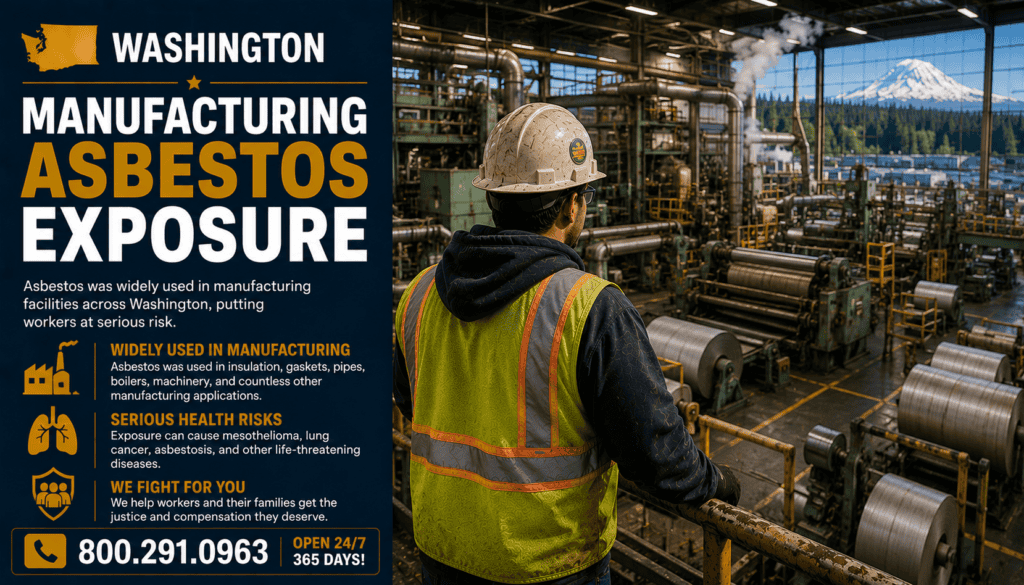
🛠️ Washington Manufacturing Asbestos Exposure
For much of the 20th century, manufacturing plants throughout Washington State relied on asbestos for heat resistance, fireproofing, and durability. Asbestos was widely used in production machinery, boilers, furnaces, ovens, presses, conveyors, and throughout building systems such as piping, electrical panels, and insulation. Many facilities also used Washington industrial asbestos products, Washington asbestos insulation products, and components associated with Washington industrial machinery asbestos exposure.
During daily production operations, asbestos-containing components were subjected to constant friction, vibration, and heat. Maintenance shutdowns, repairs, and equipment replacements further disturbed asbestos materials, releasing fibers into enclosed production floors and mechanical rooms. Workers often inhaled these fibers unknowingly for years.
Exposure risks were especially high when employees repaired Washington boiler equipment containing asbestos or serviced machinery used in factories and other Washington industrial facilities.
Many former Washington manufacturing workers are now facing asbestos-related diseases linked to these exposure environments. Additional information is available through our Washington asbestos exposure sites and Washington asbestos exposure articles.
📞 If you worked in manufacturing and were exposed, call 800-291-0963 for a confidential case evaluation.
⚠️ How Asbestos Exposure Occurred in Washington Manufacturing Plants
Manufacturing asbestos exposure commonly occurred during:
⚙️ Daily production operations, where friction and heat degraded asbestos-containing components
🔧 Equipment maintenance and repairs that disturbed asbestos gaskets, seals, packing, and insulation
🔥 High-temperature processes that accelerated the breakdown of asbestos materials
🏗️ Plant renovations and equipment upgrades that released asbestos from walls, ceilings, piping, and machinery
Poor ventilation and long shifts increased cumulative fiber exposure. Similar hazards affected Washington factory workers exposed to asbestos, employees at Washington power plants, and workers at Washington construction sites.
🏗️ Asbestos-Containing Materials Used in Manufacturing
Washington manufacturing facilities commonly used asbestos in:
⚙️ Machinery housings, heat shields, and friction components
🔥 Boiler, furnace, and oven insulation
🧰 Gaskets, packing, seals, and brake components
🔌 Electrical panels, wiring insulation, and control systems
🏭 Spray-applied fireproofing and industrial coatings
🧱 Flooring, roofing, cement board, wall materials, and other Washington asbestos products used in construction
Disturbing these materials released asbestos fibers directly into work areas. Machine operators and mechanics could also be exposed through Washington automotive brake equipment and other Washington automotive asbestos products used in industrial vehicles and production equipment.
👷 Washington Manufacturing Workers Most at Risk
Workers exposed to asbestos in manufacturing included:
Machine operators and production workers
Maintenance mechanics and millwrights
Electricians and control technicians
Welders and machinists
Boiler operators and technicians
Quality inspectors and supervisors working on production floors
Many of these occupations have dedicated exposure histories, including Washington factory workers exposed to asbestos, Washington electricians exposed to asbestos, and Washington pipefitters diagnosed with mesothelioma.
Secondhand exposure also affected spouses and family members when asbestos fibers were carried home on contaminated work clothing.
📍 Washington Manufacturing Asbestos Exposure Locations
Manufacturing asbestos exposure occurred statewide, including facilities located in:
Seattle — Industrial manufacturing and port-adjacent plants
Tacoma — Heavy manufacturing and processing facilities
Everett — Aerospace manufacturing and fabrication plants
Spokane — Manufacturing plants and industrial warehouses
Auburn — Fabrication, warehousing, and industrial manufacturing
Vancouver — Manufacturing and industrial processing facilities
Workers in Seattle, Auburn, and nearby communities may have encountered asbestos at facilities throughout King County.
Everett-area employees may have worked at contaminated manufacturing sites in Snohomish County, while workers in eastern Washington may have been exposed at facilities throughout Spokane County.
Manufacturing employees also worked near Washington shipyards and ports, railroad facilities, industrial warehouses, and public utility operations.
These cities remain key hubs for Washington manufacturing asbestos exposure investigations.
⚖️ How a Washington Asbestos Attorney Can Help Manufacturing Workers
A Washington asbestos attorney helps manufacturing workers pursue compensation while managing the legal process.
An attorney can:
✔ Identify exposure sources using manufacturing job-site records
✔ Collect medical documentation and employment histories
✔ File available Washington asbestos trust fund claims
✔ Pursue lawsuits against asbestos manufacturers, contractors, and suppliers
✔ Handle filings, deadlines, and negotiations, including compliance with the Washington mesothelioma statute of limitations
Workers diagnosed with mesothelioma, asbestos-related lung cancer, or other asbestos diseases may also qualify to pursue Washington asbestos lung cancer lawsuits or Washington wrongful death mesothelioma lawsuits, depending on their circumstances.
You do not need to identify the exact asbestos product before seeking help. Attorneys can often investigate exposure using job duties, employer records, facility histories, and known asbestos products.
📞 Call 800-291-0963 to speak with a Washington asbestos attorney today.
❓ Washington Manufacturing Asbestos Exposure FAQs
Can manufacturing exposure from decades ago still qualify?
Yes. Mesothelioma and other asbestos-related diseases often develop 20–50 years after workplace exposure.
What if I worked at more than one manufacturing plant?
Multiple exposure sites may strengthen your claim and increase compensation eligibility.
Do manufacturing workers need proof of asbestos exposure?
No. Attorneys can often identify exposure based on job duties, employment records, facility histories, and work locations.
What does an asbestos attorney cost?
Nothing upfront. Most asbestos attorneys work on a contingency fee basis, meaning no legal fee is owed unless compensation is recovered.
🧠 What You Should Do Next
📞 Call 800-291-0963 for a confidential Washington manufacturing asbestos case evaluation.
📋 Gather your job titles, facility names, employer information, and approximate work dates.
📍 Review known Washington asbestos exposure sites to help identify possible exposure locations.
⚖️ Speak with an attorney before filing deadlines expire. Acting promptly helps protect your legal rights and your ability to pursue compensation.
🛠️ Washington Manufacturing Asbestos Case Evaluation
If you worked at a Washington manufacturing facility and were later diagnosed with mesothelioma, asbestos-related lung cancer, or asbestosis, you may qualify to pursue compensation.
📞 Call 800-291-0963
✔ No upfront costs
✔ Confidential case review
✔ Help identifying manufacturing exposure sites
✔ Assistance pursuing lawsuits and asbestos trust fund claims
✔ No legal fee unless compensation is recovered