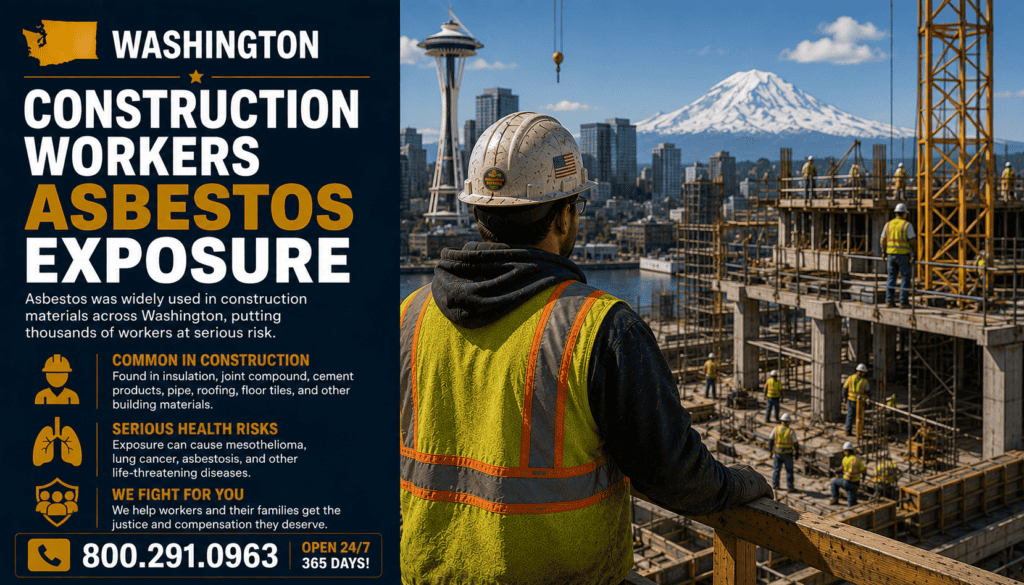
Washington Construction Workers Mesothelioma
Washington Construction Workers Mesothelioma research should connect a specific person to a physical worksite or project, actual tasks and an identified material rather than rely on a broad facility or occupation label. Historical asbestos use can generate research leads, but it does not establish individual exposure without supporting evidence.
For a person diagnosed with mesothelioma, dated employment, property, project and product records can help distinguish supported facts from assumptions. This page focuses narrowly on construction workers mesothelioma while keeping related Washington site, occupation, equipment and product topics separate.
Washington Construction Workers & Mesothelioma Overview
Construction workers can encounter many building systems and materials across new construction, renovation, maintenance and demolition projects. A construction occupation alone does not establish asbestos exposure because materials, buildings and tasks vary by project and period.
OSHA’s asbestos construction standard applies to covered construction work involving asbestos, while Washington L&I identifies multiple suspect building materials. Those current safety sources provide context but do not prove historical exposure for a particular worker.
This occupation page belongs under Washington Workers & Occupational Asbestos Exposure.
Construction Trades & Job Tasks
Carpenters, laborers, electricians, plumbers, pipefitters, insulators, roofers and other trades can work on the same project while performing very different tasks. Record the claimant’s trade, employer, crew and actual work rather than relying on a generic construction label.
Helpers and apprentices may perform cleanup, material handling or preparation work that differs from journeyman tasks. Their duties should be documented independently.
Traveling trades may work on many short projects. Union dispatch, pension, payroll and contractor records can help reconstruct assignments that are difficult to remember decades later.
| Research Focus | Potential Supporting Evidence |
|---|---|
| Worksite and dates | Employment, union, property, project and contractor records |
| Task and work area | Work orders, schedules, maintenance files and witness accounts |
| Material or component | Specifications, invoices, packaging, photographs, surveys and testing |
Building Materials & Product Research
Washington L&I identifies flooring, adhesives, pipe insulation, wall and ceiling texture, joint compound, roofing and siding among suspect material categories. Product identification still requires evidence specific to the project and period.
A material found during a later renovation should not automatically be attributed to an earlier construction phase. Installation, removal and remodeling dates can change the product history of a building.
Material-focused research is organized under Washington Asbestos Products Used in Construction.
Renovation, Demolition & Nearby Work
Renovation and demolition can disturb existing building materials, while new construction can involve work adjacent to older retained systems. Interviews should identify whether the worker personally disturbed a material or was nearby while another trade did so.
Nearby-work evidence should document the trade, task, distance and frequency. Being present on the same large project does not establish exposure to every material disturbed onsite.
Project schedules, demolition plans, permits and daily reports can help place different trades in the same work area at the same time.
Contractor, Union & Project Records
Construction workers may be employed by subcontractors rather than the property owner or general contractor. Payroll, union and subcontract records can therefore be essential for connecting a worker to a specific site.
Specifications and submittals can identify products selected for a project, while invoices and delivery records can provide evidence of actual purchasing. Catalogs alone show availability, not site-specific use.
Witnesses should establish shared employer, project, area and dates before describing tasks they observed.
| Research Focus | Potential Supporting Evidence |
|---|---|
| Worksite and dates | Employment, union, property, project and contractor records |
| Task and work area | Work orders, schedules, maintenance files and witness accounts |
| Material or component | Specifications, invoices, packaging, photographs, surveys and testing |
Evidence for a Construction Worker History
Begin with a dated chronology of employers, physical worksites, departments, projects and actual tasks. Payroll, union, pension, Social Security, contractor and military records can corroborate assignments from decades ago. A facility name or occupation is a research starting point rather than proof of asbestos exposure.
Document direct work and nearby work separately. Identify the material or component, who disturbed it, tools or methods used, frequency, proximity and the basis for product identification. Preserve uncertainty when a witness cannot reliably identify a brand, material or date.
Medical records document diagnosis and treatment but do not identify the occupational source of exposure. Preserve pathology, imaging and treatment records alongside employment, worksite and product evidence, prior lawsuits, bankruptcy trust submissions, workers’ compensation records and VA materials when applicable.
Washington Claims & Compensation Options
Potential compensation routes can include civil lawsuits, asbestos bankruptcy trust claims, workers’ compensation and VA benefits for eligible veterans. These systems have separate eligibility and proof requirements, and a worksite or occupation does not automatically establish any particular claim.
Filing deadlines depend on the claim type and individual facts. Diagnosis, discovery, death, prior filings, jurisdiction and other circumstances can affect legal analysis, so generic online information should not replace prompt individualized review by qualified counsel.
No settlement, verdict, trust payment or benefit is guaranteed. Accurate organization of worksite, occupational, product and medical evidence can preserve useful information while potential claims are evaluated.
Frequently Asked Questions
Does a worksite or occupation prove asbestos exposure?
No. Evidence should connect the individual to a specific material, task, place and time period.
Can nearby work matter?
Potentially. Document who performed the task, proximity, frequency and the basis for identifying the disturbed material.
Why are project dates important?
Materials, equipment, contractors and work practices change. Date-specific records help identify the correct conditions.
What records should be preserved?
Keep employment, union, project, property, maintenance, product and witness information when available.
Can a later asbestos survey prove earlier exposure?
Not by itself. Installation, renovation and removal history should be considered before projecting later findings backward.
Can asbestos bankruptcy trusts be relevant?
Potentially, when evidence satisfies a particular trust’s current criteria. Eligibility should not be assumed from a company or product name alone.
Are workers’ compensation or VA benefits the same as a lawsuit?
No. They are separate systems with different eligibility and proof requirements.
Is compensation guaranteed?
No. Outcomes depend on applicable law, eligibility and evidence.
Confirmed Sources & Summary
Washington exposure research should connect a specific person, place, period, task and material rather than rely on generalized worksite or occupational history. Current safety sources provide authoritative context but do not prove historical exposure for an individual.
Confirmed Sources
Review Your Washington Exposure History
Call 800.291.0963 or submit the form below to discuss informational resources and possible next steps.
Disclaimer: This page provides general educational information and is not individualized legal or medical advice. Work histories, laws and claim requirements vary, and no outcome or compensation is guaranteed.