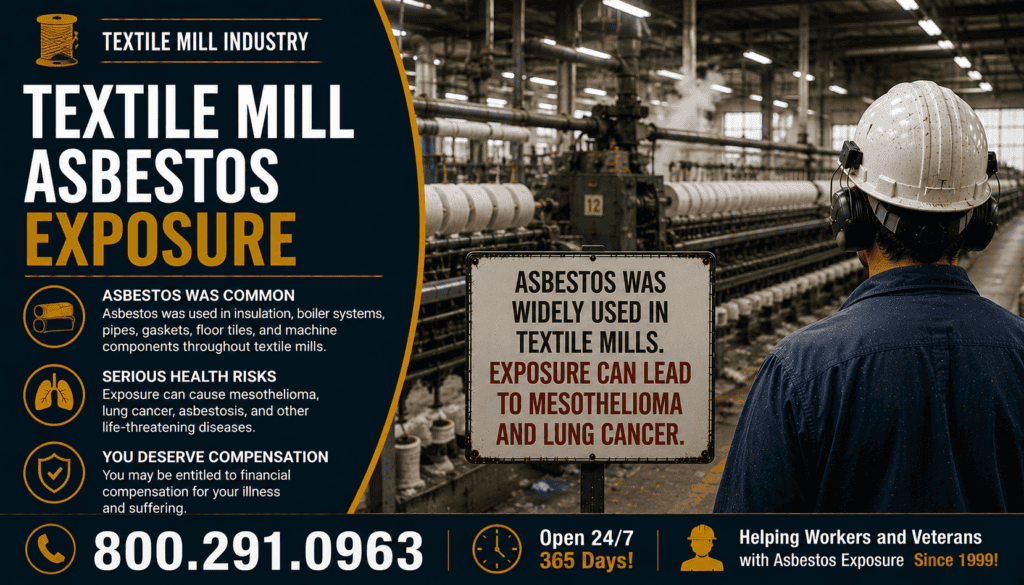
Textile Mills Asbestos Exposure
Textile Mills Asbestos Exposure concerns work in spinning rooms, weaving sheds, dye houses, finishing plants, boiler rooms and textile machinery repair shops. Depending on the era and equipment, certain products used asbestos for insulation, heat resistance or friction control. A facility name or job title alone cannot prove that a particular worker encountered asbestos.
People diagnosed with mesothelioma or asbestos-related lung cancer after employment at these facilities can use this guide to identify historical steam-pipe insulation, boiler coverings, equipment gaskets, heat-resistant textiles in certain applications and older construction materials, examine relevant tasks, preserve records and understand potential compensation options. Exposure depends on the actual product, date, disturbance and working conditions.
🏭 Where Asbestos Was Found In Textile Mills
Historical workplaces included spinning rooms, weaving sheds, dye houses, finishing plants, boiler rooms and textile machinery repair shops. Potential sources were historical steam-pipe insulation, boiler coverings, equipment gaskets, heat-resistant textiles in certain applications and older construction materials. Products varied by manufacturer and decade; a particular site should not be described as asbestos-contaminated without material-specific evidence.
Workers may have encountered suspect material during servicing heated finishing machinery, repairing boilers and steam lines, changing confirmed asbestos-containing seals, and disturbing old insulation. Work orders, facility drawings, material inventories, invoices and abatement records can help distinguish a credible exposure scenario from ordinary industrial dust.
Work Areas And Facility Systems
At spinning rooms, weaving sheds, dye houses, finishing plants, boiler rooms and textile machinery repair shops, inspect older heating, processing and mechanical systems for documented asbestos-containing materials. The location of the equipment, its age and whether it was opened or removed matter more than general plant conditions.
Service cards, model and year information, invoices, photographs, and manufacturer records may identify a specific component. A worker should not attempt to disturb or collect suspect material to prove a past exposure. A qualified professional can assess current materials using appropriate safeguards.
Repair And Overhaul Operations
Historical maintenance could involve servicing heated finishing machinery, repairing boilers and steam lines, changing confirmed asbestos-containing seals, and disturbing old insulation. Disturbance of a documented asbestos product, rather than ordinary operation of the equipment, is the important exposure question.
Building plans, contractor records, abatement reports, maintenance orders, and dated photographs can help distinguish the materials used at different times. Ordinary dust, diesel exhaust, and welding fumes should not automatically be labeled asbestos.
Facility Layout And Shared Maintenance
At textile mills, maintenance rooms and utility corridors often served more than one work area. A person who never handled insulation could still have worked nearby when another crew performed repairs. The useful questions are what material was disturbed, how the work was contained, whether dust spread and how frequently the person entered the area.
Changes Across Decades
The material mix at textile mills changed as equipment was replaced and asbestos restrictions expanded. An older structure can contain later replacement components, while newer equipment may have been installed in an older building. A reliable timeline combines purchase records, installation dates and firsthand descriptions rather than assuming a single exposure era.
👷 Workers And Daily Jobs At Textile Mills
Occupations included textile machine operators, loom mechanics, millwrights, stationary engineers, pipefitters, electricians and cleaners. Actual proximity to a disturbed product is more informative than a broad job title. Supervisors, contractors and nearby workers may have had different exposure circumstances.
Workers In Production And Maintenance
The workforce included textile machine operators, loom mechanics, millwrights, stationary engineers, pipefitters, electricians and cleaners. Different crews could have been present during equipment overhaul, plant shutdowns, cleaning and renovation.
For textile mills, maintenance assignments involving stored construction equipment, repairable machinery, vehicle components, and aging depot buildings should be described by task and equipment identification. Records can distinguish a routine inspection from a brake teardown or removal of suspect insulation.
Nearby Workers And Contractors
Contractors and employees working nearby should document how close they were to servicing heated finishing machinery, repairing boilers and steam lines, changing confirmed asbestos-containing seals, and disturbing old insulation, how long they remained there, and whether containment or cleanup measures were used.
Workers who entered repair areas briefly should document the time spent near active maintenance and whether identifiable asbestos-containing material was disturbed. The presence of visible dust alone cannot establish its composition.
Building And Utility Crews
Facilities crews may have worked on boilers, insulation, pumps, electrical equipment and older building materials. An asbestos survey or material record is needed to identify a particular product.
Electrical and facilities staff should distinguish work on modern wiring from disturbance of older electrical heat barriers, boiler insulation, or building materials. A licensed asbestos professional can assess suspect material safely.
Cleaning And Material Handling
Cleaning and materials-handling activities are relevant when dust or debris came from confirmed asbestos-containing material. General industrial dust is not a reliable indicator.
Parts handlers and cleaners may have worked near removed components or residue from repairs. Relevant details include disposal practices, housekeeping methods, work orders, and whether the underlying material was confirmed to contain asbestos.
Compare related workplaces through Related Depot Categories, Freight And Logistics Depots, and Depot Asbestos Exposure. These pages describe different operations; the actual workplace should not be conflated with a different depot category.
Shift Assignments And Contractors
Production, maintenance and contractor crews often followed different schedules. For textile mills, plant shutdowns, seasonal overhauls and emergency repairs could bring multiple trades into a confined area. Preserve shift rosters, work permits and contractor names when available.
Supervisors And Indirect Exposure
A supervisor, cleaner or parts handler may have had less direct contact than the person removing insulation or seals. Still, nearby work can be relevant if a documented asbestos product was disturbed. Describe actual locations and activities without inflating exposure or assuming that visible dust contained asbestos.
⚙️ Historical Products, Machinery And Building Materials
Products worth checking include historical steam-pipe insulation, boiler coverings, equipment gaskets, heat-resistant textiles in certain applications and older construction materials. The existence of a product category does not mean every product in it contained asbestos; specifications, labels and historical purchase records are useful.
| Material Or Equipment | Possible Historical Work | Evidence To Seek |
|---|---|---|
| Brake linings and shoes | Removal, inspection, replacement, and cleaning | Vehicle year, part number, service invoice |
| Clutch facings | Transmission or driveline service | Repair card, replacement part manufacturer |
| Pipe and boiler insulation | Steam-system repair or renovation | Building plan, abatement record, contractor invoice |
| Gaskets and packing | Pump, valve, or engine maintenance | Equipment manual, packing specification |
| Flooring or other building materials | Renovation or demolition | Materials survey, work permit, lab report |
| Railcar or locomotive components | Servicing older rolling stock where applicable | Equipment roster and overhaul record |
Insulation, Gaskets And Friction Materials
Potential materials include historical steam-pipe insulation, boiler coverings, equipment gaskets, heat-resistant textiles in certain applications and older construction materials. Some products in these categories were asbestos-free, so historical composition must be checked.
Additional related contexts include Truck Depots Asbestos Exposure, Freight Truck Terminals, and Bus Depots. Their equipment histories can overlap, but evidence from one workplace does not establish exposure at another.
Product Identification And Manufacturers
Historical purchase orders, product catalogs, drawings and maintenance manuals may identify the makers of historical steam-pipe insulation, boiler coverings, equipment gaskets, heat-resistant textiles in certain applications and older construction materials. Similar-looking components were not necessarily made from the same material. An asbestos claim generally needs more than a generic description such as “old gasket” or “dusty insulation.”
Building Materials Versus Process Equipment
Older floor tile, pipe covering and fireproofing are distinct from process equipment and manufactured products. Their maintenance histories, suppliers and disturbance pathways differ. Separating them prevents an article about textile mills from treating all workplace dust as asbestos exposure.
🛠️ How Asbestos Exposure Could Occur
Potential fiber release involved cutting, removing, abrading, opening or cleaning up confirmed asbestos-containing materials while servicing heated finishing machinery, repairing boilers and steam lines, changing confirmed asbestos-containing seals, and disturbing old insulation. Routine production dust, exhaust, rust and chemical fumes are different hazards and cannot establish asbestos exposure.
Maintenance That Disturbed Materials
Tasks such as servicing heated finishing machinery, repairing boilers and steam lines, changing confirmed asbestos-containing seals, and disturbing old insulation may have disturbed older materials. Record the specific operation, product and nearby workers.
For opening and cleaning brake assemblies, write down the approximate year, work area, names of participating crews, and any labels or part numbers remembered. Later records may confirm, refine, or contradict an initial recollection. Keeping those distinctions visible strengthens the accuracy of the history.
Renovation And Equipment Replacement
Facility upgrades can disturb older insulation or construction products. Whether asbestos was present should be established through records or qualified testing.
For removing insulation during facility repairs, write down the approximate year, work area, names of participating crews, and any labels or part numbers remembered. Later records may confirm, refine, or contradict an initial recollection. Keeping those distinctions visible strengthens the accuracy of the history.
Shared Work Areas And Air
Workers who did not handle a product directly may have shared an area with maintenance or demolition crews. Distance, ventilation, duration and product identification affect the assessment.
For nearby work and shared air, write down the approximate year, work area, names of participating crews, and any labels or part numbers remembered. Later records may confirm, refine, or contradict an initial recollection. Keeping those distinctions visible strengthens the accuracy of the history.
Disposal And Cleanup Of Old Materials
Disposal or cleanup of debris from historical steam-pipe insulation, boiler coverings, equipment gaskets, heat-resistant textiles in certain applications and older construction materials warrants review only where the material was asbestos-containing. Avoid handling or sampling suspected asbestos yourself.
For handling discarded parts and waste, write down the approximate year, work area, names of participating crews, and any labels or part numbers remembered. Later records may confirm, refine, or contradict an initial recollection. Keeping those distinctions visible strengthens the accuracy of the history.
Compare Transit Authority Depots, Train Depots, and Related Depot Operations for nearby types of operations; each has distinct tasks and possible material sources.
How Exposure Histories Are Reconstructed
A useful timeline records dates, the specific machine or room, who performed the repair, whether the material was cut or removed, housekeeping methods and how close coworkers stood. For textile mills, these details are more informative than merely recalling an old industrial facility.
Other Hazards Must Be Considered Separately
Textile Mills could also involve non-asbestos hazards, including ordinary dust, fuels, welding emissions, solvents or other process exposures depending on the site. Those exposures should not be confused with asbestos. Medical and industrial-hygiene assessments consider each agent on its own evidence.
🩺 Mesothelioma After Occupational Asbestos Exposure
Mesothelioma can emerge decades after asbestos exposure. Former textile mills workers should share a complete occupational history with their clinicians, including work at other facilities, military service and nonoccupational exposures. Diagnosis alone does not prove exposure at any one site.
Medical Records And Exposure History
People who previously worked at textile mills should preserve pathology reports, imaging summaries, treatment records, and a dated occupational history. Include all significant jobs, not just one depot. A physician may ask about other industrial work, military service, home renovations, and potential nonoccupational exposures. See Mesothelioma Diagnosis.
The date a diagnosis was communicated can matter for some legal deadlines, but it is not a substitute for advice about the particular jurisdiction. Medical care should not be delayed while employment or product records are gathered.
Long Latency Does Not Identify A Specific Defendant
A diagnosis many years after employment can be consistent with asbestos disease latency, but it does not identify which workplace or manufacturer contributed to exposure. Product evidence, timing, medical records, and governing law must be evaluated separately. Do not present a generic occupational association as proof of an individual legal claim.
🫁 Asbestos-Related Lung Cancer
Asbestos exposure can increase lung cancer risk. Clinicians should evaluate a worker’s full history, including smoking and other exposures. Neither a lung-cancer diagnosis nor employment at textile mills identifies a responsible asbestos product by itself.
Separate Different Workplace Hazards
Textile Mills also involved diesel emissions, welding fumes, road dust, cleaning chemicals, and other possible hazards. These should be documented individually. The fact that a workplace was dusty or had diesel vehicles does not prove asbestos fibers were present. See Asbestos Lung Cancer Lawsuits for a separate overview of asbestos-related lung-cancer legal issues.
Retain clinical notes, pathology findings, radiology records, and the chronology of work assignments. Avoid assuming that a smoking history automatically proves or disproves an asbestos contribution; that question requires case-specific medical assessment.
📋 Work History And Evidence Checklist
For related workplace context, compare Manufacturing Facilities and Chemical Manufacturing Plants. These are separate work settings, not proof of exposure at a particular facility.
Preserve employment dates, employers, job assignments, equipment models, suppliers, maintenance tickets, union records, photographs and witness contact details. For textile mills, identifying a specific component and the task that disturbed it can be especially valuable.
For comparison, related work settings include Defense Logistics Depots and Public Works Depots. Similar operations do not establish exposure at a particular depot.
For textile mills, preserve employer names, job titles, duty stations, dates, vehicle or equipment model numbers, parts invoices, photographs, union records, and witness names. Public agencies may retain purchasing, facility renovation, or equipment records even when individual service files are missing.
For comparison, related work settings include Port Authority Depots and Shipyard Asbestos Exposure. Similar operations do not establish exposure at a particular depot.
For textile mills, prioritize records that identify the particular maintenance job, component supplier, work location, and dates. Keep original documents and distinguish firsthand observations from later recollections or assumptions about materials.
| Document | What It May Establish |
|---|---|
| Employment and union records | Dates, job titles, shifts, and departments |
| Fleet rosters and service cards | Vehicle types, repair schedules, and components |
| Purchase orders and parts invoices | Manufacturer and product identification |
| Building surveys and contractor records | Insulation and renovation details |
| Coworker accounts | Firsthand descriptions of work and location |
| Medical records | Diagnosis and timing |
| Photographs and shop plans | Physical layout and nearby work |
Reconstructing A Career Across Multiple Depots
A worker may have transferred among bus garages, rail facilities, truck terminals, and maintenance shops. Create a separate entry for each location and period. Avoid attributing all exposure to the last employer or the site with the clearest surviving records. A dated timeline can reveal changes in vehicle fleets and material suppliers.
Interviewing Witnesses Without Leading Them
Ask coworkers to describe the layout, tools, work orders, labels, and cleanup methods in their own words. Preserve the date and context of each interview. A witness who remembers dust but not a product name should be quoted accurately. Independent invoices or specifications may later help identify the material.
For rail-related employment, Public Works Depots and Related Depot Categories provide other work-area and occupation context. They should not replace a specific history of the person’s own depot.
⚖️ Compensation And Legal Options
Legal options depend on diagnosis, product identification, responsible manufacturers, employer relationships, jurisdiction and deadlines. Possible avenues include qualifying asbestos trust claims or product-liability lawsuits; public or military employment may involve distinct rules. No result or eligibility can be guaranteed.
Identifying The Responsible Product Or Company
The central question is not simply whether someone worked at textile mills. An evaluation may examine manufacturers of asbestos-containing parts, contractors responsible for insulation work, and other potential sources. Service records and credible firsthand accounts can help identify the relevant parties. See Mesothelioma Lawsuit.
Public Employment And Third-Party Claims
Different employment arrangements can involve different legal frameworks. Certain railroad employees may have claims governed by the Federal Employers’ Liability Act, while bus, municipal, contractor, and freight-terminal workers can face different rules. The applicable law cannot be determined solely from the word “depot.” A lawyer should assess the actual employer, work, location, and legal theory.
Trust Funds, Filing Deadlines, And Families
Some bankrupt asbestos companies established trusts with their own medical and exposure criteria. Trust claims are not automatically available because a worker held a particular job. State statutes of limitations, federal rules, and wrongful-death provisions can differ, and deadlines may depend on diagnosis or death dates. Prompt individualized advice matters.
For railroad-specific lawsuit context see Asbestos Exposure At Job Sites. For any claim, retain original documents, do not alter recollections to fit a product list, and request advice about the actual filing deadline rather than relying on a nationwide generalization.
📚 Confirmed Sources
These authoritative references address general asbestos hazards, safe work practices, and medical risks; they do not establish asbestos use at any particular depot.
- OSHA — Asbestos Overview
- EPA — Brake And Clutch Repair Best Practices
- OSHA — General Industry Asbestos Standard
- National Cancer Institute — Asbestos Exposure And Cancer Risk
- OSHA — Scope Of Brake And Clutch Repair Provisions
OSHA explains that the automotive-specific brake-and-clutch repair provision does not itself cover railroad locomotives and cars; applicable asbestos controls must be assessed under the relevant standards and actual work conditions.
❓ Frequently Asked Questions
Did Every Facility Of This Type Contain Asbestos?
No. At textile mills, product composition and exposure varied by site, supplier, job and decade. Site-specific records are necessary.
Did Every Historical Product Contain Asbestos?
No. Manufacturers used both asbestos-containing and asbestos-free materials. Product specifications and dates matter.
Could Someone Working Nearby Have Been Exposed?
Possibly, if someone nearby disturbed a confirmed asbestos-containing product during work such as servicing heated finishing machinery, repairing boilers and steam lines, changing confirmed asbestos-containing seals, and disturbing old insulation. Proximity and duration need evidence.
What If The Employer Closed Years Ago?
Employment records, union files, supplier documents, coworkers and archived maintenance records may still help reconstruct work history.
Does Mesothelioma Prove Exposure At This Facility?
No. Mesothelioma warrants an occupational history review, but the diagnosis alone cannot establish the location or manufacturer of an asbestos exposure.
Can A Family Member Pursue A Claim After A Death?
Some jurisdictions permit eligible relatives or representatives to bring claims after a death, subject to state-specific deadlines and requirements.
Should I Collect A Sample Of Old Insulation?
Do not disturb or collect suspect material yourself. Qualified asbestos professionals can advise on appropriate assessment and sampling.
What Should I Do First?
Obtain medical advice, preserve work and product records, identify potential witnesses and seek timely legal guidance about applicable deadlines.
🧭 Summary
Textile Mills Asbestos Exposure requires a material-specific historical assessment. Depending on the facility and era, relevant possibilities include railcar brake parts, locomotive gaskets, maintenance-shop insulation, and heating-system materials, but the mere presence of classification tracks, switching locomotives, freight-car inspection points, and nearby repair facilities does not establish asbestos use. Identifying work orders, equipment models, maintenance practices, and witnesses can help distinguish credible exposure accounts from speculation.
A mesothelioma or lung-cancer diagnosis calls for appropriate medical attention. Potential legal options require separate evaluation of product identification, responsible parties, and applicable deadlines. Keep records organized and avoid disturbing suspect material.
GET THE COMPENSATION YOU DESERVE
Find out if you may qualify for asbestos compensation today. Call 800.291.0963. Help is available 24/7/365, with 25+ years of experience.
Mesothelioma Help Center is not a law firm or medical provider and does not determine legal or VA eligibility. This information is not individualized medical or legal advice.