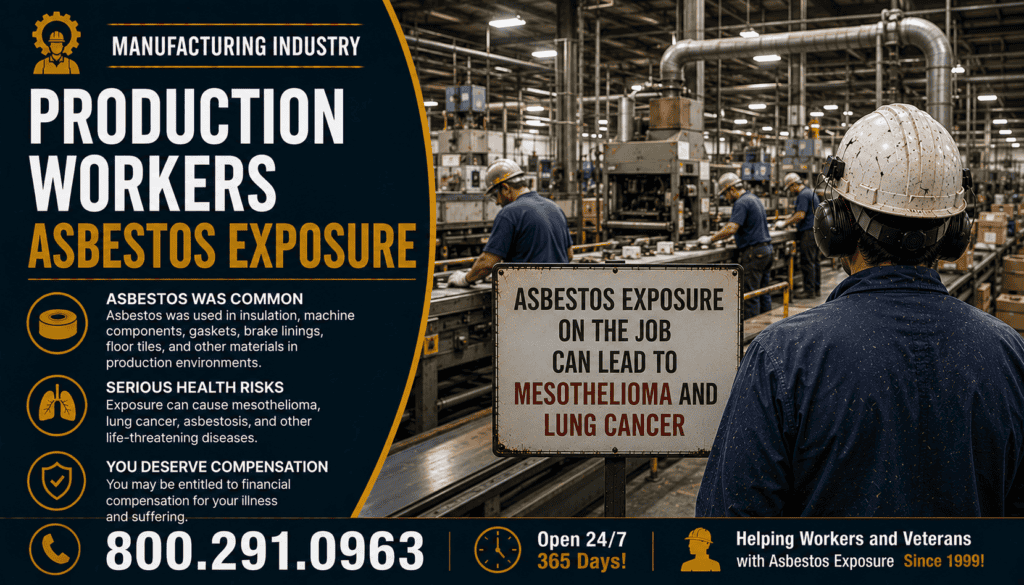
Production Workers Asbestos Exposure
Production workers in some historical manufacturing operations had direct occupational asbestos exposure because asbestos was deliberately used to make insulation, textiles, friction materials, cement products, vinyl-asbestos tile and other industrial goods. OSHA states that employees who manufacture asbestos-containing products may be exposed to asbestos fibers, making product identity and production process central to reconstructing exposure.
Production work itself does not prove asbestos exposure. Manufacturing includes thousands of asbestos-free products and processes. A reliable history should identify the factory, years worked, product, department, raw materials and tasks, while separating asbestos from other factory hazards such as silica, metals, solvents, cotton dust, noise and machinery.
Production Workers and Occupational Asbestos Exposure
Production workers can weigh raw materials, feed mixers, operate presses and machines, cut or finish products, package goods, handle scrap and clean production areas. Historical asbestos exposure was especially relevant where asbestos fibers were intentionally incorporated into manufactured products.
OSHA’s general-industry asbestos standard explicitly states that employees manufacturing asbestos-containing products may be exposed. OSHA’s historical asbestos-products classification identifies asbestos textiles, brake linings and pads, clutch facings, molded insulation, pipe and boiler covering, asbestos-cement products, roofing, siding, shingles, vinyl-asbestos tile and many other manufactured products.
NIOSH’s historical review explains that occupational asbestos exposure was once dominated by chronic manufacturing processes such as textile mills, friction-product manufacturing and cement-pipe fabrication. This supports detailed investigation of production jobs at factories known to use asbestos.
Readers can also review industrial and manufacturing factory workers asbestos exposure, machine operators asbestos exposure and fabricators asbestos exposure.
Asbestos Products and Materials in Manufacturing
Historical production workers could encounter asbestos in different forms depending on what a factory manufactured. OSHA records provide unusually specific evidence of products historically made wholly or chiefly with asbestos.
- Asbestos textiles, cloth, rope, tape, thread, yarn and woven products
- Asbestos brake linings, brake pads and friction materials
- Asbestos clutch facings
- Molded asbestos insulation and pipe or boiler covering
- Asbestos-cement pipe, sheet, siding, shingles, conduits and ducts
- Vinyl-asbestos tile and other documented asbestos flooring products
- Asbestos roofing products and building materials
- Asbestos gaskets or packing where separately documented
OSHA’s historical industry classification is useful for identifying product categories, but it does not establish that every manufacturer or every product within a category used asbestos. Product formulas, specifications, catalogs, purchasing records, safety documents and laboratory analysis can provide stronger plant-specific evidence.
Asbestos-free replacement products also became common. The manufacturing date and product formulation therefore matter when evaluating a production worker’s history.
How Production Worker Asbestos Exposure Could Occur
Potential exposure could occur when workers handled raw asbestos or mechanically processed a confirmed asbestos-containing product in ways that released fibers into workplace air.
- Raw-material handling: receiving, opening, weighing or transferring asbestos used in production
- Mixing: combining asbestos with cement, resins, binders or other ingredients
- Machine operation: forming, pressing, weaving, cutting, grinding or finishing asbestos-containing products
- Scrap handling: crushing, recycling or disposing of asbestos-containing production scrap
- Packaging: handling finished or semi-finished asbestos products where fibers or dust remained present
- Cleanup and maintenance: cleaning production dust or repairing equipment in asbestos-product manufacturing areas
NIOSH’s research on historical asbestos manufacturing shows that mechanical processing could produce significant occupational exposure. NIOSH-docketed research on a South Carolina chrysotile textile plant followed workers employed in an operation where chrysotile asbestos was used in textile manufacture, providing direct epidemiologic evidence from an asbestos production workforce.
The intensity of exposure cannot be inferred from a job title alone. It depended on fiber type, product, process, ventilation, controls, respirator practices, housekeeping and time period.
Production Lines, Factories and Work Areas
Manufacturing is diverse, so production-worker exposure should be reconstructed by product and department rather than assigned uniformly to factory employees.
Asbestos Textile Production
Historical asbestos textile operations processed asbestos fibers into yarn, cloth and other products. A study hosted in the NIOSH docket followed 2,543 men who worked at least one month from 1938 through 1958 at a South Carolina textile plant where chrysotile was the only asbestos type used.
Friction-Product Manufacturing
OSHA identifies asbestos brake linings, brake pads, clutch facings and woven friction materials among historical asbestos products. Production jobs could include mixing, molding, pressing, machining and finishing these materials.
Asbestos-Cement Manufacturing
Asbestos fibers were historically combined with cement to manufacture pressure pipe, sheets, siding, shingles, conduits and ducts. Production workers could encounter asbestos during raw-material handling, mixing, forming and mechanical finishing.
Vinyl-Asbestos Flooring Production
Historical flooring plants manufactured vinyl-asbestos tile. Production jobs could include weighing, mixing, machine operation and scrap handling. The presence of vinyl alone does not establish asbestos; the product formulation must be confirmed.
Insulation and Building-Product Manufacturing
OSHA’s historical classification includes molded asbestos insulation, pipe and boiler covering, roofing and other asbestos building materials. Production-worker exposure depended on the specific material and process.
Modern and Asbestos-Free Manufacturing
Historical evidence should not be generalized to current production. NIOSH notes that the nature of U.S. occupational asbestos exposure changed substantially over time, shifting away from chronic manufacturing exposure toward maintenance and remediation of existing asbestos-containing materials.
Related resources include machine operators asbestos exposure, cement workers asbestos exposure, vinyl workers asbestos exposure, fabricators asbestos exposure and maintenance workers asbestos exposure.
Secondary or Household Exposure
Workers who directly handled dusty asbestos fibers or asbestos-containing products could historically contaminate work clothing. A household exposure history requires evidence about the factory, asbestos source, tasks, dust conditions, clothing practices and frequency of contact. Production employment alone does not establish take-home asbestos exposure.
Need help now? Call 800.291.0963
Live chat available 24/7, 365 days a year.
Submit Your Case
Mesothelioma and Other Occupational Health Risks
OSHA states that inhaling asbestos fibers can cause asbestosis, lung cancer and mesothelioma. NIOSH’s occupational asbestos review likewise treats asbestos as a serious carcinogenic workplace hazard.
Historical production-worker studies provide direct evidence of long-term health risks in asbestos manufacturing. NIOSH-hosted research on 3,276 workers employed at an asbestos textile, friction and packing-products manufacturing facility reported excess respiratory cancer, asbestosis and mesothelioma mortality in that specific workforce. Those findings should not be generalized to workers producing asbestos-free products.
Production workers can also encounter many hazards unrelated to asbestos. NIOSH’s manufacturing program covers chemical, physical and mechanical hazards across a broad range of industries. Each exposure should be identified independently.
A mesothelioma diagnosis does not by itself identify a particular factory, product or employer as the source of asbestos exposure. Medical questions should be discussed with a qualified healthcare professional.
Documenting a Production Worker Exposure History
A useful production-worker investigation identifies the employer, factory, product, production line, raw materials and tasks associated with possible asbestos exposure.
- Employment evidence: employer names, payroll records, W-2s, tax documents, union records and Social Security earnings records.
- Factory evidence: facility names, addresses, owners, departments, production lines and dates worked.
- Product evidence: catalogs, labels, specifications, formulas, patents, safety documents and packaging.
- Raw-material evidence: purchasing records, ingredient lists, supplier records and asbestos-delivery documentation.
- Process evidence: weighing, mixing, forming, pressing, weaving, cutting, grinding, finishing and scrap handling.
- Exposure evidence: industrial-hygiene reports, air sampling, OSHA or NIOSH investigations and company monitoring records.
- Coworker evidence: operators, mixers, production employees, maintenance workers, supervisors and industrial hygienists may help reconstruct conditions.
When product names are forgotten, record what the factory manufactured, approximate years, department, production-line number, raw materials, bag labels, machinery, visible dust, ventilation, respirator use, cleanup methods and whether work clothing was taken home.
Questions That Can Strengthen a Production Worker History
Did the factory manufacture asbestos-containing products? Was raw asbestos delivered to the plant? What product and production line did the worker handle? Were asbestos fibers weighed or mixed? Were finished products cut or ground? Do industrial-hygiene or purchasing records confirm asbestos? These details can help identify a specific occupational source.
Asbestos Lawsuits, Trust Funds and Compensation
A production worker diagnosed with an asbestos-related disease may have potential legal or compensation options when evidence supports occupational asbestos exposure and applicable legal requirements are met. Possible avenues can include claims involving legally responsible companies and asbestos bankruptcy trusts.
Production employment alone does not establish asbestos trust eligibility. Each trust has separate medical and exposure requirements, and evidence may be needed connecting the worker to a covered asbestos-containing product, manufacturer, supplier, operation or recognized jobsite during a qualifying period.
Useful evidence can include employment and Social Security records, product formulas, purchasing records, plant and production-line records, industrial-hygiene reports, product catalogs, photographs, coworker testimony and medical documentation. Filing deadlines vary by jurisdiction and claim type.
Related Production, Manufacturing and Maintenance Resources
Manufacturing work: Industrial & Manufacturing Factory Workers Asbestos Exposure · Machine Operators Asbestos Exposure · Fabricators Asbestos Exposure
Product-specific work: Cement Workers Asbestos Exposure · Vinyl Workers Asbestos Exposure
Plant maintenance: Maintenance Workers Asbestos Exposure · Maintenance Mechanics Asbestos Exposure
Authoritative Sources
This page was researched using OSHA and NIOSH government sources with direct relevance to asbestos-product manufacturing, historical production processes and health outcomes among workers employed in asbestos manufacturing.
- OSHA — 29 CFR 1910.1001, Asbestos in General Industry
- OSHA — Historical Asbestos Products Manufacturing Classification
- OSHA — Asbestos Overview
- NIOSH — Workplace Exposure to Asbestos
- NIOSH Docket — Dust Exposure and Mortality in an American Chrysotile Textile Plant
- NIOSH — Mortality Patterns Among Asbestos Textile, Friction and Packing Products Manufacturing Workers
Production Workers Asbestos Exposure FAQ
Were all production workers exposed to asbestos?
No. Exposure depended on what the factory manufactured, the time period, raw materials, department and tasks. Production work alone does not prove asbestos exposure.
Does OSHA recognize asbestos exposure in manufacturing?
Yes. OSHA states that employees who manufacture asbestos-containing products may be exposed to asbestos fibers.
What products were historically manufactured with asbestos?
OSHA records identify asbestos textiles, friction products, insulation, asbestos-cement products, vinyl-asbestos tile, roofing, siding, shingles and other products.
Could machine operators in production areas encounter asbestos?
Potentially, when machines processed confirmed asbestos-containing materials. Exposure depended on the product, process, dust controls and work practices.
Could production cleanup create asbestos exposure?
Potentially. OSHA specifically recognizes housekeeping exposure in industrial facilities with asbestos-product manufacturing operations.
Did historical asbestos production workers have increased disease risks?
Studies of specific asbestos-manufacturing workforces documented increased asbestos-related disease and cancer mortality. Those findings apply to the studied asbestos-exposed populations and should not be generalized to asbestos-free manufacturing.
Can production workers qualify for asbestos trust fund claims?
Some may qualify if they satisfy a trust’s medical and exposure requirements and can connect their work to a covered asbestos product, company or operation. Job title alone does not establish eligibility.
How can a retired production worker document old asbestos exposure?
Employment and Social Security records, plant records, product formulas, purchasing files, industrial-hygiene reports, catalogs, photographs and coworker statements can help reconstruct exposure.
Get Help Reviewing a Production Worker Exposure History
Call 800.291.0963
Live chat is available 24/7, 365 days a year.
Prior production work does not automatically prove asbestos exposure, disease causation, claim eligibility or compensation. Each situation depends on the factory, dates, products, raw materials, production process, tasks, work practices, medical evidence and applicable legal requirements. Compensation is not guaranteed.
⚕️ Legal & Medical Information Disclaimer
This page provides general educational information and is not medical or legal advice. The information does not establish asbestos exposure, diagnosis, causation, liability, claim eligibility or compensation. Medical concerns should be discussed with a qualified healthcare professional, and legal questions should be reviewed with a qualified attorney.