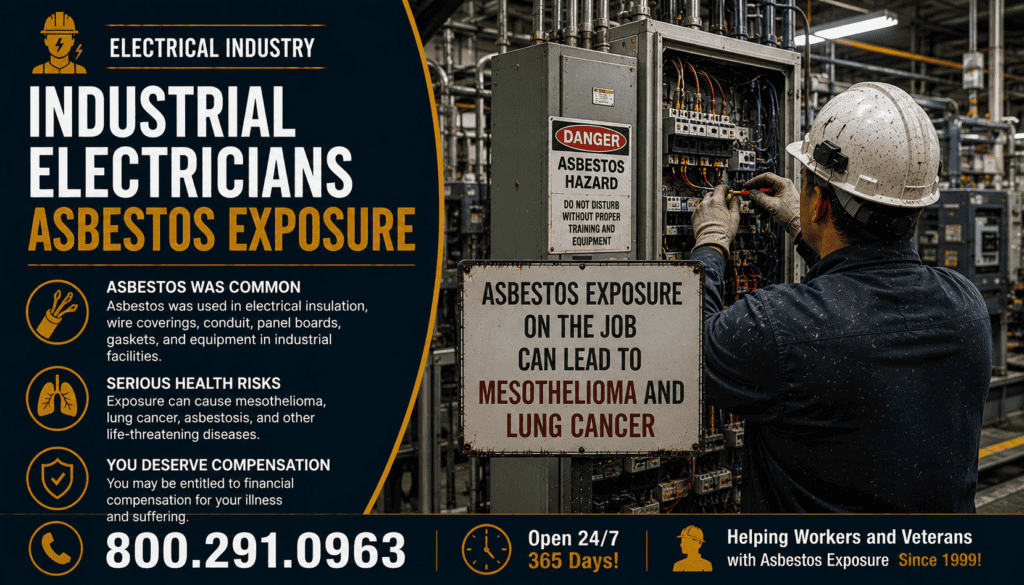
Industrial Electricians Asbestos Exposure
Industrial electricians install, troubleshoot, repair and replace wiring, controls, motors and electrical systems in factories, power stations and other industrial facilities. Historical asbestos exposure could occur when electrical work disturbed confirmed asbestos-containing insulation or building materials, involved asbestos-insulated wiring, or took place beside asbestos removal.
Industrial electrical work alone does not prove asbestos exposure. NIOSH investigations provide unusually direct evidence for some workplaces: electricians at Albright Power Station performed rewiring around boiler asbestos abatement, while a General Electric plant investigation found historical asbestos-containing insulation in a heat-treatment process where electricians worked. The facility, era, material and task remain essential.
Industrial Electricians and Occupational Asbestos Exposure
Industrial electricians can work around production machinery, furnaces, boilers, steam systems, electrical distribution equipment and process controls. In older industrial settings, those assignments sometimes overlapped with asbestos-containing thermal insulation, fireproofing, electrical cable or other legacy materials.
At Albright Power Station, NIOSH evaluated electrical workers employed by Chapman Corporation while boiler #3 was being refurbished and an asbestos-abatement project was underway. NIOSH reported that electrical workers performed rewiring outside and around the containment area and concluded that workers in the vicinity were potentially exposed to airborne asbestos concentrations above ambient levels.
NIOSH also reported an additional direct source: existing electrical wires and cables insulated with asbestos-containing material. Four sampled electrical employees worked with asbestos-coated cables or wires, although investigators could not determine how much of the measured airborne fiber concentration came from rewiring versus nearby asbestos-abatement activity.
Related resources include electrical and utility power workers asbestos exposure, electricians asbestos exposure and wiring workers asbestos exposure.
Asbestos Materials Around Industrial Electrical Work
Potential sources varied by plant, equipment and era. Where records or testing confirm asbestos, relevant materials can include:
- Specific older electrical wire or cable insulated or coated with asbestos-containing material
- Asbestos-containing insulation on boilers, steam lines, pipes and fittings near electrical systems
- Older heat-resistant insulation used in industrial processes
- Sprayed or troweled asbestos-containing fireproofing and surfacing materials
- Legacy asbestos-containing wall, ceiling or flooring materials disturbed for electrical access
- Asbestos-containing gaskets, packing or equipment insulation where product-specific evidence confirms asbestos
NIOSH’s Albright investigation reported four bulk samples of insulated thermocouple wire containing estimated asbestos concentrations ranging from 5% to 80%. That finding is strong evidence for that specific plant and material, but it should not be generalized to all industrial wiring.
At a General Electric aircraft-engine plant in Ohio, NIOSH reconstructed a heat-treatment process used by electricians and found that between 1957 and 1965, and possibly later, various insulation materials were used, including some containing asbestos. NIOSH concluded that an asbestos health hazard had existed historically in that process.
How Industrial Electricians Asbestos Exposure Could Occur
Where confirmed ACM was present, potential exposure could occur through direct disturbance or work performed near asbestos activity.
- Industrial rewiring: removing or handling specific electrical cable documented as asbestos-insulated
- Boiler and process work: accessing controls or wiring near disturbed asbestos-containing thermal insulation
- Drilling and cutting: penetrating confirmed asbestos-containing wall, ceiling or fireproofing material
- Machine maintenance: opening older industrial equipment where asbestos-containing insulation was documented
- Plant shutdowns: performing electrical upgrades while asbestos abatement or insulation removal occurred nearby
- Renovation and demolition: removing electrical systems from structures containing ACM
- Adjacent work: working near insulators, boilermakers, pipefitters or abatement contractors disturbing asbestos
OSHA’s asbestos construction standard covers alteration, repair, maintenance, renovation and demolition involving asbestos-containing structures or materials. Multi-employer worksite provisions also address employees working adjacent to regulated asbestos areas.
Electrical shock, burns, arc blast, fire and electrocution are separate industrial electrical hazards. NIOSH identifies manufacturing and utility work among industries with substantial electrical-injury concerns, but electricity itself does not create asbestos exposure.
Factories, Power Plants and Industrial Work Areas
Industrial electricians can work in many settings. The strongest asbestos history identifies a specific facility, department, electrical assignment and asbestos-containing source.
Power Stations
NIOSH’s Albright Power Station evaluation provides direct evidence involving electricians, boiler rewiring, asbestos containment and asbestos-insulated electrical cables. Air sampling showed that fiber releases occurred outside the containment area.
Manufacturing Plants
At General Electric’s Evendale plant, NIOSH investigated electricians who had worked in a heat-treatment process used in aircraft-engine manufacturing. Historical insulation used in the process included asbestos-containing materials, and NIOSH concluded that a past asbestos health hazard existed.
Boiler and Mechanical Areas
Industrial electrical controls and wiring can be located near boilers, steam piping, pumps, valves and other mechanical equipment. OSHA defines thermal-system insulation to include ACM applied to pipes, fittings, boilers, tanks and ducts when the material contains asbestos.
Production Machinery and Process Equipment
Electrical maintenance may require access to heated equipment, motors and controls. Asbestos should only be attributed to insulation, gaskets, packing or other components when specifications, surveys, laboratory analysis or reliable historical records confirm it.
Plant Shutdowns and Renovations
Shutdowns can bring electricians, insulators, pipe trades and asbestos contractors into the same work areas. The Albright investigation illustrates how electrical rewiring can occur alongside asbestos removal.
Construction of Industrial Facilities
NIOSH investigated asbestos use at the Shoreham Nuclear Power Plant construction site after employees raised concerns about an asbestos product. Laboratory analysis confirmed chrysotile asbestos in the product and settled dust, demonstrating why material-specific evidence is important on industrial construction projects.
Related resources include electricians asbestos exposure, wiring workers asbestos exposure, industrial and manufacturing factory workers asbestos exposure, maintenance mechanics asbestos exposure and industrial, manufacturing and utility buildings asbestos exposure.
Secondary or Household Exposure
If an industrial electrician’s clothing or belongings became contaminated during actual asbestos work, fibers could historically be carried away from the workplace. A household exposure history still requires evidence of the original occupational asbestos source, contamination and frequency of contact.
Need help now? Call 800.291.0963
Live chat available 24/7, 365 days a year.
Submit Your Case
Mesothelioma and Other Occupational Health Risks
NIOSH’s workplace asbestos review addresses the carcinogenic hazards associated with occupational asbestos exposure. Industrial electricians with documented exposure may therefore have a medically relevant occupational history, but the job title itself does not establish exposure or disease causation.
NIOSH’s General Electric investigation also demonstrates the value of occupational-history reconstruction. Investigators interviewed current and former electricians, reconstructed the historical process and analyzed lung tissue from two deceased electricians who had worked in the heat-treatment operation. NIOSH concluded that a historical asbestos health hazard had existed in the process.
Industrial electricians also face non-asbestos hazards, including shock, burns, arc blast, fire, falls and energized equipment. These hazards should be kept distinct from asbestos exposure.
Medical questions about asbestos exposure, symptoms, screening or diagnosis should be discussed with a qualified healthcare professional.
Documenting an Industrial Electrician Exposure History
A useful investigation identifies the employer, plant, department, dates, electrical assignment and asbestos-containing material associated with possible exposure.
- Employment evidence: employer, contractor, union, payroll, W-2 and Social Security earnings records
- Facility evidence: factory, power station, industrial plant, boiler area, production department or construction project
- Task evidence: rewiring, cable removal, troubleshooting, equipment repair, shutdown work, renovation or demolition
- Electrical evidence: cable specifications, wire records, equipment drawings and maintenance documents
- Asbestos evidence: surveys, laboratory reports, abatement records, product specifications and industrial-hygiene files
- Project evidence: outage schedules, work orders, contractor records and regulated-area documentation
- Witness evidence: electricians, maintenance mechanics, insulators, pipefitters, supervisors and asbestos contractors
The Albright and General Electric NIOSH investigations show two useful approaches: direct air and bulk-material sampling during electrical work, and reconstruction of historical processes through interviews and medical or industrial-hygiene evidence.
Questions That Can Strengthen an Exposure History
Which plants and years? Which departments or generating units? Did the electrician remove old cable or wiring? Was the cable insulation tested? Were boilers or steam lines being stripped nearby? Did the worker service heated process equipment? Was asbestos abatement underway? These details can help identify a specific pathway.
Asbestos Lawsuits, Trust Funds and Compensation
An industrial electrician diagnosed with mesothelioma or another asbestos-related disease may have potential legal or compensation options when evidence supports occupational asbestos exposure and applicable requirements are met. Possible avenues can include claims involving legally responsible companies and asbestos bankruptcy trusts.
Industrial electrical employment alone does not establish liability or asbestos trust eligibility. Each trust has separate medical and exposure requirements, and evidence may be needed connecting the worker to a covered asbestos product, company, facility or qualifying exposure period.
Potential evidence includes employment and Social Security records, union files, plant work orders, cable specifications, asbestos surveys, abatement files, equipment records, industrial-hygiene monitoring, photographs, coworker statements and medical documentation. Applicable law and filing deadlines should be reviewed individually.
Related Electrical and Industrial Resources
Electrical work: Electricians Asbestos Exposure · Wiring Workers Asbestos Exposure
Industrial work: Industrial & Manufacturing Factory Workers Asbestos Exposure · Factory Workers Asbestos Exposure
Maintenance and facilities: Maintenance Mechanics Asbestos Exposure · Industrial, Manufacturing & Utility Buildings Asbestos Exposure
Authoritative Sources
This page was researched using NIOSH and OSHA government sources, including two occupation-specific NIOSH investigations involving electricians and historical asbestos exposure.
- NIOSH — HHE 89-0262-1994, Chapman Corporation, Albright Power Station
- NIOSH — HHE 83-044-1596, General Electric Plant, Evendale, Ohio
- NIOSH — HHE 79-136-668, Shoreham Nuclear Power Plant
- NIOSH — Workplace Exposure to Asbestos
- OSHA — 29 CFR 1926.1101, Asbestos in Construction
- NIOSH — Electrical Safety in the Workplace
Industrial Electricians Asbestos Exposure FAQ
Were all industrial electricians exposed to asbestos?
No. Exposure depended on the facility, era, electrical system, asbestos-containing materials and work performed.
Did NIOSH document asbestos exposure concerns involving industrial electricians?
Yes. NIOSH evaluated electricians performing boiler rewiring at Albright Power Station and separately investigated electricians who had worked in a historical heat-treatment process at a General Electric manufacturing plant.
Did NIOSH find asbestos in industrial electrical wiring?
At Albright Power Station, NIOSH reported electrical employees working with asbestos-coated wires or cables, and bulk samples of insulated thermocouple wire were reported to contain asbestos.
Did all industrial wire contain asbestos?
No. The Albright findings were specific to materials at that facility. Manufacturer records, specifications or testing are needed before identifying other wiring as asbestos-containing.
Could industrial electricians be exposed near boilers and steam systems?
Potentially, when confirmed asbestos-containing boiler, pipe or thermal insulation was disturbed near their electrical work.
What records can document industrial electrician asbestos exposure?
Employment and union records, plant work orders, cable specifications, asbestos surveys, laboratory reports, abatement records and coworker statements can help reconstruct exposure.
Can industrial electricians qualify for asbestos trust fund claims?
Some may qualify if they satisfy a trust’s medical and exposure criteria and can connect their work to a covered asbestos source, company or qualifying facility. Employment alone does not establish eligibility.
Are electrical hazards the same as asbestos hazards?
No. Shock, burns, arc blast, fire and electrocution are electrical hazards. Asbestos exposure requires a separate asbestos-containing source and exposure pathway.
Get Help Reviewing an Industrial Electrician Exposure History
Call 800.291.0963
Live chat is available 24/7, 365 days a year.
Prior industrial electrical work does not automatically prove asbestos exposure, disease causation, liability, claim eligibility or compensation. Each situation depends on the employer, facility, dates, equipment, materials, tasks, work practices, medical evidence and applicable legal requirements. Compensation is not guaranteed.
⚕️ Legal & Medical Information Disclaimer
This page provides general educational information and is not medical or legal advice. The information does not establish asbestos exposure, diagnosis, causation, liability, claim eligibility or compensation. Medical concerns should be discussed with a qualified healthcare professional, and legal questions should be reviewed with a qualified attorney.