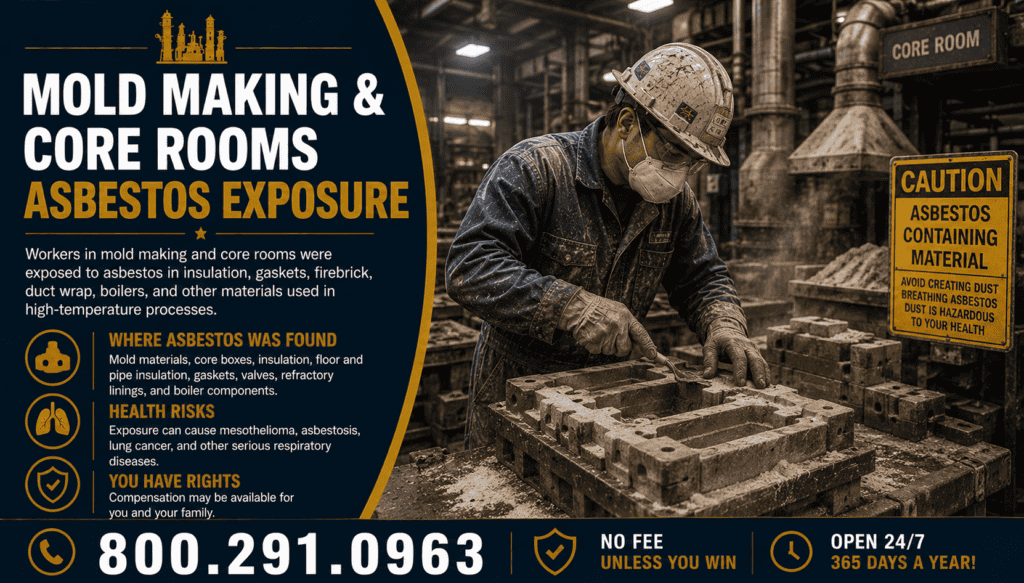
🏭 Mold Making & Core Rooms Asbestos Exposure
Workers involved in mold making and core room work at older industrial facilities may have encountered asbestos-containing products during particular tasks. The important questions are which products were used, when work occurred and whether fibers were released into occupied areas.
This guide covers assembling molds and cores, using binders, drying cores, maintaining core ovens and servicing nearby insulated utilities, explains potential connections to mesothelioma and asbestos-related lung cancer, and outlines documentation and compensation considerations. Dust or heat alone does not prove asbestos exposure.
🏭 Where Exposure Occurred
In mold making and core room work, exposure conditions depended on equipment design, the age of materials and the work schedule. Tasks such as assembling molds and cores, using binders, drying cores, maintaining core ovens and servicing nearby insulated utilities may have brought employees close to insulation, sealing materials or dust released by another crew. A specific product history matters more than a broad description of an industrial building.
Work areas were not uniform. Employees performing mold making and core room work could rotate between production areas, service rooms, pipe runs and maintenance shops. Some materials were asbestos-free, and a detailed assessment must distinguish the materials actually present at the plant.
Foundries operated under different owners and changed their equipment over time. A product documented at one plant should not automatically be assumed at another. Useful details include the plant address, department, employer, contractor, approximate dates, and equipment models.
Related work is discussed in Foundry Asbestos Exposure, Foundry Demolition, and Foundry Renovation. Those pages help distinguish production activities from building alterations.
Mold Assembly Stations
For mold assembly stations, distinguish the material installed in the original construction from later replacement parts. Ask whether workers cut, broke, scraped, brushed or removed a product, and whether the work was performed during regular operations or a scheduled outage. A dated photograph or a maintenance log can establish a sequence of events, but it does not by itself identify asbestos content. Where the product name is unknown, keep the uncertainty explicit. This helps families and reviewers avoid confusing a plausible pathway with a documented exposure.
Furnace and refractory teardown should be evaluated in relation to the plant’s actual equipment and work schedule. The key question is whether asbestos-containing material was present and disturbed during the particular task, not whether the entire department was generally dusty.
Interview notes, work orders and equipment records can clarify who handled the material, how long the work lasted and whether other employees worked nearby. This distinction is especially important when multiple contractors shared the same space.
Core Ovens And Drying Equipment
For core ovens and drying equipment, distinguish the material installed in the original construction from later replacement parts. Ask whether workers cut, broke, scraped, brushed or removed a product, and whether the work was performed during regular operations or a scheduled outage. A dated photograph or a maintenance log can establish a sequence of events, but it does not by itself identify asbestos content. Where the product name is unknown, keep the uncertainty explicit. This helps families and reviewers avoid confusing a plausible pathway with a documented exposure.
Boiler-house and steam-line removal should be evaluated in relation to the plant’s actual equipment and work schedule. The key question is whether asbestos-containing material was present and disturbed during the particular task, not whether the entire department was generally dusty.
Interview notes, work orders and equipment records can clarify who handled the material, how long the work lasted and whether other employees worked nearby. This distinction is especially important when multiple contractors shared the same space.
Insulated Utility Lines
For insulated utility lines, distinguish the material installed in the original construction from later replacement parts. Ask whether workers cut, broke, scraped, brushed or removed a product, and whether the work was performed during regular operations or a scheduled outage. A dated photograph or a maintenance log can establish a sequence of events, but it does not by itself identify asbestos content. Where the product name is unknown, keep the uncertainty explicit. This helps families and reviewers avoid confusing a plausible pathway with a documented exposure.
Dust during structural dismantling should be evaluated in relation to the plant’s actual equipment and work schedule. The key question is whether asbestos-containing material was present and disturbed during the particular task, not whether the entire department was generally dusty.
Interview notes, work orders and equipment records can clarify who handled the material, how long the work lasted and whether other employees worked nearby. This distinction is especially important when multiple contractors shared the same space.
Product And Work Area Records
For product and work area records, distinguish the material installed in the original construction from later replacement parts. Ask whether workers cut, broke, scraped, brushed or removed a product, and whether the work was performed during regular operations or a scheduled outage. A dated photograph or a maintenance log can establish a sequence of events, but it does not by itself identify asbestos content. Where the product name is unknown, keep the uncertainty explicit. This helps families and reviewers avoid confusing a plausible pathway with a documented exposure.
Contractors and waste handling should be evaluated in relation to the plant’s actual equipment and work schedule. The key question is whether asbestos-containing material was present and disturbed during the particular task, not whether the entire department was generally dusty.
Interview notes, work orders and equipment records can clarify who handled the material, how long the work lasted and whether other employees worked nearby. This distinction is especially important when multiple contractors shared the same space.
A useful exposure chronology for mold making and core room work distinguishes normal production from shutdowns, equipment replacement and contractor work. Records that identify the make and model of the affected equipment, the specific maintenance date, and the company supplying the replacement component can help establish whether an asbestos product was actually involved.
🏭 Asbestos-Containing Materials And Equipment
Some historic industrial products used asbestos for thermal resistance, insulation or friction performance. Potential sources in foundries included thermal insulation on boilers and steam pipes, gaskets and packing on pumps and valves, selected heat-resistant textiles, and some older electrical or refractory products.
Refractory materials are not automatically asbestos-containing: many were made from other minerals. Likewise, silica dust from molds and sand is a separate hazard and should not be treated as proof of asbestos exposure. Product labels, specifications, purchase records and testing are more reliable than appearance.
Where furnace linings or hot-process components are relevant, see Blast Furnaces and Refractory. Utility equipment is also discussed in Steel Mill Boilers and Steam Systems. The aim is to identify a specific product and a credible release mechanism.
| Potential Source | Relevant Task | Evidence to Look For |
|---|---|---|
| Pipe and boiler insulation | Removal or repair | Maintenance orders and insulation specifications |
| Pump or valve packing | Disassembly and replacement | Equipment manuals and parts invoices |
| Gaskets and seals | Scraping and cutting | Manufacturer and replacement-part records |
| Heat-resistant components | Furnace or hot-work servicing | Product identification and dated photographs |
For mold making and core room work, it is important to distinguish asbestos from other workplace hazards. Foundry sand can contain respirable crystalline silica, but sand dust by itself is not evidence of asbestos. Some refractory and insulating products were asbestos-free. Laboratory identification, product specifications or credible purchasing records are stronger than an assumption based on heat or dust.
🏭 Workers And Daily Tasks
For this page, the principal work pattern is demolition and decommissioning. A detailed account should separate direct handling of suspect material from bystander exposure while others repaired or dismantled equipment.
Mechanics, electricians, insulators, pipefitters, millwrights, laborers and production personnel may have occupied overlapping spaces. Responsibilities differed by plant and union jurisdiction. Contractors brought in for shutdowns may have performed asbestos-disturbing work while regular employees remained nearby.
See the related occupation pages for Foundry Mechanics and Electricians, Foundry Maintenance and Repair Workers, and Foundrymen and Metal Casters. These are different work patterns and should not be treated as interchangeable evidence.
The most useful personal history includes the exact department, shifts, supervisors, tools, names of nearby contractors and whether work occurred during scheduled shutdowns. Former coworkers may recall packaging, product names or the sequence of repairs.
Employees may remember the sequence of work better than a product name. For example, they may recall that a pump was opened, a gasket was scraped, or a steam pipe covering was removed before other repairs began. Those observations can be paired with invoices, equipment manuals and witness accounts without overstating what the worker personally knew.
🏭 How Fibers Became Airborne
Asbestos fibers are microscopic. Cutting, sawing, scraping, removing deteriorated insulation or dry sweeping contaminated debris can release them into breathing zones. The presence of a material alone does not establish how much fiber anyone inhaled.
Worksite ventilation, enclosure, wet methods, local exhaust, respiratory protection and cleanup practices all influence potential exposure. Historical practices varied widely, and a present-day safety standard should not be projected backward onto an earlier decade without evidence.
OSHA’s construction asbestos standard covers demolition, repair, maintenance and renovation where asbestos is involved. It addresses exposure assessments, controlled work practices, hazard communication and worker protections. For historical claims, the standard provides context, not automatic proof of what occurred at a particular foundry.
Modernization projects can involve adjacent production employees, as discussed in Steel Mill Renovation; demolition can create different exposure conditions, discussed in Steel Mill Demolition.
Exposure reconstruction should account for distance, frequency and duration. Someone standing beside a worker removing insulation may have a different history from a person who occasionally walked through the same room. Worksite layout, air movement, dust controls and the amount of material disturbed can change the potential exposure pathway.
📋 Mesothelioma And Diagnosis
Mesothelioma is a cancer of the lining around the lungs or, less commonly, the abdomen and other organs. Asbestos exposure is an established cause. Symptoms may emerge decades after exposure and can include shortness of breath, chest discomfort, fatigue or fluid around the lungs.
A diagnosis usually requires specialist evaluation, imaging and tissue or fluid testing when clinically appropriate. A clinician must determine the diagnosis; occupational history cannot substitute for medical confirmation.
People who worked at several employers should preserve a full lifetime job history, including military service, construction, industrial work and home renovation. More than one setting may have contributed to exposure.
Someone considering a Foundry Mesothelioma Lawsuit can review the connection between diagnosis, employment records and potential responsible products. Eligibility depends on the facts and applicable law.
Mesothelioma can appear many years after asbestos exposure. A patient should share a complete occupational and military history with the treating team, including mold making and core room work, other industrial employment, construction tasks and possible household exposure. Treatment decisions should come from clinicians familiar with the diagnosis.
📋 Asbestos-Related Lung Cancer
Asbestos exposure can also cause lung cancer. Smoking is another major lung-cancer risk factor, and asbestos and smoking can interact to increase risk. A person’s smoking history does not establish that asbestos exposure was irrelevant.
Symptoms such as persistent cough, chest pain, unexplained weight loss or coughing blood deserve medical attention. The diagnosis and cause must be assessed by qualified clinicians.
Employment dates, job tasks, asbestos product evidence and medical records may be relevant when reviewing a possible asbestos-related lung cancer claim. Lung cancer and mesothelioma are distinct diseases with different diagnostic considerations.
Families should request copies of pathology reports, imaging summaries and treating-physician notes and keep those records together with work histories.
Asbestos-related lung cancer is medically distinct from mesothelioma. Clinicians consider imaging, pathology, smoking history and other risk factors. Neither the presence of lung cancer nor an old job title alone proves an occupational cause, but a documented asbestos exposure history may be relevant to medical and legal review.
📋 Documenting Work And Exposure
A strong timeline is more useful than a general statement that a foundry was dusty. Record the employer’s legal name, plant location, years employed, department, job title and major shutdown or construction projects.
Useful documents may include Social Security earnings histories, union records, pay stubs, pension records, job descriptions, maintenance logs, product invoices, photographs and coworker statements. Some records may no longer exist, so preserving available material promptly matters.
Separate facts personally observed from information learned later. For example, witnessing an insulation removal is different from knowing its manufacturer or fiber content. That distinction makes a historical account more reliable.
The Foundry Exposure Articles collection can provide additional topic context, but the relevant site-specific records should guide the account.
Create a dated timeline covering the start and end of employment, department transfers, the type of mold making and core room work, plant shutdowns and the identities of coworkers or contractors. Preserve originals when possible, note where information came from, and avoid changing or guessing uncertain dates.
Related site and occupation guides: Foundry Asbestos Exposure; Foundry Demolition and Decommissioning; Foundry Renovation and Modernization; Foundry Mechanics and Electricians; Foundry Maintenance and Repair Workers; Foundrymen and Metal Casters; Foundry Insulation, Gaskets and Packing; Foundry Furnaces and Melting Areas; Shakeout and Sand Handling; Blast Furnaces and Refractory; Foundry Mesothelioma Lawsuit; Foundry Asbestos Trust Funds; Foundry Wrongful Death Lawsuit; Steel Mill Boilers and Steam Systems; Water Treatment Plant Asbestos Trust Funds.
📋 Lawsuits, Trust Funds And Compensation
People diagnosed with mesothelioma or asbestos-related lung cancer after qualifying asbestos exposure may have legal options, including personal-injury claims, bankruptcy trust claims or, for some surviving relatives, wrongful-death claims. Availability varies by jurisdiction, company history, product identification and filing deadlines.
Trust funds are generally associated with particular bankrupt asbestos defendants; there is no single trust fund covering all foundries. A trust claim usually requires medical and exposure documentation that matches a trust’s criteria.
Learn more from Foundry Asbestos Trust Funds, Foundry Wrongful Death Lawsuit and the broader Mesothelioma Lawsuit resource. These options may have different requirements and should be reviewed individually.
Statutes of limitations and other filing rules vary by state and type of claim. A qualified attorney can assess whether a claim is timely and what evidence is needed. No result or compensation amount is guaranteed.
Veterans who also experienced military asbestos exposure may wish to ask about VA benefits separately from civil claims. VA eligibility depends on service and medical evidence, not simply having worked in a foundry.
Trust funds and civil lawsuits follow different procedures. An eligible claimant may need pathology documentation and evidence connecting exposure to products associated with particular defendants. Filing deadlines and proof standards vary, and a qualified professional can review the individual circumstances without guaranteeing an outcome.
📋 Frequently Asked Questions
Does Every Foundry Contain Asbestos?
No. The presence of asbestos depends on the facility, products, equipment and years involved. A specific exposure history needs evidence.
Can Someone Be Exposed Without Handling Insulation Directly?
Yes. Work near insulation removal or other disturbing tasks can be relevant, but the actual circumstances and exposure pathway matter.
What If I No Longer Have My Employment Records?
Social Security earnings histories, union records, former coworkers and archived plant materials may help reconstruct work dates and tasks.
Can Lung Cancer Qualify As An Asbestos-Related Disease?
Asbestos is an established cause of lung cancer, but medical diagnosis and claim eligibility require individualized review.
Are Trust Funds The Same As Lawsuits?
No. Trusts have separate criteria and procedures. Lawsuits depend on applicable law and potentially responsible parties.
Does A Diagnosis Guarantee Compensation?
No. Medical evidence, exposure history, product identification, filing rules and other facts determine possible options.
When reviewing mold making and core room work, ask which exact product was disturbed, who performed the task, whether the claimant was nearby, what protective practices existed and which records survive. These practical questions are often more useful than a general statement that asbestos was common in heavy industry.
How To Reconstruct A Shift-By-Shift Exposure History
Begin with a calendar of approximate employment dates and identify the tasks performed on a typical shift. Next, distinguish routine production days from shutdowns, emergency repairs, equipment replacement and major construction. Ask whether suspect insulation, packing, gaskets or other materials were cut, removed or cleaned up. Record the physical distance between the task and the worker, how long the activity lasted, whether doors or ventilation systems were open and whether dust remained after the job. These details are more useful than broad statements that a plant was dusty.
Where possible, compare the recollection with maintenance schedules, equipment purchase records, contractor invoices and photographs. Plant ownership may have changed, and a department name may have been reused after machinery was replaced. It is important to match the right product and time period rather than attaching a modern equipment list to an earlier job. Former coworkers may help identify work sequences, but memories should be recorded in their own words and checked against documents when available.
What Families Can Do After A Diagnosis
Families facing a mesothelioma or asbestos-related lung cancer diagnosis often need to manage medical care and records at the same time. Keep a single folder for pathology results, imaging reports, treating-physician information, employment records, union details and relevant correspondence. A brief written work history can make later conversations with clinicians or qualified legal advisers more efficient. Do not delay medical evaluation while attempting to establish an exposure source.
When speaking with a clinician, describe all relevant exposures, including other jobs and military service, rather than assuming one workplace explains the disease. When discussing legal options, ask which companies or products can be identified, which state deadlines apply and whether a trust claim requires different evidence from a civil lawsuit. There is no automatic entitlement based only on job title or diagnosis. Keeping facts, recollections and assumptions separate helps everyone evaluate the history more accurately.
For an accurate assessment, document the type of material disturbed, who performed the work, the work area, the approximate dates, and the basis for identifying asbestos. Preserve original records and avoid guessing about manufacturers or fiber content when those facts are unknown. This approach also helps distinguish occupational exposure from unrelated sources.
Summary
Foundry Demolition and Decommissioning Asbestos Exposure concerns a specific historical work pattern, not an assumption that every foundry worker encountered asbestos. Identifying the product, task, years and people present can help families understand potential exposure and available medical and legal resources.
Confirmed Sources
- OSHA — 29 CFR 1926.1101, Asbestos in Construction
- National Cancer Institute — Asbestos Exposure and Cancer Risk
- U.S. EPA — Asbestos Information
📞 Get Help With Asbestos Compensation
Find out if you may qualify for asbestos compensation today. Call 800.291.0963. Help is available 24/7/365. 25+ years of experience. Submit Your Case Here.
Disclaimer: This information is not be considered as legal or medical advice. Mesothelioma Help Center is not a law firm or medical provider and does not determine legal or VA eligibility.