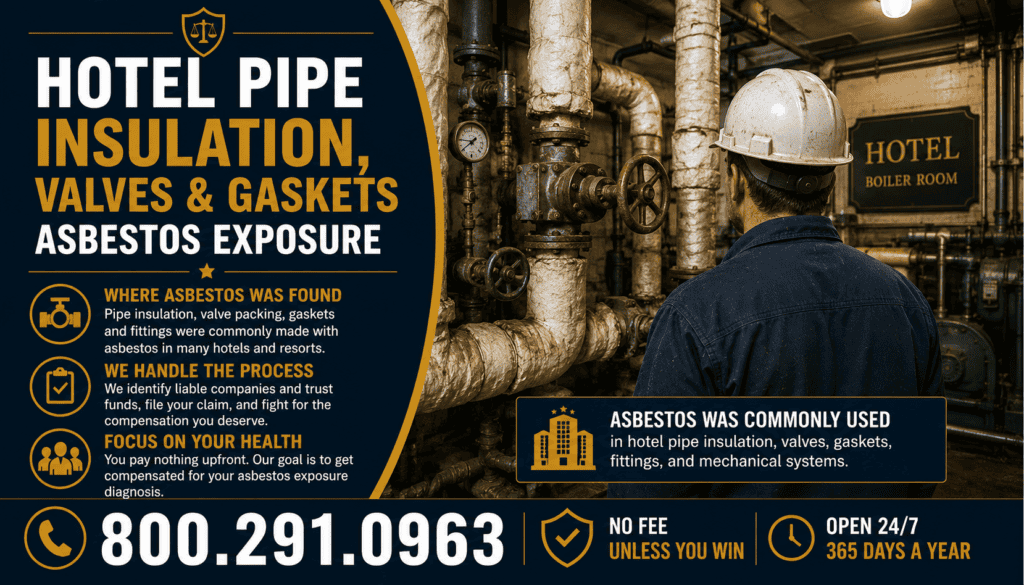
Hotel Pipe Insulation, Valves & Gaskets Asbestos Exposure
Hotel Pipe Insulation, Valves & Gaskets Asbestos Exposure addresses older pipe insulation, valve packing and flange gaskets in hotel utility systems. Historical asbestos exposure depends on the materials actually present, the period involved and whether particular work disturbed them.
Potentially relevant activities include opening pipe chases, repairing leaks, cutting insulation, replacing packing and scraping gaskets. People seeking information after a mesothelioma or asbestos-related lung cancer diagnosis can start by preserving piping diagrams, product invoices, work orders, insulation surveys and supplier identification.
🏫 Exposure Settings and Historical Context
The central question is whether older pipe insulation, valve packing and flange gaskets in hotel utility systems involved identifiable asbestos-containing products at the relevant location and time. Not every building of a given age used the same products, and asbestos exposure cannot be established from a job title alone.
Historical building records can show original installations, later replacements and periods of repair. For this topic, examine opening pipe chases, repairing leaks, cutting insulation, replacing packing and scraping gaskets and distinguish hands-on disturbance from routine occupancy. Conditions can change from one floor, wing or mechanical room to another.
Older insulation, fire-resistant products and building finishes sometimes contained asbestos. The mere presence of intact material does not establish an airborne exposure event. Work that cuts, abrades, removes or damages material requires a more specific assessment.
An exposure history should identify dates, tasks, work areas, nearby contractors, protective controls and the product or equipment involved. Piping diagrams, product invoices, work orders, insulation surveys and supplier identification can help connect those details to a particular building or employer.
For hotel pipe insulation, valves & gaskets asbestos exposure, identify the exact period when the property or campus operated and compare it with dates of additions and mechanical upgrades. A building may contain original equipment alongside replacement components installed years later. That difference matters when assessing a particular manufacturer or asbestos-containing product.
For this specific subject, consider older pipe insulation, valve packing and flange gaskets in hotel utility systems. Establish the work location, identify materials and compare the chronology with piping diagrams, product invoices, work orders, insulation surveys and supplier identification. A complete review should consider both supporting and contradictory evidence, including renovations that removed or replaced older components. This information can guide questions for qualified professionals without predetermining exposure, medical causation or legal eligibility.
Related background: Hotel Job Sites. Review that topic alongside the specific evidence and dates relevant to this article.
Related background: Mesothelioma Lawsuit. Review that topic alongside the specific evidence and dates relevant to this article.
🏗️ Materials and Work Activities
Activities worth evaluating include opening pipe chases, repairing leaks, cutting insulation, replacing packing and scraping gaskets. The mechanism matters: removal or scraping of an asbestos-containing component may release dust, while unrelated work in a separate area may present very different conditions.
When equipment is repaired, identify the precise component rather than assuming an entire system contained asbestos. Insulation, packing, gaskets, fireproofing and some older surface products had different suppliers and installation histories.
Renovation records may reveal whether regulated asbestos work occurred, whether the area was isolated and whether an abatement contractor handled materials. A renovation project is not proof of exposure without evidence of materials and circumstances.
Material surveys and laboratory results are more useful than visual guesses. Similar-looking insulation and finishes can be asbestos-containing or asbestos-free; only appropriate records or testing can resolve the distinction.
Work logs should clarify whether opening pipe chases, repairing leaks, cutting insulation, replacing packing and scraping gaskets occurred while occupants were present, whether affected spaces were isolated, and whether trained asbestos contractors performed removal. Dust from a construction project is not necessarily asbestos dust, so product identification remains essential.
For this specific subject, consider older pipe insulation, valve packing and flange gaskets in hotel utility systems. Establish the work location, identify materials and compare the chronology with piping diagrams, product invoices, work orders, insulation surveys and supplier identification. A complete review should consider both supporting and contradictory evidence, including renovations that removed or replaced older components. This information can guide questions for qualified professionals without predetermining exposure, medical causation or legal eligibility.
Related background: Hotel Building Materials & Systems. Review that topic alongside the specific evidence and dates relevant to this article.
👷 Workers and Possible Exposure Pathways
People whose work histories warrant individual review include plumbers, pipefitters, maintenance mechanics, insulators and renovation contractors. Duties vary even within the same occupation, and employees who directly handled old materials may have different histories from employees working in other areas.
Contractors may have moved between multiple properties or buildings. Their employment and union records, dispatch records, invoices and project schedules can help identify where and when specific tasks took place.
Secondary exposure questions may arise when contaminated work clothing or tools were brought home. Such histories require careful fact-finding; proximity or family relationship alone does not establish a diagnosis or legal claim.
Exposure intensity, duration, frequency, ventilation and protective measures all affect the historical assessment. Keep recollections separate from confirmed documentary evidence.
Interviews with plumbers, pipefitters, maintenance mechanics, insulators and renovation contractors can help reconstruct events, but witnesses may recall different details. Ask about task frequency, specific equipment, building floors, contractor names, protective measures and whether anyone actually saw a labeled asbestos product.
For this specific subject, consider older pipe insulation, valve packing and flange gaskets in hotel utility systems. Establish the work location, identify materials and compare the chronology with piping diagrams, product invoices, work orders, insulation surveys and supplier identification. A complete review should consider both supporting and contradictory evidence, including renovations that removed or replaced older components. This information can guide questions for qualified professionals without predetermining exposure, medical causation or legal eligibility.
Related background: Hotel Boiler Rooms & Mechanical Systems. Review that topic alongside the specific evidence and dates relevant to this article.
📋 Documenting Products and Work History
Start a chronological list of employers, job sites, buildings and dates. Add room numbers or mechanical areas where possible, along with the names of coworkers and contractors who can corroborate the work.
Records to seek include piping diagrams, product invoices, work orders, insulation surveys and supplier identification. Photographs, equipment manuals, purchase orders, blueprints and inspection reports can supply details that are absent from a general job description.
When a company or product name is uncertain, preserve original wording from records rather than guessing. Different manufacturers supplied similar products, and precise identification can matter for both lawsuits and asbestos bankruptcy trusts.
For long-ago work, documents may be dispersed among owners, contractors, insurers, archives and former employees. Preserve copies of any records lawfully available and document their sources.
The most helpful evidence connects a product to a work activity and a date. Piping diagrams, product invoices, work orders, insulation surveys and supplier identification should be compared with purchase histories, contractor invoices and any asbestos survey. Preserve uncertainty rather than filling gaps with assumptions.
For this specific subject, consider older pipe insulation, valve packing and flange gaskets in hotel utility systems. Establish the work location, identify materials and compare the chronology with piping diagrams, product invoices, work orders, insulation surveys and supplier identification. A complete review should consider both supporting and contradictory evidence, including renovations that removed or replaced older components. This information can guide questions for qualified professionals without predetermining exposure, medical causation or legal eligibility.
Related background: Hotel Pipe Insulation, Valves & Gaskets. Review that topic alongside the specific evidence and dates relevant to this article.
🏥 Mesothelioma and Other Health Effects
Mesothelioma is a cancer strongly associated with asbestos exposure and can arise decades after exposure. Diagnosis requires medical evaluation, often including imaging, pathology and specialist review; occupational history does not substitute for medical evidence.
People diagnosed with mesothelioma may benefit from gathering pathology reports, treatment summaries and a detailed history of employment and other possible exposures. A treating clinician can discuss staging and treatment options.
A person can have a diagnosis without being able to identify a particular responsible product immediately. Medical questions and legal questions are distinct and should be evaluated by appropriately qualified professionals.
Family members may assist by compiling work histories and preserving documents, especially when a patient is receiving treatment. Record the source of each recollection and avoid assuming every older material contained asbestos.
Long latency is one reason older employment records can matter even when the building has since been renovated or demolished. Medical teams determine diagnosis and treatment; legal reviewers separately assess whether evidence supports exposure to a responsible product.
For this specific subject, consider older pipe insulation, valve packing and flange gaskets in hotel utility systems. Establish the work location, identify materials and compare the chronology with piping diagrams, product invoices, work orders, insulation surveys and supplier identification. A complete review should consider both supporting and contradictory evidence, including renovations that removed or replaced older components. This information can guide questions for qualified professionals without predetermining exposure, medical causation or legal eligibility.
Related background: Hotel HVAC & Ventilation Systems. Review that topic alongside the specific evidence and dates relevant to this article.
🫁 Asbestos-Related Lung Cancer
Asbestos exposure is an established cause of lung cancer. Smoking is also a major cause and can compound asbestos-related risk; an individual medical assessment is needed to understand possible contributing factors.
An asbestos-related lung cancer evaluation may require diagnosis records, exposure history and evidence of the circumstances of work. The disease can have multiple causes, and job-site presence alone does not establish causation.
Other asbestos-related conditions include asbestosis and certain pleural abnormalities. These conditions are not interchangeable with mesothelioma or lung cancer, and legal claim requirements can differ by diagnosis.
If someone has symptoms or concerns about past exposure, a clinician can advise on appropriate evaluation. This article does not diagnose illness or determine whether an individual has a compensable condition.
Lung cancer and mesothelioma are different diseases with different diagnostic pathways. A medical record that mentions possible asbestos exposure is not the same as proof of where exposure happened or which company may be legally responsible.
For this specific subject, consider older pipe insulation, valve packing and flange gaskets in hotel utility systems. Establish the work location, identify materials and compare the chronology with piping diagrams, product invoices, work orders, insulation surveys and supplier identification. A complete review should consider both supporting and contradictory evidence, including renovations that removed or replaced older components. This information can guide questions for qualified professionals without predetermining exposure, medical causation or legal eligibility.
Related background: Hotel Flooring, Ceiling Tiles & Adhesives. Review that topic alongside the specific evidence and dates relevant to this article.
🗂️ Evidence and Records to Preserve
Preserve piping diagrams, product invoices, work orders, insulation surveys and supplier identification. Where possible, keep originals or readable copies with dates, names and locations; a dated timeline often makes later review more reliable.
Write down the exact activities involved in opening pipe chases, repairing leaks, cutting insulation, replacing packing and scraping gaskets, who performed them and what materials were visible. Avoid embellishing uncertain memories or assigning product names without support.
Inspection and abatement records can be especially important, but an absence of paperwork is not proof that a hazardous material was present or absent. Building owners and public agencies may maintain different types of archives.
Medical records and exposure records should be organized separately, then linked through a chronology. Attorneys and medical professionals use different standards and should not be expected to make each other’s determinations.
Create a record index with document date, issuing organization, location, relevant task and any product identification. This approach makes piping diagrams, product invoices, work orders, insulation surveys and supplier identification easier to evaluate and helps separate direct evidence from later recollections.
For this specific subject, consider older pipe insulation, valve packing and flange gaskets in hotel utility systems. Establish the work location, identify materials and compare the chronology with piping diagrams, product invoices, work orders, insulation surveys and supplier identification. A complete review should consider both supporting and contradictory evidence, including renovations that removed or replaced older components. This information can guide questions for qualified professionals without predetermining exposure, medical causation or legal eligibility.
Related background: Hospital HVAC & Ventilation Systems. Review that topic alongside the specific evidence and dates relevant to this article.
⚖️ Lawsuits, Trust Funds and Compensation
Legal options can include personal-injury litigation, qualifying asbestos bankruptcy trust claims or, in some circumstances, a wrongful-death action. Eligibility depends on diagnosis, evidence, responsible entities and applicable law.
State statutes of limitations and other filing rules vary. Some claims against public entities involve special procedural requirements or shorter notice periods, so a qualified attorney should assess deadlines promptly.
Trust claims generally depend on exposure to products or operations associated with a particular trust and on that trust’s criteria. Working at a school or hotel does not automatically establish eligibility for any trust.
Potential compensation cannot be predicted from an occupation, location or diagnosis alone. An individualized legal review can consider prior claims, available evidence and the jurisdiction involved.
A legal review may consider the role of manufacturers, suppliers, premises owners and contractors. Available claims, defenses, deadlines and required proof depend on state law and case facts. Do not delay obtaining advice because records are incomplete.
For this specific subject, consider older pipe insulation, valve packing and flange gaskets in hotel utility systems. Establish the work location, identify materials and compare the chronology with piping diagrams, product invoices, work orders, insulation surveys and supplier identification. A complete review should consider both supporting and contradictory evidence, including renovations that removed or replaced older components. This information can guide questions for qualified professionals without predetermining exposure, medical causation or legal eligibility.
Related background: Rubber Plant Boiler & Steam Systems. Review that topic alongside the specific evidence and dates relevant to this article.
❓ Frequently Asked Questions
Did every older building contain asbestos? No. Products, construction periods and renovation histories varied, and material identification requires evidence.
Can exposure occur during routine maintenance? It can if asbestos-containing material is disturbed; the particular task, component and controls matter.
Are all workers in the same building exposed equally? No. Job duties, location, timing and disturbance can differ substantially.
What should a diagnosed person preserve? Medical records, employment dates, work orders, product information and witness names are useful starting points.
Is compensation automatic? No. Every lawsuit or trust claim has evidence, eligibility and filing requirements.
**Can an old building be evaluated today?** Surviving plans, historical surveys, maintenance records and testimony can sometimes reconstruct prior conditions, although uncertainty may remain.
For this specific subject, consider older pipe insulation, valve packing and flange gaskets in hotel utility systems. Establish the work location, identify materials and compare the chronology with piping diagrams, product invoices, work orders, insulation surveys and supplier identification. A complete review should consider both supporting and contradictory evidence, including renovations that removed or replaced older components. This information can guide questions for qualified professionals without predetermining exposure, medical causation or legal eligibility.
Summary
If someone has been diagnosed with mesothelioma or asbestos-related lung cancer, preserve medical records and piping diagrams, product invoices, work orders, insulation surveys and supplier identification. Medical professionals can discuss diagnosis and treatment; qualified legal counsel can evaluate potential claims and filing deadlines.
Hotel Pipe Insulation, Valves & Gaskets Asbestos Exposure concerns older pipe insulation, valve packing and flange gaskets in hotel utility systems. The key facts are the specific materials, dates, work activities and available documents—not simply the age or category of a building.
Confirmed Sources
- U.S. EPA — Asbestos and School Buildings
- U.S. EPA — AHERA School Responsibilities
- OSHA — Asbestos Construction Standard
- National Cancer Institute — Asbestos Exposure and Cancer Risk
Find Out if You May Qualify for Asbestos Compensation Today
Find out if you may qualify for asbestos compensation today. Call 800.291.0963. Help is available 24/7/365. 25+ years of experience.
This information is not be considered as legal or medical advice. Mesothelioma Help Center is not a law firm or medical provider and does not determine legal or VA eligibility.