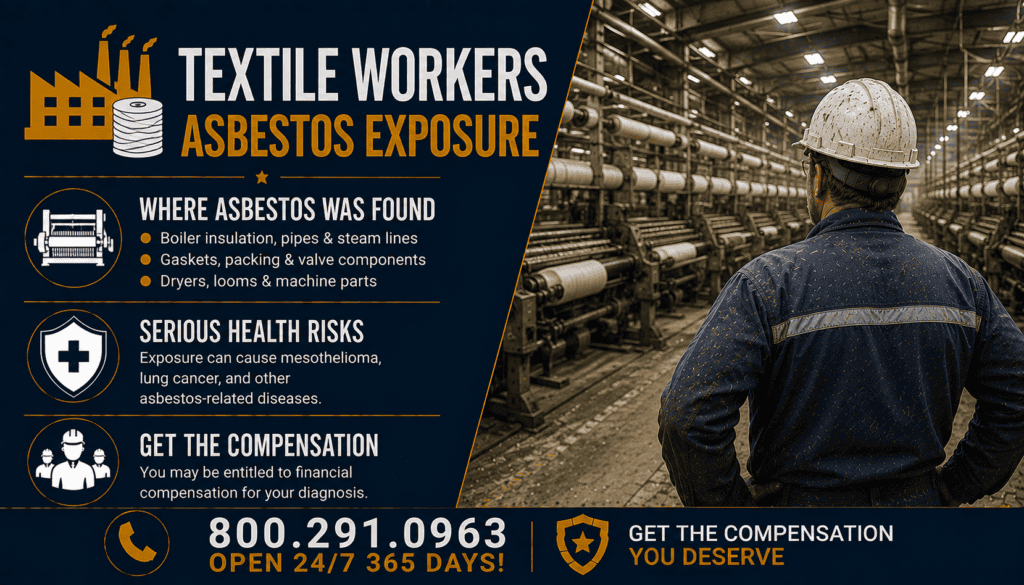
Textile Workers Asbestos Exposure
Textile workers historically produced many different materials, and employment in a textile mill does not automatically establish asbestos exposure. However, OSHA specifically identifies asbestos cloth, cord, felt, rope, tape, thread, wick and yarn as manufactured asbestos products, while NIOSH reports that historical chronic asbestos exposure once occurred in manufacturing processes used in textile mills.
A worker-specific history should identify the mill, years worked, department, fibers and products handled, machinery and maintenance duties. The strongest cases distinguish workers who actually processed asbestos textiles from workers exposed to cotton, wool, synthetic or other non-asbestos fibers, while also investigating asbestos-containing machinery components and building materials where supported by evidence.
Textile Workers and Occupational Asbestos Exposure
Historical textile manufacturing included a specialized asbestos-products industry. OSHA’s asbestos-products classification identifies establishments primarily engaged in manufacturing asbestos textiles and lists numerous woven and fibrous asbestos goods.
NIOSH’s scientific roadmap likewise explains that occupational asbestos exposure in earlier decades was dominated in part by chronic exposures in manufacturing processes such as those used in textile mills, friction-product manufacturing and cement-pipe fabrication.
These sources provide direct evidence that some textile workers had occupational asbestos exposure. They do not establish that every textile mill or every textile worker handled asbestos.
Potential exposure depended on the employer, era, product line, fiber used, job assignment and work practices. Employees directly handling asbestos fiber could have a substantially different history from workers producing conventional fabrics.
Related resources include textile, apparel and consumer goods manufacturing workers asbestos exposure, industrial, manufacturing and factory workers asbestos exposure, production workers asbestos exposure and factory workers asbestos exposure.
Asbestos Cloth, Yarn, Rope and Textile Products
OSHA’s historical industrial classification provides unusually specific evidence about asbestos textile manufacturing. It lists carded asbestos fiber and finished or semi-finished textile products made with asbestos.
Documented Asbestos Textile Products
- Asbestos cloth
- Asbestos yarn and thread
- Asbestos rope and cord
- Asbestos tape
- Woven asbestos felt
- Asbestos wick
- Carded asbestos fiber
- Woven asbestos friction materials
These products were valued historically because asbestos fibers have strength, flexibility and resistance to heat and electricity. NIOSH explains that asbestos fibers can become airborne when asbestos-containing materials are handled and can be inhaled because of their microscopic, fibrous nature.
A textile worker who handled confirmed asbestos fiber or asbestos textiles presents a direct occupational pathway. For a worker at a conventional fabric mill, an asbestos source must be separately documented.
Carding, Spinning, Weaving and Finishing
Textile production commonly involves preparing fibers and converting them into yarn and woven or finished material. When the fiber itself was asbestos, repeated handling during production could create chronic occupational exposure.
Tasks Worth Investigating
- Receiving or opening containers of documented asbestos fiber
- Preparing or carding asbestos fiber
- Spinning asbestos yarn or thread
- Weaving asbestos cloth, tape or other textile products
- Cutting, trimming or finishing confirmed asbestos textiles
- Handling waste, scraps or dust from asbestos-textile production
- Packaging asbestos cloth, rope, yarn or related products
- Cleaning equipment and production areas where asbestos was processed
NIOSH’s asbestos review includes scientific literature concerning mortality among asbestos textile workers and asbestos textile factories. NIOSH has also stated that excess lung-cancer and mesothelioma risks have been well documented in North Carolina and South Carolina asbestos-textile worker populations.
Historical industrial-hygiene reports, plant records, product catalogs, material specifications and coworker testimony can help determine which fibers were processed and in which departments.
Visible textile dust is not enough to identify asbestos. The actual raw material or product must be established through reliable evidence.
Mill Machinery, Maintenance and Building Materials
Textile workers who did not directly manufacture asbestos textiles could still have potential exposure from machinery or plant materials when asbestos-containing components are documented.
Historical industrial facilities commonly used steam, heat and mechanical systems. Asbestos was used in products such as pipe and boiler insulation and other heat-resistant materials. Exposure could occur when those materials deteriorated or were disturbed during maintenance.
Additional Exposure Sources Worth Investigating
- Boilers and steam lines with documented asbestos insulation
- Pipe insulation confirmed to contain asbestos
- Production machinery with identified asbestos-containing heat or friction components
- Mechanical rooms containing asbestos materials
- Building surfacing or insulation materials documented to contain asbestos
- Maintenance, repair or renovation that disturbed confirmed ACM
Maintenance mechanics and millwrights may have performed more direct disturbance work than production employees. Nearby textile workers could still have an exposure question if asbestos fibers or debris spread into occupied production areas.
Related resources include machine operators asbestos exposure, millwrights asbestos exposure, maintenance workers asbestos exposure and industrial, manufacturing and utility buildings asbestos exposure.
Need help now? Call 800.291.0963
Live chat available 24/7, 365 days a year.
Submit Your Case
Asbestos Dust vs. Cotton and Other Textile Dust
Textile mills can contain respiratory hazards that have nothing to do with asbestos. NIOSH has studied cotton-dust exposure for decades and identifies byssinosis as an airways disease associated with cotton dust.
NIOSH separately identifies asbestosis as a disease caused by inhaling asbestos fibers. The two exposure histories should not be confused simply because both can involve dusty textile workplaces.
Evidence That Helps Identify the Fiber
- Raw-material purchasing and receiving records
- Product catalogs and specifications
- Department and machine assignments
- Industrial-hygiene air-sampling records
- Safety data and historical plant documents
- Union records and coworker testimony
- Photographs, labels and packaging identifying asbestos products
A worker could have encountered cotton dust, asbestos or multiple occupational hazards during the same career. Each suspected exposure should be documented separately.
This distinction improves both medical and legal accuracy because a dusty textile job alone does not establish the mineral fibers responsible for an exposure.
Mesothelioma and Other Asbestos-Related Health Risks
NIOSH states that exposure to asbestos fibers causes cancer and asbestosis in humans. Its asbestos roadmap specifically discusses the potency of chrysotile for causing mesothelioma.
NIOSH records also describe excess risks of lung cancer and mesothelioma among workers in asbestos textile plants in North Carolina and South Carolina. These population-level findings support asbestos textile manufacturing as a historically significant exposure setting but do not prove causation for any individual worker.
Asbestos-related diseases can develop after long latency periods. Former textile workers may therefore need plant, employment, product, union and industrial-hygiene records from decades earlier.
Employment in a textile mill does not by itself establish asbestos exposure or disease causation. The fiber used, job tasks, duration and circumstances of exposure, medical evidence and other relevant factors must be evaluated individually.
Medical questions concerning prior occupational asbestos exposure, symptoms, screening or diagnosis should be discussed with a qualified healthcare professional.
Documenting Textile Worker Asbestos Exposure
A useful occupational history connects the worker to specific asbestos fiber, products, processes, machinery or plant materials.
- Employment: company, mill, years, department and job title
- Raw fibers: asbestos, cotton, wool, synthetics or other materials processed
- Products: asbestos cloth, yarn, thread, rope, tape, felt or wick where documented
- Tasks: carding, spinning, weaving, cutting, finishing, packaging or cleanup
- Equipment: machinery and components documented to contain asbestos
- Plant materials: asbestos insulation, surfacing material or other confirmed ACM
- Records: industrial-hygiene reports, product catalogs, specifications, union and safety records
- Witnesses: coworkers, supervisors, mechanics, millwrights and safety personnel
Questions That Can Strengthen an Exposure History
Which mill and years? Which department and machines? What fibers and products were processed? Was asbestos fiber received or stored? Did the worker card, spin, weave, cut or package asbestos textiles? Did maintenance disturb asbestos-containing equipment or insulation? Are plant records, catalogs, union files or coworkers available?
Lawsuits, Trust Funds and Compensation
A textile worker diagnosed with mesothelioma or another asbestos-related disease may have potential legal or compensation options when evidence supports occupational asbestos exposure and applicable requirements are met.
Textile employment alone does not establish asbestos exposure, causation, liability, trust eligibility or compensation. Depending on the evidence and jurisdiction, potential issues can involve asbestos suppliers, textile-product manufacturers, equipment companies, contractors, premises-related parties, workers’ compensation systems or asbestos bankruptcy trusts.
Trust eligibility generally requires satisfying the individual trust’s medical and exposure criteria and connecting the claimant’s history to a covered company, product, facility or qualifying period. Compensation is not guaranteed.
Related Textile and Manufacturing Resources
Textile manufacturing: Textile, Apparel & Consumer Goods Manufacturing Workers Asbestos Exposure
Manufacturing: Industrial, Manufacturing & Factory Workers Asbestos Exposure · Production Workers Asbestos Exposure
Plant work: Machine Operators Asbestos Exposure · Millwrights Asbestos Exposure
Authoritative Sources
This page was researched using OSHA and NIOSH government evidence. OSHA directly documents asbestos cloth, yarn, rope, thread and other asbestos textile products. NIOSH documents historical chronic asbestos exposure in textile manufacturing, asbestos-related disease and excess lung-cancer and mesothelioma risks in asbestos-textile worker populations.
- OSHA — Asbestos Products Manufacturing Classification
- NIOSH — Asbestos Fibers and Other Elongate Mineral Particles
- NIOSH — Workplace Exposure to Asbestos: Review and Recommendations
- NIOSH — Revised Recommended Asbestos Standard
- NIOSH — Asbestos Occupational Health Overview
- NIOSH — Lung Disease in Textile Workers
Textile Workers Asbestos Exposure FAQ
Were all textile workers exposed to asbestos?
No. Textile employment does not establish asbestos exposure. The mill, product, raw fiber, department, machinery and job duties should be documented.
Did textile mills actually manufacture asbestos products?
Yes. OSHA’s historical asbestos-products classification specifically lists asbestos cloth, cord, felt, rope, tape, textiles, thread, wick and yarn.
Which textile jobs could involve direct asbestos handling?
Workers who received, prepared, carded, spun, wove, cut, finished, packaged or cleaned up confirmed asbestos fibers and textile products could have direct exposure pathways.
Did asbestos textile workers have increased cancer risks?
NIOSH records describe well-documented excess risks of lung cancer and mesothelioma in asbestos textile worker populations. Population-level findings do not prove an individual worker’s exposure or causation.
Could mill machinery or insulation expose textile workers?
Potentially. Documented asbestos-containing equipment components, pipe or boiler insulation and other plant ACM could create additional exposure pathways when disturbed.
Is cotton dust the same as asbestos dust?
No. Cotton dust is associated with hazards including byssinosis, while asbestos fibers are associated with diseases including asbestosis, lung cancer and mesothelioma.
What records can help document asbestos exposure in a textile mill?
Employment records, product catalogs, raw-material records, industrial-hygiene reports, union files, machine specifications, plant safety documents, photographs and coworker statements can help reconstruct exposure.
Can textile workers qualify for asbestos trust fund claims?
Some may qualify if they meet a trust’s medical and exposure requirements and connect their work to a covered asbestos company, product, facility or qualifying period. Textile employment alone does not establish eligibility.
Get Help Reviewing Textile Worker Asbestos Exposure
Call 800.291.0963
Live chat is available 24/7, 365 days a year.
Prior textile employment does not automatically prove asbestos exposure, disease causation, liability, claim eligibility or compensation. Each situation depends on the mill, employment dates, raw fibers, products, machinery, work tasks, exposure evidence, medical evidence and applicable legal requirements. Compensation is not guaranteed.
⚕️ Legal & Medical Information Disclaimer
This page provides general educational information and is not medical or legal advice. The information does not establish asbestos exposure, diagnosis, causation, liability, claim eligibility or compensation. Medical concerns should be discussed with a qualified healthcare professional, and legal questions should be reviewed with a qualified attorney.