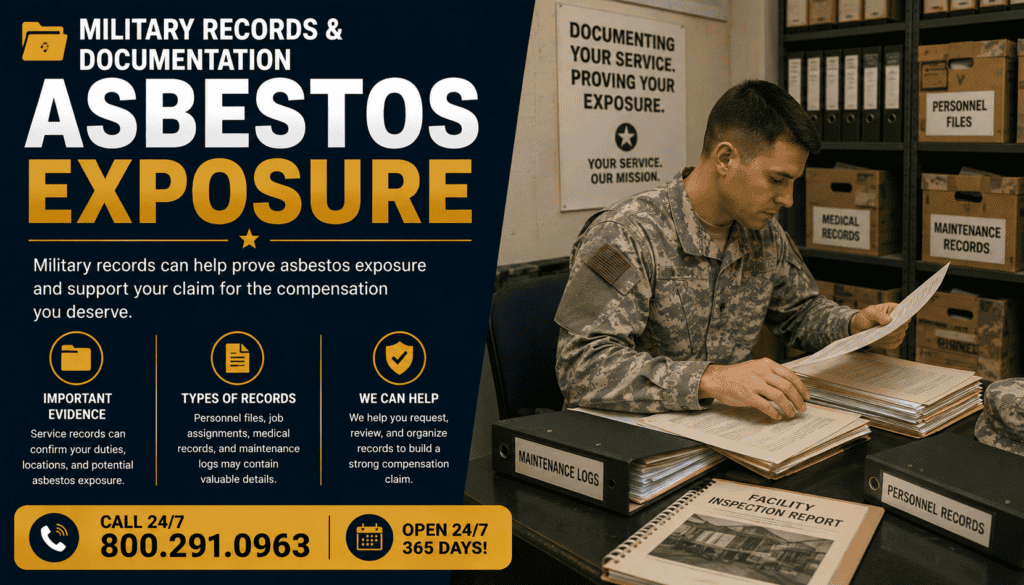
Military Records Documentation for Asbestos Exposure
Military records documentation for asbestos exposure can help establish a veteran’s branch, occupation or specialty, units, duty stations, assignments, and service dates. These records provide the framework for connecting military duties to locations, equipment, products, and work that may have involved asbestos.
DD214 records, Official Military Personnel Files, assignment histories, technical records, and medical evidence can serve different parts of the documentation process. The strongest exposure history separates confirmed service facts from recollection and connects each claimed exposure to supporting evidence whenever possible.
Military Records Documentation for Asbestos Exposure
Military records can help reconstruct where a veteran served, the jobs or specialties performed, units and duty assignments, and other facts relevant to an asbestos exposure history. VA specifically identifies service records listing a veteran’s job or specialty as evidence used with an asbestos-related disability claim.
Records rarely prove every detail by themselves. A stronger exposure history combines official service documentation with task-specific information, equipment or facility records, product evidence, medical records, and firsthand statements when available.
Military Records That Can Help Document Exposure
- DD Form 214 or earlier separation documents
- Official Military Personnel File (OMPF)
- Duty-station and assignment records
- MOS, rating, AFSC, specialty, and qualification records
- Training, performance, and evaluation records
- Medical and service treatment records when relevant
- Unit, ship, aircraft, vehicle, or facility records
- Maintenance, technical, procurement, or work records when available
The National Archives notes that OMPFs are primarily administrative records and can contain assignments, qualifications, performance information, awards, and separation documents.
DD214 and Separation Documents
The DD214 can verify military service and may include the veteran’s last duty assignment, rank, military job specialty, military education, awards, foreign service, and separation information. Earlier veterans may have equivalent separation forms rather than a DD214.
A DD214 is an important starting record, but it may not contain enough detail to identify every duty station, maintenance task, product, or exposure event.
Official Military Personnel File (OMPF)
The OMPF can provide a broader service history than a separation document. Depending on the veteran and service period, it may include enlistment or appointment information, duty stations, assignments, training, qualifications, performance, awards, administrative remarks, and separation information.
These records can help build a timeline that connects an occupation or specialty to particular installations, units, ships, aircraft, vehicles, or work environments.
Duty Stations, Jobs and Specialty Records
VA states that evidence for an asbestos-related disability claim should include service records listing the veteran’s job or specialty. VA compensation guidance also notes that evidence of military asbestos exposure may include the veteran’s military occupational specialty and where the veteran was stationed.
Record the branch-specific MOS, rating, AFSC, unit, ship, squadron, installation, depot, or other assignment together with exact dates whenever possible.
Supporting Exposure Documentation
Personnel records can establish service facts, but exposure research may require additional documentation showing what equipment, products, materials, or work processes were present.
- Technical manuals and maintenance procedures
- Work orders, inspection records, and overhaul files
- Parts catalogs, part numbers, and NSNs
- Procurement and manufacturer records
- Ship, aircraft, vehicle, base, depot, or facility histories
- Asbestos surveys, renovation records, or abatement records where relevant
- Specific firsthand coworker or witness statements
How to Request Military Service Records
The National Archives allows veterans and eligible next of kin to request military service records online, by mail, or by fax. Its eVetRecs system can be used for online requests, while Standard Form 180 (SF-180) can be mailed or faxed.
Record location depends on branch, service status, and separation date. National Archives guidance should be checked before submitting a request, particularly for recent records, National Guard records, and older archival files.
Missing or Incomplete Military Records
A missing document does not necessarily end exposure research. If a complete personnel file is unavailable, other records may help reconstruct the veteran’s service and duties, including separation documents, unit records, pay or award records, medical records, technical manuals, maintenance histories, and firsthand statements.
Keep a written timeline identifying which facts are documented, which are based on recollection, and which still need corroboration.
Medical Records and the VA Evidence Connection
VA says an asbestos-related disability claim generally requires medical records stating the health condition, service records listing the veteran’s job or specialty, and a doctor’s statement connecting military asbestos exposure to the health condition.
Medical evidence and exposure evidence serve different purposes. Service records can help document military history, while qualified medical evidence addresses diagnosis and the relationship between the condition and service exposure.
Using Records for VA and Other Claims
VA evaluates asbestos-related disability claims using evidence of military exposure, a related health condition, and a connection between the two. Organized records can make the veteran’s occupational and assignment history easier to evaluate.
Separate asbestos trust fund or civil claims may require additional evidence identifying asbestos-containing products, manufacturers, work sites, exposure circumstances, and applicable dates.
Frequently Asked Questions
Is a DD214 enough to prove asbestos exposure?
Not necessarily. It can verify important service facts, but additional assignment, occupational, maintenance, facility, product, or witness evidence may be needed to document a specific exposure pathway.
What is an OMPF?
The Official Military Personnel File is primarily an administrative record of a service member’s military history and may include assignments, training, qualifications, performance information, awards, and separation documents.
Can I request military records online?
Yes. The National Archives provides eVetRecs for online requests and also accepts qualifying requests by mail or fax using SF-180.
Does VA require service records for an asbestos claim?
VA states that claim evidence includes service records listing the veteran’s job or specialty, along with medical evidence and a medical connection between the condition and military asbestos exposure.
Confirmed Sources
Review Your Military Records and Exposure History
Gather your DD214 or separation documents, OMPF, specialty or rating information, units, duty stations, service dates, equipment assignments, and maintenance history. Build a dated timeline and preserve copies of records that support each part of the exposure history.
Call 800.291.0963 for a no-obligation case evaluation and to speak with a real person 24/7, 365 days a year. Mesothelioma Help Center is not a law firm or medical provider.
Disclaimer: General information only—not legal or medical advice. This website is not a law firm. Exposure, VA eligibility, liability and deadlines vary by case and jurisdiction. Do not disturb suspected asbestos. Past results do not guarantee future outcomes.