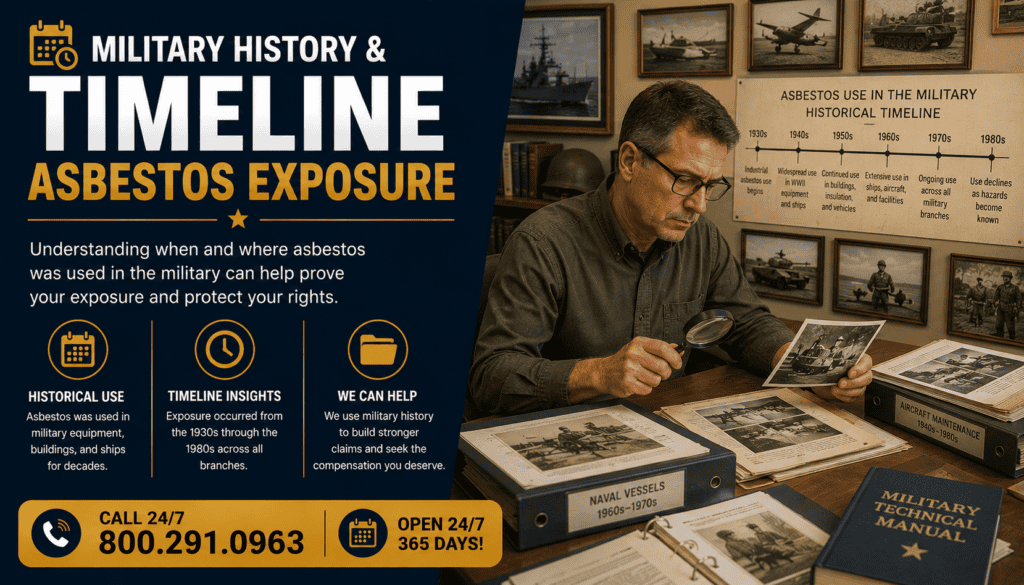
Military History Timeline of Asbestos Exposure
The military history timeline of asbestos exposure spans decades of shipbuilding, construction, mechanical maintenance, aviation, vehicles, bases, and industrial work. Understanding when a veteran served is useful, but exposure research must also identify the occupation, location, equipment, materials, and tasks involved.
Military asbestos use changed over time as products, regulations, maintenance practices, and equipment inventories changed. Older asbestos-containing materials could remain in ships, buildings, machinery, and replacement inventories long after new use declined, making an individual service and work timeline especially important.
Military History Timeline of Asbestos Exposure
Military asbestos exposure developed across decades of shipbuilding, construction, maintenance, transportation, aviation, and mechanical work. VA identifies historical military asbestos use in friction products and heat-resistant materials such as brakes, gaskets, valves, cements, adhesives, flooring, pipe coverings, and lagging.
Exposure history should be evaluated by service period, branch, occupation, duty station, equipment, and the specific material or maintenance activity involved. A veteran’s presence during a particular era does not by itself prove asbestos exposure.
Before World War II
Before World War II, asbestos was already valued for heat resistance, insulation, fire protection, and friction applications. Military facilities, ships, mechanical systems, and construction materials from this period can be relevant when researching later maintenance, renovation, or removal work.
For individual exposure research, the key question is not simply when a building or vessel was constructed, but which asbestos-containing materials remained in place when the veteran worked there.
World War II and Rapid Military Expansion
World War II brought enormous expansion in U.S. military shipbuilding, bases, industrial facilities, vehicles, and mechanical infrastructure. VA identifies Navy ships and shipyards as major historical exposure settings, particularly enclosed engine and boiler spaces where asbestos-containing materials were used for fire safety and heat protection.
Shipyard, insulation, boiler, pipe, construction, repair, and mechanical occupations from this period deserve detailed exposure research tied to actual tasks and materials.
Postwar and Korean War Era
After World War II, the military continued operating, repairing, modernizing, and replacing large inventories of ships, buildings, vehicles, aircraft, boilers, piping, and industrial equipment. Older asbestos-containing materials could remain in service even as equipment was rebuilt or modified.
Maintenance records, technical manuals, part numbers, facility histories, and procurement records can help determine what materials were present during a veteran’s particular assignment.
Cold War Military Asbestos Exposure
Cold War military operations relied on extensive fleets, installations, depots, shipyards, aircraft maintenance facilities, power systems, housing, and industrial infrastructure. Veterans may have encountered asbestos during repair, overhaul, construction, demolition, and maintenance of older equipment and facilities.
VA health guidance identifies pipefitters, welders, boiler operators, renovation and demolition specialists, shipyard workers, and personnel handling damaged asbestos-containing material among groups that may have experienced military exposure.
Vietnam Era Military Exposure
During the Vietnam era, older ships, bases, aircraft-support facilities, vehicles, mechanical systems, and buildings remained in military use. Navy veterans working below deck, in engine spaces, boiler rooms, and shipyards are among the populations specifically identified in VA asbestos-exposure guidance.
Exposure research should identify the veteran’s exact unit, ship, base, aircraft, vehicle, occupation, maintenance task, and service dates rather than relying only on the conflict era.
1970s and 1980s: Declining Use and Continuing Legacy Materials
Asbestos use declined substantially from its U.S. peak in the 1970s, but older military buildings, ships, equipment, replacement parts, and installed materials could remain in service. Renovation, maintenance, removal, and demolition could disturb legacy asbestos-containing materials.
Federal restrictions also expanded during this period. EPA and other federal agencies prohibited several asbestos uses, and EPA issued a major asbestos ban-and-phase-out rule in 1989. Most of that 1989 rule was later overturned in court, leaving specific product bans and the prohibition on new uses.
1990s to Present: Legacy Asbestos and Damaged Buildings
Later service does not automatically eliminate possible asbestos exposure. VA notes that Navy shipyard work extended into the 1990s as a potential exposure setting, and service members in Iraq and other countries in the region may have encountered asbestos when older buildings were damaged and fibers became airborne.
Modern exposure research should distinguish legacy installed asbestos from newer materials and identify the actual damaged building, renovation, demolition, repair, or cleanup activity involved.
Military Occupations Across the Timeline
- Shipyard workers and shipboard engineering personnel
- Pipefitters, plumbers, and steam-system workers
- Boiler operators and mechanical maintenance personnel
- Welders, machinists, and metalworkers
- Aircraft and vehicle mechanics
- Construction, carpentry, renovation, and demolition personnel
- Insulation workers and maintenance crews
Occupation titles are useful starting points, but exposure documentation should connect the job to specific materials, equipment, facilities, and tasks.
Building a Veteran’s Exposure Timeline
A chronological exposure history can help organize evidence across multiple duty stations and assignments.
- Branch, MOS, rating, AFSC, and unit
- Duty stations, ships, bases, depots, and facilities
- Aircraft, vehicles, machinery, and mechanical systems
- Daily maintenance, repair, construction, or demolition tasks
- Technical manuals, maintenance records, part numbers, and NSNs
- Facility, shipyard, overhaul, and procurement records
- Specific firsthand coworker statements
VA Benefits and Exposure Evidence
VA states that asbestos-related disability compensation may be available when a veteran has a health condition caused by asbestos and had contact with asbestos during military service. Claim evidence includes medical records, service records listing the veteran’s job or specialty, and a doctor’s statement connecting military asbestos exposure to the condition.
Historical context can guide research, but VA claims are decided case by case and require evidence tied to the individual veteran.
Frequently Asked Questions
When was asbestos used by the military?
Military use spanned many decades and included ships, shipyards, buildings, insulation, friction products, gaskets, valves, cements, adhesives, flooring, pipe coverings, and other heat-resistant materials. The relevant period depends on the veteran’s specific assignment and product history.
Did asbestos disappear from military settings after the 1970s?
No. Use declined, but previously installed materials and older equipment could remain in service and could be disturbed during maintenance, renovation, repair, or demolition.
Which Navy periods deserve particular attention?
VA guidance identifies ships built before the mid-1970s, Navy veterans on ships whose keels were laid before 1983, shipyard workers from the 1930s through the 1990s, and personnel working below deck before the early 1990s among groups warranting exposure consideration.
Can recent veterans have asbestos exposure histories?
Yes. VA notes possible exposure when older buildings were damaged in Iraq and other countries in the region. Individual evidence is still needed to document the circumstances.
Confirmed Sources
Review Your Military Asbestos Exposure Timeline
Write down each service period, unit, duty station, occupation, ship, aircraft, vehicle, building, equipment system, and maintenance task you remember. Add dates and supporting records wherever possible so the timeline distinguishes documented facts from recollection.
Call 800.291.0963 for a no-obligation case evaluation and to speak with a real person 24/7, 365 days a year. Mesothelioma Help Center is not a law firm or medical provider and does not determine VA eligibility.
Disclaimer: General information only—not legal or medical advice. This website is not a law firm. Exposure, VA eligibility, liability and deadlines vary by case and jurisdiction. Do not disturb suspected asbestos. Past results do not guarantee future outcomes.