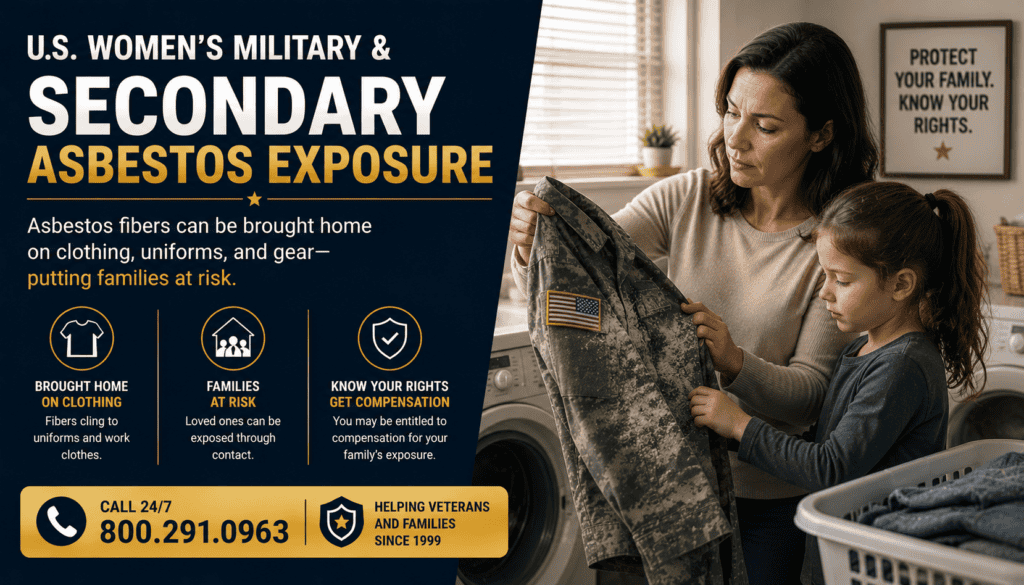
Women’s Military & Secondary Asbestos Exposure
Women’s military asbestos exposure can involve direct service in ships, bases, construction areas, maintenance facilities, or other settings where asbestos-containing materials were historically used. Women also may have experienced secondary exposure when a spouse or family member unknowingly carried workplace fibers home on clothing, footwear, hair, tools, or personal belongings.
Understanding the pathway matters because direct military exposure and household take-home exposure require different supporting evidence. Service records may help document a veteran’s duties and locations, while secondary-exposure histories may rely on household timelines, laundry practices, witness accounts, and records identifying the original military or occupational asbestos source.
Women’s Military & Secondary Asbestos Exposure
Women may have encountered asbestos directly during military service or indirectly when fibers were carried from military workplaces, ships, maintenance areas, or construction settings into family environments. This hub separates direct service exposure from secondary or take-home exposure so readers can identify the records and timelines most relevant to their history.
A military connection does not by itself prove asbestos exposure or disease causation. Useful evidence can include service records, military occupational specialties, duty stations, ship or facility records, employment histories, household timelines, medical records, and testimony describing how dusty work clothing or equipment entered the home.
How Military and Secondary Exposure Could Occur
Military asbestos exposure historically involved settings such as shipyards, ships, construction, demolition, insulation work, flooring, roofing, pipe systems, brakes, gaskets, and other heat-resistant materials. VA recognizes that certain military occupations and products created potential asbestos contact.
Secondary exposure is different: a person may not have worked with asbestos-containing material but could have encountered fibers transported from a workplace on clothing, shoes, skin, hair, tools, or other items. Historical public-health investigations have documented this take-home pathway in some occupational settings.
Women Veterans and Direct Exposure
Women veterans may have direct exposure histories tied to their own service, assignments, workplaces, buildings, maintenance environments, or occupational specialties. VA states that an asbestos-related disability claim generally requires evidence of a current condition, military asbestos exposure, and a relationship between the two.
Service records can help establish where and when a veteran served. They should be evaluated alongside records describing the materials, equipment, buildings, ships, or work activities associated with the claimed exposure.
Military Families and Take-Home Exposure
Spouses, children, and other household members may have experienced secondary exposure when contaminated work clothing or dust entered the home. Laundry tasks can be particularly important to reconstruct because shaking, sorting, or washing dusty clothing could disturb fibers that had been carried from a workplace.
The strength of a historical exposure account depends on the facts. A useful timeline identifies the service member or worker, duty location, occupation, dates, likely source materials, household residence, laundry practices, and the person who handled work clothing.
Records That Can Help Reconstruct Exposure
No single document necessarily establishes a decades-old exposure. A stronger reconstruction often combines several independent sources. Military records can establish service and assignment facts; ship or base records can add location context; employment and product records can help identify potential asbestos sources; medical records document diagnosis and clinical history.
For secondary exposure, family records, addresses, photographs, correspondence, witness statements, and descriptions of household routines can help connect the occupational source to the person who experienced take-home exposure.
| Record | What it may help establish |
|---|---|
| Service records | Dates, branch, specialty, assignments, and duty locations |
| Ship/base records | Location and historical work context |
| Product/work records | Potential asbestos-containing materials and activities |
| Household evidence | Residence, laundry practices, and take-home pathway |
| Medical records | Diagnosis and clinical history |
Explore the Military & Secondary Exposure Guides
- Secondhand Asbestos Exposure in Women — Detailed guidance on this exposure pathway and the records that may help document it.
- Laundry-Related Asbestos Exposure in Women — Detailed guidance on this exposure pathway and the records that may help document it.
- Military Family Asbestos Exposure in Women — Detailed guidance on this exposure pathway and the records that may help document it.
- Take-Home Asbestos Exposure in Women — Detailed guidance on this exposure pathway and the records that may help document it.
- Women Veterans Asbestos Exposure — Detailed guidance on this exposure pathway and the records that may help document it.
Health Evaluation and Exposure History
Asbestos-related diseases can have long latency periods. A clinician evaluating a possible asbestos-related condition may consider occupational, military, environmental, and household exposure history together with symptoms, imaging, pathology, and other medical evidence.
Exposure alone is not a diagnosis. Anyone concerned about a possible asbestos-related condition should discuss their history and symptoms with an appropriate health-care professional. Veterans can also ask VA about environmental health resources.
Legal and Benefits Considerations
A military-connected exposure history can raise different questions depending on who was exposed. A veteran may investigate VA benefits when a condition is linked to asbestos exposure during service. A family member with secondary exposure may instead need to examine potential civil claims, asbestos trust funds, or other legal options based on the responsible products and companies.
Eligibility, deadlines, proof standards, and available compensation vary. A VA disability claim is also distinct from a civil asbestos lawsuit, and one should not be described as automatically establishing the other.
Frequently Asked Questions
Can women veterans have direct military asbestos exposure?
Yes. Exposure depends on the person’s actual duties, locations, materials, and circumstances—not gender. Service and occupational records can help reconstruct those facts.
What is secondary asbestos exposure?
Secondary or take-home exposure refers to asbestos fibers transported from an occupational setting into another environment, historically including fibers carried on clothing, shoes, skin, hair, or belongings.
Can laundering military work clothes matter?
It can be relevant when dusty clothing came from an asbestos-contaminated work setting. The specific work, time period, clothing practices, and household routine should be documented rather than assumed.
Does living on a military base prove asbestos exposure?
No. Residence or presence at a base establishes location, not exposure by itself. Evidence about a particular building, material, activity, renovation, or other source is needed.
What records are useful for a veteran?
Service records, occupational specialty, duty stations, ship or facility records, medical records, and records identifying materials or work activities may all be useful.
What records help with a family member’s secondary exposure?
Household addresses, service or employment records for the source worker, photographs, letters, laundry routines, witness statements, and medical records may help reconstruct the timeline.
Is asbestos exposure itself a VA disability?
VA states that exposure by itself is not a condition subject to service connection; a claim generally concerns a disease or disability related to military asbestos exposure.
Can a family member automatically receive VA asbestos compensation?
Not simply because a veteran may have carried asbestos fibers home. VA benefits and civil claims have different eligibility rules, so the applicable route depends on the claimant and facts.
Summary
Women’s military and secondary asbestos exposure can involve direct service, work on military installations, or take-home exposure through a family member’s contaminated clothing and belongings. Reconstructing the history carefully—who worked where, what work occurred, how dust may have traveled, and what records remain—can help organize medical, benefits, and legal questions without overstating what any single fact proves.
Confirmed Sources
Talk With a Real Person About Your Exposure History
If you or a loved one has been diagnosed with mesothelioma and you are investigating military or secondary asbestos exposure, Call 800.291.0963 or use live chat 24/7, 365 days a year. You can also submit your case for a no-obligation case evaluation.