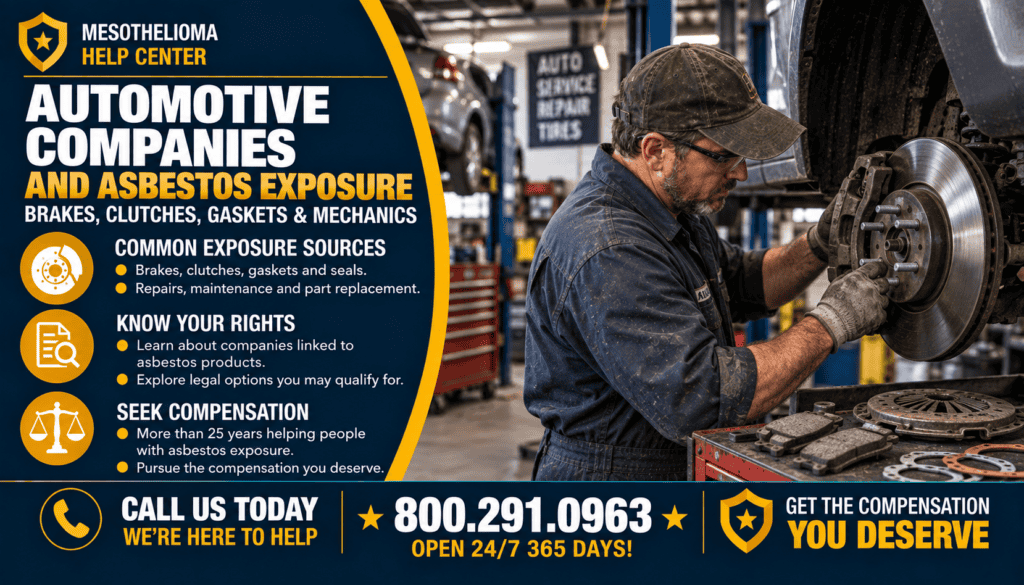
Automotive Companies and Asbestos Exposure
Brakes, Clutches, Gaskets & Mechanics
Asbestos was historically used in automotive friction and heat-resistant components because the mineral could tolerate high temperatures and wear. The best-documented automotive applications include brake linings and shoes, brake pads and clutch facings. Court records also document asbestos-containing gaskets and other vehicle components in particular makes, models and time periods. The U.S. Environmental Protection Agency continues to warn that some, but not all, automotive brakes and clutches available or in use may contain asbestos.
Mechanics could encounter asbestos-containing dust while inspecting, removing, replacing, grinding or cleaning historical brakes and clutches. EPA states that brake and clutch dust can contain microscopic asbestos fibers when asbestos-containing components are involved, and OSHA maintains mandatory work practices for covered professional automotive brake and clutch operations. Because asbestos use varied by manufacturer, supplier, component and year, a vehicle brand alone does not prove asbestos exposure.
🚗 Automotive Asbestos History
Automotive asbestos exposure is most strongly associated with historical friction products. As brakes slow a vehicle and clutches transfer engine power, both systems generate heat. Asbestos was historically incorporated into friction materials because of its heat resistance and durability. Vehicle manufacturers also purchased asbestos-containing components from outside suppliers, making supplier and replacement-part identification important.
| Topic | Evidence-based overview |
|---|---|
| Primary historical concern | Asbestos-containing automotive friction products. |
| Most documented components | Brake linings/shoes, brake pads and clutch facings. |
| Other documented components | Certain historical gaskets and heat-resistant vehicle parts, depending on manufacturer/model/year. |
| Fiber commonly documented in automotive friction products | Chrysotile asbestos. |
| Original equipment | Could include asbestos-containing components during historical periods. |
| Replacement parts | Could also contain asbestos and might come from vehicle manufacturers or independent suppliers. |
| Current EPA position | Some, but not all, brakes and clutches available or in use may contain asbestos. |
| Identification problem | EPA says asbestos content generally cannot be determined just by looking at a brake or clutch component. |
Automotive Asbestos Timeline
| Period | Development |
|---|---|
| 1940s–1960s | Published litigation documents extensive asbestos use in vehicle friction components. |
| 1971 | Federal OSHA asbestos workplace regulation began. |
| 1970s | Warnings and industry attention to automotive asbestos exposure increased. |
| 1980s and later | Manufacturers increasingly transitioned away from asbestos-containing friction materials, but timing varied. |
| 2006 | OSHA issued a safety bulletin emphasizing precautions for asbestos-containing automotive brakes and clutches. |
| Current | EPA and OSHA still publish brake/clutch asbestos precautions because older vehicles and some components may present exposure concerns. |
🛞 Asbestos-Containing Auto Parts
The component is more important than the badge on the hood. Historical vehicles could contain original-equipment parts from outside suppliers, and later replacement parts could come from entirely different manufacturers. EPA therefore recommends treating unidentified brake and clutch components cautiously rather than relying on visual appearance.
| Component | Historical asbestos concern |
|---|---|
| Brake linings / shoes | One of the best-documented automotive asbestos applications. |
| Brake pads | Historical asbestos-containing formulations are documented. |
| Clutch facings | EPA and OSHA specifically address asbestos exposure during clutch repair. |
| Gaskets | Certain historical engine, exhaust and other gaskets contained asbestos; manufacturer/model evidence is required. |
| Brake assemblies | Asbestos-containing friction linings could be incorporated into assemblies supplied to automakers. |
| Aftermarket friction products | Replacement brakes/clutches could contain asbestos even when not manufactured by the vehicle company. |
| Insulation / heat shields | Certain historical vehicle applications may require product-specific investigation. |
| Modern components | Do not assume asbestos content; verify manufacturer/packaging/SDS information when available. |
Component Identification Rules
| Statement | Accurate treatment |
|---|---|
| All old brakes contained asbestos | No. |
| Some historical brakes and clutches contained asbestos | Yes. |
| Appearance alone identifies asbestos | No; EPA says visual inspection is insufficient. |
| A vehicle manufacturer always made its own friction material | No; court records document outside suppliers. |
| Replacement parts always match original-equipment composition | No. |
| Exact brand, supplier, component and date improve exposure analysis | Yes. |
👨🔧 Automotive Workers at Risk
Professional mechanics are the clearest occupational group associated with automotive asbestos exposure, but other workers could also encounter historical friction dust. Frequency, duration, work methods, component composition and ventilation can materially change the exposure analysis.
| Worker / occupation | Potential historical activity |
|---|---|
| Automotive mechanics | Removing, installing and cleaning brakes and clutches. |
| Brake specialists | Repeated brake inspection, disassembly and replacement. |
| Dealership technicians | Servicing original-equipment and replacement friction components. |
| Service-station mechanics | Brake, clutch and general repair work. |
| Fleet mechanics | Repeated service on cars, trucks and other fleet vehicles. |
| Truck / trailer mechanics | Brake-lining replacement and drum cleaning. |
| Parts rebuilders | Handling and rebuilding friction components. |
| Home mechanics | DIY brake and clutch repair can disturb dust if asbestos-containing components are present. |
Potential Work Settings
| Setting | Evidence to investigate |
|---|---|
| Auto dealerships | Service records, vehicle makes, parts invoices and coworker testimony. |
| Independent repair shops | Parts suppliers, job tickets and brake/clutch work frequency. |
| Service stations | Historical repair practices and product brands. |
| Fleet garages | Vehicle/maintenance records and replacement-part purchasing. |
| Truck terminals | Trailer/truck brake maintenance histories. |
| Home garages | Vehicle ownership, repair dates, receipts and component packaging. |
Need help now? Call 800.291.0963
Live chat is available 24/7, 365 days a year.
Submit Your Case
🌫️ How Automotive Asbestos Exposure Occurred
EPA explains that visible brake and clutch dust can be accompanied by microscopic particles that cannot be seen. If the component contains asbestos, the dust may contain asbestos fibers that can be inhaled. OSHA’s mandatory Appendix F specifies engineering controls and work practices intended to reduce employee exposure during covered brake and clutch inspection, disassembly, repair and assembly.
| Activity | Potential exposure pathway |
|---|---|
| Removing brake drums / wheels | Disturbing accumulated brake dust. |
| Compressed-air cleaning | Can disperse dust; EPA/OSHA guidance favors controlled methods rather than uncontrolled dust blowing. |
| Grinding / beveling linings | Mechanical disturbance of historical friction material. |
| Brake shoe replacement | Handling/removing asbestos-containing friction components. |
| Clutch disassembly | Disturbing dust inside clutch assemblies. |
| Sweeping shop dust | Can re-suspend contaminated dust. |
| Opening / handling replacement parts | Potential contact if historical replacement parts contained asbestos. |
| Work-clothing contamination | Potential secondary pathway requires claimant-specific evidence. |
EPA / OSHA Control Concepts
| Method / rule | Purpose |
|---|---|
| Negative-pressure enclosure / HEPA vacuum | Captures brake/clutch dust during servicing. |
| Low-pressure wet cleaning | Wets the assembly and collects runoff to limit airborne dust. |
| Wet-wipe method | Permitted by OSHA for qualifying low-volume operations under specified conditions. |
| No visual assumption | EPA advises that asbestos and non-asbestos brakes cannot reliably be distinguished by appearance. |
| Professional servicing | EPA suggests professional servicing when a home mechanic cannot determine asbestos content. |
| OSHA Appendix F | Mandatory engineering-control/work-practice requirements for covered employers. |
🏭 Automotive Companies & Brands
Automotive asbestos cases often involve several layers of companies: the vehicle manufacturer, original-equipment friction supplier, replacement-part manufacturer, distributor and repair business. Court records show why these distinctions matter. For example, evidence in California litigation stated that Ford purchased brake assemblies or linings from suppliers, while other cases document GM/Delco asbestos-containing brake products during particular historical periods.
| Company / category | Documented context |
|---|---|
| Ford Motor Company | Published cases document historical asbestos-containing brakes, pads, clutch facings and replacement parts in particular periods. |
| General Motors / Delco | California appellate record documents GM/Delco brake parts containing chrysotile asbestos in the 1946–1948 period at issue. |
| Pneumo Abex / Abex | California appellate record states Abex manufactured brake linings sold to aftermarket/OEM brake manufacturers. |
| Bendix | Appears in published automotive asbestos litigation and friction-product evidence. |
| Rayloc / NAPA supply chain | Watts record describes Rayloc brake products using Abex linings distributed through NAPA. |
| Independent replacement suppliers | Could supply asbestos-containing friction parts for vehicles made by another company. |
| Dealership/service operations | May create occupational exposure settings independent of who manufactured the friction material. |
| Other automotive defendants | Require company-, product-, vehicle- and date-specific evidence before asbestos content is stated. |
Company Research Rules
| Question | Why it matters |
|---|---|
| Who manufactured the vehicle? | Identifies possible OEM specifications and records. |
| Who manufactured the friction material? | May differ from vehicle manufacturer. |
| Was the part original or replacement? | Changes responsible-company analysis. |
| What brand was on the replacement box? | Can identify a separate friction-products defendant. |
| What model/year was serviced? | Helps determine likely original component. |
| Was the claimant working at a dealership, independent shop or fleet? | Can help reconstruct parts sourcing and work frequency. |
Abex Corporation Asbestos Exposure
Abex Corporation manufactured automotive and industrial friction products, including brake components historically associated with asbestos exposure. Mechanics, brake technicians, maintenance workers, and others who handled older asbestos-containing friction materials may have encountered airborne fibers during repairs, removal, or replacement.
Read more about Abex Corporation Asbestos Exposure, including potentially affected workers, historical products, and legal claims.
📚 Government & Court Evidence
Government guidance and published appellate decisions provide strong evidence that automotive brake and clutch work can involve asbestos exposure when asbestos-containing friction components are present. Individual court outcomes vary because product identification, exposure dose, causation, warnings and state law differ from case to case.
| Source / record | What it establishes |
|---|---|
| U.S. EPA brake/clutch guidance | Some automotive brakes and clutches may contain asbestos; mechanics can be exposed to asbestos-containing dust. |
| OSHA 29 CFR 1910.1001 Appendix F | Mandatory engineering controls/work practices for covered automotive brake and clutch operations. |
| Scott v. Ford (Cal. Ct. App. 2014) | Mechanic/service-station owner had decades of brake/clutch asbestos exposure; jury found Ford proportionately liable in that case. |
| Darden v. General Motors (Cal. Ct. App. 1995) | Record states GM brake parts in 1946–1948 contained 40–60% chrysotile asbestos. |
| Petitpas v. Ford (Cal. Ct. App. 2017) | Ford interrogatory evidence stated some pre-1980s vehicles had asbestos-containing brake linings, pads and clutch facings purchased from suppliers. |
| Watts v. Pneumo Abex (Cal. Ct. App. 2024) | Documents Abex asbestos-containing brake-lining supply relationships including Ford, GM and Rayloc/NAPA. |
| Skrzynski v. Akebono/Ford (N.Y. App. Div. 2025) | Affirmed judgment after jury evidence of dealership exposure to asbestos-containing Ford friction products and mesothelioma. |
| Walls federal litigation (M.D.N.C. 2022) | Documents repeated truck/trailer brake work, dust-generating tasks and asbestos-containing brake evidence in the record. |
Evidence Limits
| Finding | Correct interpretation |
|---|---|
| Historical automotive friction products contained asbestos | Confirmed. |
| All brakes and clutches contained asbestos | No. |
| Every vehicle from a named manufacturer had asbestos components | No. |
| A supplier relationship proves a particular claimant used that product | No. |
| A verdict against one manufacturer determines every future case | No. |
| Product, date, task and claimant-specific evidence remain necessary | Yes. |
📋 Asbestos Claims & Evidence
An automotive asbestos claim generally requires more than showing that someone worked as a mechanic. Useful evidence can connect the claimant to specific vehicles, components, manufacturers or replacement-part brands and document the frequency and manner of brake, clutch or gasket work.
Evidence That May Help
- Medical and pathology records supporting the claimed asbestos-related disease.
- Employment, union, Social Security and dealership/service-station records.
- Vehicle makes, models and model years regularly serviced.
- Brake, clutch and gasket brands or original-equipment part information.
- Parts invoices, boxes, catalogs, service manuals and purchasing records.
- Coworker testimony describing brake/clutch work and dust-control practices.
- Records showing grinding, sanding, blowing, sweeping or drum-cleaning methods.
- Evidence of other occupational or non-automotive asbestos exposures.
| Step | Question |
|---|---|
| 1 | Is an asbestos-related disease medically documented? |
| 2 | What automotive work did the claimant perform? |
| 3 | Which vehicle makes/models/years were serviced? |
| 4 | Can original or replacement friction-product manufacturers be identified? |
| 5 | Were brakes, clutches or qualifying gaskets disturbed? |
| 6 | How often and for how many years was the work performed? |
| 7 | Are invoices, service records, catalogs or witnesses available? |
| 8 | Are other asbestos exposures documented for a complete exposure history? |
Compensation Accuracy Rules
| Item | Treatment |
|---|---|
| Universal automotive asbestos trust | None; claims depend on responsible companies and their legal status. |
| Universal mechanic payout | None. |
| Average settlement | Not invented from isolated verdicts. |
| Trust eligibility | Must be researched company by company. |
| Lawsuit eligibility | Depends on exposure evidence, diagnosis, jurisdiction and deadlines. |
| Guaranteed compensation | None. |
Compensation is not guaranteed. Some responsible automotive/friction-product companies may have bankruptcy trusts, while others remain defendants in civil litigation. Each company must be researched separately before stating a trust, payment percentage or disease value.
❓ Frequently Asked Questions
Why was asbestos used in automotive parts?
Asbestos was historically used in friction and heat-resistant components because it tolerated high temperatures and wear. Brake linings, brake pads and clutch facings are among the best-documented automotive applications.
Which automotive parts historically contained asbestos?
Historical asbestos has been documented in certain brake linings and shoes, brake pads, clutch facings, gaskets and other heat-resistant components. Composition varied by manufacturer, supplier and year.
Can a mechanic tell whether a brake or clutch contains asbestos by looking at it?
No. EPA says asbestos-containing and non-asbestos brake or clutch components generally cannot be reliably distinguished simply by appearance.
How could mechanics have been exposed?
Removing brake drums, cleaning dust, grinding or replacing linings, servicing clutches, sweeping shop dust and other disturbance of asbestos-containing components could create an inhalation pathway.
Did Ford and General Motors vehicles use asbestos-containing brakes?
Published court records document asbestos-containing friction components associated with Ford and GM during specific historical periods. That does not mean every vehicle, model or replacement part contained asbestos.
Do automotive asbestos claims have one bankruptcy trust?
No. There is no single automotive asbestos trust. Potential claims depend on the specific vehicle, component and friction-product companies involved and whether a responsible company has a trust or remains subject to civil litigation.
Are asbestos brakes still a concern?
EPA currently states that some, but not all, automotive brakes and clutches available or in use may contain asbestos, and older vehicles may also retain or receive asbestos-containing components.
What evidence may support an automotive asbestos claim?
Medical records, employment history, vehicle makes/models, parts invoices, component brands, service records and coworker testimony can help establish product identity and exposure.
🧾 Automotive Asbestos Exposure Summary
| Detail | Confirmed / carefully qualified information |
|---|---|
| Primary historical products | Brake linings/shoes, brake pads and clutch facings. |
| Other possible components | Certain gaskets and heat-resistant parts, depending on manufacturer/model/year. |
| Primary workers at risk | Automotive, brake, dealership, fleet, truck/trailer and service-station mechanics. |
| Primary exposure mechanism | Inhalation of asbestos-containing dust when qualifying friction components are disturbed. |
| EPA current guidance | Some, but not all, brakes and clutches available or in use may contain asbestos. |
| OSHA standard | 29 CFR 1910.1001 Appendix F specifies mandatory controls for covered brake/clutch work. |
| Product identification | Vehicle badge alone is insufficient; OEM and replacement suppliers matter. |
| Universal automotive trust | None. |
| Universal settlement value | None. |
| Current products | Do not infer asbestos content from historical litigation. |
| Guaranteed compensation | No. |
📚 Confirmed Government & Court Sources
- U.S. EPA — Current Best Practices for Brake & Clutch Repair Workers
- U.S. EPA — Brake Repair and Past Asbestos Exposure
- OSHA — 29 CFR 1910.1001 Appendix F, Automotive Brake & Clutch Work
- Scott v. Ford Motor Co. — California Court of Appeal (2014)
- Darden v. General Motors Corp. — California Court of Appeal (1995)
- Petitpas v. Ford Motor Co. — California Court of Appeal (2017)
- Watts v. Pneumo Abex — California Court of Appeal (2024)
- Skrzynski v. Akebono Brake Corp. — New York Appellate Division (2025)
- Walls Automotive/Trailer Brake Litigation — U.S. District Court (2022)
Submit Your Case
Call 800.291.0963
Live chat is available 24/7, 365 days a year.
Submit Your Case
Working as a mechanic or servicing an older vehicle does not automatically establish asbestos exposure or a compensable claim. The specific vehicle, component, manufacturer or supplier, dates, work practices, medical evidence and applicable law must be evaluated individually. Compensation is not guaranteed.
⚕️ Legal & Medical Information Disclaimer
This page provides general educational information and is not legal or medical advice. Do not deliberately disturb suspected asbestos-containing automotive components to identify them. Consult qualified automotive safety, healthcare and legal professionals for individual guidance.