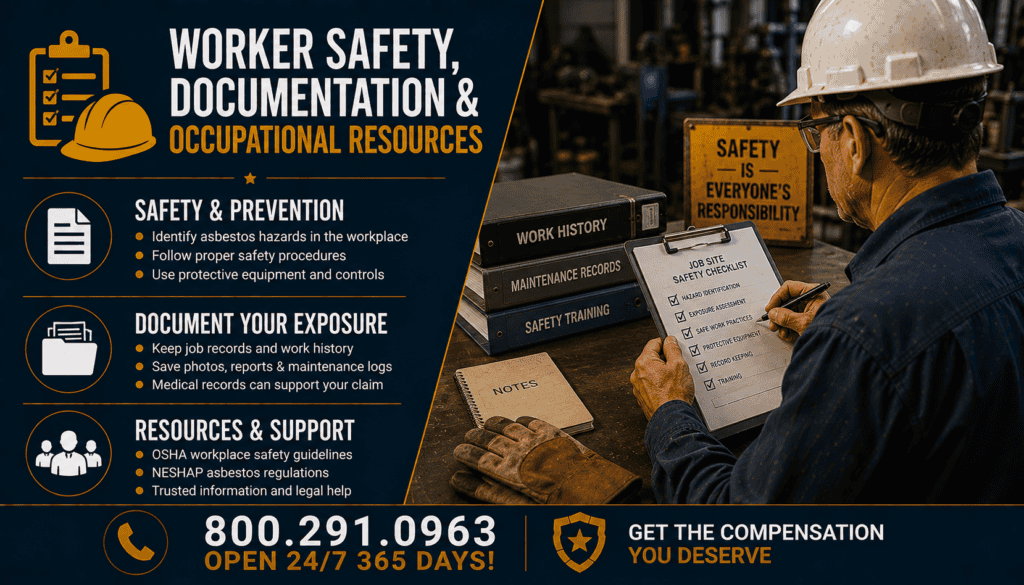
Worker Safety, Documentation & Occupational Asbestos Resources
Occupational asbestos exposure is best evaluated with evidence showing where a person worked, what tasks were performed, which asbestos-containing materials were present and whether those materials could release airborne fibers. OSHA asbestos standards require exposure monitoring and recordkeeping in covered circumstances, while separate OSHA rules give employees and designated representatives rights of access to relevant exposure and medical records.
Employment records, exposure measurements, asbestos surveys, training records, work orders, union records, Social Security work history, coworker statements and NIOSH Health Hazard Evaluation reports can help reconstruct a worker’s history. No single record automatically proves asbestos exposure, disease causation, liability or compensation.
Asbestos Worker Safety and Occupational Resources
Workers can encounter asbestos in construction, manufacturing, maintenance, shipyards, utilities, transportation, public buildings and other settings. The relevant evidence varies by occupation and workplace.
OSHA defines employee exposure under its general-industry asbestos standard in terms of airborne asbestos exposure that would occur without respiratory protection. The standard establishes requirements for exposure limits, monitoring, regulated areas, engineering controls, work practices, respiratory protection, communication, training, medical surveillance and records when its provisions apply.
NIOSH occupational risk assessment likewise focuses on the hazard, amount of exposure and resulting health risk. This evidence-based approach helps distinguish a documented asbestos exposure from assumptions based only on a job title or an older workplace.
Workers researching a past job can start with asbestos exposure in high-risk jobs, asbestos exposure in buildings and industrial, manufacturing and utility buildings asbestos exposure.
OSHA Asbestos Safety Requirements
OSHA maintains asbestos standards for general industry, construction and shipyard employment. Which standard applies depends on the work and industry. Requirements can include exposure assessment, regulated areas, engineering and work-practice controls, respiratory protection, training, medical surveillance and recordkeeping.
Important Safety Records and Controls
- Personal and area exposure-monitoring results
- Regulated-area documentation
- Respirator and protective-equipment records when required
- Asbestos training and awareness records
- Medical-surveillance records for covered employees
- Engineering-control and work-practice documentation
- Asbestos surveys and material-identification records
- Signs, labels and safety data information when applicable
Under OSHA’s general-industry asbestos standard, employers must notify affected employees of monitoring results within the required period. The standard also requires accurate records of asbestos exposure measurements, including the date, operation monitored, sampling methods, sample duration and results, respiratory protection and employees represented by the exposure data.
Safety requirements have changed over time. A historical exposure investigation should consider the rules and work practices applicable during the worker’s actual employment rather than assuming today’s controls were always in place.
Employee Exposure and Medical Records
OSHA’s employee-record-access standard is especially useful for occupational documentation. Its purpose is to give employees and designated representatives access to relevant exposure and medical records so the information can contribute to detection, treatment and prevention of occupational disease.
The rule applies to covered general-industry, maritime and construction employers that make, maintain, contract for or have access to employee exposure or medical records concerning toxic substances or harmful physical agents.
Records That May Be Relevant
- Workplace air-monitoring and personal-sampling results
- Records showing operations associated with monitored exposure
- Medical-surveillance records
- Industrial-hygiene reports
- Analyses based on employee exposure or medical records
- Asbestos training documentation
- Records identifying affected work areas or operations
OSHA requires many employee exposure records to be preserved for at least 30 years. Under the general-industry asbestos standard, asbestos exposure-monitoring records are maintained for at least 30 years, while covered medical-surveillance records are maintained for the duration of employment plus 30 years.
Employees and former employees can request access to qualifying exposure records. Medical records have additional privacy protections, and access by another person generally requires specific written consent.
Need help now? Call 800.291.0963
Live chat available 24/7, 365 days a year.
Submit Your Case
Building an Occupational Work History
A detailed work history can help connect an individual worker to particular employers, jobsites, products, equipment and asbestos-related tasks. This is especially important when exposure may have occurred decades earlier.
Work-History Evidence to Collect
- Employer names and approximate dates of employment
- Job titles, departments, crafts and daily duties
- Plant, shipyard, construction, military or building locations
- Equipment, machinery and mechanical systems worked around
- Asbestos-containing products or materials when reliably identified
- Personnel, payroll and pension records
- Social Security earnings or employment-history records
- Union membership, dispatch and apprenticeship records when relevant
- Coworker, supervisor and contractor statements
Records can be cross-checked against asbestos surveys, purchase records, product specifications, maintenance files, construction documents, shipping records and historical industrial-hygiene reports.
A worker should distinguish between what is remembered personally and what is established by documents. Statements such as “the insulation contained asbestos” are stronger when supported by specifications, surveys, sampling, manufacturer information or reliable historical records.
Occupation-Specific Resources
Examples include construction workers asbestos exposure, maintenance workers asbestos exposure, factory workers asbestos exposure, shipyard workers asbestos exposure and warehouse, logistics and material handling workers asbestos exposure.
NIOSH Health Hazard Evaluations
The NIOSH Health Hazard Evaluation Program is a federal resource for evaluating possible workplace health hazards. Employees, employers and union officials can request an evaluation, and the service is provided without cost to the requestor or workplace.
NIOSH may review exposure, illness and injury reports, observe work processes, talk with employees and employer representatives, measure exposures, survey workers and conduct medical testing when appropriate. For on-site evaluations, NIOSH publishes findings in Health Hazard Evaluation reports without company or employee names.
Why Historical HHE Reports Can Matter
- They may identify workplace materials and processes.
- They may contain air-sampling or exposure measurements.
- They may describe engineering controls and work practices.
- They may identify damaged or disturbed asbestos-containing materials.
- They may document worker tasks and locations.
- They may provide recommendations for reducing exposure.
An HHE involving a similar industry does not prove that a particular worker was exposed. A report is strongest when it concerns the worker’s actual facility, employer, process or substantially documented circumstances.
NIOSH also provides exposure-sampling information explaining that sampling can cover an entire work shift or a specific task and that workers who undergo sampling are notified of their results.
Asbestos Health Risks and Medical Documentation
NIOSH’s scientific review of workplace asbestos exposure addresses the evidence linking occupational asbestos exposure with serious disease. OSHA’s asbestos standard requires medical surveillance for certain covered employees with qualifying exposure.
Medical records can be important for documenting occupational history, respiratory symptoms, examinations, pulmonary-function testing and other information. However, workplace exposure documentation and medical diagnosis answer different questions: a medical diagnosis does not by itself identify the employer, product or jobsite responsible for an exposure.
Medical and Exposure Evidence Should Be Kept Distinct
- Medical records can document diagnosis and clinical history.
- Employment records can document where and when a person worked.
- Exposure records can document measured workplace conditions.
- Asbestos surveys can identify ACM at a facility.
- Product and purchasing records can identify asbestos products.
- Witness evidence can help reconstruct tasks and work locations.
Asbestos-related diseases can have long latency periods, making preservation of old records particularly valuable. Medical concerns involving past occupational asbestos exposure should be discussed with a qualified healthcare professional.
Exposure Documentation for Asbestos Claims
Asbestos claims commonly require more than proof that a person worked in an occupation historically associated with asbestos. Documentation should connect the individual to a credible asbestos source, time period, location and exposure pathway.
Evidence That May Help Reconstruct Exposure
- Employment and Social Security work-history records
- Union records and apprenticeship histories when applicable
- Jobsite, ship, plant or building records
- Asbestos surveys and abatement documents
- Product, purchase and supplier records
- Exposure-monitoring and industrial-hygiene reports
- NIOSH HHE reports involving the workplace or process
- Coworker and witness statements
Questions to Answer
Where did the worker work? During which years? What tasks were performed? Which products, equipment or building materials were present? Is there reliable evidence they contained asbestos? How could fibers have become airborne? How often and how close was the worker to the disturbance? What records or witnesses corroborate the history?
Trust Funds, Lawsuits and Other Compensation
Documentation requirements vary by claim type, jurisdiction and asbestos trust. An asbestos bankruptcy trust generally applies its own medical and exposure criteria, while litigation requirements depend on applicable law and evidence.
Employment in a high-risk occupation does not automatically establish asbestos exposure, causation, liability, trust eligibility or compensation. Compensation is not guaranteed.
Related Occupational Resources
High-risk jobs: Asbestos Exposure in High-Risk Jobs
Industrial and mechanical work: Industrial, Manufacturing & Factory Workers Asbestos Exposure · Mechanical Trades, Pipe Trades & HVAC Asbestos Exposure
Buildings and worksites: Asbestos Exposure in Buildings · Construction Sites Asbestos Exposure
Authoritative Sources
This page relies on OSHA and NIOSH primary government sources. OSHA establishes requirements for asbestos exposure monitoring and recordkeeping and provides workers access to qualifying exposure and medical records. NIOSH provides workplace hazard evaluations, exposure sampling and scientific occupational-risk resources.
Worker Safety & Documentation FAQ
What records can help document occupational asbestos exposure?
Exposure-monitoring records, asbestos surveys, work orders, employment files, product records, industrial-hygiene reports, union records when applicable, work-history records and coworker statements can all be useful depending on the case.
Can workers request access to exposure records?
OSHA’s employee-record-access standard gives employees and designated representatives rights of access to qualifying exposure records. Medical records have additional privacy and consent protections.
How long are asbestos exposure-monitoring records kept?
Under OSHA’s general-industry asbestos standard, required asbestos exposure-monitoring records are maintained for at least 30 years.
How long can covered asbestos medical-surveillance records be kept?
OSHA’s general-industry asbestos standard requires covered medical-surveillance records to be maintained for the duration of employment plus 30 years.
What is a NIOSH Health Hazard Evaluation?
It is a federal workplace-health evaluation that employees, employers or union officials can request when they suspect workplace exposures or conditions are harming workers’ health.
Can a NIOSH report prove an individual worker was exposed?
Not automatically. It can provide valuable workplace and exposure evidence, especially when it concerns the actual facility or process, but the individual worker’s tasks, dates and locations still need to be connected to the evidence.
Does working in a high-risk occupation prove asbestos exposure?
No. Job title alone does not establish asbestos exposure. Evidence should identify an asbestos-containing source and a credible pathway by which fibers could have reached the worker.
Can occupational records help with asbestos trust or lawsuit claims?
Yes. Employment, product, jobsite, exposure and witness records can help document a claim, but each trust or legal action has its own requirements. Compensation is not guaranteed.
Get Help Reviewing Occupational Asbestos Exposure
Call 800.291.0963
Live chat is available 24/7, 365 days a year.
Prior employment, a high-risk job title or work in an older facility does not automatically prove asbestos exposure, disease causation, liability, claim eligibility or compensation. Each situation depends on the employer, jobsite, products, equipment, work tasks, exposure evidence, medical evidence and applicable legal requirements. Compensation is not guaranteed.
⚕️ Legal & Medical Information Disclaimer
This page provides general educational information and is not medical or legal advice. The information does not establish asbestos exposure, diagnosis, causation, liability, claim eligibility or compensation. Medical concerns should be discussed with a qualified healthcare professional, and legal questions should be reviewed with a qualified attorney.