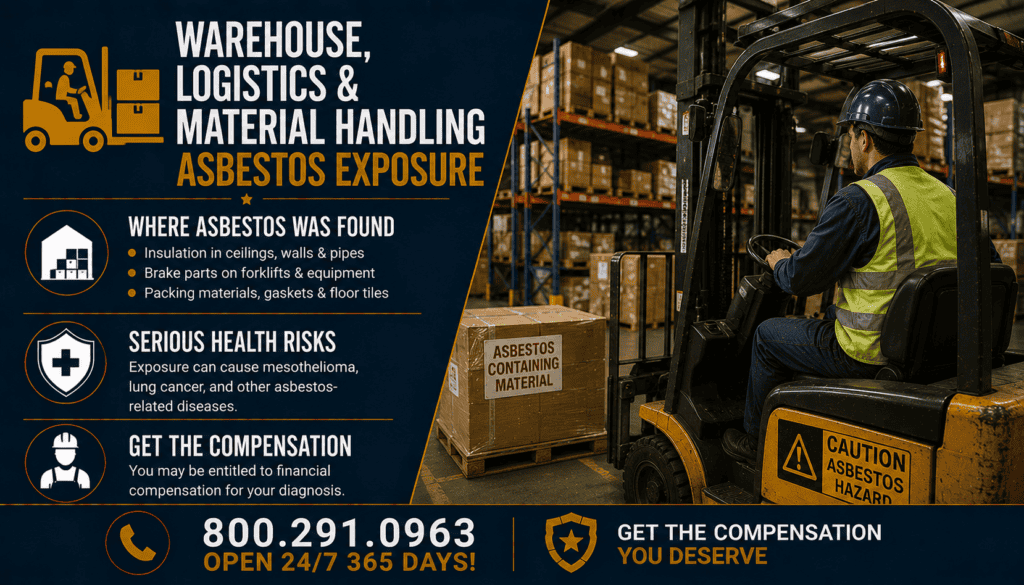
Warehouse, Logistics & Material Handling Workers Asbestos Exposure
Warehouse, logistics and material handling workers could have encountered asbestos when their jobs involved receiving, unloading, storing, moving or cleaning up confirmed asbestos materials. NIOSH documented an asbestos warehouse where material handlers unloaded bags and rolls of asbestos from railcars, stacked asbestos in storage and moved it with powered lift trucks.
Warehouse employment alone does not prove asbestos exposure. Risk depended on what was stored or transported, the condition of bags or materials, spills and cleanup, the age and condition of the building, and whether asbestos-containing materials were disturbed during maintenance or renovation.
Warehouse, Logistics & Material Handling Workers Asbestos Exposure
Warehousing and logistics work can include receiving, shipping, palletizing, loading, unloading, inventory control, forklift operation, material movement and cleanup. Most warehouse work does not inherently involve asbestos, but historical government investigations show that some facilities stored and handled asbestos directly.
In a NIOSH Health Hazard Evaluation involving a felt mill and asbestos warehouse, bags and rolls of asbestos were stored in a raw-materials warehouse. Investigators documented workers unloading asbestos from railcars, warehousing rolls in stacks and using powered lift trucks to handle the material.
A separate NIOSH warehouse investigation documented visible asbestos fibers dispersing through a warehouse during an asbestos-handling operation. Investigators warned that fibers could accumulate on nearby stored materials and equipment, creating possible repeated exposures when those items were later handled.
Related resources include asbestos exposure in high-risk jobs, industrial and manufacturing workers asbestos exposure, production workers asbestos exposure and asbestos exposure in buildings.
Stored Asbestos Materials and Cargo Handling
Direct handling of confirmed asbestos-containing cargo can provide stronger occupational exposure evidence than warehouse job title alone. Historical asbestos could arrive as raw fiber, bags, rolls, manufactured products or materials destined for production operations.
Warehouse Activities Worth Investigating
- Receiving bags or rolls of asbestos
- Unloading asbestos-containing cargo from railcars or trucks
- Stacking or restacking asbestos materials
- Moving asbestos products between storage and production areas
- Handling torn, damaged or leaking containers
- Loading asbestos-containing materials for shipment
- Cleaning contaminated storage areas
NIOSH’s documented asbestos-warehouse operation included material handlers and hydropulper operators. Bags or rolls of asbestos were unloaded periodically from railcars, stored in the warehouse and transported with powered lift trucks.
Evidence should identify the product and supplier whenever possible. Shipping records, bills of lading, inventory records, purchase orders, product labels, safety documents and coworker testimony can help determine whether a warehouse actually stored asbestos.
Forklifts, Pallets, Bags and Material Handling
Powered lift trucks and other material-handling equipment can move large quantities of bagged or palletized material. NIOSH directly documented powered lift trucks being used to handle asbestos in an asbestos warehouse.
Bag handling can also create dust when containers are damaged or contaminated. NIOSH research on bag stackers in mineral-processing operations explains that dust can be released from material on the outside of bags or from inside bags as they are moved and stacked. That general dust-control principle does not prove asbestos exposure unless the material itself is confirmed as asbestos-containing.
Evidence to Review
- Product labels and container markings
- Shipping and receiving records
- Inventory and warehouse-location records
- Damaged-bag or spill reports
- Forklift and pallet-handling assignments
- Industrial-hygiene and air-monitoring records
- Housekeeping and contamination-control procedures
A forklift operator moving ordinary merchandise should not be characterized as asbestos-exposed without separate evidence. The strongest cases connect the worker to confirmed asbestos cargo, contaminated materials or another documented asbestos source.
Older Warehouses, Buildings and Renovation
Warehouse workers can also encounter building-related asbestos that is separate from the products stored inside. EPA explains that asbestos-containing materials can remain in commercial buildings and that renovation or replacement of utility systems increases the potential for disturbing ACM.
Building Conditions Worth Investigating
- Pipe or boiler insulation in older warehouse utility areas
- Documented asbestos-containing floor or ceiling materials
- Insulated mechanical or HVAC systems
- Roofing or wall materials confirmed as asbestos-containing
- Renovation or demolition while warehouse areas remained occupied
- Utility-system replacement involving confirmed ACM
- Damaged asbestos materials near stored inventory or workstations
A NIOSH Hurricane Katrina response investigation illustrates why evidence matters. Investigators inspected a dusty warehouse after an asbestos concern but found no observable asbestos source and determined that asbestos air sampling was not justified. Dust alone was not treated as proof of asbestos.
That evidence-based approach should also be used for older warehouses: identify the material through surveys, sampling, building records or other reliable documentation before attributing exposure to asbestos.
Need help now? Call 800.291.0963
Live chat available 24/7, 365 days a year.
Submit Your Case
Spills, Cleanup and Maintenance Exposure
Cleanup can create a different exposure pattern from routine storage. NIOSH documented workers responsible for cleaning and vacuuming asbestos spills and contamination in an asbestos warehouse and production operation.
Another NIOSH investigation found visible fibers on workers’ clothing and visible fiber dispersion through a warehouse. Investigators warned that contaminated clothing could expose workers and other people and that asbestos could settle on stored materials and equipment.
Activities Worth Reviewing
- Cleaning spilled asbestos fiber or damaged asbestos products
- Sweeping or vacuuming contaminated storage areas
- Handling damaged bags and contaminated pallets
- Cleaning forklifts or equipment used around asbestos
- Repairing equipment in contaminated warehouse areas
- Moving inventory coated with asbestos-containing dust
- Handling contaminated work clothing
NIOSH has recommended substitution, engineering controls, appropriate ventilation, HEPA-filtered vacuuming and avoiding dry sweeping in asbestos-handling operations. Modern exposure assessment should consider the controls actually used during the worker’s employment.
Related resources include maintenance workers asbestos exposure, maintenance mechanics asbestos exposure and factory workers asbestos exposure.
Mesothelioma and Other Asbestos-Related Health Risks
NIOSH’s scientific review recognizes occupational asbestos exposure as a serious health hazard. Diseases associated with asbestos exposure include malignant mesothelioma, lung cancer and asbestosis.
Asbestos-related disease can develop after a long latency period. Former warehouse and material handling workers may therefore need shipping, inventory, employment and facility records from decades earlier to determine whether asbestos was actually present.
Warehouse employment, visible dust or operation of a forklift does not establish asbestos exposure or disease causation. The asbestos-containing material, task, disturbance, frequency, duration, controls and medical evidence should be evaluated individually.
Medical concerns involving past occupational asbestos exposure, symptoms, screening or diagnosis should be discussed with a qualified healthcare professional.
Documenting Warehouse and Material Handling Exposure
A useful occupational history connects the worker to a specific warehouse, confirmed asbestos-containing material and credible handling or contamination pathway.
- Employment: employer, warehouse, facility, years and job title
- Products: raw asbestos, bags, rolls or manufactured ACM stored or shipped
- Tasks: receiving, unloading, forklift operation, stacking, loading and cleanup
- Shipping evidence: bills of lading, manifests, purchase orders and receiving records
- Inventory: product names, suppliers, warehouse locations and stock records
- Industrial hygiene: air sampling, spill reports and contamination surveys
- Employment evidence: personnel files, Social Security records, union records when applicable and job descriptions
- Witnesses: coworkers, supervisors, forklift operators, drivers and production employees
Questions That Can Strengthen an Exposure History
Which warehouse and years? What materials were received and stored? Were bags or rolls labeled asbestos? Did the worker unload railcars or trucks? Operate a forklift? Clean spills? Handle damaged containers? Were asbestos-containing building materials also present? Are shipping records, inventory documents, air samples or coworkers available?
Secondary or Take-Home Exposure
Take-home exposure may be relevant when a warehouse worker’s clothing, shoes, hair or personal items became contaminated with asbestos. NIOSH has documented visible fibers accumulating on clothing during warehouse asbestos handling and warned that this could expose people who later contacted the contaminated clothing.
Lawsuits, Trust Funds and Compensation
A warehouse, logistics or material handling worker diagnosed with mesothelioma or another asbestos-related disease may have potential legal or compensation options when evidence supports occupational asbestos exposure and applicable requirements are met.
Warehouse employment alone does not establish exposure, causation, liability, trust eligibility or compensation. Depending on the evidence and jurisdiction, relevant parties can include asbestos-product manufacturers, suppliers, facility operators, contractors, equipment-related companies, workers’ compensation systems or asbestos bankruptcy trusts.
Trust eligibility generally requires satisfying the individual trust’s medical and exposure criteria and connecting the claimant’s history to a covered company, product, facility or qualifying period. Compensation is not guaranteed.
Related Warehouse, Manufacturing and Building Resources
High-risk occupations: Asbestos Exposure in High-Risk Jobs
Industrial work: Industrial, Manufacturing & Factory Workers Asbestos Exposure · Production Workers Asbestos Exposure
Buildings and maintenance: Asbestos Exposure in Buildings · Maintenance Workers Asbestos Exposure
Authoritative Sources
This page has strong direct government support. NIOSH documented material handlers unloading, storing and moving asbestos with powered lift trucks in an asbestos warehouse. Another NIOSH warehouse investigation documented visible asbestos-fiber dispersion, contamination of workers’ clothing and possible contamination of nearby stored materials and equipment. EPA guidance supports the separate discussion of asbestos-containing materials in older commercial buildings and renovation work.
- NIOSH — HHE 77-80-620, Felt Mill and Asbestos Warehouse
- NIOSH — HHE 79-151-657, Warehouse Asbestos Handling
- NIOSH — HHE 83-438-1479, Asbestos Bag Handling and Controls
- NIOSH — Workplace Exposure to Asbestos: Review and Recommendations
- EPA — Information for Owners and Managers of Buildings that Contain Asbestos
- EPA — Setting Up an Asbestos Operations and Maintenance Program
Warehouse, Logistics & Material Handling Workers FAQ
Were all warehouse workers exposed to asbestos?
No. Warehouse employment does not establish asbestos exposure. A specific asbestos-containing product, cargo, building material or contamination pathway should be documented.
Did warehouses actually store raw asbestos?
Yes. NIOSH documented a raw-materials warehouse where bags and rolls of asbestos were unloaded from railcars, stored and moved with powered lift trucks.
Could forklift operators have asbestos exposure?
Potentially, when powered lift trucks were used to move confirmed asbestos materials or contaminated cargo. Forklift operation alone does not establish exposure.
Could damaged asbestos bags expose material handlers?
Potentially. Damaged containers, spills and contaminated bag surfaces can create additional dust-handling concerns when the material is confirmed to contain asbestos.
Could asbestos contaminate other warehouse inventory?
NIOSH documented visible asbestos-fiber dispersion in one warehouse and warned that fibers could accumulate on nearby stored materials and equipment, potentially creating later exposures.
Can older warehouse buildings contain asbestos?
Yes, some older commercial buildings contain ACM. Building age alone is not proof; surveys, sampling and records should identify the material.
What records can help document warehouse asbestos exposure?
Shipping and receiving records, bills of lading, inventory documents, product labels, purchase orders, air-sampling reports, spill records, employment files and coworker statements can help reconstruct exposure.
Can warehouse workers qualify for asbestos trust claims?
Some may qualify if they satisfy a trust’s medical and exposure requirements and connect their work to a covered asbestos company, product, facility or qualifying period. Warehouse employment alone does not establish eligibility.
Get Help Reviewing Warehouse Asbestos Exposure
Call 800.291.0963
Live chat is available 24/7, 365 days a year.
Prior employment in warehousing, logistics or material handling does not automatically prove asbestos exposure, disease causation, liability, claim eligibility or compensation. Each situation depends on the employer, facility, stored materials, cargo, work tasks, contamination history, exposure evidence, medical evidence and applicable legal requirements. Compensation is not guaranteed.
⚕️ Legal & Medical Information Disclaimer
This page provides general educational information and is not medical or legal advice. The information does not establish asbestos exposure, diagnosis, causation, liability, claim eligibility or compensation. Medical concerns should be discussed with a qualified healthcare professional, and legal questions should be reviewed with a qualified attorney.