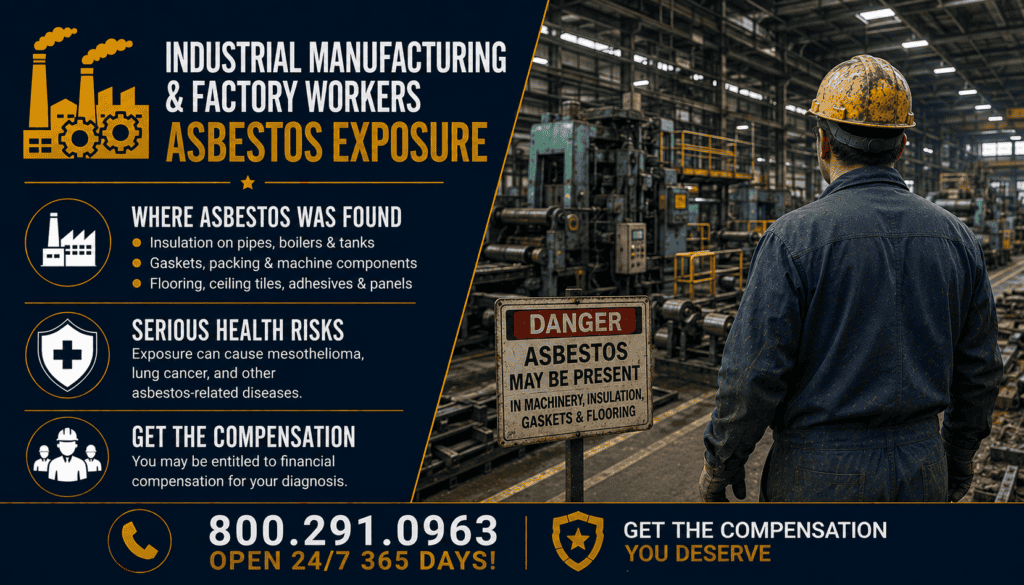
Industrial & Manufacturing Factory Workers Asbestos Exposure
Industrial and factory workers may have encountered asbestos through two different pathways: manufacturing asbestos-containing products or working around legacy asbestos materials installed in plants and machinery. OSHA specifically identifies asbestos-product manufacturing—including textiles, friction products, insulation and other building materials—as work where exposure can occur.
Factory employment alone does not prove asbestos exposure. Risk depended on the industry, plant, era, process, products, machinery, insulation and tasks performed. CDC has identified manufacturing among the industrial settings with historical occupational asbestos exposure, while NIOSH notes that exposure patterns shifted over time from chronic manufacturing-process exposure toward maintenance and remediation of existing asbestos-containing materials.
Industrial and Factory Worker Asbestos Exposure
Manufacturing facilities can contain production lines, boilers, furnaces, piping, pumps, valves, ovens, kilns, electrical equipment, warehouses and maintenance shops. Historically, asbestos could be present in products being manufactured, process equipment, thermal insulation or building materials.
OSHA’s general-industry asbestos standard applies to occupational exposure except where construction or shipyard asbestos standards govern the work. It establishes exposure limits, regulated areas, engineering controls, work practices, respiratory protection, hygiene, training and medical-surveillance requirements for covered employees.
Exposure histories should distinguish workers who directly handled asbestos raw material or asbestos-containing products from workers whose possible exposure came from maintenance, repair or disturbance of installed asbestos in an industrial plant.
Readers can also review high-risk jobs associated with asbestos exposure, industrial construction asbestos exposure and asbestos exposure in buildings.
Asbestos Materials in Manufacturing and Factories
Historical factories could contain asbestos in manufactured products, production materials, machinery components and building systems. The actual material should be confirmed through product records, specifications, asbestos surveys, laboratory reports, maintenance documents or other reliable evidence whenever possible.
- Asbestos textiles and woven products manufactured in certain plants
- Asbestos-containing friction products such as some historical brake and clutch materials
- Asbestos-containing insulation and building products manufactured at certain facilities
- Older pipe, boiler, furnace, tank and duct insulation
- Older asbestos-containing gaskets and packing where documented
- Asbestos-containing cement products and other manufactured materials at facilities that produced them
- Legacy asbestos-containing building materials disturbed during maintenance or renovation
NIOSH’s review of occupational asbestos exposure describes historical manufacturing processes involving asbestos. A NIOSH-docketed cohort study of an American chrysotile textile plant examined 2,543 men employed at the plant and reported excess respiratory-cancer mortality among workers 20 or more years after first employment, along with deaths attributed to asbestosis. That evidence applies to the studied asbestos-textile workforce and should not be generalized to all factory employees.
Material-specific evidence is essential. A worker in a food-processing, electronics or modern manufacturing plant should not be assumed to have handled asbestos merely because the workplace was a factory.
How Industrial and Factory Exposure Could Occur
Potential exposure could occur when asbestos fibers became airborne during manufacturing, fabrication, cutting, handling, maintenance, repair, removal or cleanup involving asbestos-containing material.
- Product manufacturing: mixing, forming, weaving, cutting or finishing asbestos-containing products in historical operations
- Machinery maintenance: disturbing confirmed asbestos-containing gaskets, packing or insulation during equipment repair
- Boiler and pipe work: cutting or removing asbestos-containing thermal insulation to access mechanical systems
- Furnace and process-equipment work: disturbing asbestos-containing insulation around high-temperature equipment where documented
- Building maintenance: drilling, cutting or removing older asbestos-containing materials during plant repairs
- Cleanup: sweeping or handling dust and debris contaminated by disturbed asbestos-containing material
OSHA requires engineering and work-practice controls for covered asbestos work. Depending on the operation, these can include local exhaust ventilation, HEPA-filtered vacuuming and wet methods designed to reduce airborne fibers.
Exposure levels could differ greatly among workers in the same plant. A production worker directly handling asbestos-containing material, a mechanic repairing insulated machinery and an office worker in the same facility could have very different exposure histories.
Manufacturing Industries, Jobs and Work Areas
CDC surveillance has identified historical occupational asbestos exposure in manufacturing and other industrial operations. The strongest individual evaluation focuses on the specific industry, plant, department, products and tasks rather than treating manufacturing as one uniform exposure category.
Asbestos-Product Manufacturing
OSHA identifies textiles, friction products, insulation and other building materials as examples of asbestos products whose manufacture could expose workers. Historical production records, product formulas, industrial-hygiene reports and employment records can help establish whether asbestos was actually used.
Industrial Machinery and Maintenance
Maintenance workers and mechanics may have serviced pumps, valves, boilers, furnaces, piping and other equipment containing or surrounded by older asbestos materials. Related information is available on maintenance workers asbestos exposure and maintenance mechanics asbestos exposure.
Boilers, Steam Systems and Insulation
Factories often rely on steam, hot-water and process-heating systems. Where asbestos-containing thermal insulation was installed, operators and repair trades could encounter it during maintenance. See boiler room operators asbestos exposure, steamfitters asbestos exposure and insulators and laggers asbestos exposure.
Pipe, Valve and Mechanical Work
Plant piping and process equipment may require repairs to valves, fittings and insulated lines. When historical components contained asbestos, disturbance could create an exposure pathway. Related resources include pipefitters asbestos exposure and valve workers asbestos exposure.
Renovation and Demolition Inside Plants
Factory modernization can disturb legacy asbestos in insulation and building materials. Exposure from renovation or demolition should be tied to the material disturbed, work location, proximity and controls used rather than inferred solely from employment at the facility.
Other Industrial Hazards
Factory workers may also encounter silica, welding fumes, solvents, metals, noise, heat, moving machinery and other hazards. These exposures are separate from asbestos and should not be described as asbestos exposure unless asbestos-containing material is actually involved.
Secondary or Household Exposure
Historically, workers who handled dusty asbestos-containing materials could carry fibers away from the workplace on clothing or equipment. A household exposure history requires evidence about the asbestos source, work task, dust conditions, clothing practices and frequency of contact. Factory employment alone does not establish take-home exposure.
Need help now? Call 800.291.0963
Live chat available 24/7, 365 days a year.
Submit Your Case
Mesothelioma and Other Occupational Health Risks
OSHA states that inhaling asbestos fibers can cause asbestosis, lung cancer and mesothelioma. NIOSH considers asbestos an occupational carcinogenic hazard and recommends reducing workplace exposure to the lowest feasible concentration.
CDC surveillance confirms the historical importance of manufacturing. Its analysis of U.S. malignant-mesothelioma mortality notes that hazardous occupational asbestos exposure occurred in manufacturing, shipbuilding and repair, construction, mining and milling. A later CDC analysis of women with mesothelioma also identified manufacturing among the industries represented in 2020 death-certificate data.
Industry or occupation information on a death certificate does not identify the actual asbestos source or prove that exposure occurred at that job. CDC specifically notes this limitation. Individual causation requires a separate occupational and medical investigation.
Medical questions about occupational exposure, symptoms, screening or diagnosis should be discussed with a qualified healthcare professional.
Documenting an Industrial or Factory Exposure History
Industrial workers may have long careers involving multiple departments, production lines or facilities. A useful historical investigation identifies the plants, products, processes, equipment and tasks where asbestos-containing materials were documented or reliably supported.
- Employment evidence: employer names, payroll records, W-2s, tax documents and Social Security earnings records.
- Plant evidence: facility names, addresses, owners, departments, production lines and dates worked.
- Product evidence: materials manufactured, formulas, product catalogs, safety records and supplier documents.
- Equipment evidence: boilers, furnaces, pumps, valves, piping, ovens, kilns and machinery serviced.
- Asbestos evidence: industrial-hygiene records, asbestos surveys, laboratory reports, specifications and abatement files.
- Task evidence: mixing, cutting, weaving, machining, repair, insulation removal, cleanup and demolition.
- Coworker evidence: production workers, mechanics, engineers, pipe trades, insulators, supervisors and safety personnel may help reconstruct conditions.
When product names are forgotten, record what the plant manufactured, the department, approximate years, machinery used, visible dust, insulation condition, maintenance practices and which trades worked nearby.
Questions That Can Strengthen an Industrial Work History
Did the plant manufacture an asbestos-containing product? Did workers handle raw asbestos or dusty asbestos mixtures? Were boilers, furnaces or pipes insulated? Were gaskets or packing replaced? Did shutdowns or renovations disturb insulation? Do plant asbestos surveys or industrial-hygiene records exist? These details can help identify a specific exposure source.
Asbestos Lawsuits, Trust Funds and Compensation
An industrial or factory worker diagnosed with an asbestos-related disease may have potential legal or compensation options depending on the evidence and applicable law. Possible avenues can include claims involving legally responsible companies and asbestos bankruptcy trusts when their requirements are satisfied.
Factory employment alone does not establish asbestos trust eligibility. Each trust has separate medical and exposure requirements, and evidence may be needed connecting the worker to a covered asbestos-containing product, manufacturer, supplier, operation or recognized jobsite during a qualifying period.
Useful evidence can include employment and Social Security records, plant records, product specifications, purchasing documents, maintenance logs, industrial-hygiene reports, asbestos surveys, photographs, coworker testimony and medical documentation. Filing deadlines vary by jurisdiction and claim type.
Related Industrial and Mechanical Worker Resources
Industrial settings: High-Risk Jobs Asbestos Exposure · Industrial Construction Asbestos Exposure · Asbestos Exposure in Buildings
Maintenance and mechanical work: Maintenance Workers Asbestos Exposure · Maintenance Mechanics Asbestos Exposure · Boiler Room Operators Asbestos Exposure
Pipe and insulation work: Pipefitters Asbestos Exposure · Insulators & Laggers Asbestos Exposure
Authoritative Sources
This page was researched using OSHA, NIOSH and CDC primary government sources with direct relevance to asbestos manufacturing, industrial exposure and mesothelioma.
- OSHA — Asbestos Overview and Asbestos-Product Manufacturing
- OSHA — 29 CFR 1910.1001, Asbestos in General Industry
- NIOSH — Workplace Exposure to Asbestos
- CDC — Malignant Mesothelioma Mortality, United States, 1999–2015
- CDC — Malignant Mesothelioma Mortality in Women, United States, 1999–2020
- NIOSH Docket — Mortality Study of an American Chrysotile Textile Plant
Industrial and Factory Worker Asbestos Exposure FAQ
Were all factory workers exposed to asbestos?
No. Exposure depended on the industry, facility, era, products, machinery and tasks. Factory employment alone does not prove asbestos exposure.
Did factories manufacture asbestos-containing products?
Yes, historically some did. OSHA identifies asbestos textiles, friction products, insulation and other building materials among asbestos products whose manufacture could expose workers.
Could factory maintenance expose workers to asbestos?
Potentially. Maintenance can disturb legacy asbestos-containing insulation, gaskets, packing or building materials when those materials are actually present.
Could industrial boilers and piping contain asbestos insulation?
Yes, some older systems used asbestos-containing thermal insulation. The actual material should be confirmed rather than assumed from equipment age alone.
Does CDC associate manufacturing with historical asbestos exposure?
Yes. CDC identifies manufacturing among industrial operations where hazardous occupational asbestos exposure historically occurred.
Can factory workers develop mesothelioma from occupational asbestos exposure?
Occupational asbestos exposure can cause mesothelioma, but a diagnosis and factory work history do not by themselves identify the source. The worker’s actual asbestos exposure must be investigated.
Can industrial workers qualify for asbestos trust fund claims?
Some may qualify if they satisfy a trust’s medical and exposure requirements. Job title or factory employment alone does not establish eligibility.
How can a retired factory worker document old asbestos exposure?
Employment and Social Security records, plant and product records, maintenance logs, asbestos surveys, industrial-hygiene documents, photographs and coworker statements can help reconstruct older exposure.
Get Help Reviewing an Industrial or Factory Exposure History
Call 800.291.0963
Live chat is available 24/7, 365 days a year.
Prior industrial or factory work does not automatically prove asbestos exposure, disease causation, claim eligibility or compensation. Each situation depends on the facility, dates, products, processes, equipment, materials, tasks, work practices, medical evidence and applicable legal requirements. Compensation is not guaranteed.
⚕️ Legal & Medical Information Disclaimer
This page provides general educational information and is not medical or legal advice. The information does not establish asbestos exposure, diagnosis, causation, liability, claim eligibility or compensation. Medical concerns should be discussed with a qualified healthcare professional, and legal questions should be reviewed with a qualified attorney.