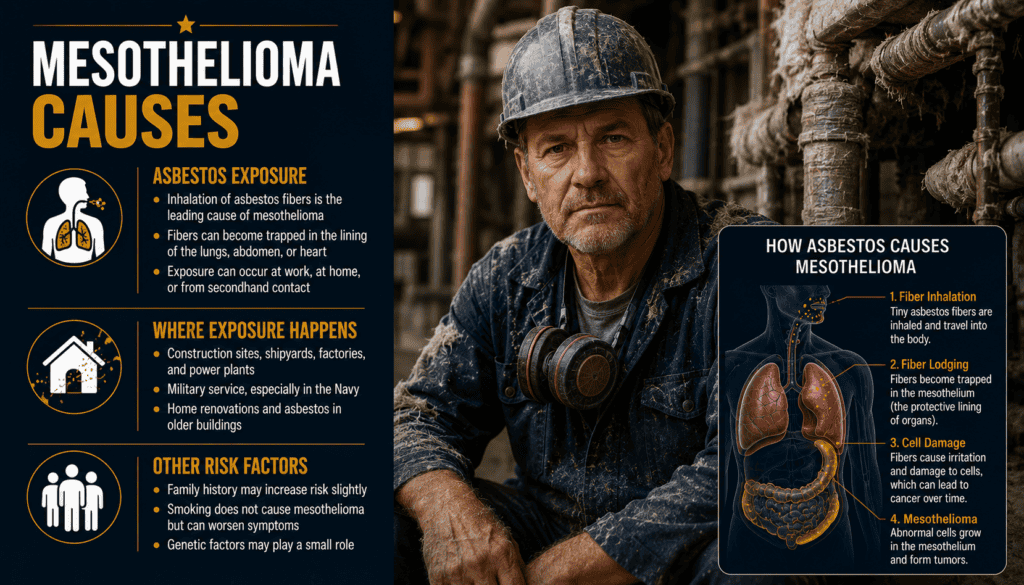
Mesothelioma Causes
Mesothelioma is a rare and aggressive cancer most strongly associated with exposure to asbestos. For many people who develop mesothelioma, that exposure occurred decades before symptoms appeared or the disease was diagnosed.
Understanding what causes mesothelioma, who may be at greater risk, and how asbestos exposure can occur can help patients and families make sense of a diagnosis and reconstruct possible exposure histories.
Asbestos exposure can occur in many settings. Some people worked directly with asbestos-containing materials. Others worked near employees who disturbed asbestos. Family members may have encountered fibers brought home on work clothing, while other individuals experienced environmental, residential, military, or product-related exposure.
Not everyone exposed to asbestos develops mesothelioma. Risk can be influenced by the amount and duration of exposure, the type of work or environment involved, the time that has passed since exposure, and other individual factors.
This hub explains the major causes and risk factors associated with mesothelioma and connects readers with more detailed resources about asbestos exposure, latency, occupational risks, secondary exposure, environmental exposure, and other factors associated with the disease.
What Causes Mesothelioma?
The primary established cause of mesothelioma is asbestos exposure.
Asbestos is the name given to a group of naturally occurring fibrous minerals that were widely used because of their resistance to heat, fire, chemicals, and electricity. For decades, asbestos was incorporated into insulation, boilers, pipe coverings, gaskets, cement products, construction materials, machinery components, automotive parts, ship equipment, and many other products.
Problems can occur when asbestos-containing materials are cut, drilled, sanded, removed, repaired, deteriorated, or otherwise disturbed. Microscopic fibers can become airborne and may be inhaled or swallowed.
Because these fibers are extremely small, exposure may occur without a person realizing it.
Once fibers enter the body, some may remain in tissue for many years. The resulting biological processes can contribute to cellular damage and, in a small proportion of exposed individuals, eventually lead to mesothelioma.
Asbestos Exposure and Mesothelioma
The connection between asbestos and mesothelioma is central to understanding the disease.
Exposure historically occurred in industries and occupations where workers handled asbestos-containing materials or worked around equipment and structures containing asbestos.
Examples include:
- Shipyards and maritime work
- Construction and demolition
- Power plants
- Oil refineries
- Chemical plants
- Manufacturing facilities
- Steel mills and foundries
- Railroads
- Automotive repair
- Insulation work
- Plumbing and pipefitting
- Electrical work
- Boiler maintenance
- Industrial machinery repair
- Military service
Exposure was not necessarily limited to workers who personally installed or removed asbestos products.
A mechanic, electrician, laborer, machinist, engineer, maintenance employee, supervisor, or other worker could potentially have been exposed simply by working near activities that released fibers.
How Asbestos Fibers Can Enter the Body
The principal route of occupational asbestos exposure is inhalation.
When asbestos-containing material releases fibers into the air, workers and others nearby may breathe contaminated dust.
Fibers may also be swallowed after contaminated particles enter the mouth or upper respiratory tract.
The body’s natural defenses can remove some foreign material, but asbestos fibers are highly durable. Some fibers can persist in the body for decades.
Mesothelioma most commonly develops in the lining surrounding the lungs, known as the pleura, but it can also occur in the lining of the abdominal cavity, around the heart, or in the lining surrounding the testes.
Who Is at Risk of Developing Mesothelioma?
Anyone with a history of asbestos exposure may have some degree of risk, but exposure does not mean that a person will develop mesothelioma.
Most people exposed to asbestos do not develop the disease.
Risk assessment therefore involves more than determining whether exposure occurred. Important considerations may include:
- How frequently exposure occurred
- How long exposure continued
- The concentration of airborne fibers
- The work being performed
- Whether asbestos-containing materials were disturbed
- Proximity to the source of exposure
- The type and characteristics of asbestos fibers involved
- How much time has passed since the exposure
- Individual biological susceptibility
A person’s complete occupational, military, residential, and environmental history can therefore be important when investigating possible asbestos exposure.
Risks of Developing Mesothelioma
Your existing resource provides additional information about factors associated with developing the disease:
Risks of Developing Mesothelioma
https://mesotheliomahelp.center/what-is-mesothelioma/mesothelioma-diagnosis/risks-of-developing-mesothelioma/
This page should be reparented beneath Mesothelioma Causes & Risk Factors rather than remaining under Mesothelioma Diagnosis.
Diagnosis addresses how doctors identify mesothelioma.
Risk factors address why someone may be more likely to develop it.
Separating those search intents creates a cleaner medical information architecture.
Occupational Asbestos Exposure
Occupational exposure has historically been one of the most important pathways of asbestos exposure.
Millions of workers were employed in industries where asbestos-containing materials were manufactured, installed, maintained, repaired, removed, or disturbed.
Workers did not always know the materials they handled contained asbestos.
In some workplaces, asbestos-containing insulation, gaskets, packing, cement, fireproofing, floor materials, brake components, refractory products, and other materials were part of routine operations.
Activities capable of disturbing these materials included:
- Cutting
- Grinding
- Sanding
- Drilling
- Sawing
- Scraping
- Mixing
- Removing insulation
- Replacing gaskets
- Repairing boilers
- Maintaining pumps and valves
- Demolishing structures
- Renovating older buildings
The resulting dust could affect not only the employee performing the task but also coworkers in the surrounding area.
High-Risk Occupations
Some occupations historically had greater opportunities for asbestos exposure than others.
Examples include:
Insulators — Frequently handled thermal insulation around pipes, boilers and industrial equipment.
Pipefitters and plumbers — Worked around insulated pipes, valves, pumps, boilers, gaskets and other mechanical systems.
Boilermakers — Could encounter insulation, refractory materials, gaskets and other heat-resistant components.
Shipyard workers — Worked aboard vessels containing extensive insulation and other asbestos-containing materials.
Construction workers — Could encounter asbestos in insulation, cement, flooring, roofing, fireproofing and numerous building materials.
Electricians — Worked around electrical equipment and building systems that sometimes incorporated heat-resistant asbestos materials.
Automotive mechanics — Historically encountered asbestos in brakes, clutches, gaskets and other friction products.
Industrial maintenance workers — Repaired equipment and mechanical systems where asbestos-containing components were commonly used.
The site’s occupational asbestos-exposure sections should provide the detailed occupation-specific information, while this hub explains occupational exposure as a mesothelioma risk factor and links readers into those deeper resources.
Workplace Bystander Exposure
A worker did not have to personally handle asbestos to encounter airborne fibers.
This is sometimes described as bystander exposure.
For example, one tradesperson might remove pipe insulation while electricians, laborers, engineers, inspectors, or other employees worked nearby.
Dust generated by one activity could spread into surrounding work areas.
This distinction is important when reconstructing exposure histories because some patients may initially believe they were never exposed simply because they never personally worked with a product labeled as containing asbestos.
Military Asbestos Exposure
Military veterans are another historically important population when considering asbestos exposure.
Asbestos-containing products were used extensively in military ships, facilities, vehicles, machinery, mechanical systems, and other applications during portions of the twentieth century.
Potential exposure circumstances varied significantly according to:
- Military branch
- Years of service
- Occupation or rating
- Duty station
- Ship or facility
- Equipment worked on
- Maintenance responsibilities
Veterans should be directed from this medical risk-factor hub into your extensive U.S. Military Veterans Asbestos Exposure architecture for branch-, occupation-, ship-, base-, equipment-, and service-specific information.
This prevents duplication while creating a strong contextual connection between asbestos exposure history and mesothelioma risk.
Secondhand Asbestos Exposure
Occupational workers were not the only people who could encounter asbestos fibers.
Historically, asbestos dust could sometimes leave a workplace on:
- Work clothes
- Shoes
- Hair
- Tools
- Personal belongings
Family members could potentially encounter this contamination at home.
For example, a spouse or other household member who handled or laundered contaminated work clothing could have experienced repeated exposure without ever working at the industrial facility where the asbestos originated.
This pathway is commonly referred to as secondhand, secondary, household, or take-home asbestos exposure.
The site’s dedicated Secondhand Asbestos Exposure section should contain the detailed exposure-specific pages, while this hub explains why secondhand exposure is relevant to mesothelioma risk.
Environmental Asbestos Exposure
Asbestos exposure can also occur outside traditional workplaces.
Naturally occurring asbestos deposits exist in some geographic areas. Disturbance of asbestos-bearing rock or soil can potentially release fibers.
Environmental exposure may also occur around locations contaminated by past industrial activity, mining, manufacturing, demolition, waste disposal, or asbestos-containing materials.
The circumstances surrounding environmental exposure can differ considerably from occupational exposure, but the central concern remains the same: inhalation or ingestion of airborne asbestos fibers.
Residential Asbestos Exposure
Many older homes and residential buildings were constructed during periods when asbestos-containing materials were widely used.
Potential asbestos-containing materials historically included some:
- Pipe insulation
- Boiler insulation
- Furnace materials
- Floor tiles
- Vinyl flooring
- Adhesives
- Roofing materials
- Siding
- Cement products
- Textured coatings
- Insulation
- Fire-resistant materials
The presence of asbestos-containing material does not necessarily mean fibers are being released.
Risk is particularly associated with circumstances in which asbestos-containing material becomes damaged, deteriorated, or disturbed.
Renovation and demolition can therefore be important exposure scenarios in older buildings.
Readers looking for property-specific information should be directed into your Asbestos Exposure in Homes and Asbestos Exposure in Buildings silos.
Renovation and Demolition Risks
Renovation can disturb asbestos-containing materials that remained intact for decades.
Activities such as removing flooring, opening walls, replacing old mechanical systems, demolishing ceilings, removing insulation, or cutting construction materials can potentially release fibers if asbestos is present.
The risk may be difficult to recognize because asbestos generally cannot be reliably identified simply by looking at a material.
This is one reason older-building renovation deserves separate attention within your broader asbestos-exposure architecture.
Asbestos Exposure From Products
Asbestos was incorporated into thousands of commercial and industrial applications over the decades.
Product-related exposure could occur during:
- Manufacturing
- Installation
- Routine use
- Maintenance
- Repair
- Removal
- Replacement
- Demolition
Potential product categories historically included insulation, gaskets, packing, cement, fireproofing materials, friction products, refractory materials, construction products, and industrial components.
This hub should not duplicate your large Asbestos Exposure in Products silo.
Instead, it should explain product exposure as a mesothelioma risk pathway and direct users to the product-specific research section.
Talc and Potential Asbestos Exposure
You currently have:
Asbestos Exposure & Talc Powder
https://mesotheliomahelp.center/what-is-mesothelioma/asbestos-exposure-talc-powder/
I recommend moving this page out of the What Is Mesothelioma silo and into the appropriate Asbestos Exposure in Products architecture.
Talc and asbestos are distinct minerals, but geological deposits can occur near one another, making asbestos contamination an important issue in some talc-related exposure discussions.
The detailed subject belongs in the product-exposure silo rather than being duplicated here.
Duration and Intensity of Exposure
Asbestos-related disease risk is influenced by exposure characteristics.
In general, repeated or substantial exposure can increase risk. Someone who spent years performing dusty asbestos-related work may have experienced a very different exposure profile from someone with an isolated incidental encounter.
However, there is no simple formula that predicts whether a particular exposed individual will develop mesothelioma.
This is why exposure history should be evaluated individually rather than assuming that every exposed person faces the same risk.
Can Brief Asbestos Exposure Cause Mesothelioma?
Mesothelioma is often associated with substantial occupational exposure, but documented cases are not limited to workers with decades of direct asbestos handling.
Exposure circumstances vary widely.
The important distinction is that lower or shorter exposure does not mean zero risk, while exposure itself does not mean that mesothelioma will develop.
Patients should not attempt to determine the cause of their disease solely by estimating whether they remember experiencing “enough” asbestos exposure.
A complete exposure history can reveal circumstances that were not initially obvious.
Mesothelioma’s Long Latency Period
One of the defining characteristics of mesothelioma is the long period that can pass between asbestos exposure and diagnosis.
This interval is called the latency period.
Mesothelioma commonly develops decades after the relevant exposure occurred.
Consequently, a person diagnosed today may need to investigate jobs, military service, homes, products, or environmental conditions dating back many years.
This long delay also explains why mesothelioma continues to be diagnosed even though many historical uses of asbestos were reduced or discontinued long ago.
Why Latency Matters When Investigating Exposure
The long latency period can make identifying the source of asbestos exposure difficult.
A patient may have:
- Changed occupations several times
- Worked for companies that no longer exist
- Forgotten specific products
- Served at multiple military installations
- Lived in several homes
- Worked alongside other trades
- Encountered asbestos without knowing it
- Experienced secondhand exposure
Creating a chronological history of employment, military service, residences, and significant exposure circumstances can therefore help identify potential sources.
Age and Mesothelioma Risk
Mesothelioma is diagnosed more frequently in older adults, in large part because of the disease’s long latency period and historical patterns of asbestos use.
Someone exposed during employment decades earlier may not develop symptoms until much later in life.
Age itself should therefore be interpreted together with exposure history and latency rather than viewed as an independent explanation for the disease.
Does Smoking Cause Mesothelioma?
Smoking is not considered a cause of mesothelioma.
This is an important distinction because smoking and asbestos are often discussed together in relation to lung disease.
Smoking is a major cause of lung cancer, and combined smoking and asbestos exposure substantially affects lung-cancer risk. Mesothelioma, however, has a different relationship with asbestos exposure.
Patients should therefore distinguish between:
Asbestos-related lung cancer
and
Mesothelioma
even though both can occur in people with histories of asbestos exposure.
For more information, see:
What Is Asbestos Lung Cancer?
https://mesotheliomahelp.center/what-is-mesothelioma/related-asbestos-diseases/what-is-asbestos-lung-cancer/
Genetic Susceptibility and BAP1
Researchers have identified genetic factors that may influence susceptibility to mesothelioma in some individuals.
One of the best-known involves changes involving the BAP1 gene.
Inherited BAP1 variants are uncommon and account for only a subset of cases, but their discovery has helped researchers better understand why individual responses to carcinogenic exposures may differ.
Genetics should not be presented as replacing asbestos as the principal established environmental cause of mesothelioma.
Instead, genetic susceptibility is an area of research that may help explain why some exposed people develop disease while many others do not.
Can Someone Develop Mesothelioma Without Remembering Asbestos Exposure?
Yes.
A person may not remember a specific asbestos exposure even when historical exposure occurred.
There are several possible reasons.
The exposure may have happened decades earlier. The person may not have known a product contained asbestos. Exposure may have occurred indirectly from nearby work. Fibers may have been brought into the home by another household member. Environmental or building-related exposure may also have gone unnoticed.
Therefore:
“I don’t remember working with asbestos” does not necessarily mean “I was never exposed to asbestos.”
A detailed exposure history may be necessary.
Reconstructing a Mesothelioma Exposure History
For someone diagnosed with mesothelioma, reconstructing past exposure can involve examining many areas of life.
Useful information can include:
Employment history — Employers, job titles, facilities, trades and dates of employment.
Military history — Branch, duty stations, ships, bases, occupations and equipment.
Coworkers — People who remember work conditions, products or specific tasks.
Products and equipment — Insulation, machinery, gaskets, boilers, pumps, valves, construction products and other materials encountered.
Residential history — Older homes, renovations and possible household exposure.
Family employment history — Particularly where take-home exposure may have occurred.
Environmental history — Residence or employment near potential sources of asbestos contamination.
Because exposure may have occurred many decades earlier, no single source of information necessarily provides the entire picture.
Mesothelioma Risk Is Not the Same as Diagnosis
A risk factor indicates something associated with a greater probability of developing a disease.
It does not establish that a person has mesothelioma.
Symptoms associated with mesothelioma can also occur with many other medical conditions.
Diagnosis may involve imaging, pathology, biopsy and other medical testing.
For diagnostic information, see:
Mesothelioma Diagnosis
https://mesotheliomahelp.center/what-is-mesothelioma/mesothelioma-diagnosis/
Keeping these subjects separate is important:
Causes & Risk Factors → Why mesothelioma may develop.
Symptoms → What a patient may experience.
Diagnosis → How physicians determine whether mesothelioma is present.
Stages → How far the disease has progressed.
Prognosis → Expected disease course and outlook.
Treatments → Medical options after diagnosis.
Understanding Your Asbestos Exposure History
Many people diagnosed with mesothelioma initially have difficulty identifying when or where exposure occurred.
That is understandable given the disease’s long latency period.
A useful starting point is to construct a timeline beginning with early employment and moving forward through:
- Jobs and employers
- Military service
- Industrial facilities
- Construction or renovation work
- Machinery and equipment
- Products handled
- Coworkers and trades working nearby
- Homes and residences
- Family members’ occupations
- Potential environmental exposures
The objective is not to assume that every possible encounter caused the disease. It is to develop a complete historical picture that can be evaluated more carefully.
Frequently Asked Questions About Mesothelioma Causes and Risk Factors
What is the main cause of mesothelioma?
Asbestos exposure is the principal established cause of mesothelioma. Exposure can occur occupationally, through secondhand household contamination, environmentally, during military service, or through asbestos-containing products and materials.
Does everyone exposed to asbestos develop mesothelioma?
No. Most people exposed to asbestos do not develop mesothelioma. Risk varies according to exposure circumstances and individual factors.
Can you develop mesothelioma after brief asbestos exposure?
Mesothelioma has occurred in people with varying exposure histories. Lower exposure should not be interpreted as zero risk, but asbestos exposure also does not mean that someone will necessarily develop the disease.
How long after asbestos exposure can mesothelioma develop?
Mesothelioma generally has a long latency period, often measured in decades. This is why exposure investigations frequently involve employment or environmental conditions from many years earlier.
Can family members of asbestos workers be at risk?
Historically, workers could bring asbestos fibers home on clothing, footwear, tools, or other belongings. Household members could then experience secondhand or take-home exposure.
Is smoking a cause of mesothelioma?
No. Smoking is not considered a cause of mesothelioma. Smoking is highly relevant to lung cancer, including risk considerations involving asbestos exposure, but mesothelioma is a different cancer.
Can mesothelioma occur without occupational asbestos exposure?
Yes. Occupational exposure is only one pathway. Secondhand, household, environmental, residential, military, and product-related exposures can also be relevant.
Why can’t some mesothelioma patients identify where they were exposed?
Exposure may have occurred decades earlier, asbestos was not always identified to workers or consumers, and some exposure occurred indirectly. Reconstructing a complete employment and residential history can sometimes reveal previously unrecognized sources.
Explore Mesothelioma Information
Understanding risk is only one part of understanding mesothelioma.
Readers may also want information about:
Types of Mesothelioma
https://mesotheliomahelp.center/what-is-mesothelioma/types-of-mesothelioma/
Mesothelioma Symptoms
https://mesotheliomahelp.center/what-is-mesothelioma/mesothelioma-symptoms/
Mesothelioma Diagnosis
https://mesotheliomahelp.center/what-is-mesothelioma/mesothelioma-diagnosis/
Mesothelioma Stages
https://mesotheliomahelp.center/what-is-mesothelioma/mesothelioma-stages/
Mesothelioma Prognosis
https://mesotheliomahelp.center/what-is-mesothelioma/mesothelioma-prognosis/
Mesothelioma Treatments
https://mesotheliomahelp.center/what-is-mesothelioma/mesothelioma-treatments/
These resources provide a structured path from understanding what may cause mesothelioma through diagnosis, staging, prognosis and treatment.
Mesothelioma Causes & Risk Factors: Key Takeaways
Asbestos exposure is the principal established cause of mesothelioma, but exposure circumstances can vary substantially from one patient to another.
Exposure may have occurred:
- At work
- During military service
- Around coworkers disturbing asbestos
- Through contaminated work clothing
- In older buildings
- During renovation or demolition
- Through asbestos-containing products
- Through environmental sources
Because mesothelioma can develop decades after exposure, determining where exposure occurred may require examining events from much earlier in a person’s life.
Most importantly, having a risk factor is not the same as having mesothelioma, and asbestos exposure does not mean that a person will necessarily develop the disease. Anyone concerned about symptoms, past asbestos exposure, or an individual medical risk should discuss those concerns with a qualified healthcare professional.
Get Help Understanding Your Mesothelioma Options
A mesothelioma diagnosis can raise questions about treatment, past asbestos exposure, financial concerns, and available legal options.
Mesothelioma Help Center provides information designed to help patients and families understand the resources that may be available to them.
Call 800.291.0963 — Open 24/7, 365 Days